Granagh Castle: An Anglo-Norman Defensive Castle in Ireland


Site at a Glance
- Rating
- 4.4
- Popularity
- Very Low
- Country
- Ireland
- Primary era
- Medieval
- Eras represented
- Medieval
- Civilizations
- English, Norman
- Site type
- Military
- Remains
- Castle
On this page8 sections
History
Granagh Castle is a medieval Anglo-Norman castle in Ireland, built around 1290 in County Kilkenny beside the River Suir and near the boundary with County Waterford. It was established by the Le Poers, a feudal family descended from Norman knights who conquered Ireland after the invasion that began in 1169. The castle, also known as Grandison, Grannagh, and Granny, defended the family’s lands against Irish clans seeking to recover their territories.
The Le Poers and the Crown
The Le Poers eventually lost Granagh Castle and its surrounding lands to the English Crown after Eustace FitzArnold Le Per was accused of treason and executed. In 1375, Edward III, king of England from 1327 to 1377, granted the castle and its lands to James Butler, 2nd Earl of Ormond, an Anglo-Irish nobleman. Butler’s descendants retained the property until 1650.
Margaret FitzGerald, known as the great Countess of Ormond, owned the castle in 1501. A description published in 1837 identified Granagh as her residence and connected her with the construction of Ballin and Cukill castles.
Conflict and destruction
During the Irish uprising that began in 1641, the owners of Granagh supported the movement for Irish independence and raised the flag of the Irish Confederation over the castle. The Confederation was the Catholic political and military organization formed during that uprising. In 1650, forces led by Oliver Cromwell during the English Parliamentarian conquest of Ireland stormed Granagh under Colonel Axtell. The castle and its lands were confiscated, and the building was severely damaged.
Later repair efforts
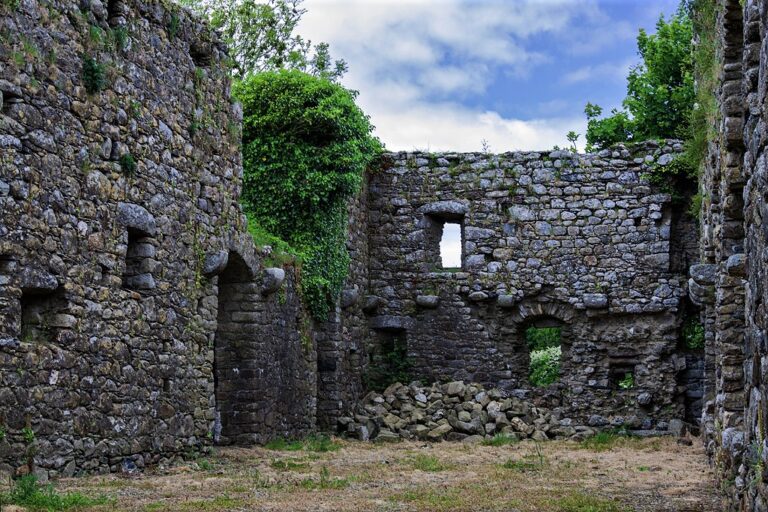
After the damage, local inhabitants dismantled parts of the castle and reused its stone in houses. George Roche of Limerick began repairs in 1824, but the work was not completed. The local council started another repair effort in 1925, which also remained unfinished. Granagh Castle is now a ruin.
Remains
Castle plan and surviving fabric
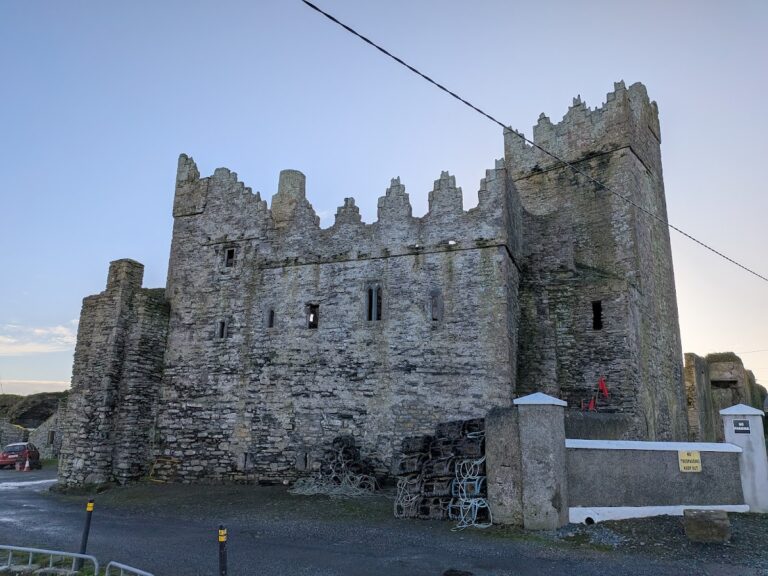
Granagh Castle was laid out on a square plan, with massive walls and cylindrical towers at the corners. The building underwent repeated alterations, although sections of its fabric retain a thirteenth-century form. The earls of Ormond added a large tower at the northern corner during the fourteenth century. The riverside facade is described as having remained substantially unchanged since the castle was built in the thirteenth century.
Sculpture and heraldic decoration
Fragments of ornamental stucco or plasterwork and sculptural decoration survive among the ruins. The surviving sculpture includes a relief of an angel, an image of the archangel Michael, and a representation of the scales of justice. Coats of arms associated with the earls of Ormond and with Margaret FitzGerald also remain on the castle.
The hanging arch
An arch survives that local legend associates with the hanging of rebels who fought for Irish independence.
Nearby sites