Sacred Heart Church in Stegna: A Roman Catholic Parish with Protestant Origins
Site at a Glance
- Popularity
- Medium
- Country
- Poland
- Primary era
- Early Modern
- Eras represented
- Early Modern, Modern
- Civilizations
- German, Kingdom of Prussia, Polish–Lithuanian Commonwealth
- Site type
- Religious
- Remains
- Church
On this page15 sections
History
The Sacred Heart Church in Stegna, Poland, is a Roman Catholic parish church whose present building was erected by Protestants in 1681–1683. Its history also includes an earlier Gothic church and a wartime diplomatic meeting.
Earlier churches
A church in Stegna is recorded from the fourteenth century. In 1465, a Gothic church there hosted Polish–Teutonic peace negotiations during the final years of the Thirteen Years’ War, fought between the Polish Crown and the Teutonic Order from 1454 to 1466. In 1609, the German pastor Georg Klein built a small wooden church. A fire destroyed it in 1676, although its tower and several furnishings survived.
Rebuilding and Lutheran use
Work on a replacement church began on 25 March 1681 at the earlier church’s site. A city engineer and surveyor from Gdańsk supervised the project. The church was built by Protestants and consecrated by the priest Martin Kruger on 29 November 1681. Its choir was completed on 25 May 1682, the organ was enlarged on 15 June 1683, and the building was finished on 17 November that year.
The church served a Lutheran congregation, part of a Protestant tradition that developed from the Reformation, until 1945. Most of Stegna’s population was Protestant before that year. Clergy served the Kobbelgrube-Steegen congregation from the early seventeenth century. In the nineteenth and twentieth centuries, two clergy served the larger parish, which included Stutthof, where a pastor sometimes lived. From 1817 to 1945, the congregation belonged to the Danzig Spit church district within the Evangelical Church of the Old Prussian Union, a Protestant church body in Prussia.
Catholic parish after 1945
Catholics took over the church in 1945, and it was consecrated for the Latin rite, the Western liturgical tradition of the Catholic Church. The first postwar pastor arrived in Stegna on 12 June 1946. In 1948, Andrzej Wronka, apostolic administrator of the Diocese of Gdańsk, established a parish whose area covered almost the entire Vistula Spit.
Stegna became predominantly Catholic after the war. The church now serves as a Roman Catholic parish church and the principal church of its own deanery, a subdivision of a diocese, within the Diocese of Elbląg.
Remains
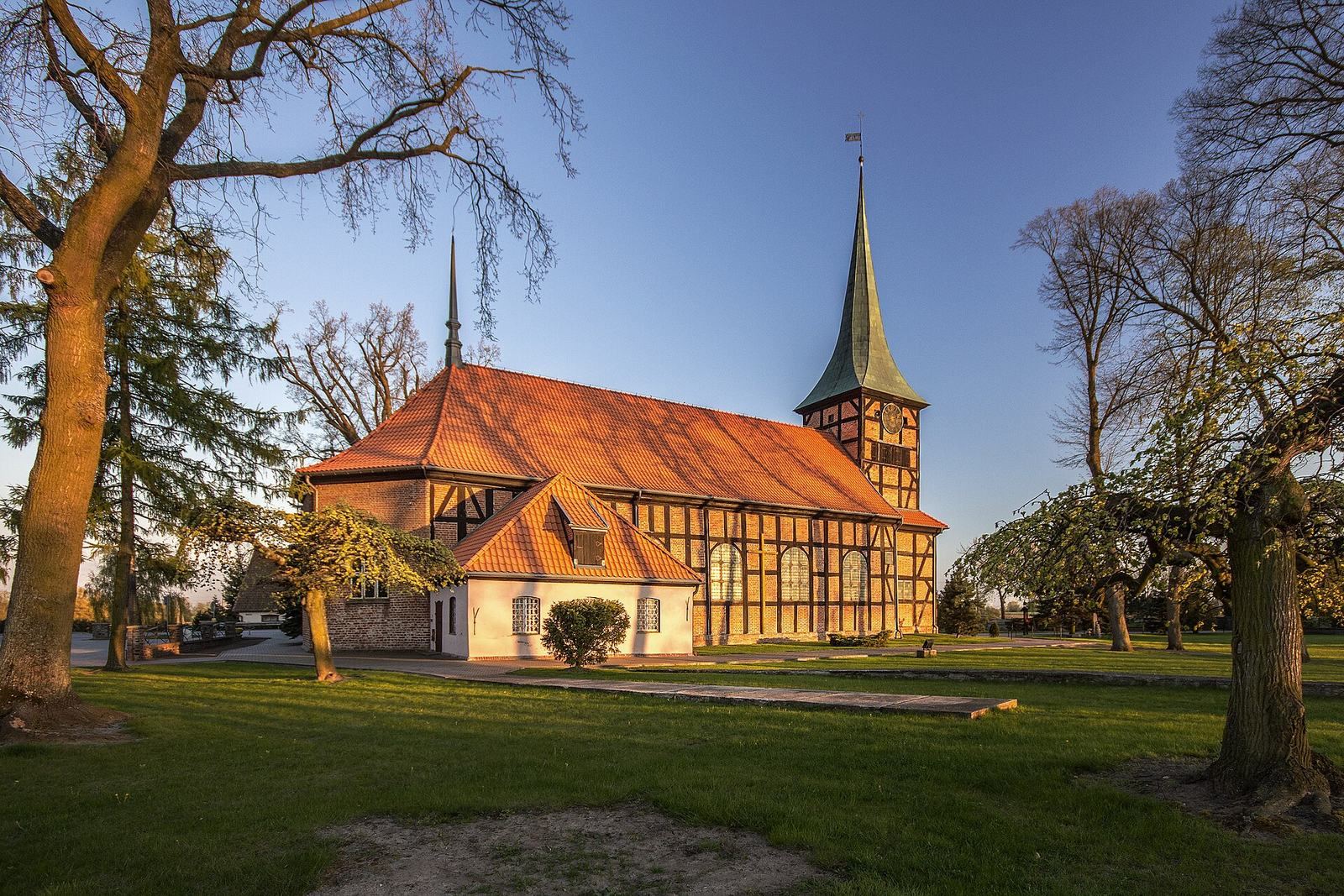
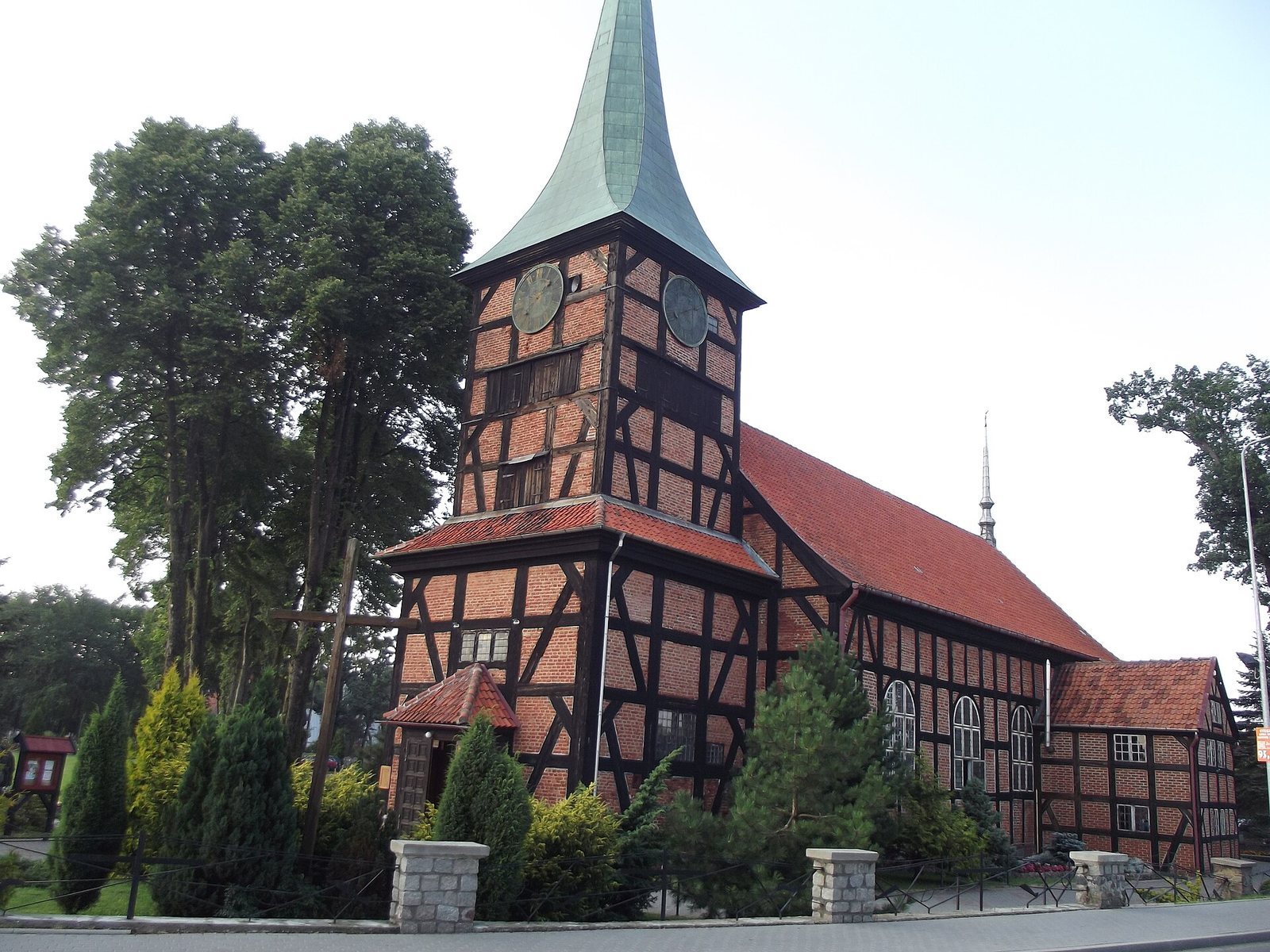
The church is a half-timbered building, with a timber frame filled with brick, and has one main worship space beneath a wooden ceiling. A tower stands at the front, topped by a narrow, needle-shaped spire and a weather vane dated 1683.
Church and tower
Wood from the tower that survived the 1676 fire was reused in the replacement church’s tower. The tower houses a bell dated 1643, which also survived the fire and strikes noon each day. Its inscription means “Lord, grant peace in our time.” Two larger bells date from 1732. German forces removed the eighteenth-century bells during the Second World War, and one was later returned through the cooperation of Professor Januszajtis and Father Knapik.
Painted interior
Ceiling canvas
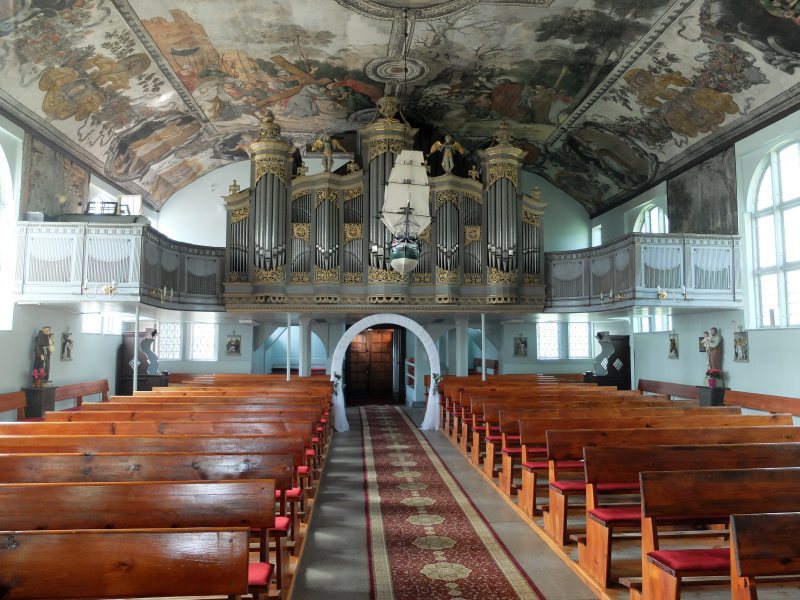
Painter Reinhold Schneider completed the ceiling painting in 1688. It covers a loosely woven linen canvas measuring 35 by 18 metres, fastened with special nails to a wooden backing. The weave uses varying thread counts, averaging six to seven threads per square centimetre. The painting is the largest in Poland and among the largest in Europe.
The central scene shows the Resurrection of Christ. The four corners depict the Parable of the Ten Virgins, Christ meeting the Samaritan woman, the carrying of the Cross and the raising of Lazarus. Above part of the presbytery, the area around the main altar, is a Last Judgment scene, partly obscured by the altar. The border features the twelve Apostles, plant ornaments and medallions, garlands of plants and fruit, and framed panels with head motifs. Schneider applied prepared paints in layers, sometimes opaquely and sometimes with a dry brush.
From 1973 to 1980, Ewa and Jerzy Wolski conserved the painting. They treated it with resin solutions and dried it to remove moisture accumulated over three centuries. The parish archive holds an eight-volume chronicle of the conservation work.
Wall paintings
Four more linen paintings by Schneider, also dated 1688, hang on the walls. Their subjects are the Baptism of Christ, Jacob’s Dream, the Parable of the Sower and the Entry into Jerusalem.
Furnishings
High altar
The wooden high altar is in the Baroque style, a European artistic style prominent in the seventeenth and eighteenth centuries. It was conserved in 1687, when two decorative openwork wings were added. Its sea-green, oil-painted finish probably dates from the nineteenth or twentieth century. At its centre is Rafał Dębski’s painting of the Sacred Heart of Jesus, made to commemorate a jubilee year. Behind it is a mirror copy of Caravaggio’s Entombment. Special ropes allow Dębski’s painting to be raised, revealing the canvas of Christ’s burial.
The altar’s central section is set back and topped by gold columns. The openwork side wings hang from a ledge supported by two more gold columns; their simply shaped bases are painted sea-green. Four Evangelists, the Gospel writers Matthew, Mark, Luke and John, stand on the ledges in red and blue robes. In the upper tier, a painting depicts the Resurrection. Nearby sculptures show a woman with a child and a girl holding the woman’s dress, and another woman with a book bearing a phrase meaning “Charity and Truth,” accompanied by a lamb. Two further figures stand beside gold columns: one woman holds a belt, while a lamb tries to climb onto the knees of the other.
A sculpture of John the Baptist, leaning on a staff and looking toward Christ, stands to Christ’s right. Moses, holding the tablets of the Ten Commandments, stands to his left. Their bases bear the numbers 16 and 87, which together refer to the altar’s conservation in 1687. A tabernacle, the receptacle for the consecrated Eucharist, is below Christ. The separate altar used for services bears a painting of the Last Supper.
Organ
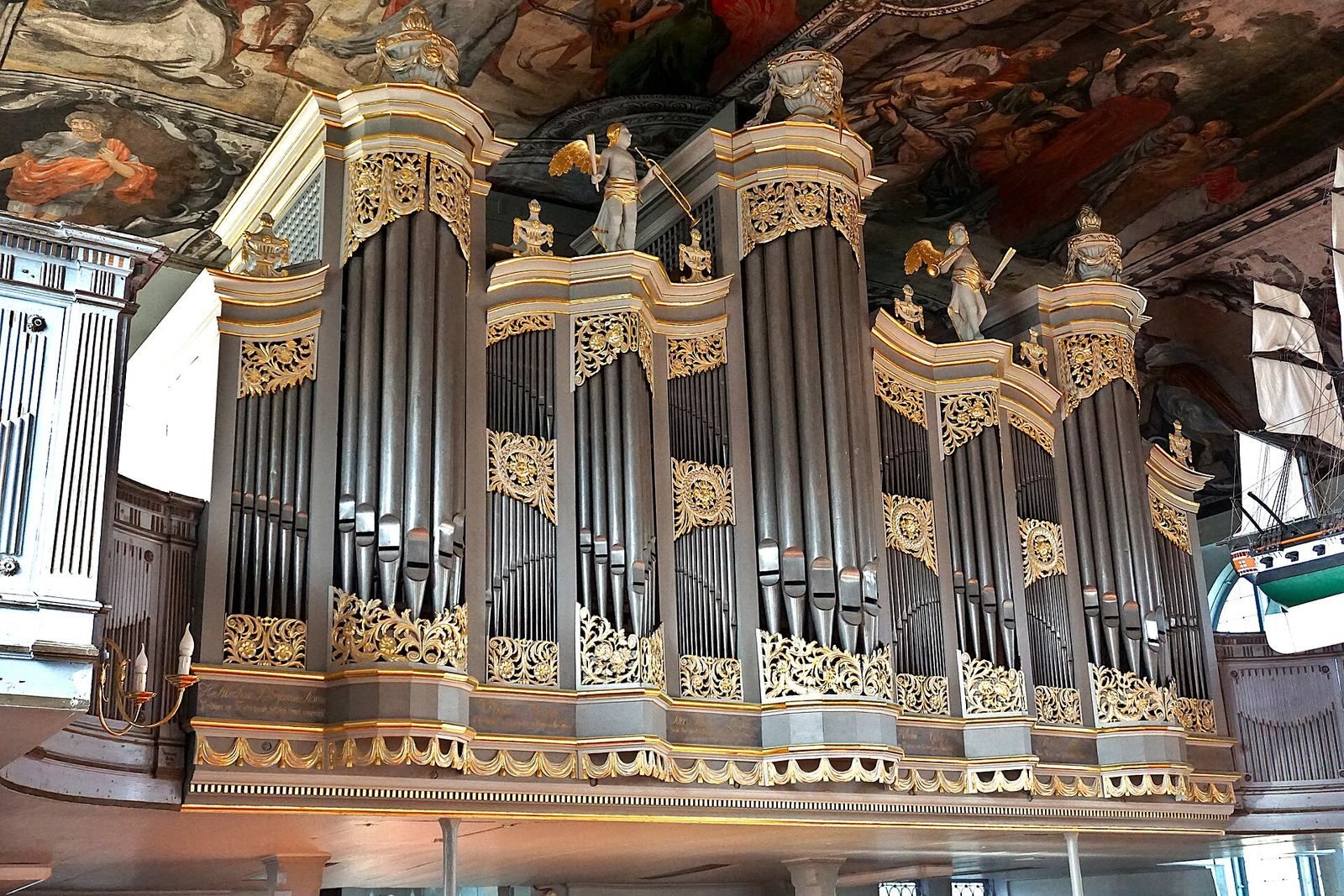
The elaborate Baroque organ case survived the fire that destroyed the earlier church. The present air-operated organ was made by Schlag & Söhne of Świdnica and installed in 1914, three days before the outbreak of the First World War. It has 32 stops, controls for sets of pipes, two rows of drawknobs that operate the stops, and one manual, or keyboard. A foot-operated roller mechanism brings individual stops into use. Some years after its installation, an organist and his son built a large air blower using written instructions alone.
Baptismal font
The Baroque baptismal font dates from 1666. It was made for St John’s Church in Danzig as a gift from the foundation of benefactor Katarzyna Zapio. Through the efforts of M. Kruger, it was given to the Stegna church on 15 November 1682. Jolanta Pabiś-Gagis and Andrzej Gagis conserved it in 1999.
Pulpit
Marcin Glabitzki completed the pulpit on 30 July 1687. Its reliefs depict the four Evangelists and the four Major Prophets, Isaiah, Jeremiah, Ezekiel and Daniel, among foliage decoration. Inscriptions on the pulpit point to the church’s German origins.
Thanksgiving ship model
The church’s ship model was offered by its crew in gratitude for their deliverance. Made by F.W. Wehlm, it was completed on 23 December 1872 and is the largest ship model in Poland. About 130 years later, K. Bogacki conserved it at the Maritime Museum in Gdańsk.