Săvârșin Castle: The Romanian Royal Family’s Country Residence


Site at a Glance
- Rating
- 4.1
- Popularity
- Low
- Country
- Romania
- Primary era
- Modern
- External website
- Open
- Eras represented
- Early Modern, Modern
- Civilizations
- Habsburg, Hungarian
- Site type
- Domestic
- Remains
- Palace
On this page12 sections
History
Săvârșin Castle is a large country house in Romania, located at Săvârșin in Arad County. Built by the Hungarian noble Forray family between 1650 and 1680, it became the official country residence of the Romanian Royal Family, and statutes defining the family’s role and powers are signed there.
Early estate and Baroque castle
The estate’s landscape predates the castle. Baron Andreas Forray had a 6.5-hectare park with a lake laid out in 1514. By the mid-eighteenth century, a western Baroque building dating from 1680 stood at the centre of the estate. Western Baroque architecture is associated with dynamic forms, elaborate decoration, and theatrical spatial effects. At that time, the property belonged to the Edelspacher de Gyorok family.
Destruction and nineteenth-century rebuilding
The castle was caught up in the Horea uprising, a major peasant revolt in Transylvania in 1784 led by Horea, Closca, and Crisan. On 9 June, insurgents led by Peter Baciu abducted Andras Forray the Elder, lord of the castle. Emperor Joseph II, the Habsburg ruler of the territories that included Transylvania, later paid for his release. In November 1784, the castle was set on fire and largely destroyed, requiring reconstruction from its foundations.
After the destruction, the property passed through several owners. Count Leopold Nádasdy de Nádasd et Fogarasföld acquired it in 1858 and rebuilt the castle in 1860. Its present appearance is also dated to 1870, placing the surviving country house within the nineteenth-century rebuilding of the estate.
Royal ownership and communist use
Following a property exchange in 1941, Săvârșin Castle became the possession of the Mocioni-Starcea family, which prepared it for royal “crown weekends.” In 1943, King Michael I acquired the castle from the Crown property by purchasing the shares of its principal shareholder, Anton Mocioni. He made the acquisition as a gift for his mother, Queen Helen.
King Michael’s forced abdication on 30 December 1947 brought the royal ownership to an end. The communist authorities nationalized the castle, which served successively as a hospital for internal diseases, a tuberculosis sanatorium, and a sanatorium for nervous disorders until 1967. A sanatorium was an institution for the long-term care of people with particular illnesses or disorders. Nicolae Ceaușescu, Romania’s communist leader from 1965 to 1989, later converted the property into a guest house for visiting heads of state. It was also used as a hunting residence.
Restitution and royal continuity
In 2000, the High Court of Cassation and Justice ruled that the entire property and its land should be restored to King Michael I. The castle and estate had been returned to the Romanian Royal Family by 1 June 2001. A restoration campaign began in May 2007 and ended in October 2015, with the work associated with Serban Sturdza, Eugen Pănescu, Augustin Ioan, and David Baxter. The restored castle was inaugurated on 27 October 2015.
After restitution, King Michael I and Queen Anne spent their annual Christmas holidays at Săvârșin. Margareta, Custodian of the Romanian Crown and senior representative of the royal family, continued the tradition. Carolers come from nearby villages and from communities in Arad, Alba, Hunedoara, and Timiș counties, while members of the royal family attend religious services on Christmas Day at the Orthodox church in Săvârșin village. On 10 May 2021, Margareta formally opened the castle grounds and Royal Automobile Museum to the public during the summer months.
Remains
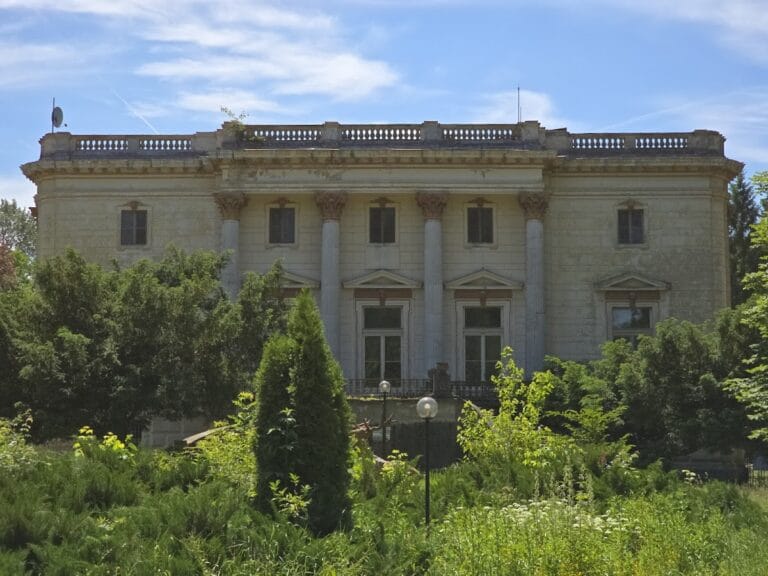
Săvârșin Castle is a large Neoclassical country house set within Săvârșin Park, a 6.5-hectare private estate. The grounds include gardens, a lake, a royal courtyard, and the castle grounds. The present building belongs to the nineteenth-century reconstruction, while the estate’s earlier central building was a western Baroque castle dating from 1680.
Castle and estate
Neoclassical country house
The castle’s current form was created during the rebuilding commissioned by Count Leopold Nádasdy de Nádasd et Fogarasföld in 1860, with its present appearance also dated to 1870. It is described as Neoclassical, an architectural style drawing on the forms and proportions of ancient Greek and Roman architecture. The building was reconstructed from its foundations after the fire of 1784 and was restored during the campaign completed in 2015.
Park and royal courtyard
The castle stands within a designed estate containing gardens, a lake, and a royal courtyard. The park’s layout reaches back to 1514, when Andreas Forray established the 6.5-hectare landscape with its lake. These elements form the wider setting of the country house and remain part of the castle property.
Automobile collections
Royal Automobile Museum
The estate’s public facilities include the Royal Automobile Museum. The museum forms part of the modern interpretation of the royal property and was opened with the castle grounds by Margareta on 10 May 2021 for the summer period.
King Michael’s vehicles and workshop
The automobile displays include King Michael’s collection of World War II Jeeps and a recreated version of his car workshop. These features preserve material connections with the former king and extend the estate’s physical presentation beyond the castle itself.
Nearby sites