Mocioni-Teleki Castle: A Noble Estate Palace in Romania

Site at a Glance
- Rating
- 4.3
- Popularity
- Low
- Country
- Romania
- Primary era
- Modern
- External website
- Open
- Eras represented
- Modern
- Civilizations
- Austria-Hungary, Habsburg, Hungarian
- Site type
- Domestic
- Remains
- Elite Residence
On this page7 sections
History
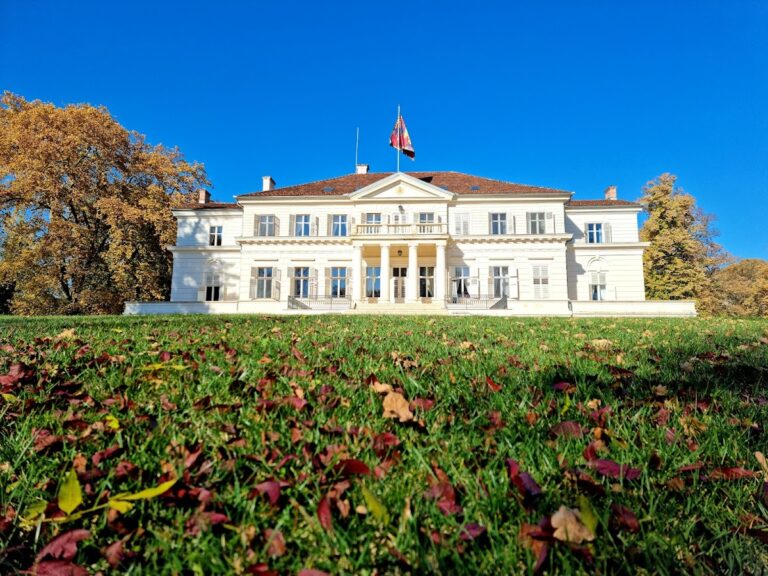
Mocioni-Teleki Castle is a 19th-century French-style palace in Căpâlnaș, Romania, built for the noble, Aromanian-origin Mocioni family. Its plans were drawn up in 1867, and the estate later became associated with the Teleki counts through marriage. The castle and its surrounding ensemble are listed as a historic monument in Arad County under code AR-II-a-A-00594.
The Mocioni family and the Căpâlnaș estate
The Mocioni family traced its rise to Constantin Mocioni, an Orthodox priest who moved from Macedonia to Hungary. His five sons accumulated wealth through commerce in Budapest. Two of them, Andrei and Mihai, were ennobled by Emperor Joseph II and became the ancestors of the de Mocioni and de Foeni branches. The Căpâlnaș estate belonged to Mihai’s branch, whose family had earlier held houses and land at Tokay in Hungary. Mihai’s sons were later ennobled by Francis I.
In 1836, Mihai de Mocioni, who lived from 1811 to 1890, married his cousin Ecaterina de Foeni, bringing the two family branches together. In 1853, Ecaterina’s father, Ioan Mocioni de Foeni, bought the 6,000-iugăre estate at Căpâlnaș from the Zichy counts for 260,000 florins. An iugăr was a historical Central European measure of agricultural land whose size varied by region and period, while florins were currency units used in Central Europe, including the Habsburg monarchy.
The palace and its community
Mihai and Ecaterina established the French-style palace at Căpâlnaș. Ecaterina became an influential figure in the local community and supported her brother Andrei in promoting Romanian cultural activities during the period. One room in the castle was arranged as a pharmacy, where medicines were supplied to peasants living on the estate.
The family connection reflected in the castle’s name developed when the last female member of the Mocioni family married a member of the Teleki counts. The association brought the two noble families together at Căpâlnaș. During the 1930s, the English traveler Patrick Leigh Fermor visited the estate while journeying through Europe and later described the palace and the Teleki family in Between the Woods and the Water.
Later use and protection
The castle now functions as a sanatorium, more specifically as a psychiatric hospital. Its physical fabric was restored in 1964, and the castle ensemble retains its protected status as a historic monument in Arad County.
Remains
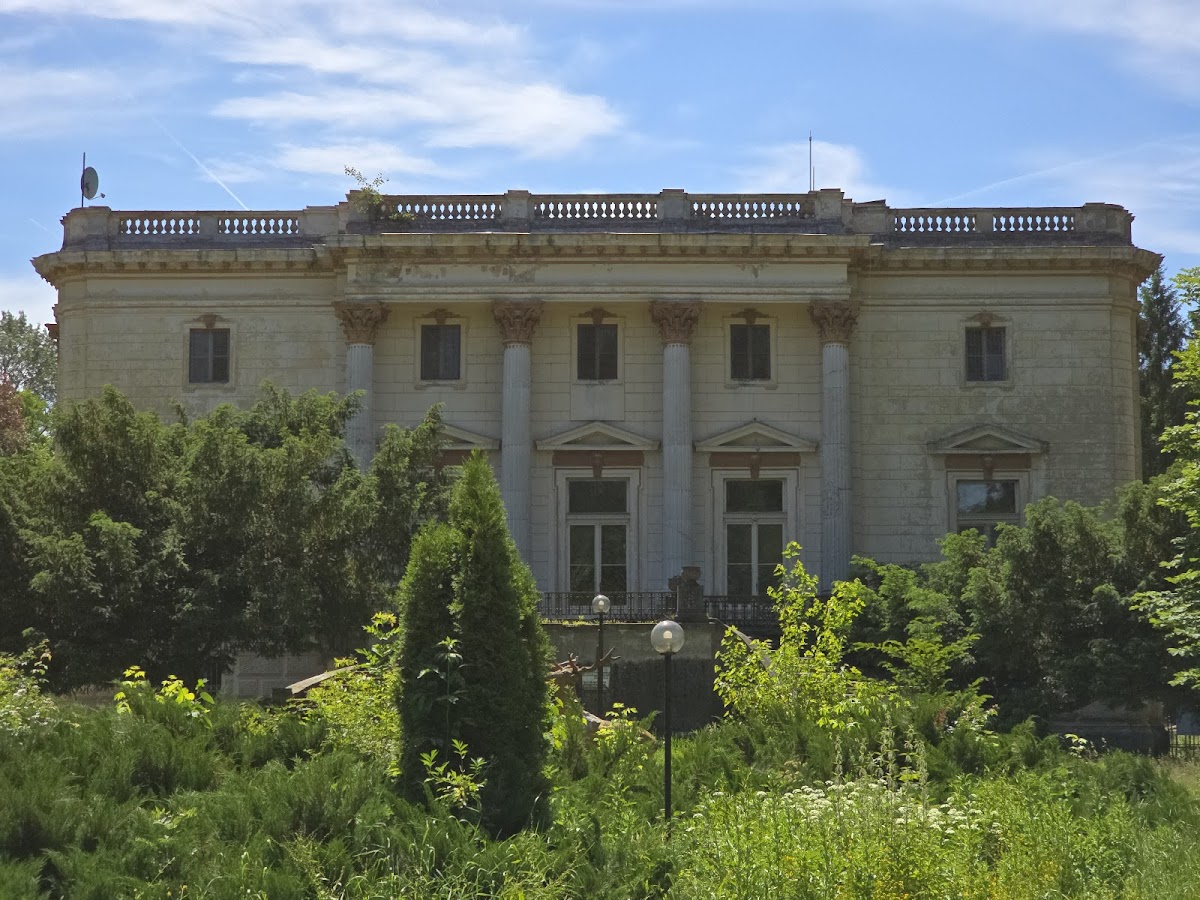
Mocioni-Teleki Castle stands in the center of Căpâlnaș village and consists of a ground floor and an upper floor. An extensive park surrounds the building, with a deer statue positioned in front of the palace. The surviving design combines a formal French-style composition with an entrance facade organized around columns, doors, windows, and a terrace.
Facade and terrace
The main facade has four stone columns topped by Corinthian capitals, whose ornament is based on acanthus leaves. Three large doors stand between the columns, each with a square window above it. Across the full width of the facade, an artistically lace-like cornice extends above the windows. The doors open from the salon onto a spacious terrace, while two semicircular marble steps provide access to the terrace from outside.
Library and natural-history collection
The palace library held numerous rare books. The interior collections also included butterflies assembled by Count Teleki, a passionate entomologist. These books and specimens formed part of the cultural and scholarly world associated with the castle and its owners.