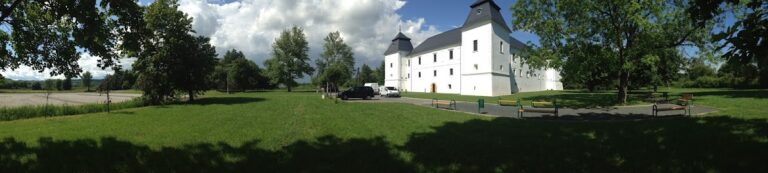
Sárvár Castle: A Medieval Castle-Palace and Frontier Fortress in Hungary


Site at a Glance
- Rating
- 4.6
- Popularity
- Medium
- Country
- Hungary
- Primary era
- Early Modern
- External website
- Open
- Eras represented
- Medieval, Early Modern, Modern
- Civilizations
- Hungarian
- Site type
- Military
- Remains
- Castle
On this page15 sections
History
Sárvár Castle, also known as Nádasdy Castle, is a medieval fortified castle-palace in Sárvár, Hungary. Its origins date to the late thirteenth century, and its first written mention, from 1327, identifies it as a royal possession of King Charles Robert, the fourteenth-century king of Hungary. Located near the western bank of the Rába River, the castle later became the administrative center of the expanding Nádasdy estates and developed into a frontier fortress during the Ottoman wars.
Royal possession and the Kanizsai period
After belonging to the Németújvári family, Sárvár was recovered for the Crown by Sándor Köcski. In 1390, King Sigismund of Luxembourg, who later became Holy Roman Emperor, granted the castle to János Kanizsai, Archbishop of Esztergom and a member of the king’s inner court. Because of the Kanizsai family’s disloyalty, the property passed for several years to the Garai family and to Pipo of Ozora. It returned to the Kanizsais in 1424.
By the end of the fifteenth century, the Kanizsais had transformed Sárvár into a closed-courtyard castle with palace wings and stronger defenses. The complex later passed through Kanizsai Orsolya’s marriage to her husband, Tamás Nádasdy. Under the Nádasdy family, Sárvár became the administrative center of a growing network of estates. During Tamás Nádasdy’s frequent absences, Orsolya managed the estates’ economic affairs from the castle.
Frontier fortress and Nádasdy residence
Between 1549 and 1562, Sárvár was gradually developed as a frontier fortress against Ottoman raiding. Its five Italian-style bastions and broad moat formed the principal defensive system. An Italian-style bastion is an angular artillery fortification designed to project defensive fire along adjoining walls. The Renaissance complex took shape around 1560, giving the castle the basic form that still defines it.
Ferenc Nádasdy II, known to the Ottomans as the “Black Bey,” was a prominent late-sixteenth-century commander on the Hungarian anti-Ottoman frontier. He repeatedly led Hungarian forces to victory and launched incursions into Ottoman territory. After his death, his widow, Elisabeth Báthory, lived at Sárvár. In 1610, Palatine György Thurzó ordered her arrest at Csejte Castle, where she remained imprisoned until her death. Elisabeth Báthory was later convicted of murdering servants.
During the seventeenth century, Sárvár stood at the center of a wealthy Nádasdy estate. Ferenc Nádasdy III, a magnate who held the office of judge royal, commissioned the castle’s ceremonial hall between 1649 and 1653. He was later implicated in the Wesselényi conspiracy, an aristocratic plot against Habsburg rule in Hungary. He was beheaded with his associates, and his extensive estates were confiscated.
Confiscation, later ownership, and changing functions
Count Miklós Draskovich purchased Sárvár and its dependent serf villages for 1.3 million forints after the confiscation. During the Rákóczi War of Independence, an early-eighteenth-century Hungarian uprising against the Habsburgs, insurgent forces held the castle briefly. In the second half of the eighteenth century, it belonged to Ádám Szily, who commissioned additional paintings for the ceremonial hall. The property later passed to the Esterházy family, one of Hungary’s leading aristocratic dynasties.
Once Sárvár lost its military importance, later owners substantially altered the complex. After it passed in 1803 to Archduke Ferdinand Charles Anthony, the outer moats were filled and the buildings were renovated in the Classical style. The Wittelsbach royal princes of Bavaria, members of the German dynasty that provided Bavaria’s monarchs, became the last private owners before nationalization after the Second World War. King Ludwig III of Bavaria died at Sárvár in 1921. His younger son, Prince Franz, inherited the castle, and the family of his nephew Albrecht of Bavaria visited repeatedly while living in exile in Budapest from 1939.
Soviet troops were quartered in the castle in 1945. Following nationalization, the complex was transferred to the municipality of Sárvár in 1949, which installed apartments and an agricultural school. These uses were relocated during the 1960s and 1970s, after which the restored buildings received a city library, cultural center, and marriage hall. Archaeological investigations began in 1962, and monument restoration followed from 1966. The castle is now included in the third phase of Hungary’s National Castle Programme, while its renovation has been planned since 2017. Continuous occupation and maintenance account for its unusually complete survival. The complex currently houses the Ferenc Nádasdy Museum.
Remains
Sárvár survives as a castle-palace whose overall form is still governed by the Renaissance frontier fortress created in the sixteenth century. Five Italian-style bastions project from the defensive circuit, which was formerly protected by a broad water-filled moat. The moat has since been drained and converted into a small park. Renaissance and Baroque elements remain visible throughout the complex, together with later Classical alterations that reflect its change from military stronghold to aristocratic residence.
Courtyard and defensive enclosure
Renaissance bastions and moat
The five bastions were part of the fortress system developed between 1549 and 1562 and shaped the complex around 1560. Their angular forms were designed for artillery defense and remain the clearest expression of Sárvár’s frontier role. The surrounding moat belonged to the same defensive arrangement. Although it no longer carries water, its former course survives as a park around the castle.
Inner courtyard arcade
A Renaissance arcade surrounds the inner courtyard, linking the palace wings within the enclosed plan. The arcade forms part of the castle’s surviving Renaissance character, while the buildings around it also preserve Baroque work and later Classical changes. Together, these elements show how the defensive enclosure continued to serve as a residential complex after its military function declined.
Baroque ceremonial interiors
Ceremonial hall
The ceremonial hall was constructed between 1649 and 1653 for Ferenc Nádasdy III. Its ceiling paintings were produced in 1653 by Hans Rudolf Miller and combine frescoes, painted on wet plaster, with secco works applied to dry plaster. The hall contains a monumental cycle of battle scenes regarded as the largest-scale historical wall-painting series of Hungarian Baroque art. Most of the scenes represent Ferenc Nádasdy II’s battles against the Ottomans.
Old Testament paintings
In 1769, István Dorfmeister the Elder painted Old Testament scenes on the hall’s side walls. He used mixed techniques, including oil painting and the combined al fresco-secco method. The subjects include Mordecai and Esther, Samson and Delilah, David and Goliath, Ahasuerus and Esther, Joshua, Judith and Holofernes, Jael and Sisera, Gideon’s offering, and the anointing of David as king. Dorfmeister also decorated the tower room with frescoes.
Cabinet cupboards
Two double-door cabinet cupboards in the ceremonial hall are decorated with marble inlay and gilding. The museum acquired them from the Ocskay family, and they remain part of the furnishings associated with the hall.
Earlier remains and museum spaces
Earlier medieval earthwork
An earlier medieval earthen castle associated with the Magyar conquest period is reported to have stood several hundred metres from the later castle-palace. It represents an earlier stage in the history of fortification at Sárvár, separate from the Renaissance complex that developed around 1560.
Ferenc Nádasdy Museum
The Ferenc Nádasdy Museum occupies 1,300 square metres of the building. Its exhibitions cover Hungarian hussars from 1526 to 1945, the history of maps, applied arts, the history of Sárvár, and printing and book publishing on the Nádasdy estates. These displays use the surviving castle-palace as the setting for interpreting its military, aristocratic, local, and cultural history.