Schönenwerd Castle Ruins: A Medieval Moated Castle in Switzerland


Site at a Glance
- Rating
- 4.2
- Popularity
- Very Low
- Country
- Switzerland
- Primary era
- Medieval
- Eras represented
- Medieval
- Civilizations
- Habsburg
- Site type
- Military
- Remains
- Castle
On this page6 sections
History
The Schönenwerd ruins in Dietikon, Switzerland, are the remains of a medieval lowland moated castle whose construction probably began after 1100, at the beginning of the twelfth century. The castle stood near the Limmat and became connected with the Lords of Schönenwerd, Habsburg service, and the territorial rivalry surrounding trade routes in the Zurich region.
Origins and the Lords of Schönenwerd
The castle was rebuilt after a fire, and two additional buildings were erected in its courtyard during this later phase. The Lords of Schönenwerd first appear in written evidence in 1240. They were Habsburg ministeriales, formally unfree officials who could nevertheless hold influential administrative and military positions. The family exercised bailiwick rights over Dietikon-Oberdorf, then a separate administrative and judicial territory, and held substantial estates along the Reppisch.
Glanzenberg and the Limmat Bridge
During the first half of the thirteenth century, the Regensbergs, a noble family with territorial interests in the Zurich region, competed with the growing city of Zurich. They expanded the older Fahr Castle, built around 1044, into Glanzenberg and probably founded the town of Glanzenberg around 1240 on the opposite side of the Limmat from Dietikon. The new settlement was intended to control trade on the river and on the road to Baden. Its position also suited the construction of a bridge and placed it near Fahr Abbey, another Regensberg foundation.
A bridge would have required the cooperation of the Lords of Schönenwerd, whose castle stood on the opposite bank. Zurich resisted the project because it feared that Glanzenberg could create a trade route to central Switzerland that bypassed the city. In 1257, the Lords of Schönenwerd agreed not to sell land on the far bank of the Limmat for bridge construction.
Destruction, Ownership, and Excavation
The castle is said to have been sacked and burned by forces from Zurich in 1334 and again in 1371. Heinrich von Schönenwerd had become too poor to rebuild the ruin, while Wettingen Abbey, a Cistercian monastery, gradually acquired the knights’ properties. In 1367, the bailiwick rights over both parts of Dietikon passed to the abbey. Hans Hediger of Altstetten purchased the ruin from the Zurich Stagel family in 1434.
Archaeologist Karl Heid excavated the castle between 1930 and 1935. Conservation work followed in 1970 and 1971 under the Zurich city building authority. The City of Dietikon now owns the ruins.
Remains
Moated Castle Layout
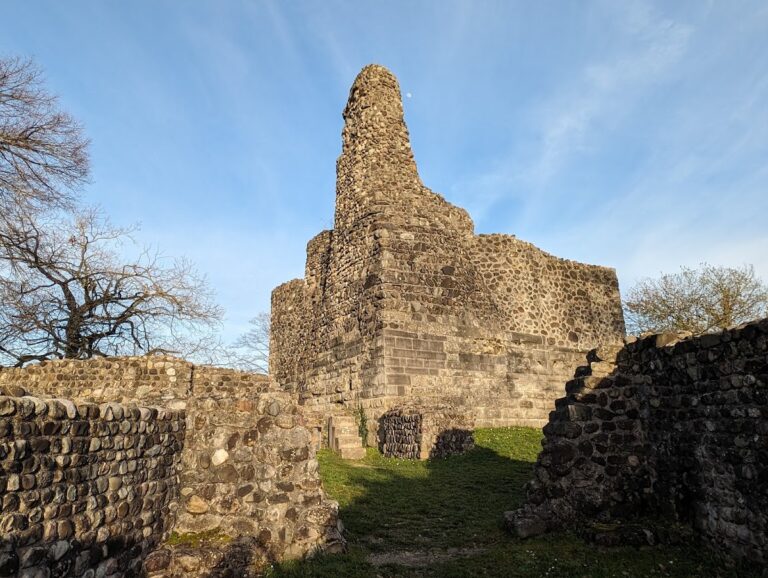
The site preserves the remains of a moated castle that was probably built on an island in the Limmat. The ruins now stand approximately 200 metres from the river’s left bank. The original complex reportedly included a tower, a palas, the principal residential and representative building of a medieval castle, a zwinger, meaning an outer defensive enclosure or passage between defensive walls, and a ring wall.
After the fire, the castle was rebuilt and its courtyard enlarged with two ancillary buildings. The surviving remains therefore reflect both the original defensive and residential arrangement and the later rebuilding phase. Across the Limmat, approximately 700 metres downstream on the right bank, lie the ruins of Glanzenberg Castle and the former town of Glanzenberg, the settlement whose planned bridge and trade route drew the Lords of Schönenwerd into conflict with Zurich.