Alte Kirche Höngg: A Historic Reformed Church in Zürich
Site at a Glance
- Rating
- 4.4
- Popularity
- Very Low
- Country
- Switzerland
- Primary era
- Medieval
- External website
- Open
- Eras represented
- Medieval, Early Modern, Modern
- Civilizations
- Carolingian, Holy Roman Empire, Swiss
- Site type
- Religious
- Remains
- Church
On this page14 sections
History
Alte Kirche Höngg is a historic Evangelical Reformed church in Zürich, Switzerland, with archaeological evidence placing its basement in the eighth or ninth century. A church at Höngg was first documented on 8 February 870, when the nobleman Landeloh transferred it to the Abbey of St Gall for the salvation of his soul and ancestors. Its prominent position above the Limmat Valley has made it a widely visible landmark of the Höngg district.
Early ecclesiastical history
In 890, the Abbey of St Gall transferred the Höngg church to the Church of St Magnus, founded outside the city of St Gall under Solomon III, Bishop of Constance and Abbot of St Gall. The church was dedicated to Saint Mauritius, also known as Saint Maurice, a Christian martyr who was widely venerated in medieval Europe. Seals belonging to parish priests in 1297 and 1390 record this dedication, and an inscription above the main entrance stated until 1819 that the church had long been called Saint Mauritius.
Alte Kirche Höngg belonged to the Diocese of Constance within the Archdeaconry of Zürich and the Deanery of Kloten. These were administrative divisions of a medieval diocese. On 28 June 1376, Pope Gregory XI ordered the church’s incorporation into Wettingen Abbey, placing it under the institutional administration of the monastery. This arrangement continued until 1837.
The historical parish of Höngg extended beyond the village church. It included the chapel at Regensdorf, the chapel at Niederhasli from 1364, the Chapel of Saint Ottilie in Watt, and the Chapel of Saints Theodul and Herhard on the northern Hönggerberg. Affoltern remained ecclesiastically affiliated with Höngg until 1683.
Destruction, Reformation, and enlargement
Swiss Confederates burned the church in 1443, after which inhabitants of Höngg rebuilt it in 1446. During the Reformation, the sixteenth-century religious movement that transformed established Catholic structures in parts of Europe, Catholic worship was prohibited in the Canton of Zürich in 1523. The church then continued as a place of Reformed worship, while local inhabitants removed statues and images from its interior.
The building grew westward during the sixteenth and seventeenth centuries. In 1703, the nave was extended toward the north and raised throughout. Two galleries were added along the long sides in 1783. These alterations shaped the church’s later interior and contributed to the unusual relationship between its narrow nave and square choir.
Nineteenth- and twentieth-century changes
In 1863, the tower roof was raised with gables, steep triangular elements that emphasize the vertical lines of Gothic roofs and towers. The roof and clock face were also renewed, probably under the direction of the architect Gottfried Semper. Four bells were cast that year by Jakob II Keller of Zürich-Unterstrass. The western porch followed in 1896.
The church was renovated in 1969 and again in 1993. The 1969 work included a new choir window and baptismal font. Today, Alte Kirche Höngg is used by the Zürich parish congregation as an Evangelical Reformed church within the Evangelical Reformed Church of the Canton of Zürich. The vineyard on which it stands has been associated with prayer and gathering for more than 1,200 years.
Remains
Site setting and exterior
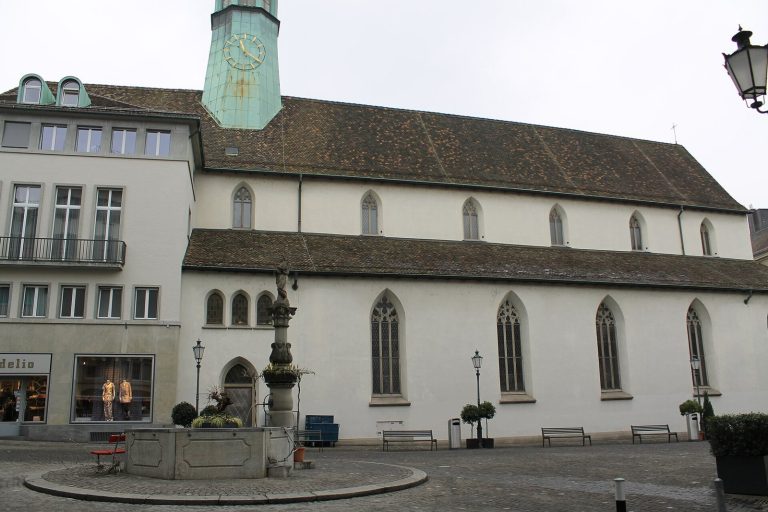
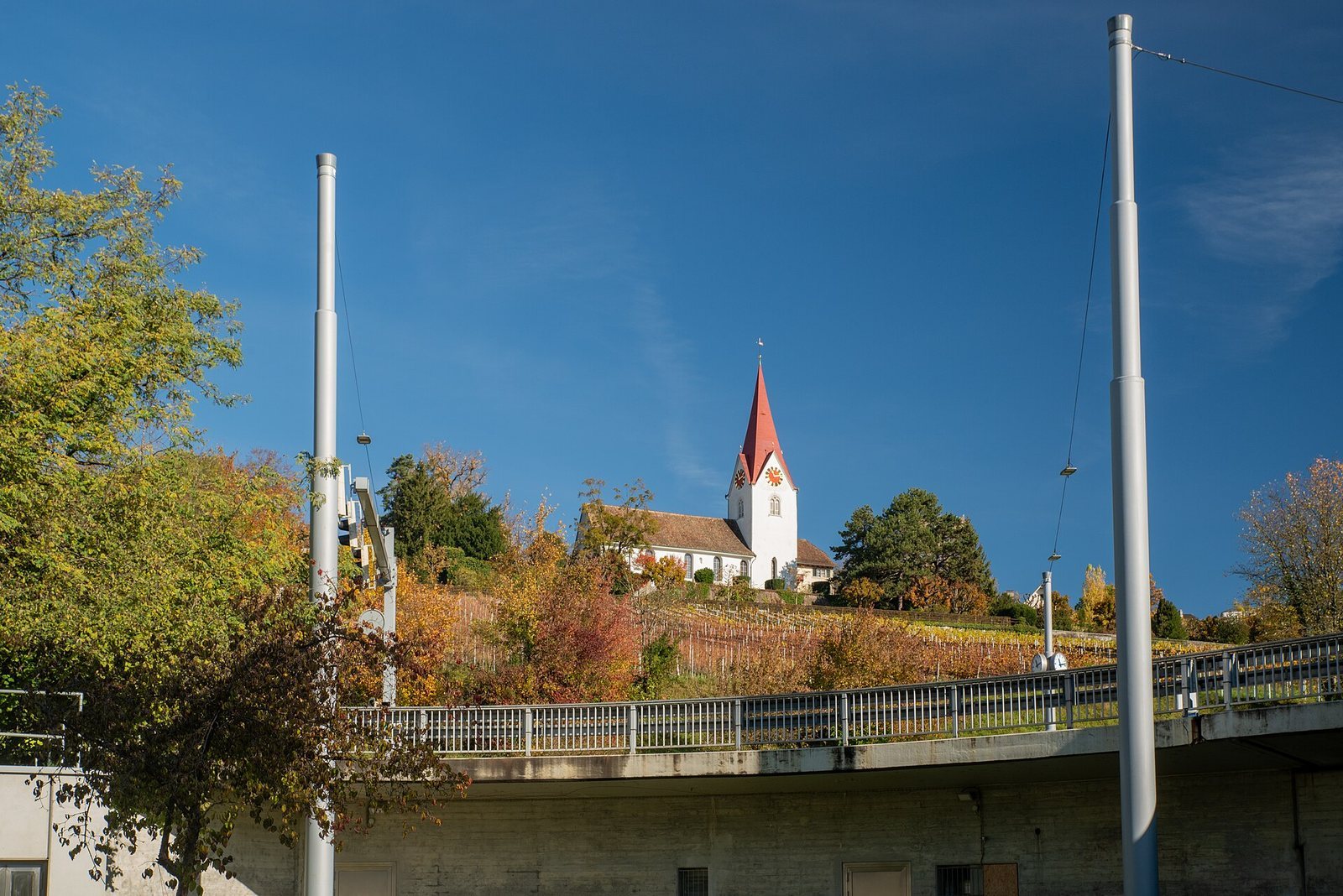
Alte Kirche Höngg stands above the Europabrücke and a vineyard. The former churchyard developed into the Höngg cemetery on the south side, with later additions extending down the slope. A paved square opens toward the district on the north side. Together, these spaces preserve the church’s position within the former village setting.
Tower and roof
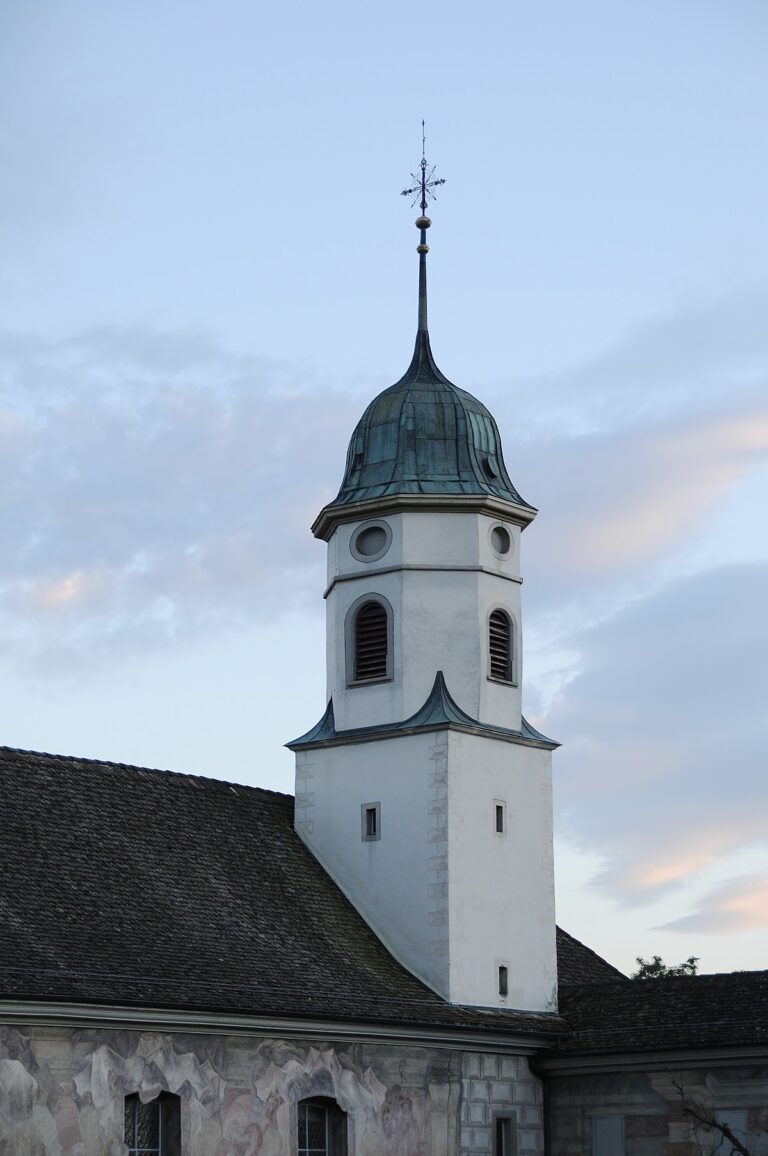
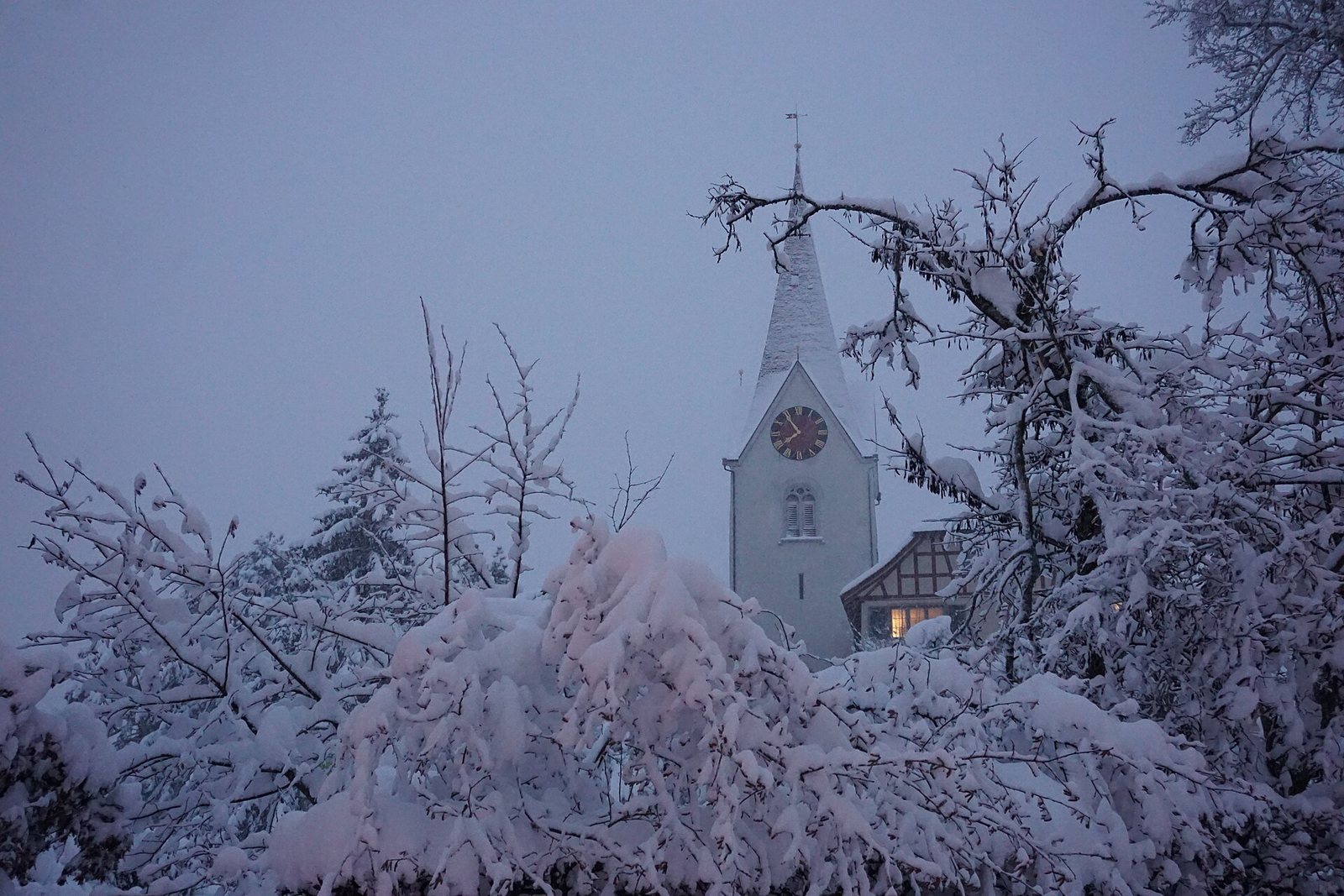
A monumental tower rises above the choir. Its clock, gables, and red-shingled pointed roof give the building its distinctive exterior appearance. The roof was raised and renewed in 1863, when the clock face was also replaced.
Porch and medieval windows
The western porch, added in 1896, is attached to the church and shelters the entrance. Two coupled pointed-arch windows from the thirteenth century remain visible in the south wall. An old rectangular sacristy adjoins the choir. The sacristy, a room for storing vestments and liturgical objects, and the medieval windows preserve evidence of earlier phases of the building.
Interior arrangement
Nave, choir, and gallery
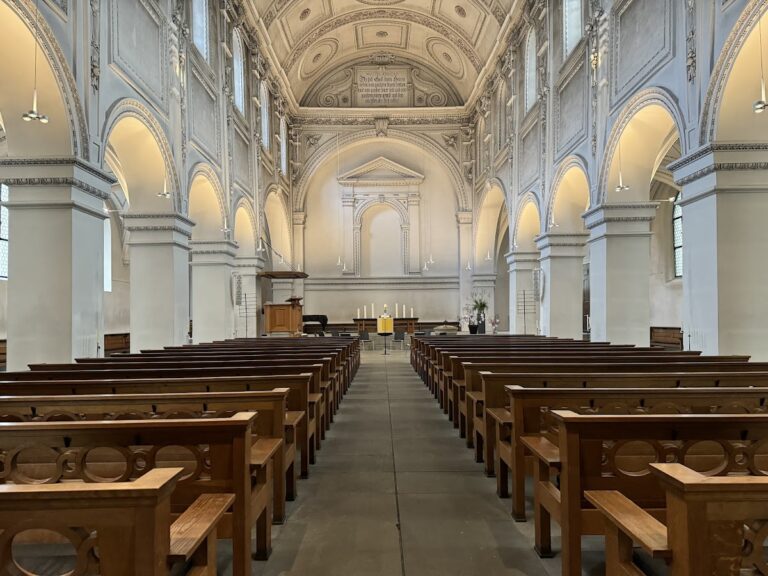
The interior is formed by a narrow nave, the principal area for the congregation, and a square choir associated with clergy and liturgical singing. The nave was widened by 3.20 metres toward the north, creating an asymmetrical relationship with the choir that is unusual among village churches in the city of Zürich. A U-shaped gallery rests on profiled oak columns. The pulpit and its sounding board date from the nineteenth century.
Choir window and baptismal font
Franz Karl Opitz designed the choir window in 1969, and the baptismal font dates from the same year. These features belong to the church’s twentieth-century renewal while remaining within the older medieval and early modern structure.
Bells and organ
Bells
The church has four bells cast in 1863 by Jakob II Keller of Zürich-Unterstrass. They belong to the same nineteenth-century phase that altered the tower roof and renewed the clock face.
Organs
A pneumatic organ with membrane chests was built in 1898 by Carl Theodor Kuhn of Männedorf. It had nine stops on two manuals and a pedal. In 1925, it was replaced by another pneumatic instrument by the same builder, this time with pocket chests, 17 speaking stops, two manuals, and a pedal.
The present organ was built in 1972 by Orgelbau Kuhn AG of Männedorf. It is a mechanical slider-chest organ with 20 stops on two manuals and a pedal, revised by the same firm in 1991. Its couplers are II/I, I/P, and II/P, and a tremulant operates on all divisions. In this terminology, manuals are hand-operated keyboards, the pedal is played with the feet, and stops control individual ranks or sound colors.