Ruine Nollig: A Medieval Hilltop Castle and Watchtower Ruin


Site at a Glance
- Rating
- 4.5
- Popularity
- Low
- Country
- Germany
- Primary era
- Medieval
- Eras represented
- Medieval
- Civilizations
- Holy Roman Empire
- Site type
- Military
- Remains
- Castle
On this page8 sections
History
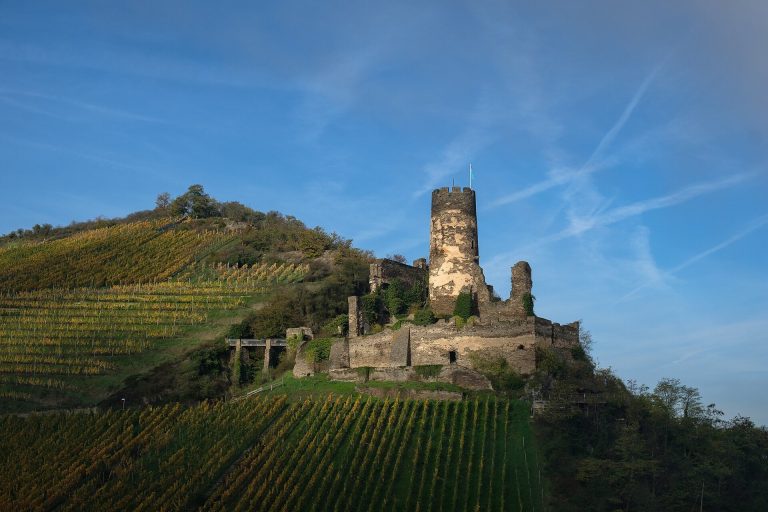
Ruine Nollig is the ruin of a medieval hilltop castle above Lorch in Germany, built around 1300 on the Nollig or Wachtenberg ridge. More recent interpretations partly identify it with Burg Fürsteneck, also known as Fürsteneck near Lorch, but this connection remains uncertain. The site formed part of the political and defensive landscape of the early fourteenth-century Middle Rhine.
Construction and identification
A Mainz document from 1349 describes the stone expansion of a castle called Fürsteneck above Lorch. A fief register of the Middle Rhine Marshals of Waldeck lists Fürsteneck near Lorch as a holding granted by Mainz to the Marshals of Waldeck. The register traces possession back to Johann III, Marshal of Waldeck at Sooneck. This family was separate from the Hessian noble house of Waldeck.
Competing powers on the Middle Rhine
Thomas Steinmetz interprets Nollig or Fürsteneck as a counter-castle, a fortification intended to oppose or control another stronghold. In this view, the Archbishopric of Mainz built it against Fürstenberg Castle, which had been established by the Electorate of Cologne and transferred to the Electoral Palatinate under the Treaty of Bingen on 29 May 1344. Mainz, Cologne, and the Electoral Palatinate were major territorial powers of the medieval Holy Roman Empire, and their castles expressed competing defensive and political interests.
The site may also have served as a watchtower belonging to Lorch rather than functioning solely as a castle. Under this interpretation, its tower could have provided shelter during emergencies. Since 2002, Ruine Nollig has formed part of the Upper Middle Rhine Valley UNESCO World Heritage property, an international designation for places recognized as having outstanding cultural or natural importance.
Remains
Fortification on the ridge
Timber-framed core
The ruin stands at approximately 176 metres above sea level on the Nollig or Wachtenberg ridge. Its core was an almost square building measuring about 10 metres on each side. The three-storey structure used a timber frame, a wooden structural framework with infill between its members. Soon after its initial construction, a massive masonry wall enclosed and strengthened the timber-framed core.
Shield wall and corner towers
On the side facing the mountain, a neck ditch cut across the ridge and helped protect the fortification. Behind it stood a shield wall, a particularly strong wall placed on the side most exposed to attack, flanked by two round corner towers. The shield wall continues laterally. This may indicate an intention to connect the structure with Lorch’s town fortifications, although that interpretation has been challenged and its supposed role in the town defences remains uncertain.
Surrounding landscape
The area around the ruin is among the most species-rich habitats in Hesse. It supports animals and plants otherwise found mainly in southern Europe, while former fallow land and parts of the vineyards receive protection. Fertilizer use and the complete abandonment of land management threaten this biodiversity by encouraging scrub to spread. Historical images show that the landscape remained almost entirely without woodland until the Second World War.