Craufurdland Castle: Historic Seat of the Crawfords


Site at a Glance
- Rating
- 4.6
- Popularity
- Low
- Country
- United Kingdom
- Primary era
- Medieval
- External website
- Open
- Eras represented
- Medieval, Early Modern, Modern
- Civilizations
- British, Kingdom of Scotland
- Site type
- Domestic
- Remains
- Castle
On this page7 sections
History
Craufurdland Castle is a historic castle near Kilmarnock in Scotland, United Kingdom, whose oldest parts date to the late medieval or early modern period and whose present form was established through Gothic-style remodelling between 1830 and 1840. It was the historic seat of the Crawfords of Craufurdland, who held the property from the thirteenth century.
Medieval and sixteenth-century connections
The precise date of the oldest parts is uncertain. John Crauford of Craufurdland was killed at the Battle of Flodden in 1513, a major Anglo-Scottish conflict. The family also had close connections with the Scottish royal household. Archibald Crauford, a younger brother of the laird John Craufurd, was Parson of Eaglesham and an almoner, an official responsible for charitable gifts and related religious duties, serving both Mary of Guise and her daughter, Mary, Queen of Scots.
Archibald Crauford visited Mary, Queen of Scots, at Joinville on 17 April 1561. He was responsible for her chapel goods and silver plate. After her forced abdication in 1567, he delivered some of her silverware to Regent Moray, James Stewart, who governed Scotland on her behalf, and to the treasurer Robert Richardson in November of that year.
Expansion and nineteenth-century remodelling
The castle was remodelled and extended during the seventeenth century, followed by further additions in the eighteenth and nineteenth centuries. Building work and a Gothic-style remodelling carried out between 1830 and 1840 established the appearance seen today. Ownership passed to the Howiesons in 1793. The house was restored during the 1980s and remains occupied.
Craufurdland Castle received Category A listed-building protection in 1971. This is Scotland’s highest listed-building category, reserved for structures of national or exceptional architectural or historic importance. Simon Houison Craufurd, the twenty-ninth laird of Craufurdland Castle, holds the Scottish ceremonial office of Washer of the Sovereign’s Hands, which is associated with royal ritual.
Remains
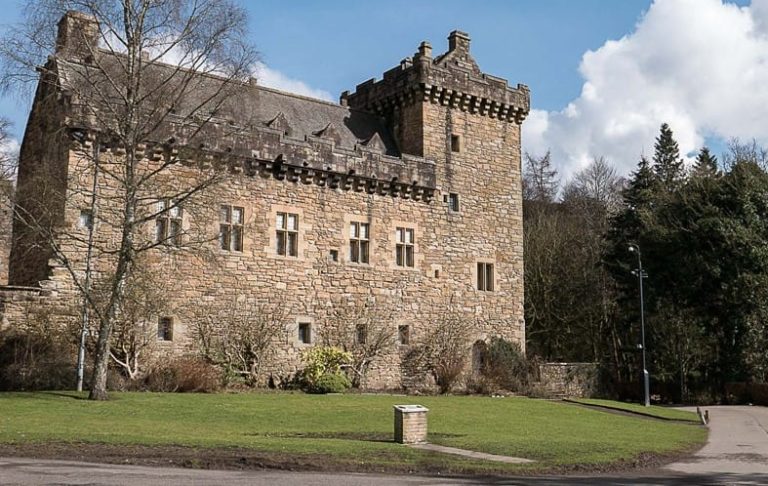
Craufurdland Castle is a rebuilt tower house on an isolated estate about 4.0 kilometres northeast of Kilmarnock, north of the Craufurdland Water. Its fabric combines a west-wing tower with later wings and Gothic-style additions. Rubble masonry, partly covered with harling, a rough cast coating traditionally made from lime-based material and small aggregate, forms part of the exterior, while stepped gables and crenellated parapets contribute to its later castellated character.
West-wing tower
The original tower forms part of the west wing and is probably fifteenth-century in date. Three storeys high, it retains defensive elements including a corbelled-out battlement, an overhanging wall-walk with machicolations, and corner tourelles. Machicolations are openings in a projecting parapet through which defenders could drop objects onto attackers below; tourelles are small projecting corner turrets. The tower also has a vaulted basement, while its interior has been substantially altered. A large hall contains a cross-vault, and a leaded-glass window above a doorway incorporates heraldic symbols.
Seventeenth-century east wing
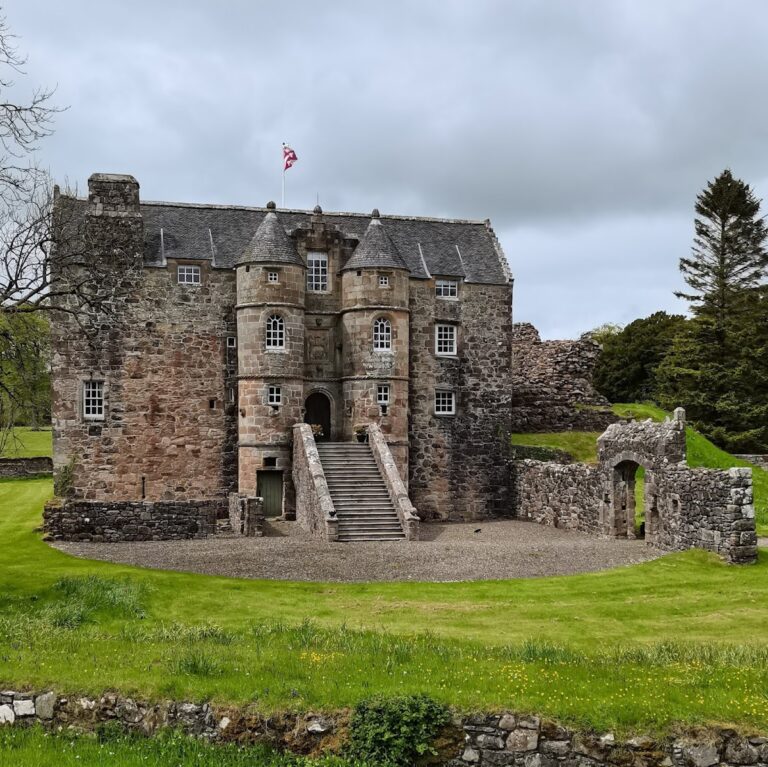
The two-storey east wing was added during the seventeenth century and is oriented towards the east. Its interiors contain richly ornamented plaster ceilings and wood panelling. The fine plaster ceiling in the King’s Room bears the date 1668 and incorporates the arms of the Stewarts. Other seventeenth-century stucco work carries the date 1648.
Gothic-style exterior
The later remodelling shaped the castle as a crenellated Gothic-style mansion. Crenellation is a parapet design with regularly spaced raised sections and openings. The stepped gables have stair-like outlines along their sloping sides, while the harled rubble walls unite the older tower and later additions within the castle’s present exterior.
A tradition connects Craufurdland Castle with Dean Castle, several miles away, through an underground passage. The existence of this passage remains uncertain.