Rottenmünster Abbey: A Cistercian Nunnery and Imperial Abbey
Site at a Glance
- Popularity
- Medium
- Country
- Germany
- Primary era
- Early Modern
- Eras represented
- Medieval, Early Modern
- Civilizations
- Holy Roman Empire
- Site type
- Religious
- Remains
- Monastery
On this page6 sections
History
Rottenmünster Abbey was a Cistercian nunnery near Rottweil in Germany, founded around 1220 and later rebuilt in the Baroque style, a European architectural style prominent in the seventeenth and eighteenth centuries. The Cistercians were a Catholic monastic order whose members followed the Rule of Saint Benedict. The abbey became an Imperial Abbey in 1442, its territory placed directly under the Holy Roman Emperor.
Foundation and imperial status
The abbey developed from a community of religious women at Hochmauren, near Rottweil. A branch of that community was established there in 1221, forming the basis of the future monastery. On 9 May 1224, the community entered the Cistercian order and came under the supervision of the abbot of Salem. Eberhard von Rohrdorf, Salem’s abbot, became its first supervising abbot, while Williburgis, the community’s former leader, became its first abbess.
In 1237, Emperor Frederick II placed the abbey under his protection and assigned that responsibility to the imperial city of Rottweil. Its status changed in 1442, when it gained imperial immediacy, meaning that its territory answered directly to the emperor rather than to an intervening lord. As an Imperial Abbey, it was represented at the Imperial Diet, the assembly of the Empire’s estates. The abbess held one collective vote through the Swabian Prelates’ Bench, which represented the region’s ecclesiastical territories, and the abbey belonged to the Swabian Imperial Circle, a regional administrative grouping.
Territory and convent life
Donations and dowries gave the abbey land between the Black Forest and the Swabian Alb. A dispute over the extent of its possessions was resolved in 1771. By the late eighteenth century, its holdings included Aixheim, Frittlingen, Neukirch, Zepfenhan, half of Hausen ob Rottweil, the Rotenstein estate and castle, eight farms, and woodland. The territory covered about 55 square kilometres and had roughly 3,000 inhabitants.
The convent’s numbers varied over time. It had about 100 nuns at the end of the fourteenth century, while later communities generally numbered between 20 and 30. In 1662, it consisted of 14 choir nuns, who took part in the full liturgical office, and three lay sisters, whose work was generally practical. Its numbers rose again during the eighteenth century, when the community exceeded 30 sisters.
War and reconstruction
During the Thirty Years’ War, a major European conflict fought from 1618 to 1648, roaming troops plundered the abbey. In 1643, forces of Duke Eberhard III of Württemberg burned it down. The abbess and convent then chose to rebuild the church and monastery in the style of their time. Under Abbess Ursula Scherlin, whose tenure lasted from 1658 to 1687, architects Michael Beer and Michael Thumb were commissioned for the work, which took place from 1662 to 1669.
Secularization and later use
On 23 November 1802, Württemberg took over the abbey’s property and territory during German mediatization, the transfer of smaller imperial territories, including church lands, to larger states. The community remained in place after the takeover, with 24 choir nuns, four novices in training, and 14 lay sisters. The last abbess, Juliana Mayer, died in 1826. Franziska Gaupp, the last surviving sister, left in 1850, ending the site’s use as a Cistercian nunnery.
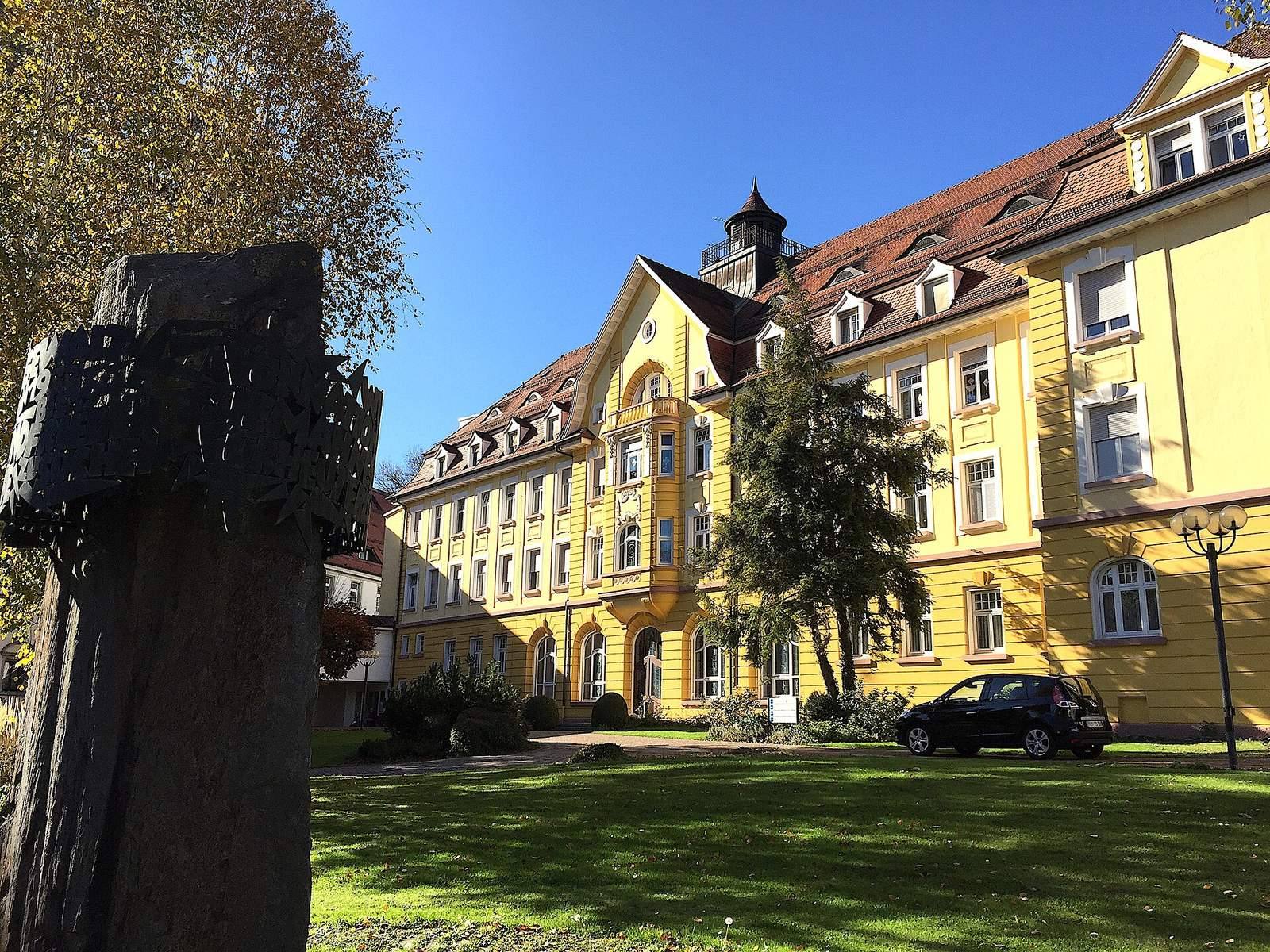
In 1896, the Sisters of Mercy of Saint Vincent de Paul from Untermarchtal took over the monastery buildings. They opened a mental-health institution there in 1898; it developed into the present Vinzenz von Paul Hospital.
Remains
The abbey complex includes its church and convent buildings, reconstructed in the Baroque style. Former abbey buildings, including the convent rooms, now accommodate the hospital. The buildings thus retain their association with the monastery while serving a later institutional use.