Ross Castle: A Fifteenth-Century Tower House in Ireland



Site at a Glance
- Rating
- 4.6
- Popularity
- Medium
- Country
- Ireland
- Primary era
- Medieval
- External website
- Open
- Eras represented
- Medieval
- Civilizations
- Irish
- Site type
- Military
- Remains
- Castle
On this page8 sections
History
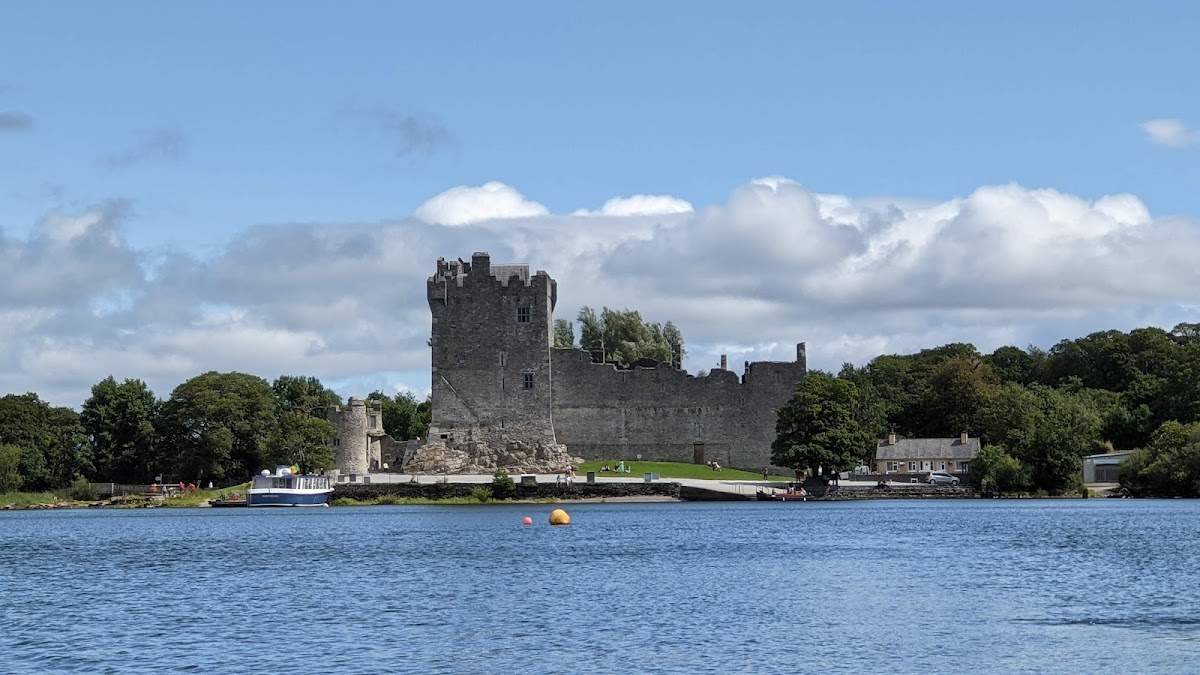
Ross Castle is a late-fifteenth-century tower house and keep in Ireland, located at Killarney on the edge of Lough Leane. Built by the locally ruling O’Donoghue Mór clan, it became the ancestral home of the Chiefs of Clan O’Donoghue and was later associated with the Brownes of Killarney.
O’Donoghue and Browne ownership
During the Second Desmond Rebellion of the 1580s, an uprising in Munster linked to the Desmond dynasty and its supporters, ownership passed to MacCarthy Mór. The title MacCarthy Mór was associated with the MacCarthy dynasty, a major Gaelic ruling family in southern Ireland. MacCarthy subsequently leased Ross Castle and its lands to Sir Valentine Browne, an ancestor of the Earls of Kenmare.
After the Irish Confederate Wars, the conflicts in Ireland during the 1640s and early 1650s that ended with the Cromwellian conquest, the Brownes retained the lands by demonstrating that their heir had been too young to participate in the rebellion. By about 1688, they had built a mansion near the castle. Their support for King James II, the Catholic king displaced during the Glorious Revolution of 1688 to 1689, led to their exile. The Brownes did not return to live at Ross and instead built Kenmare House near Killarney.
The siege of 1652
Irish Confederates occupied Ross Castle during the Irish Confederate Wars, and it became one of the last Irish strongholds to surrender to Oliver Cromwell’s forces. Oliver Cromwell was the English Parliamentarian leader whose forces conquered much of Ireland in the early 1650s. Lord Muskerry, a member of the MacCarthy family, defended the castle against Edmund Ludlow, a Parliamentarian commander who approached with 4,000 infantry and 200 cavalry.
The castle was captured in 1652 only after artillery was brought against it from the water. Boats built at Kinsale were taken by water to Killorglin, then hauled by oxen to the castle before being used on Lough Leane. In June 1652, MacCarthy and Donal O’Brien surrendered at Ross Castle and were taken as hostages.
An Irish prophecy said that Ross Castle could not be captured until a warship sailed on Lough Leane. The lake was too shallow for a true warship, but the artillery boats were regarded as fulfilling the prophecy.
Barracks and later interpretation
After the wars, Ross Castle was converted into a military barracks, a use that continued until the early nineteenth century. Recorded governors of its garrison included Pierce Ferriter until 1652; Sir John Peyton, who died in 1675; Colonel Sir John Edgeworth from about 1679 to 1701; Colonel Richard Hedges from about 1705 to 1714; John Sterling in 1715; William FitzMaurice, 2nd Earl of Kerry, in 1721; Lieutenant-General John Folliot from 1753 to 1762; Sir Francis Lumm, 1st Baronet, in 1762; Lieutenant-General Charles Eustace until 1801; and Lieutenant-General Sir Henry Johnson from 1801 to 1835.
Ross Castle has been interpreted as a symbol of the Irish struggle for independence. Local tradition says that the O’Donoghue chief was sucked or leapt from the great chamber with his horse, table, and library into the lake. According to the tradition, he continues to live in a palace beneath the water and watches events on the surface. Ross Castle is a designated Irish national monument, operated by Ireland’s Office of Public Works, and is partially restored.
Remains
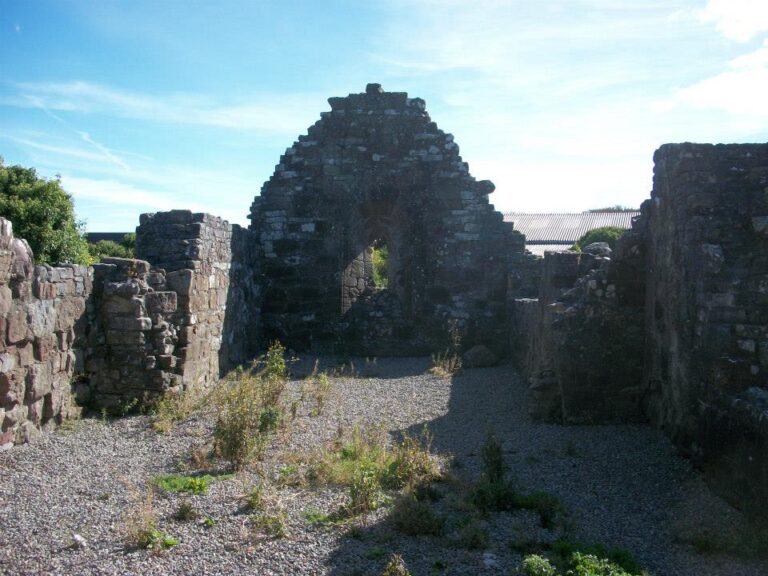
Ross Castle is a fifteenth-century tower house and keep standing at approximately 18 metres above sea level on the edge of Lough Leane in Killarney National Park, County Kerry. Its central fortified tower was originally enclosed by a square bawn, an enclosed defensive courtyard, with round corner towers at its ends.
Central tower
The central tower house has square bartizans, or projecting corner turrets, at diagonally opposite corners and a thick end wall. Its roof-level parapet, a protective wall along the top of a fortification, is crenellated with raised merlons and recessed crenels. These arrangements allowed defenders to shelter behind the merlons while firing through the openings.
Entrances and defensive features
The front entrance led into a small anteroom protected at the outer wall by an iron yett, a heavy fortified grille. A chain allowed the yett to be drawn shut from inside even when the main door was closed. Small access holes opened from the anteroom, while a murder-hole above it enabled defenders to attack people entering below.
The inner entrance door consisted of two layers of thick Irish oak. The boards in one layer ran at right angles to those in the other and were fastened with rivets. The door opened inward and was strengthened by two heavy beams fitted into the stone structure.
Narrow vertical openings at the lower levels allowed occupants to fire arrows or guns while restricting entry. Larger windows on the upper levels supplied more light at heights considered difficult for attackers to reach. Two stone machicolations, projecting defensive structures with openings for dropping missiles or liquids, extend from the upper walls. One stands above the front door and the other on the rear wall, while the entrance machicolation allowed stones or boiling oil to be dropped onto attackers.
Internal rooms and upper levels
The first floor served for storage. The second floor contained living space for attendants and guards, who slept on straw and typically had little or no furniture. The third floor provided food-preparation, living, and dining space for attendants and guards. The fourth floor held the sleeping and living quarters of the chieftain and his family.
An arched stone roof on the fourth floor supports the stone floor of the fifth story, unlike the timber-beam floors on the lower levels. The fifth floor is the great room, used for dining and entertainment. Its stone floor also provided a final refuge because it helped protect the room from fires that began below.