Roggenburg Abbey: A Premonstratensian Monastery in Germany
Site at a Glance
- Popularity
- High
- Country
- Germany
- Primary era
- Early Modern
- Eras represented
- Medieval, Early Modern, Modern
- Civilizations
- German, Holy Roman Empire, Kingdom of Bavaria
- Site type
- Religious
- Remains
- Monastery
On this page13 sections
History
Foundation and early growth
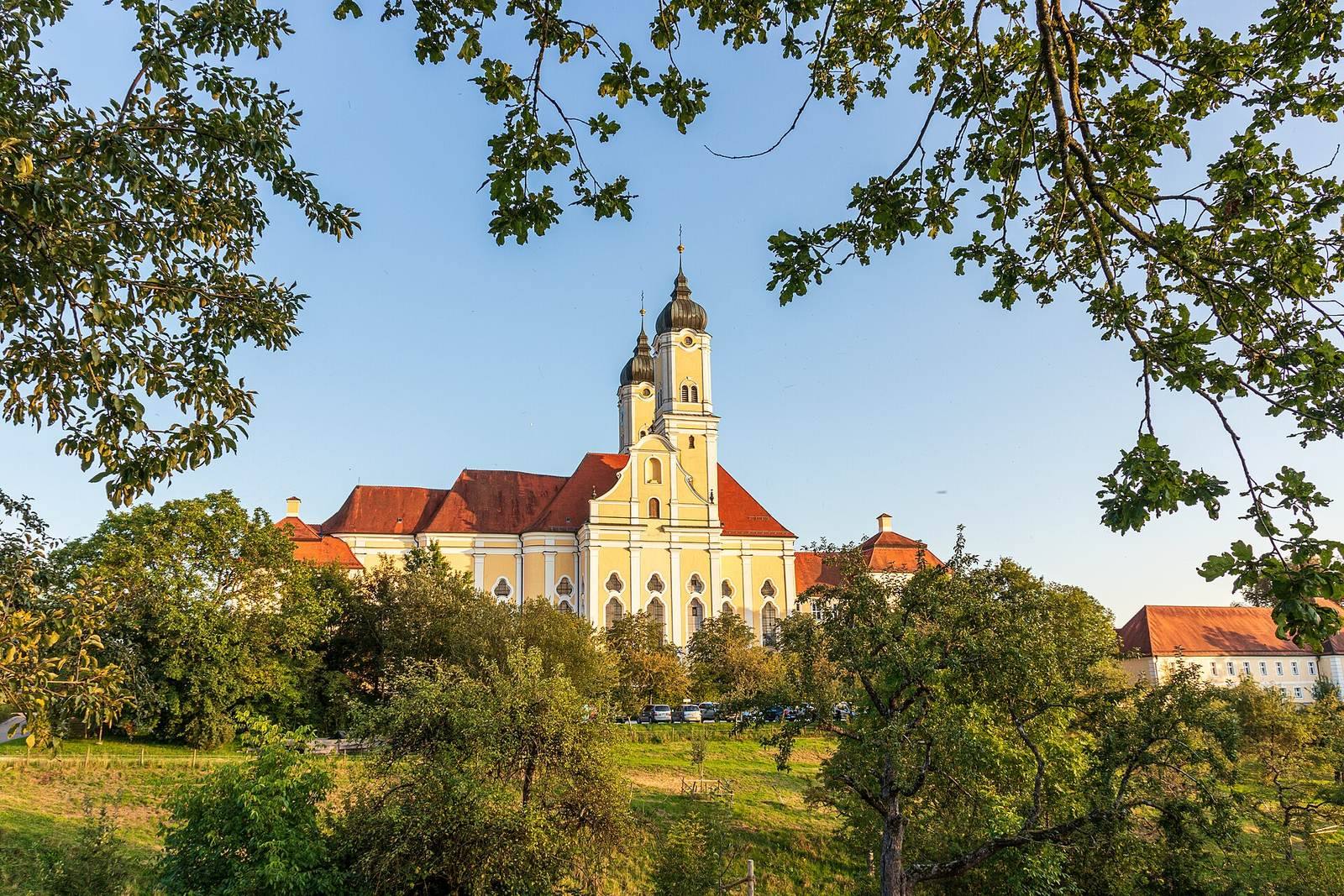
Roggenburg Abbey is a Premonstratensian monastery near Meßhofen in Germany, founded in 1126 by Count Berthold von Biberegg, his wife, and his brothers Konrad, bishop of Chur, and Siegfried, a canon in the Diocese of Augsburg. The foundation expressed the family’s support for the pope in an anti-imperial conflict, a form of allegiance that southern German nobles also demonstrated by founding monasteries. The abbey later acquired a Baroque character, while its church became a major example of Swabian Rococo architecture.
The first Premonstratensian canons arrived from nearby Ursberg around 1130 and built the community’s first church. A provostry, a monastic house led by a provost, Roggenburg also began as a double monastery housing both men and women. Its church, dedicated to Mary and Augustine, was consecrated in 1160, and the nuns were last mentioned in 1178. The Premonstratensians, also called Norbertines, are canons who combine communal religious life with pastoral work. During the twelfth century, Roggenburg established daughter foundations at Adelberg, St Luzi in Chur, and Churwalden. St Luzi and Churwalden later returned to Roggenburg’s administration in the early seventeenth century.
Territory and imperial standing
The abbey received the villages of Meßhofen, Breitenthal, Ebershausen, Ingstetten, and Schießen. Its bailiwick, the secular guardianship and administration associated with a church institution, passed as an imperial fief to Reisensburg and then to the imperial city of Ulm in 1412. After 1477 it was held for much of the time by a Swabian authority, and from 1548 by Austria. Roggenburg gained lesser judicial authority in 1406 and, in 1513, the right to try serious crimes, including the power to impose capital punishment.
Roggenburg became an abbey in 1444, and its abbots wore a mitre from 1500. Its imperial immediacy, meaning direct standing within the Holy Roman Empire rather than subjection to a territorial lord, was first noted in 1482–85. The abbey was identified as an imperial abbey in 1544, although its legal position remained contested until 1775. From 1547, its abbot could take a formal seat in the Imperial Diet on the Bench of the Prelates of Swabia. Reforms to courts and policing helped secure the abbey’s standing, as did its extensive regulations of 1573. Four offices, at Roggenburg, Breitenthal, Nordholz, and Wiesenbach, administered its territory. Abbot George IV became a leading figure among the Swabian imperial prelates from 1768.
Conflict, religious life, and rebuilding
During the German Peasants’ War, a series of uprisings in 1524–25, the Leipheim peasant band plundered Roggenburg on 1 April 1525. Abbot Jodok and the canons had already left, so the attackers encountered no resistance. The preacher and peasant leader Hans Jakob Wehe of Leipheim and the Ingstetten captain Jörg Ebner took part; during a feast, Ebner proclaimed himself the new abbot. The next day, after the Leipheim group had gone, the Illertissen band arrived and caused further damage to the buildings.
The abbey operated amid rivalry between the Wittelsbach and Habsburg houses and later between Protestant and Catholic forces, using these conflicts to extend its influence. It escaped damage during both the Protestant Reformation and the Thirty Years’ War, the European conflict of 1618–48. Its canons served eight parishes and supported the Marian pilgrimage at nearby Schießen. They encouraged devotion to Mary and the saints, the veneration of relics, religious confraternities, and processions.
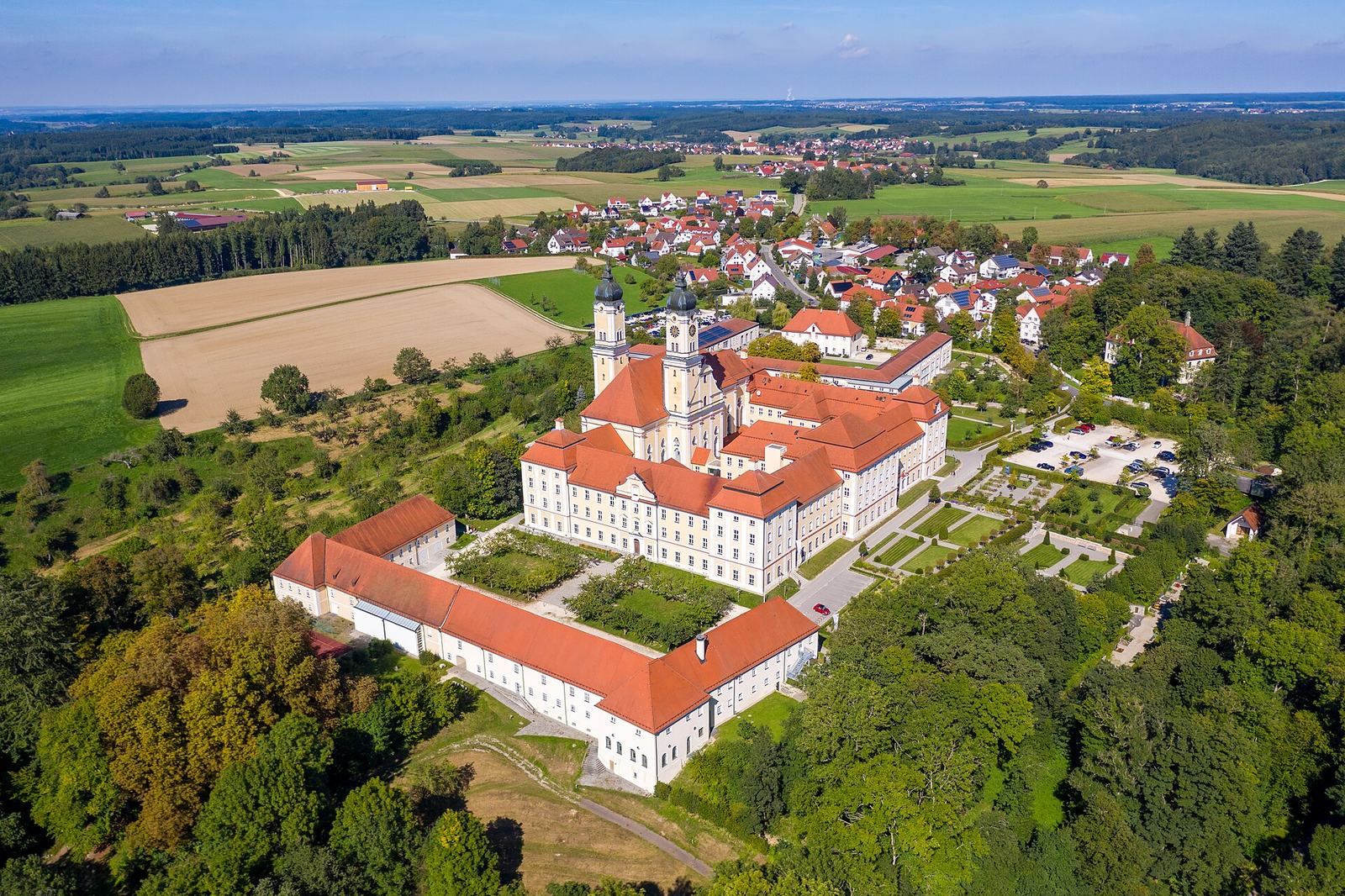
Roggenburg and its dependent parish and subsidiary churches underwent extensive Baroque rebuilding between 1732 and 1766. The work employed local laborers and craftspeople over many years. In the eighteenth century, the abbey housed an average of 40 canons and administered a domain that included 25 villages and about 50 square kilometres. At secularization, the transfer of church institutions and property to secular government, its territory covered about 112 square kilometres and had approximately 3,300 to 5,000 inhabitants. The abbey was also an economic and administrative center, employing about 100 people in its offices, farms, and trades, including carpentry, baking, blacksmithing, saddlery, and brewing. It undertook social duties and supported musicians and composers, historians, translators, and jurists. Its boarding school educated pupils according to Jesuit principles, associated with the Catholic order’s tradition of formal schooling.
Dissolution and return of the canons
Bavarian troops occupied Roggenburg when the imperial abbey was secularized in 1802. The community was dissolved, its 34 remaining canons dismissed, and the last abbot, Thaddäus Aigler, removed from office. Bavaria incorporated the territory in 1803. The abbey’s property passed into private hands, while the Bavarian government took over the buildings. A district court and financial administration for royal estates operated there; the court and rent office remained until 1862. Later uses included a school, forestry and parish offices, a household school, and a convent of Franciscan nuns from Dillingen. After the Second World War, the premises also housed people displaced from eastern Germany, and eventually served the parish.
Attempts by the Premonstratensian abbeys of Averbode in 1924 and Tepl in 1932 to resettle Roggenburg did not succeed. Canons returned in 1982 and resumed pastoral care of the parish. On 8 November 1992, Roggenburg became a dependent priory of Windberg Abbey, a monastery governed by another abbey. A decade-long program of interior and exterior repair and restoration brought the complex back into good condition by 2015. The monastery buildings are protected as historic monuments.
Remains
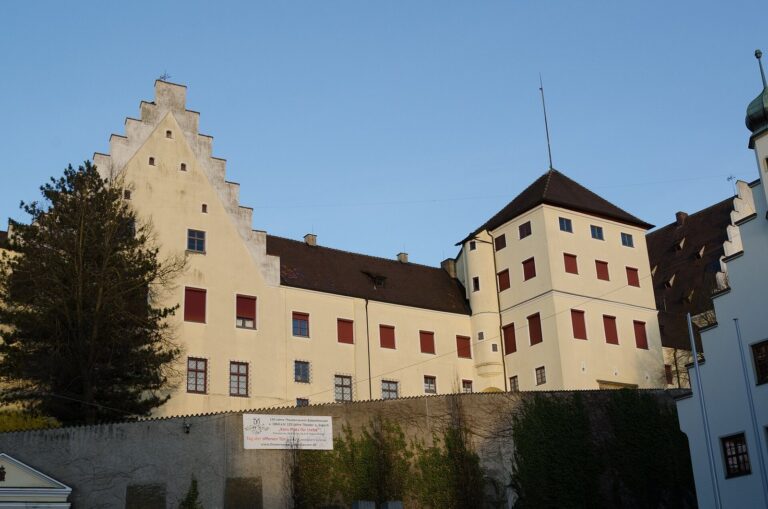
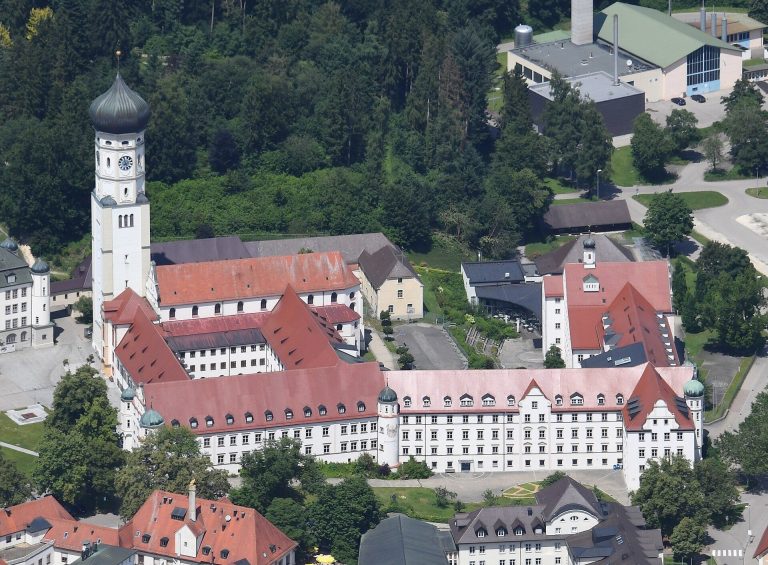
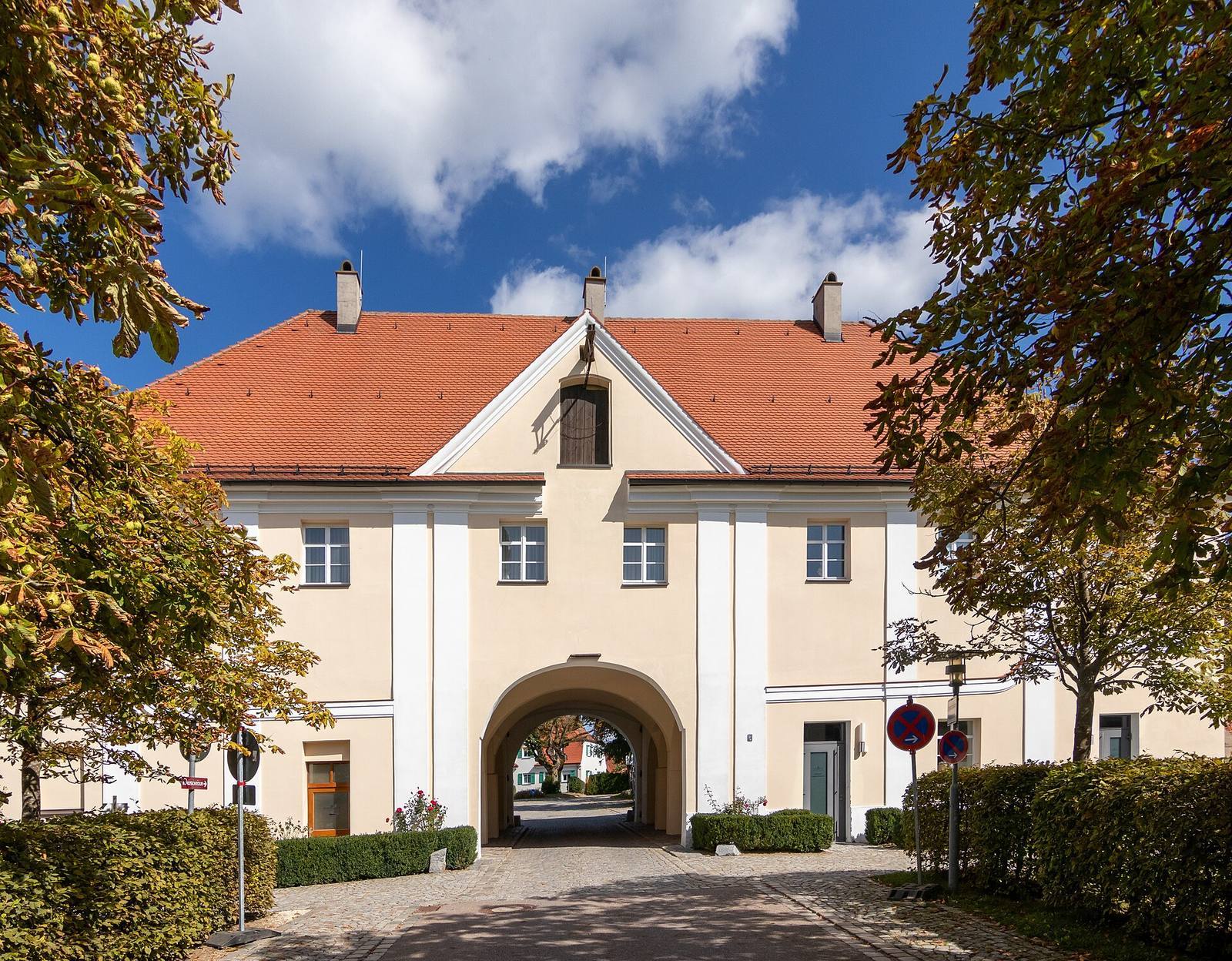
The monastery retains its largely unchanged Baroque buildings, with the abbey church integrated into the larger complex. The conventual buildings were rebuilt from 1732, while the church, its furnishings, and the later garden features reflect distinct phases of construction and alteration.
Abbey church
Plan and construction
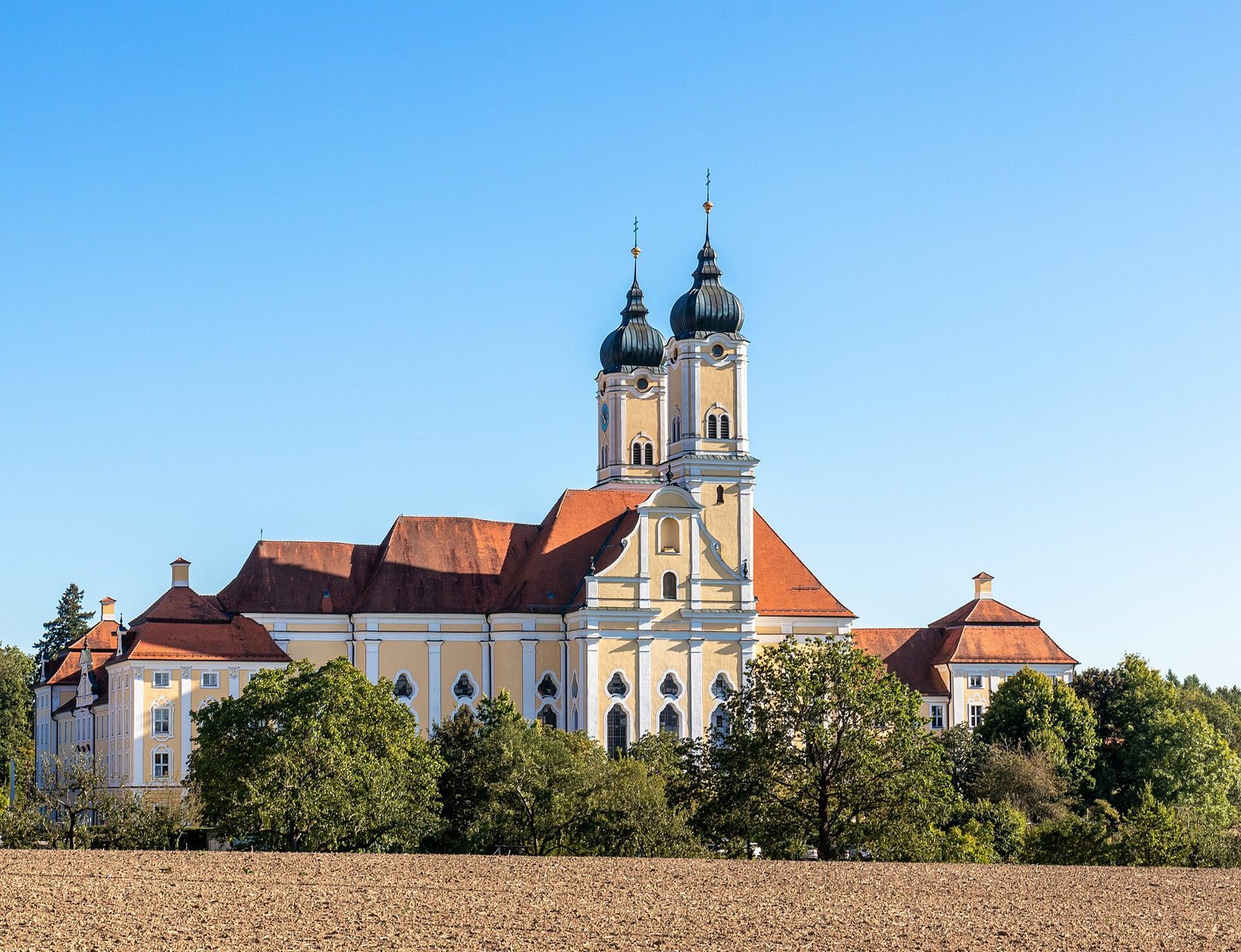
Built from 1752 to 1758 to plans by Simpert Kraemer, the church is a major work of Swabian Rococo, an ornate style that developed in eighteenth-century Europe. Its cross-shaped plan combines a broad single nave, the main space for worship, with an extended transept, the crosswise part of the building. The church measures 70 metres long and 35 metres wide, with an interior height of 28 metres; its twin towers rise 70 metres. Integrated into the monastery complex, it has no main entrance façade at the end of its long axis. It is dedicated to the Assumption of Mary.
Ceiling and decoration
Decorative plasterwork, probably made by craftspeople of the Wessobrunn tradition of Bavarian stucco design, enriches the church interior. Franz Martin Kuen painted the ceiling frescoes, which are regarded as his principal work. Most were lost when the ceiling collapsed in 1845. After the ceiling was restored, Waldemar Kolmsperger painted replacements in 1900. The central image shows the Nativity, recalling the Premonstratensian Order’s foundation at Christmas in 1121.
The church roof is carried by a hanging truss, a roof framework spanning the full 35-metre width. Resting on the walls, it places little outward pressure on them, so they do not require lateral bracing. The ceiling hangs from this framework. The structure rises roughly three storeys and is exceptionally rare in southern Germany.
Altars, figures, and relics
Kuen also painted the high-altar and side-altar paintings. Large figures by Anton Sturm flank the high altar: Saint Augustine, regarded as the author of the Premonstratensian rule, stands on the left, and John the Baptist, the order’s patron, on the right. Figures for the cross altar and transept altars were carved by Christoph Rodt in 1628 and brought from the earlier church. The choir stalls, also from that church, provide seats for 50 canons.
Relics are displayed in the lower parts of the side altars. They include a drop of holy blood, fragments of the Cross and the Holy Lance, a holy nail, a copy of Saint Veronica’s shroud, and the remains of four martyrs from Roman catacombs.
Organ
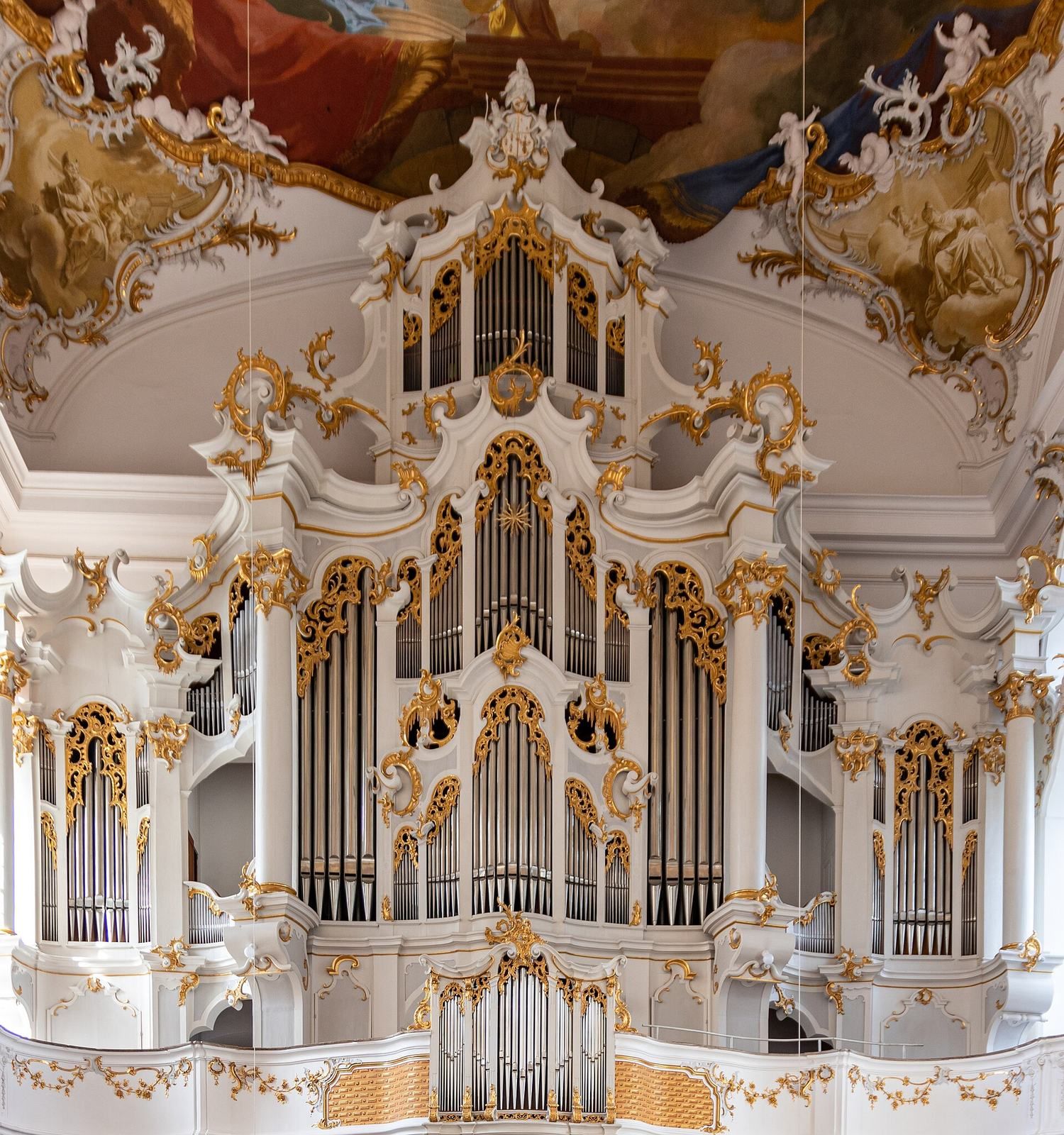
The organ’s imposing case, made by the Bergmüller family of altar carpenters, resembles a large altar and has survived successive replacements and alterations to the instrument. It is popularly known as the Great Lady of Roggenburg. Georg Friedrich Schmahl of Ulm built its first organ in 1761; toward the end of the eighteenth century, Johann Nepomuk Holzhey gave it a more French character.
Gebrüder Hindelang of Ebenhofen replaced that instrument in 1905 with a large late-Romantic organ operated by pneumatic action. The Nenninger firm installed a neo-Baroque instrument in 1955–56, reusing some of its predecessor’s registers, or sets of pipes with a particular tone. Following plans by Rudolf Quoika and Arthur Piechler, Gerhard Schmid of Kaufbeuren substantially redesigned the organ’s sound and mechanism in 1984–86. Further changes from 1996 to 2008 broadened its range for nineteenth- and twentieth-century music while preserving its Baroque sound. A separate choir division, playable from the main console, was installed behind the high altar’s tabernacle in 2005.
The present instrument has 63 stops and about 4,000 pipes. Its main organ has 56 stops, four keyboards, and a pedal; the choir organ has seven stops and can be played from the fourth keyboard. Keys connect to pipes through mechanical linkages, while electrical and pneumatic controls operate the stops. Special effects include a glockenspiel, a cymbal star, bird song, and a hail effect.
Bells
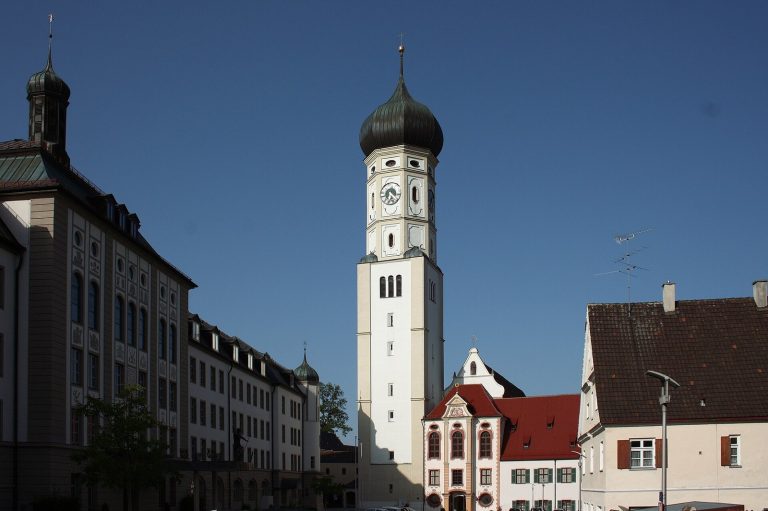
Seven bells hang in the church’s two towers. Five are considered historic, while the other two were cast in the twentieth century.
Monastery garden
A labyrinth added to the monastery garden in 2016 is formed from tendrils drawn from 300 varieties of ivy. The ivy collection was transferred to Roggenburg from Neuburg Abbey near Heidelberg through the gardening company Dehner.