Schloss Autenried: A Historic Manor House and Orthodox Cultural Centre in Germany


Site at a Glance
- Rating
- 4
- Popularity
- Very Low
- Country
- Germany
- Primary era
- Early Modern
- Eras represented
- Early Modern, Modern
- Civilizations
- Holy Roman Empire
- Site type
- Domestic
- Remains
- Manor House
On this page12 sections
History
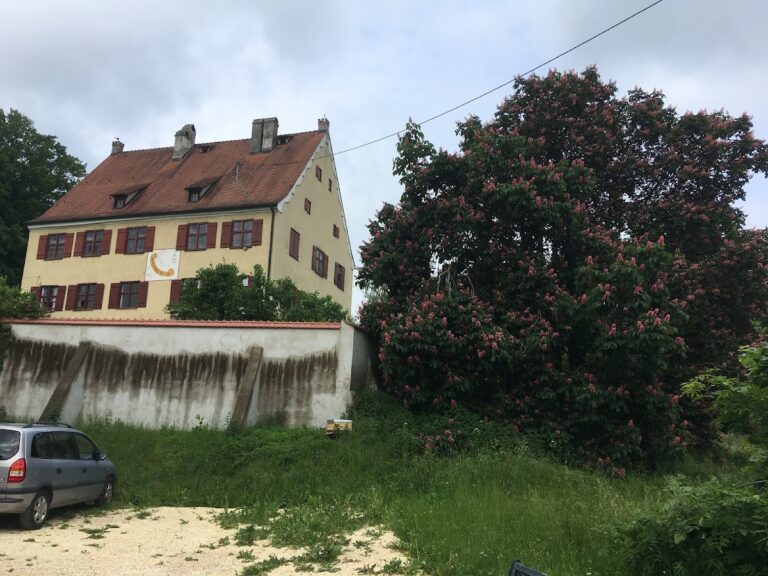
Schloss Autenried is a historic manor house in Ichenhausen, Germany, whose present form was built between 1708 and 1711 as a spacious residence. It developed on the site of an earlier castle belonging to the Augsburg prince-bishopric, an ecclesiastical territory in which the bishop exercised both religious and territorial authority.
Creation of the present residence
Baron Josef Anton Eusebius von der Halden acquired the local manorial lordship through his marriage to the widow of the previous owner, Philipp Friedrich von Lapière. Between 1708 and 1711, he ordered the former manor house to be demolished and commissioned a new residence from Johann Georg Reiner, a master builder from Ichenhausen. The construction cost 4,508 gulden, 5 kreuzer, and 5 heller. Its generous scale and residential character reflected the status intended for the estate.
The property changed hands in 1771, passing first to the von Lasser family and later to the von Lassberg family. In 1805, the von Reck family became the owners and remodelled the façade in the Classical style. This alteration gave the building a later architectural character while retaining its role as a substantial country residence.
Religious and museum use
In 1959, the Orthodox Church of Germany, under Bishop Boris Rothemund, acquired the estate. It established the Icon Museum in cooperation with the Slavic Institute of the University of Munich. An icon is a sacred devotional image in the Eastern Christian tradition. The museum’s holdings expanded from a relatively small collection in the 1950s through donations, bequests, and purchases.
Since then, Schloss Autenried has served both as the home of the Icon Museum of the Munich Slavic Institute and as a centre for an Orthodox congregation. The museum is described as Germany’s oldest and largest icon museum and as the largest institution of its kind outside the Slavic countries and Greece. An Orthodox church occupies the ground floor of the Upper Castle. Its congregation includes Greek, German, and other Christians and belongs to the Orthodox Metropolis of Aquileia and Western Europe, an Orthodox ecclesiastical jurisdiction headed by a metropolitan bishop. The congregation is led by Bishop Jakobus Puckett.
The Lower Castle and its later adaptation
The Lower Castle stands east of Schloss Autenried and is approximately 500 years old. In 2009, the Autenried Castle Brewery restored the building and converted it into a low-energy hotel with 26 rooms, a sauna, and a steam bath, while largely preserving its historic fabric. The Bavarian State Foundation supported the work. The estate also accommodates a brewery inn with a hotel, and the historic roof structure of the Lower Castle houses the Autenried Brewery Museum. Its exhibits and information panels explain former beer-brewing practices in Swabia.
Remains
The surviving estate consists of the principal castle, the Upper Castle church and museum rooms, and the Lower Castle to the east. The main building is a three-storey structure with a hipped roof, which slopes down on all sides, and a ground plan measuring 19 by 29 metres. Its façades preserve the arrangement created for an 18th-century residence together with the Classical remodelling carried out in 1805.
Principal castle
Façades and roof
The eastern show façade is organized around a raised central projecting section, or avant-corps, with four bays. It is crowned by a flat tympanum, the defined field within a pediment. On the western side, the garden façade has a cross gable, a gable projecting across the main roof or façade. These features give the building a carefully ordered exterior suited to its original residential purpose.
Icon Museum
The Icon Museum contains approximately 2,000 icons and 500 examples of decorative art. Its collection extends from Early Christianity to the present, with particular emphasis on the sixteenth through nineteenth centuries. Most of the icons and related objects come from the territories of the former Russian Empire and from the Greek world. Other material represents areas once within the Byzantine Empire, the Balkans, and the wider Christian East, including Ethiopia, Coptic Egypt, Palestine, Armenia, and Georgia.
The displays include goldsmiths’ work, bronze castings, embroideries, ecclesiastical vestments, woodcarvings, ivory work, and manuscripts. A special group of early Church Slavonic printed works accompanies the collection. Church Slavonic is a historical liturgical language used in many Slavic Orthodox churches. The museum also possesses several thousand graphic sheets devoted chiefly to iconographic motifs, and regular special exhibitions bring manuscripts and graphic works from storage into view.
Approximately twelve icons have silver overlays called oklads. An oklad is a metal covering fitted over an icon while leaving important parts of the image visible. These coverings are richly decorated with more than 1,000 pearls. Together with the icons themselves, they illustrate the range of materials and devotional practices represented within the castle’s collections.
Library and graphic collections
Reference library
The castle’s reference library specializes in the art and cultural history, theology, and ethnography of the Christian East, as well as early Church Slavonic printing. Its foundation came from theological and art-historical books held in Munich by the Slavic Institute. Later acquisitions included publications on icons, exhibition catalogues, and antiquarian holdings from the nineteenth and the first half of the twentieth century.
The library also incorporates books from private-library estates, dissolved Alpine parish libraries, and secularized monastic libraries, especially editions from the sixteenth to nineteenth centuries. Central European works form the largest part of these additional holdings. Several volumes once belonged to the private library of King Otto of Greece. In total, the library contains approximately 25,000 volumes, including bound journal runs, several manuscripts, two incunabula, about 3,500 printed works from 1500 to 1800, and approximately 4,000 nineteenth-century titles. An incunabulum is a book printed before approximately 1500, during the first decades of European printing.
The two incunabula are in Latin, and the sixteenth-century books are chiefly Latin. Works published before 1700 are mainly Latin but also include German, French, Ancient Greek, and Church Slavonic. The eighteenth- and nineteenth-century holdings add English, Dutch, Italian, Russian, Chinese, and Sanskrit. The sixteenth-century books are primarily theological works or editions of ancient authors. The collection also preserves later material on literature, philosophy, travel, devotion, art, and cultural history.
One notable item is the earliest Russian book in the library, a Psalter dated by its printer’s statement to 1555. It includes an appendix of liturgical texts, Renaissance-style ornamental title vignettes, and a leather cover decorated with Renaissance motifs. Its spine was renewed later, possibly in the nineteenth century. The library also contains late sixteenth-century, mostly two-colour Gospel books for liturgical use, printed by the workshop of the Kyiv Cave Monastery.
Other examples include Les vies des SS. Peres d’occident et d’orient by Sieur de Villefore, published in Paris in 1708–1711 with numerous engravings; John King’s The Rites and Ceremonies of the Greek Church in Russia, published in London in 1772 with engravings by P. Mazell; a Moscow print of 1787 containing a printed Life of Saint Nicholas and its liturgical canon; and Nikodim Kondakov’s Iconography of the Mother of God, published in Russian in Saint Petersburg in 1911.
Graphic collection
The associated graphic collection contains watercolours, drawings, woodcuts, engravings, etchings, lithographs, steel engravings, wood engravings, and early photographs. Religious graphics form its main focus, although the holdings also include views of monasteries, churches, cities, and landscapes in Orthodox countries. Most of the sheets originated in Western Europe.
Special holdings include small devotional prints showing saints and eighteenth-century religious engraving series with iconographically rare images. Biblia ectypa contains 666 engravings by Christoph Weigel from around 1700. Another important work, Historiae Biblicae Veteris et Novi Testamenti, contains 100 detailed, scene-rich engravings by the Klauber brothers and was published in Augsburg in 1748.
Lower Castle
The Lower Castle preserves its historic roof structure as the setting for the Autenried Brewery Museum. The building itself was adapted after its restoration into a 26-room low-energy hotel with a sauna and steam bath. Its continued use combines the preserved historic fabric with an interpretation of brewing practices in Swabia.
Nearby sites