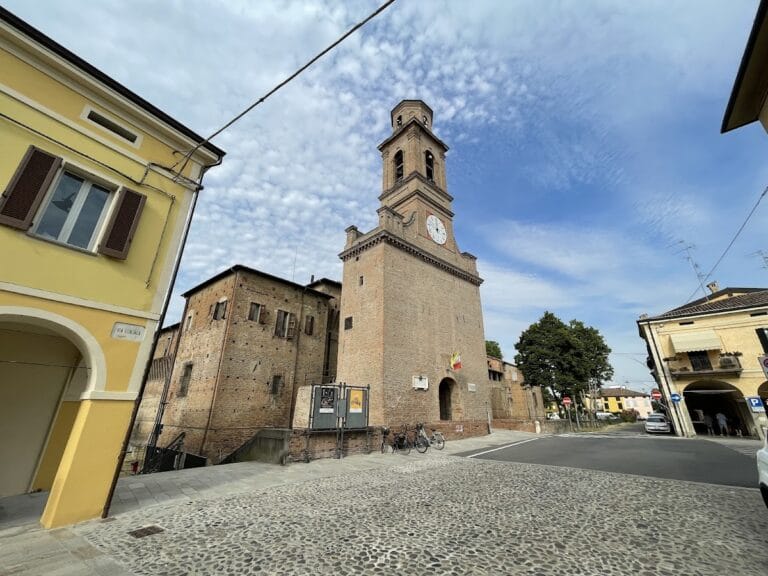
Rocca Estense: A Fortress Transformed into a Cultural and Museum Center


Site at a Glance
- Rating
- 4.4
- Popularity
- Low
- Country
- Italy
- Primary era
- Medieval
- External website
- Open
- Eras represented
- Medieval, Early Modern
- Civilizations
- Holy Roman Empire
- Site type
- Domestic
- Remains
- Castle
On this page14 sections
History
Rocca Estense is a castle in San Martino in Rio, Italy, whose history begins in the twelfth century. An earlier fortification belonged to the Roberti family, which held the territory as a fief granted by Matilda of Canossa, the powerful countess whose lands extended across much of northern and central Italy.
Medieval fortification
Frederick Barbarossa, the twelfth-century Holy Roman Emperor involved in conflicts with Italian cities and territorial powers, destroyed the fortification in 1167. It was later rebuilt with strong towers. The Gonzaga, a ruling family based in Mantua, destroyed the fortress again in 1353, after which it was rebuilt and strengthened once more. The Roberti retained possession until the beginning of the fifteenth century.
Este rule and aristocratic transformation
At the beginning of the fifteenth century, the fortress came under the direct control of the Este, the northern Italian dynasty that ruled territories including Ferrara and Modena. Borso d’Este ordered a major restoration and sent Este engineers and painters to San Martino in Rio. Around the transition from the fifteenth to the sixteenth century, the local lords became the Este of San Martino, a secondary marquisal branch of the dynasty.
Filippo I d’Este, the first marquis of this branch, converted the fortress from a military structure into an aristocratic residence. The court architect Giovan Battista Aleotti may have taken part in the work. The fortress continued to serve the strategic purpose of territorial defense until the sixteenth century, while its rooms increasingly expressed the character of a courtly palace.
Public ownership and modern use
After the death of Carlo Filiberto II d’Este in the second half of the eighteenth century, the property passed to the marquis Paolo Rango d’Aragona. When he died without heirs in 1792, the structure returned to public ownership. A restoration project begun in 1977 under the direction of Mauro Severi converted Rocca Estense into a cultural and museum center with a civic library, an agriculture museum, an art gallery, and the Henghel Gualdi archive.
Remains
The surviving complex combines defensive masonry, a quadrangular internal courtyard, a medieval chapel, and decorated rooms associated with the successive lords of the palace. The principal evidence of its original military role is a large square corner tower of brick masonry, while the interior preserves architectural and painted features from the fortress’s later development as an aristocratic residence.
Fortification and courtyard
Corner tower
The large square corner tower is built in brick masonry and crowned by Ghibelline crenellation, a battlement form traditionally associated with the imperial side in medieval Italian political conflicts. It is the clearest surviving architectural indication of the fortress’s original defensive purpose. The tower later became the setting for the Unicorn Room, whose decoration was commissioned by Borso d’Este.
Internal courtyard
The internal courtyard has a quadrangular plan and includes a fifteenth-century portico with four arches. Its form belongs to the phase in which the fortified complex was being adapted to the requirements of an aristocratic residence.
Chapel of Saint John
The Chapel of Saint John was built in 1395 at one end of the courtyard. It retains its old portal and apse, the semicircular end of the chapel, together with a historic marble altar bearing the coat of arms of the Roberti da Tripoli family.
Decorated interior rooms
Museum rooms and Green Room
The museum occupies the ground floor, including the eastern rooms used by the agriculture museum. Wooden ceilings from the fifteenth and seventeenth centuries survive in the complex. Some ceilings retain frescoes showing achievements of the Este family, while the Green Room contains objects connected with the Erri family. Other rooms preserve decorations by various artists and reflect the successive lords who occupied the palace.
Theatre Room
The Theatre Room was originally intended for another purpose, but it was used for theatrical performances around the turn of the twentieth century. Its frescoes represent Este achievements and virtues. The first-floor rooms now serve as a library and as spaces for cultural events.
Unicorn Room
The Unicorn Room is located in the tower. Its decorations were commissioned by Borso d’Este and include an image of the mythical unicorn, linking the room’s surviving appearance to the artistic patronage of the Este court.
Former podesta’s waiting room
One of the smaller rooms served as the waiting room of the podesta’s office until the end of the Second World War. A podesta was a civic official who commonly exercised judicial and administrative authority in an Italian commune. The room contains a locally produced depiction of Italo Balbo’s transatlantic flight.