Vyšší Brod Cistercian Abbey: A Gothic Monastery in Czechia
Site at a Glance
- Rating
- 4.5
- Popularity
- Medium
- Country
- Czechia
- Primary era
- Medieval
- External website
- Open
- Eras represented
- Medieval, Early Modern, Modern
- Civilizations
- Austria-Hungary, Austrian Empire, Habsburg, Holy Roman Empire, Kingdom of Bohemia
- Site type
- Religious
- Remains
- Fortified Monastery
On this page21 sections
History
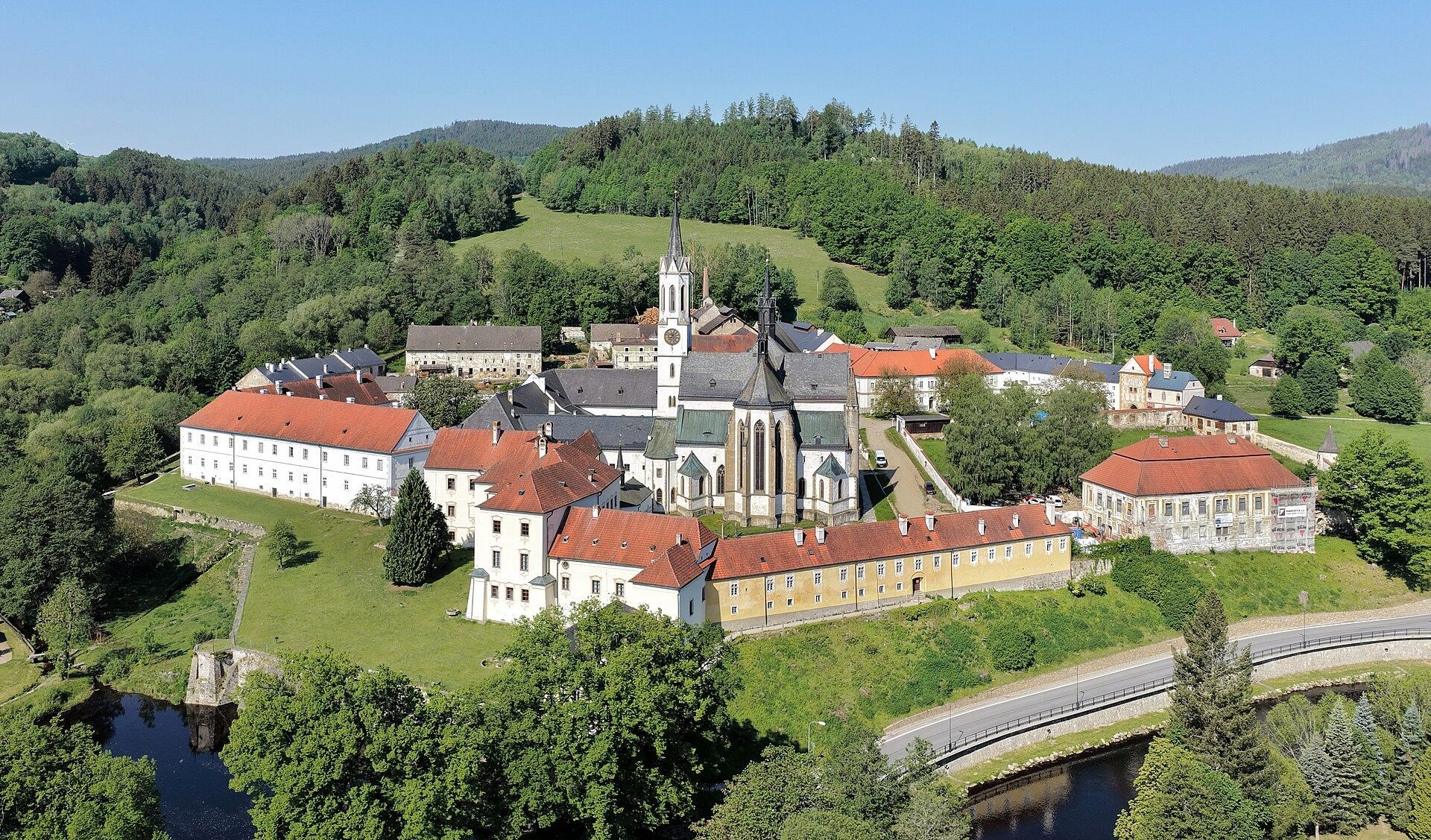
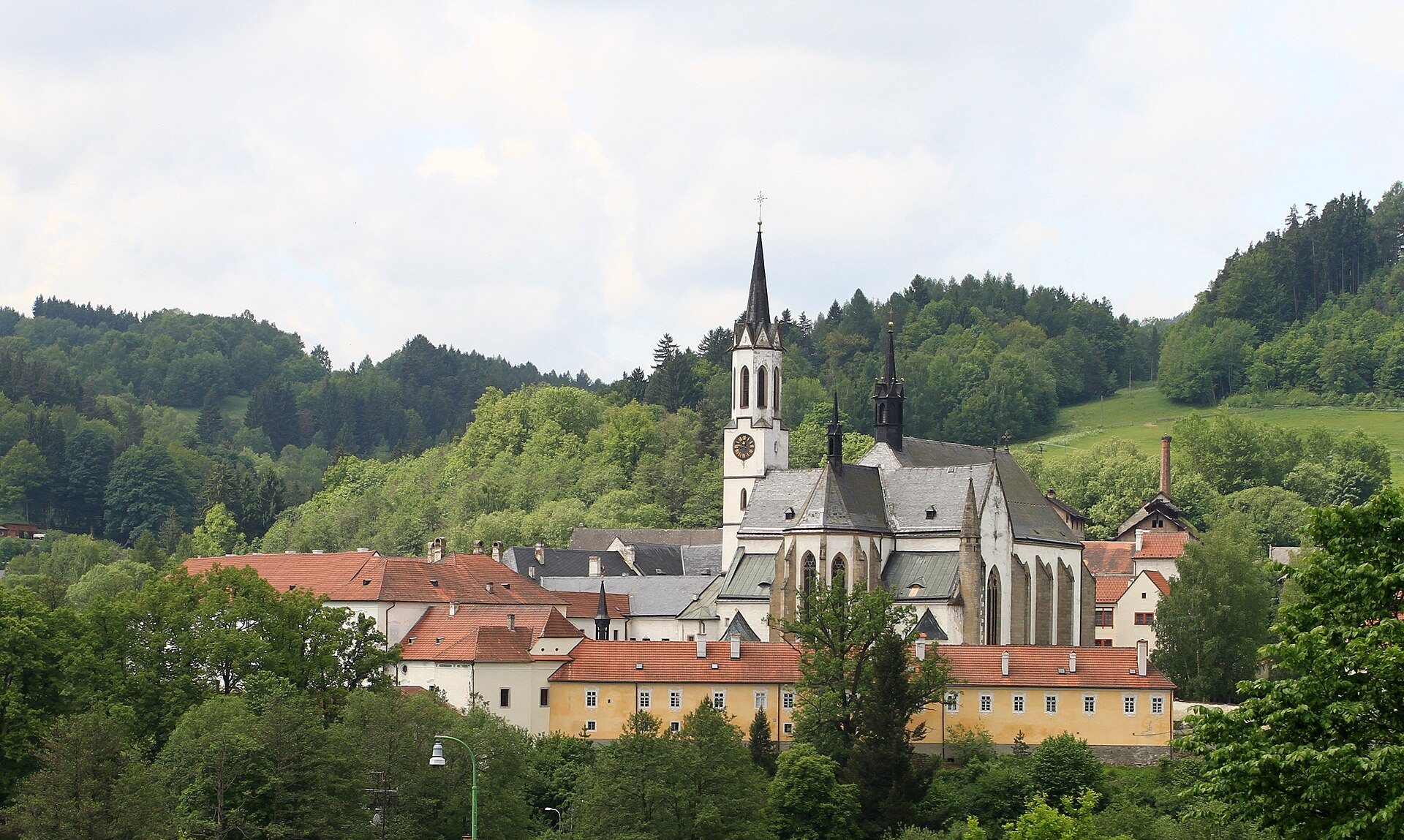
Vyšší Brod Cistercian Abbey is a Roman Catholic Cistercian monastery in Vyšší Brod, Czechia, on the Vltava River in southern Bohemia. Founded in 1259 by Wok I of Rosenberg, the Bohemian supreme marshal, it developed into a major religious, economic, and commemorative centre and remains the only functioning male Cistercian monastery in the Czech Republic.
Foundation and Rosenberg Patronage
Wok I founded the abbey after negotiations with the Cistercian general chapter at Cîteaux. Prague Bishop John III of Dražice confirmed the foundation on 23 May 1259, while 1 June, the day on which the temporary wooden church was consecrated, is treated as the monastery’s foundation date. A tradition connects the foundation with Wok’s rescue during flooding on the Vltava.
The new monastery was established as a daughter house of Wilhering, an Austrian Cistercian abbey. Twelve monks led by Abbot Otto I probably arrived during 1259 as the first wooden buildings were being erected. Wok endowed the foundation with property valued at sixty talents, including forests, villages in southern Bohemia, an Austrian village, a Silesian village, part of several tithes, and income from three churches. The initial estate included undeveloped land and was relatively poor, but later Rosenberg donations strengthened the community. King Ottokar II confirmed the foundation on 17 July 1264, and Pope Nicholas III confirmed its privileges on 21 March 1278. On 12 November 1281, Henry of Rosenberg gave four villages for construction of the church.
The abbey soon became closely tied to the Rosenbergs, a powerful Bohemian noble family. The first Rosenberg burial took place in 1262, and the monastery served as the family’s dynastic burial foundation for ten generations. Peter Wok of Rosenberg, the last male member of the dynasty, was buried there in 1611.
Medieval Construction and Expansion
Construction of the permanent stone church probably began before the end of 1286. Five altars, including the high altar, had been consecrated before 1306, and the eastern part of the Gothic church was completed under Abbot Otto II. The western part, the cloister, and the principal monastic buildings were completed during the second half of the fourteenth century. Around the transition from the fourteenth to the fifteenth century, the Master of the Vyšší Brod Altarpiece created a cycle of paintings for the abbey.
By the second half of the fourteenth century, the monastery controlled more than seventy villages and the towns of Vyšší Brod and Hořice. Its estates supported animal husbandry, fishing, vineyards, mills, and breweries. The community also operated a school and a scriptorium, the writing room where medieval monks copied and corrected manuscripts, and provided assistance to poor people.
In 1402, Pope Boniface IX granted Abbot Otto IV and his successors pontifical vestments and insignia, together with the right to confer minor orders, give solemn blessings, and consecrate altars, chalices, and vestments. During the early fifteenth century, however, financial problems and declining discipline caused some monks to leave. Inspectors from Wilhering intervened with corrective measures.
Hussite Wars and Early Modern Recovery
The Hussites were followers of the reform movement associated with Jan Hus, and their wars in the early fifteenth century brought military attacks and upheaval across Bohemia. In spring 1420, the monks moved to a Franciscan monastery in Český Krumlov while a military garrison occupied Vyšší Brod. Hussite attackers fought the garrison in 1422 and burned the church roof. Hořice was attacked the following year.
The community returned after six years, but Abbot Zygmunt Pirchman could not obtain enough rebuilding money at the Council of Basel or later in Vienna. In 1433, the Hussite commander Jan Čapek of Sány entered Vyšší Brod after one of the monastery’s estates had been mortgaged. The abbey remained heavily indebted for a long period. Around the middle of the fifteenth century, the community comprised eighteen religious.
During the sixteenth century, the monastery opposed the spread of Protestantism across its estates. Jesuit preaching contributed to the return of hundreds of Protestants to Catholicism in 1588, while those who did not convert were required to leave the town. The abbey’s religious and political influence continued to develop alongside its economic recovery.
War, Baroque Renewal, and Institutional Rights
At the beginning of the Thirty Years’ War in 1618, many monks sought refuge in Austrian Cistercian monasteries. Troops belonging to both sides occupied Vyšší Brod at different times, and the community began returning during the calmer years from 1621 to 1623. The conflict brought plundering, livestock theft, fires, forced payments, persecution of local inhabitants, and severe damage to the estates. Swedish troops raided the abbey in 1648, although Abbot Wendschuh escaped to Linz.
The abbey’s abbots secured the right to sit and vote in the Bohemian provincial diet during the seventeenth century, after more than sixty years of petitions. The monastery came under the patronage of the Eggenberg family and, from 1719, the Schwarzenberg family. Its long dispute over dependence on the Krumlov estate ended in 1822, when Abbot Isidor Teutschmann secured the abbey’s independence from that lordship.
Baroque furnishings were added to the complex without replacing its Gothic character. The community produced important theological works, and by the end of the seventeenth century it numbered fifty-eight monks. A major fire on 17 June 1690 seriously damaged the monastery.
Josephine Reforms and Nineteenth-Century Renewal
The Josephine reforms, the late eighteenth-century religious and administrative measures of Emperor Joseph II, subjected the abbey to investigation, confiscated part of its property, restricted the admission of novices, and imposed public-administration duties. Abbot Hermann Kurz was removed in 1786 but was later reinstated with Emperor Leopold II’s approval. The abbey narrowly avoided suppression, probably because the state would otherwise have had to assume its debts.
Most restrictions were reversed in 1789 and 1790, although the monastery had to provide four, and later five, professors for educational institutions in České Budějovice until 1921. The community numbered about sixty-five monks at the end of the eighteenth century, despite a state-imposed limit of eighteen.
The nineteenth century brought renewed intellectual and economic activity. Under Abbot Leopold Wackarž, the monastery and church were repaired, new buildings were constructed, a water supply was installed, and agricultural, brewing, forestry, and livestock enterprises were expanded. Wackarž became general abbot of the Cistercian Order in the 1890s and also served as mayor of Vyšší Brod.
Abbot Bruno Pammer built a hydroelectric plant in 1904, modernized the brewery, constructed a sawmill, and helped develop the Hohenfurth electric local railway from 1911. After the First World War and the creation of Czechoslovakia, land reform reduced the abbey’s property. Under Abbot Tecelin Jaksche, restoration of the monastery church and other churches and parish buildings provided employment during the inflation of 1923 and the mass unemployment of 1929 and 1930. In 1933, the abbey owned just under 5,000 hectares.
War, Dissolution, and Exile
In 1937, Abbot Tecelin Jaksche invited Czechoslovak President Edvard Beneš to Vyšší Brod in an effort to ease local political tensions. The community reached a historical maximum of about seventy members in 1938. Jaksche refused Adolf Hitler access to the monastery when Hitler intended to use it as a summer residence. The Gestapo arrested and imprisoned Jaksche before expelling him from the Reich.
During the Second World War, monks were transferred to parishes, conscripted, imprisoned, or sent to concentration camps. Father Engelbert Blochl died at Dachau in 1942 from hunger and mistreatment. The Nazi authorities used the monastery to store looted works of art, while the buildings also housed German resettlers from Bessarabia and later a Wehrmacht reserve hospital. In 1945, United States forces protected the stored art, and more than 1,000 objects were transferred to the Central Collecting Point in Munich in June and July.
The Linz Gestapo dissolved the monastery on 17 April 1941. Some monks returned after the war, and Abbot Jaksche attempted to rebuild the community and recover its property. The expulsion of much of the German-speaking population under the Beneš decrees, postwar Czechoslovak measures that enabled property confiscation and population expulsions, severely reduced the convent. Communist authorities dissolved the abbey again on 4 May 1950. The remaining monks were interned, and the buildings were later used by the army and border-guard units. Parts of the complex subsequently stood empty and deteriorated.
On 7 October 1959, the displaced community was formally united with Rein Abbey in Austria as Rein-Hohenfurth. The union preserved institutional continuity until a return to Vyšší Brod became possible. Matthäus Quatember, a Hohenfurth monk, served as general abbot of the Cistercian Order from 1950 to 1953.
Return and Restoration
Following the political changes of 1989, two monks returned in 1990 and the state returned the first monastery buildings. The union with Rein formally ended on 18 January 1991, and monks moved back into the buildings in March after the state heritage administrator had left. The abbey library was restituted in 1991, followed by extensive repairs and restoration.
Since 2011, the community has used an extended form of the traditional Liturgy of the Hours and has celebrated Mass according to the classical Roman rite and the pre-conciliar Cistercian missal. Because it has not yet reached the number of monks required to elect an abbot, the community is led by a prior. Its membership reached ten in 2020.
In 1995, Vyšší Brod was declared a National Cultural Monument of the Czech Republic. The monastery is also part of the Cisterscapes group, incorporated into the European Heritage designation in 2024. Property restitution continued to shape the abbey’s recovery. In 2017, the state initially returned 3,600 hectares of forest and twenty-two hectares of ponds confiscated under the Beneš decrees. A 2019 Prague court ruling required the return of most of the forest, disrupting employment and planned rebuilding. In 2022, the Czech Constitutional Court annulled that ruling, after which the disputed property was transferred back to the Cistercians. The court recognized the community as a victim of religious persecution and found no evident collaboration with the Nazis.
Remains
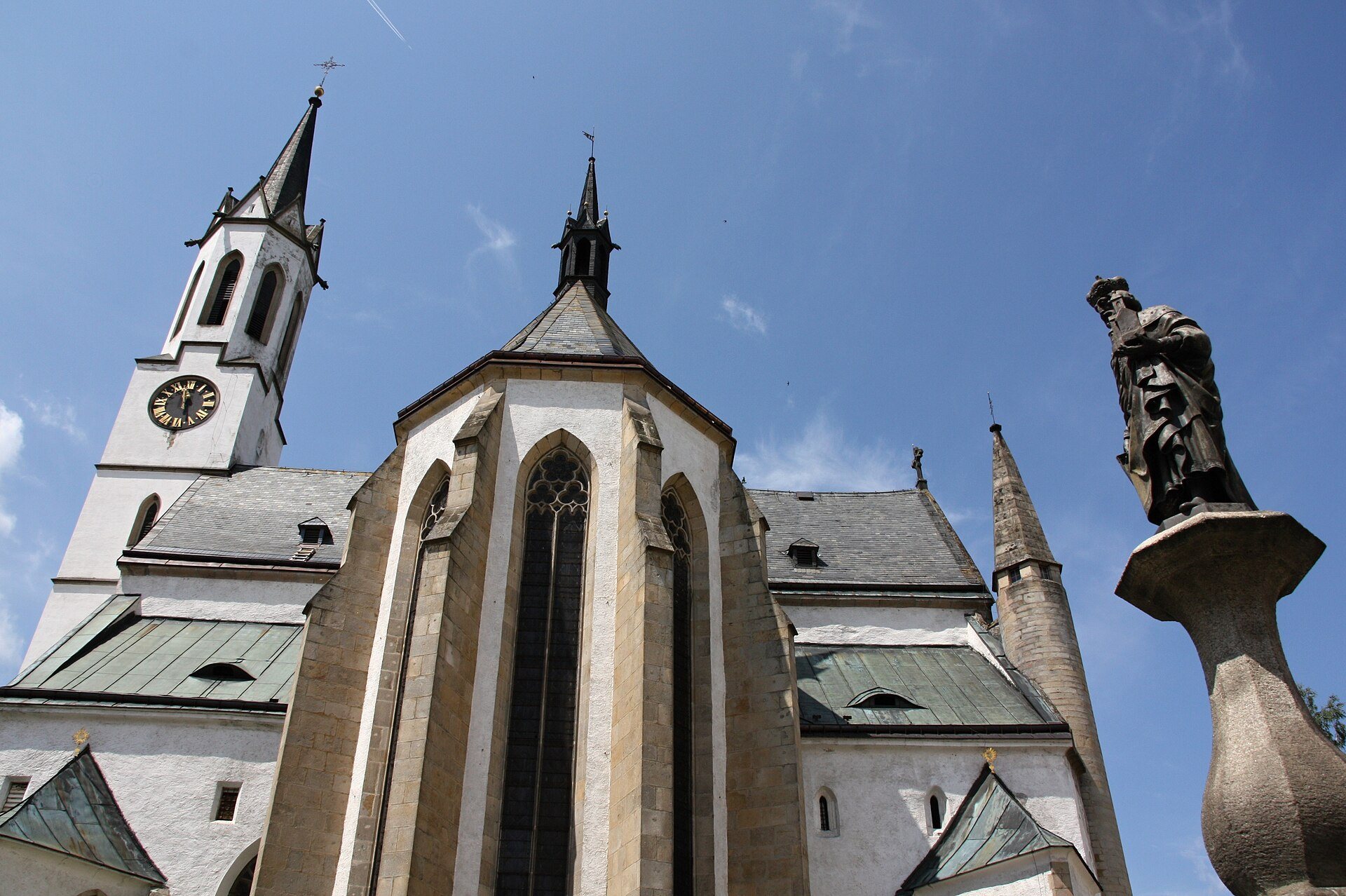
Vyšší Brod stands in the south-western part of the town on the right bank of the Vltava, west of its confluence with the Little Vltava. The complex developed as an imposing Gothic monastery with fortifications. Its principal elements include the Church of the Assumption of the Virgin Mary, the cloister, conventual buildings, chapels, the chapter house, the library, and associated agricultural and industrial installations.
Church and Liturgical Features
Church of the Assumption of the Virgin Mary
The original church was wooden and consecrated in 1259. It was rebuilt in stone between about 1270 and 1280, while the vaulting of the three-aisled Gothic building was completed between 1360 and 1370. The church is oriented and measures about fifty-two metres in length, seventeen and a half metres in height, and twenty-nine metres across the transept. It contains four chapels, a wooden gilded presbytery, eight altars from different periods, and nineteenth-century organs.
The building was reconstructed or renovated between 1830 and 1862, from 1878 to 1882, during the late 1920s, and again after 1989. A Neo-Gothic tower replaced the earlier Baroque tower in 1862. The early Baroque high altar was made in 1644 and 1646, and its altarpiece was designed to be changed four times each year according to the liturgical season. The carved Late Gothic winged altars of Saint Roch and Saint Barbara date from 1524 and 1525.
Paintings and Organs
The high altar once carried nine paintings of the life of Christ, commissioned by Peter I of Rosenberg before 1347 and created by the Master of the Vyšší Brod Altarpiece. The cycle has been in the National Gallery in Prague since 1938. The Gothic panel painting known as the Madonna of Vyšší Brod, first recorded in 1384, is also held there.
The main organ was built in 1892 by Leopold Breinbauer of Ottensheim. It has two manuals, forty-one stops, 2,052 pipes, and its original mechanical action. Breinbauer built the smaller choir organ in 1911. It has eight stops on one manual and pedal and is incorporated into the choir stalls. Another small organ is concealed in the wall of the monastic choir and is used mainly to accompany the monks’ prayers.
Rosenberg Crypt and Adjacent Structures
The Rosenberg crypt lies beneath the presbytery and served as the family’s burial place from 1262 to 1611. It was closed after Peter Wok’s burial. In 1902, the crypt was rediscovered beneath the high altar after the steps had subsided. Modern examination established that the dead were placed in coffins rather than seated on golden thrones, as claimed by a later legend.
A portal from the southern transept to the sacristy dates from about 1270 to 1280. Its relief-decorated tympanum shows the hand of God surrounded by vine leaves. The earliest surviving two-storey masonry building, erected by 1270, probably contained a chapel and reference library above an oratory on the ground floor. Its surviving storey now serves as the sacristy.
Saint Anne’s Chapel stands beside the church and was historically a pilgrimage destination. Its reconstruction was completed in 2012. The Winter Chapel can be reached from the cloistered area or from the church through the choir loft and is used for public winter services.
Cloister and Medieval Convent
Chapter House
The square Chapter House was built between 1285 and 1300. Three-branched vault ribs rise from a central octagonal pillar, while a ring-shaped central window forms part of an ambitious vaulting design. Gothic tracery and decoration express a medieval Christian conception of the cosmos. The room was the monastery’s principal meeting place, where the monks assembled daily, heard the Rule read, conducted important negotiations, and elected abbots.
Cloister and Paradise Garden
The cloister was built between 1360 and 1380. Monks were formerly buried beneath its floor, while abbots were first buried in the Chapter House and later near the church entrance. The centre contains the inner garden known as the Paradise Garden, intended to evoke the paradise promised in Christian teaching.
Refectory, Dormitory, and Gallery
The refectory and dormitory date from 1385. A picture gallery occupies the first floor above the western cloister wing. It was created from 1835 during the Neo-Classical rebuilding of the monastic cells, using designs by Karl Jambora of Český Krumlov. Its characteristic features include Bohemian vaults carried on Tuscan columns.
Library and Collections
Rococo Library
The three-room Rococo library was built in 1757 above the southern wing of the medieval convent. It consists of a library corridor, a philosophical hall, and a theological hall, whose ceiling paintings were added in the early nineteenth century. The collection contains more than 70,000 books, manuscripts, incunabula, and other volumes, including a fifteenth-century Vyšší Brod songbook, a 1410 song manuscript, a manuscript containing the oldest version of the Quempas, about 200 parchment manuscripts, and approximately 400 incunabula.
The library’s collection reaches back to the thirteenth century and grew through the medieval scriptorium. Under Abbot Quirinus Mickl, the library was rebuilt and enlarged between 1753 and 1755. During the communist period, its administration was transferred to the South Bohemian Scientific Library in České Budějovice. The collection returned to the abbey in an almost intact condition in 1991 and is now housed in four rooms dating from the eighteenth and nineteenth centuries.
Gothic Gallery and Zavis Cross
The Gothic gallery was established for a 2013 regional exhibition and displays works from the restituted monastery collections. These collections include paintings by Czech artists, seventeenth- and eighteenth-century liturgical objects, Bibles in forty languages, and extensive theological and philosophical literature.
The Zavis Cross is a probably thirteenth-century, two-armed Byzantine-style gold reliquary. A reliquary is a container made to preserve and display a religious relic. Associated with Zavis of Falkenstein, the cross contains a piece of wood believed to come from the True Cross and other relics. Fifty-one precious stones and 230 pearls decorate it. The cross is kept in the Rosenberg Oratory under special security, while its archaeology and presentation are explained through a multimedia exhibition in the Gothic cellar.
Later Buildings and Economic Installations
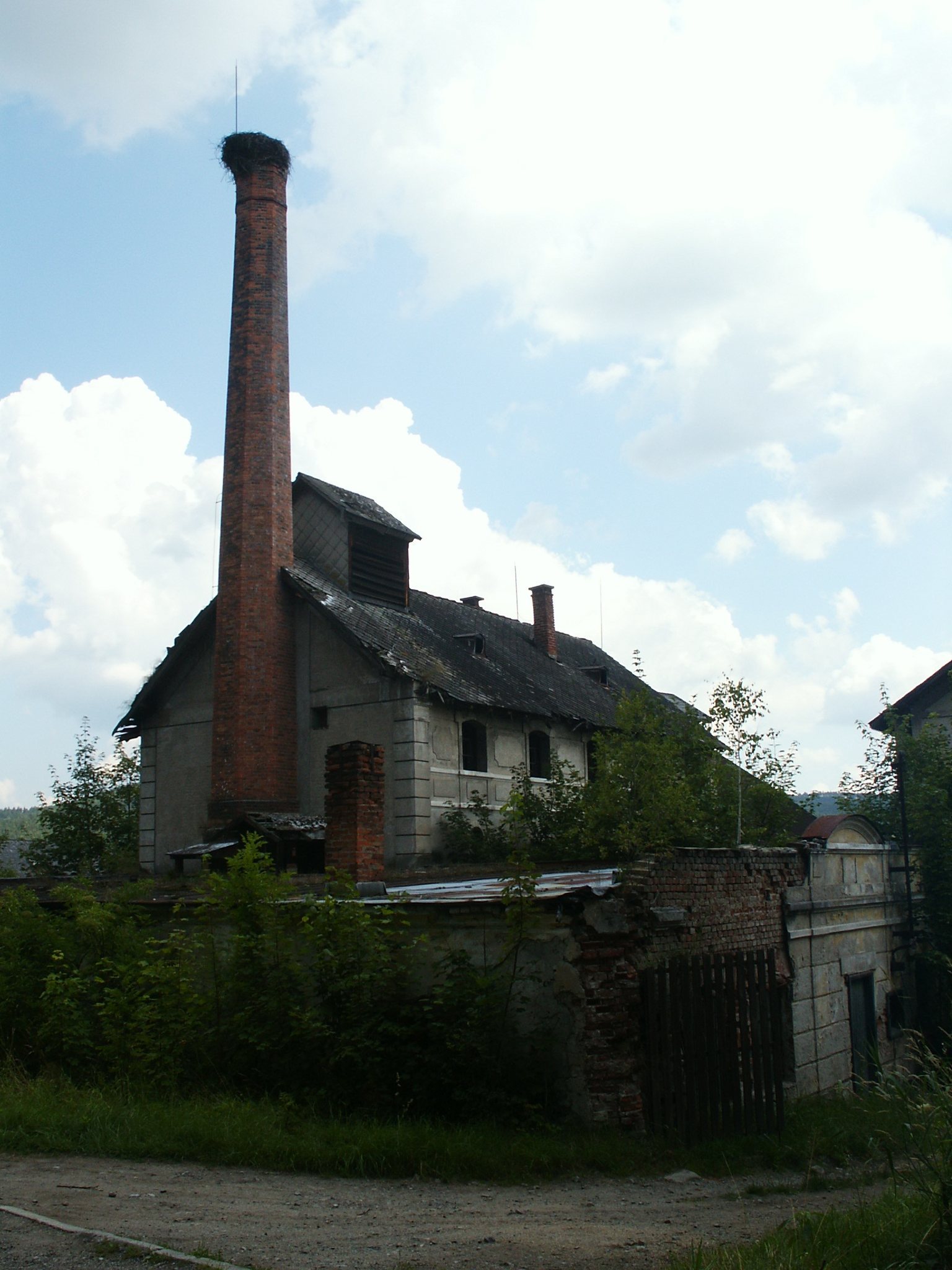
The Abbot’s House originated during the period of William of Rosenberg and was later used as a pharmacy. A new conventual building was erected south of the medieval complex during the second half of the seventeenth century. The monastery grounds also include orchards, fishponds, a sawmill, a brewery, beekeeping facilities, and a small hydroelectric plant. A branch of the Prague Postal Museum occupies part of the grounds.