Samarsky Pustynno-Mykolaivsky Monastery: A Historic Orthodox and Cossack Monastery in Ukraine
Site at a Glance
- Rating
- 4.7
- Popularity
- Low
- Country
- Ukraine
- Primary era
- Early Modern
- External website
- Open
- Eras represented
- Early Modern, Modern
- Civilizations
- Russian
- Site type
- Religious
- Remains
- Monastery
On this page12 sections
History
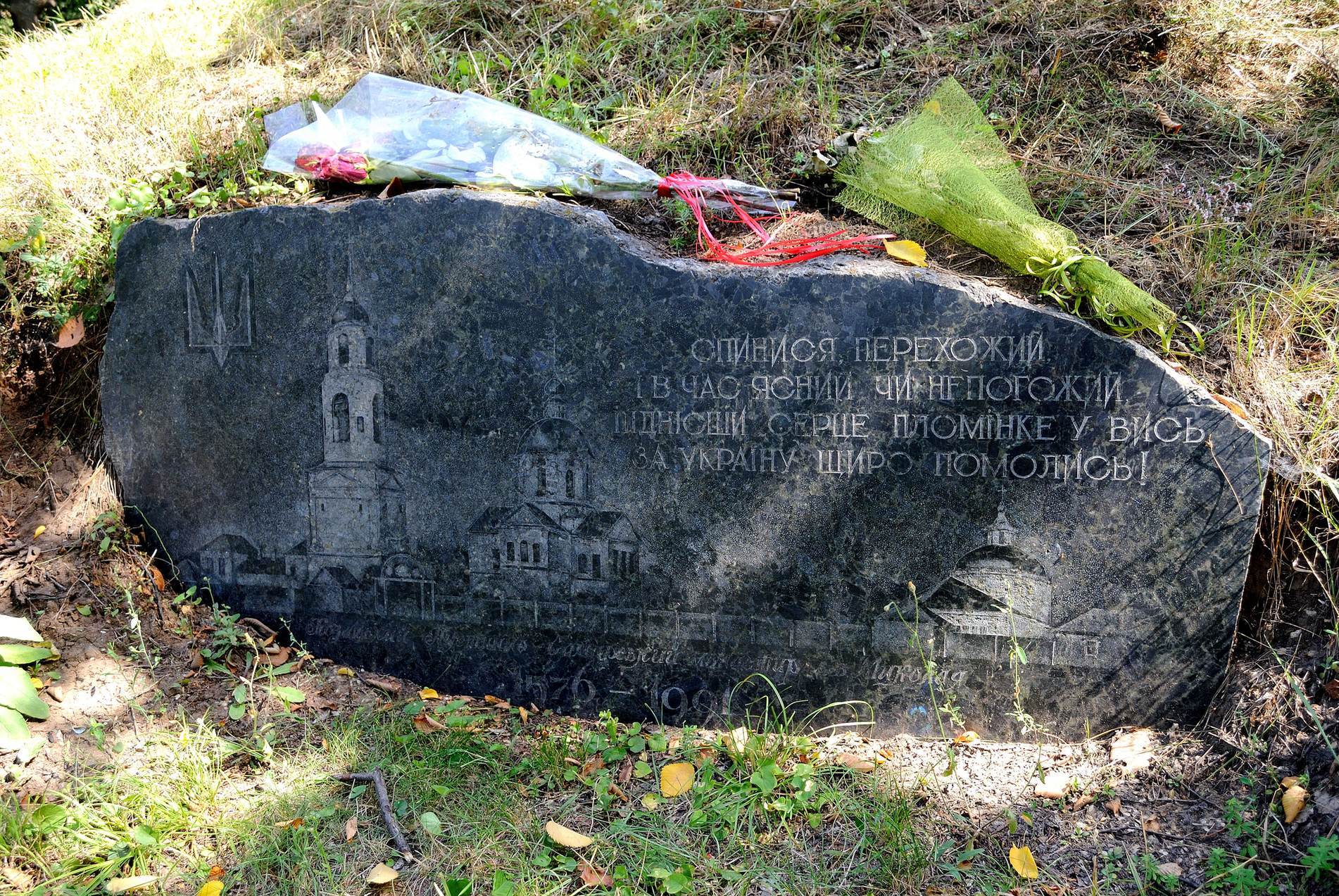
Samarsky Pustynno-Mykolaivsky Monastery is an active Orthodox male monastery in Ukraine’s Dnipropetrovsk Oblast, dedicated to Saint Nicholas and historically connected with the Zaporizhian Cossacks. Its exact foundation date is uncertain. Local tradition places it in 1576, although the document supporting that date is generally considered a later forgery. Another tradition attributes its establishment in 1602 to Hieromonk Paisiy of the Kyiv-Mezhyhirskyi Monastery. The first dependable written references date from the late seventeenth century.
Foundation and the Zaporizhian Sich
The monastery was organized under the Ecumenical Patriarchate of Constantinople, the senior patriarchate of Eastern Orthodox Christianity, and became a military monastery of the Zaporizhian Sich. The Sich was the Cossack military and political community that controlled much of the lower Dnieper frontier. The monastery was directly subject to the Sich council, or Kosh, its central governing authority.
Its role was both religious and practical. The monastery held extensive lands, supplied the Cossack community with grain and other food, and maintained a hospital for sick and elderly Cossacks. During the Russo-Polish War of the 1650s, it was severely devastated. Restoration had been completed by the 1670s, when a rebuilt church was consecrated in April 1672. Official documents from the 1670s and 1680s mention the revived community.
Expansion and destruction in the late seventeenth century
The monastery prospered during the Russo-Turkish War that began in 1681. Cossacks and regular troops stationed at Samara made substantial donations, allowing the community to develop new buildings, mills, apiaries, and candle-making workshops. A later locust infestation devastated the surrounding lands, reduced the brotherhood, and left the church without regular services.
In 1688, the monks supported Zaporizhian Cossacks who opposed the construction of the Novobohorodytska Fortress. The fortress was feared as a base for punitive actions against the Cossacks. Troops commanded by Prince Vasily Golitsyn attacked the monastery and tortured monks. An epidemic in 1690 then killed almost the entire monastery population and many nearby inhabitants. The community’s property and archive were destroyed, and the Kyiv-Mezhyhirskyi Monastery began sending hieromonks to serve as abbots.
War, abandonment, and rebuilding
The monastery suffered further damage during the 1709 uprising associated with Ivan Mazepa, the hetman whose revolt against Peter I had major consequences for the Zaporizhian region. Retreating Cossacks removed some property and abandoned other possessions. Administration was subsequently assigned to the archimandrite of the Azov Monastery of the Nativity of Saint John the Baptist.
Tatar forces destroyed the monastery again in 1711. After the Treaty of Pruth, its lands and property came under the control of the Crimean Khanate. Reconstruction began in 1720 through the initiative and funding of Colonel Danylo Apostol, later hetman, and his son Pavlo Apostol. They invited Hieromonk John from the Kyiv-Mezhyhirskyi Monastery to become abbot. A wider period of rebuilding and reorganization followed during the 1720s.
Religious and military center of Zaporizhia
After the Zaporizhian Cossacks returned to the region in 1734, the monastery was restored and reorganized. By 1739 it had again become an important religious center of Zaporizhia, with schools, hospitals, and a dependent population of up to 500 peasants, estate workers, and servants. Its possessions included the settlement of Chernenna, four farmsteads, Lake Solenoye, the Protovcha River, mills, apiaries, and approximately 18,698 dessiatines, a historical Russian land measure.
The monastery also served as a burial and monastic center for Zaporizhian officers, including the ataman Filip Fedorov, military interpreter Ivan Shvydky, military clerk Dmitry Romanovsky, and military judge Moses Sukhoy. In 1736 it was strengthened with retrenchments, defensive earthworks intended to reinforce a military position. The complex functioned as a Zaporizhian stronghold during the Russo-Turkish wars of 1735–1739 and 1768–1774. During the later war, it housed many Tatar and Turkish prisoners. Some were baptized there, and some later became monks.
Diocesan residence and the modern period
In 1780, the monastery was attached to the stavropegic Kyiv-Mezhyhirskyi Monastery, a monastery placed directly under patriarchal authority rather than the ordinary jurisdiction of a local bishop. A synodal decree of 25 November 1791 converted it into the residence of the bishops of the Yekaterinoslav Diocese. It later served as the diocesan bishops’ country residence.
In 1908, the community had a resident administrator, three hieromonks, two hierodeacons, two monks, and five novices. Its recorded estate covered 444 dessiatines and 1,927 square sazhen, another historical Russian area measure, including 243 dessiatines and 141 square sazhen of oak forest. The monastery remained active during the First World War, although its history through the Revolution and Civil War is poorly documented.
During the 1920s, the monastery was associated with the followers of Archbishop Grigory Yatskovsky, an Orthodox archbishop connected with the church movement that followed him. The community had 25 novices. From the middle of that decade, people disabled in the Civil War were settled at the site. The monastery closed in 1929 or 1930 and became a home for disabled people.
After the Second World War, the complex was used as a home for elderly metalworkers. Numerous additions in the Stalinist Empire style substantially damaged the earlier monastic buildings. In the 1960s, the site became a residential institution for mentally ill girls.
A parish was restored in the buildings in 1993, and monastic life resumed in 1995, initially as a women’s community. On 12 March 1998, the Holy Synod converted the women’s monastery and the associated Saint Nicholas parish in Novomoskovsk into a male monastery. Hieromonk Dositheus Savelyov became its superior with the rank of hegumen, the superior of a male monastery, while the nuns led by Abbess Marina Tkachuk were transferred to the Tikhvin Monastery in Dnipropetrovsk.
Restoration continued in the twenty-first century. On 3 April 2004, Metropolitan Irenei consecrated the restored and reconstructed refectory church dedicated to Saints Anthony and Theodosius of the Caves and blessed renovated refectory and domestic rooms. On 16 April 2011, he consecrated the restored Church of the Transfiguration. The monastery is included in Ukraine’s national register of immovable monuments. Its principal feast is held on 19 December for Saint Nicholas, a fourth-century Christian bishop venerated in Eastern Orthodoxy, and daily Orthodox services are celebrated there.
Remains
Layout and defensive setting
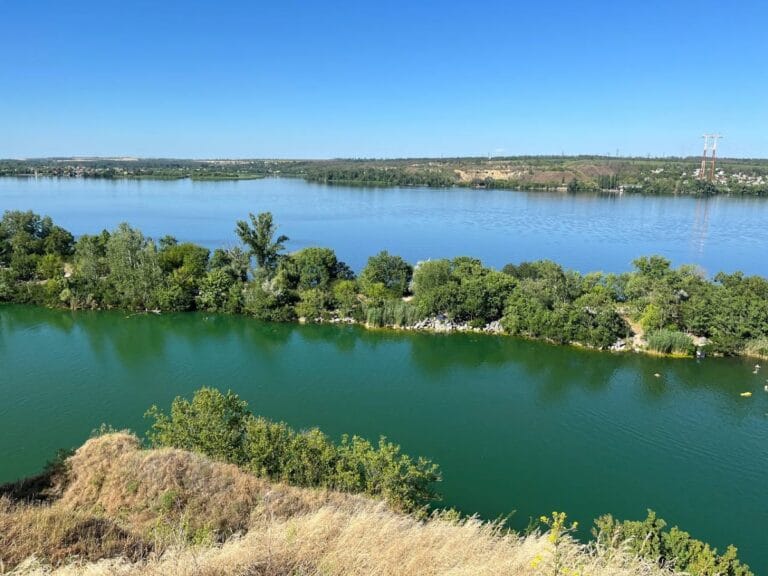
The monastery historically stood near the Samara River within the Samara palanka, one of the territorial districts of the Zaporizhian Sich. Research places the community at several locations during the seventeenth and eighteenth centuries. It may have moved away from the Bogoroditsk Fortress, occupied ground near the Novosergievsk Fortress, shifted to the left bank of the Samara near its confluence with the Tatarka, and reached its present site around the boundary of the 1750s and 1760s. A map of 1779 is the first to show it in its present location.
From the 1720s, the complex developed separate religious, residential, economic, and service areas. Monastic cells, churches, schools, hospitals, mills, apiaries, candle workshops, and agricultural holdings formed part of this wider arrangement. The site was fortified with retrenchments in 1736. During the eighteenth and nineteenth centuries, its principal buildings included several churches, a separate bell tower, residential cells, an episcopal house, a refectory, and other service structures.
Saint Nicholas Cathedral
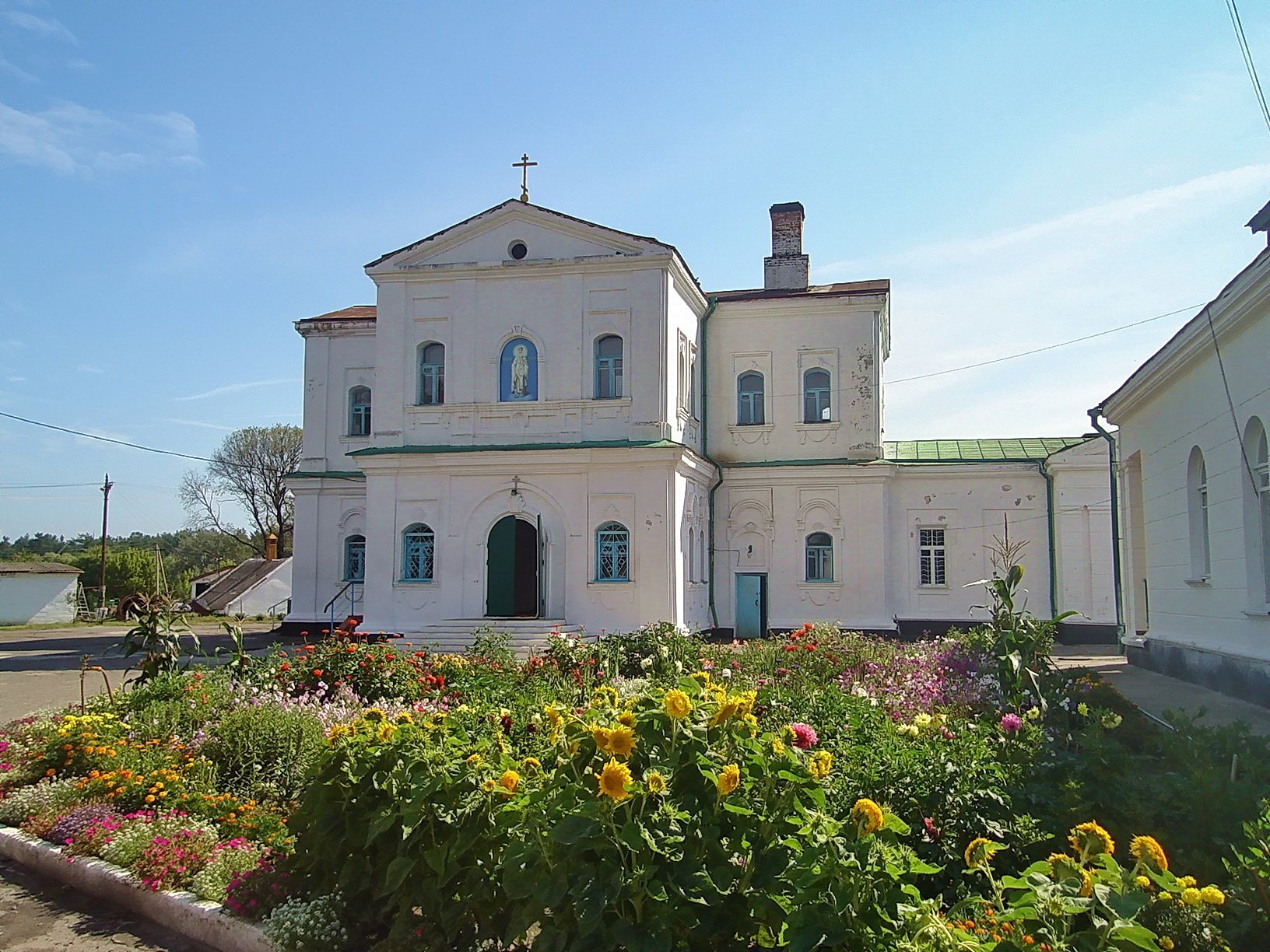
Saint Nicholas Cathedral replaced an earlier wooden church and was consecrated on 7 March 1787. The stone building had three altars. The central altar was dedicated to Saint Nicholas, the northern altar to the Joy of All Who Sorrow icon of the Mother of God, and the southern altar to the martyrs Cyricus and Julitta.
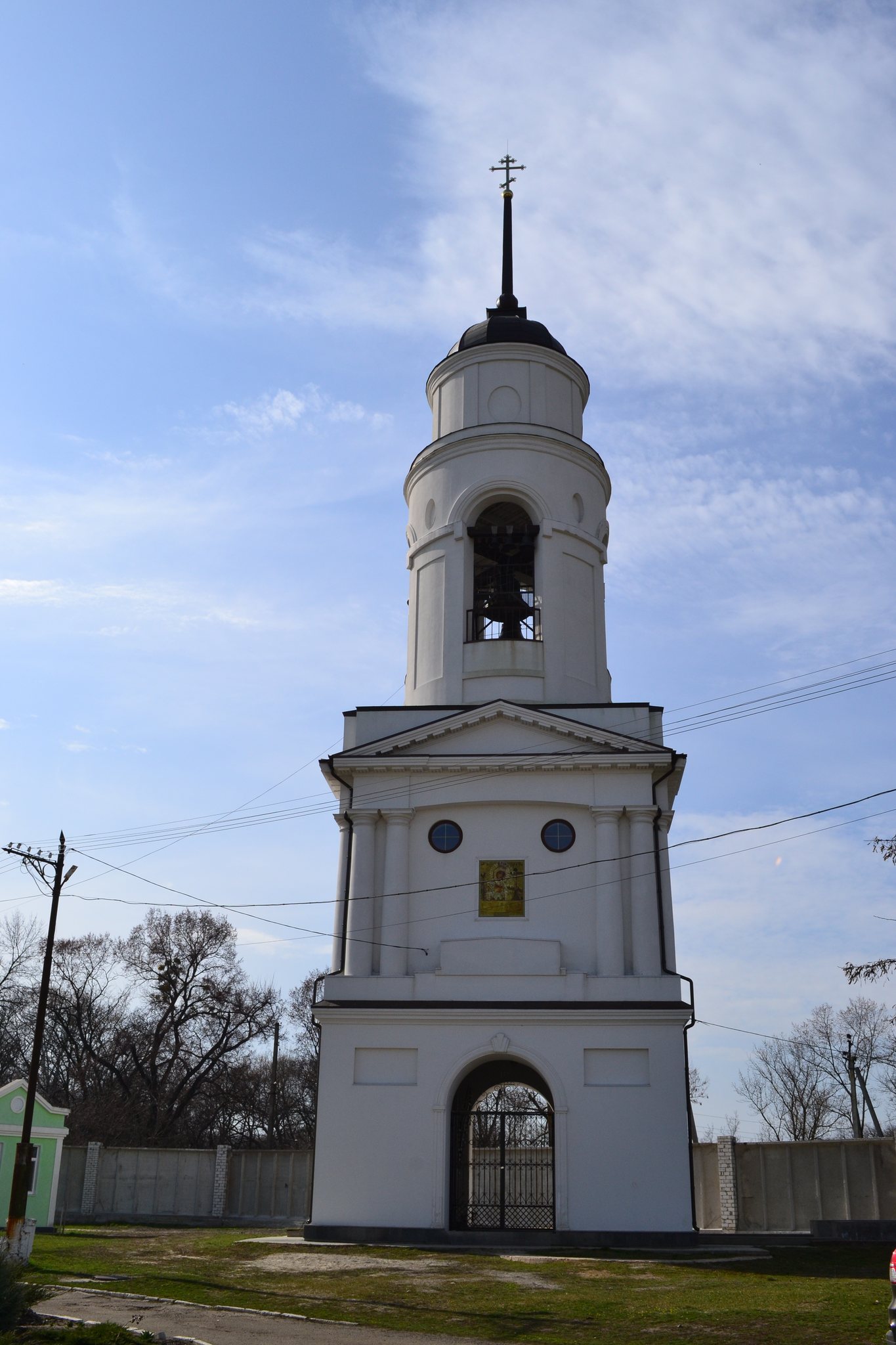
An episcopal house and bell tower were added to the cathedral in 1828. The bell, acquired in the eighteenth century and paid for by the Zaporizhian Cossacks, weighed 169 poods and 22 pounds and cost 8,320 rubles and 90 kopecks. The separate bell tower was later blown up after the monastery closed. The cathedral itself was converted into a theatre hall before subsequent restoration efforts.
Churches and the refectory
A wooden refectory Church of the Transfiguration was built in 1815. It had one altar and no separate bell tower. A stone Church of Saint George the Victorious followed in 1838. It was also a one-altar church without its own bell tower. A 1908 description identifies the cathedral and bell tower as stone buildings, Saint George as a one-altar stone church, and the Transfiguration church as a wooden domestic church incorporating the refectory.
The refectory church dedicated to Saints Anthony and Theodosius of the Caves was restored and reconstructed before its consecration in 2004. The two saints are traditionally associated with the foundation of the Kyiv Caves Monastery, one of the principal monastic centers of Eastern Slavic Orthodoxy. The restored Church of the Transfiguration was consecrated in 2011.
Cells and associated buildings
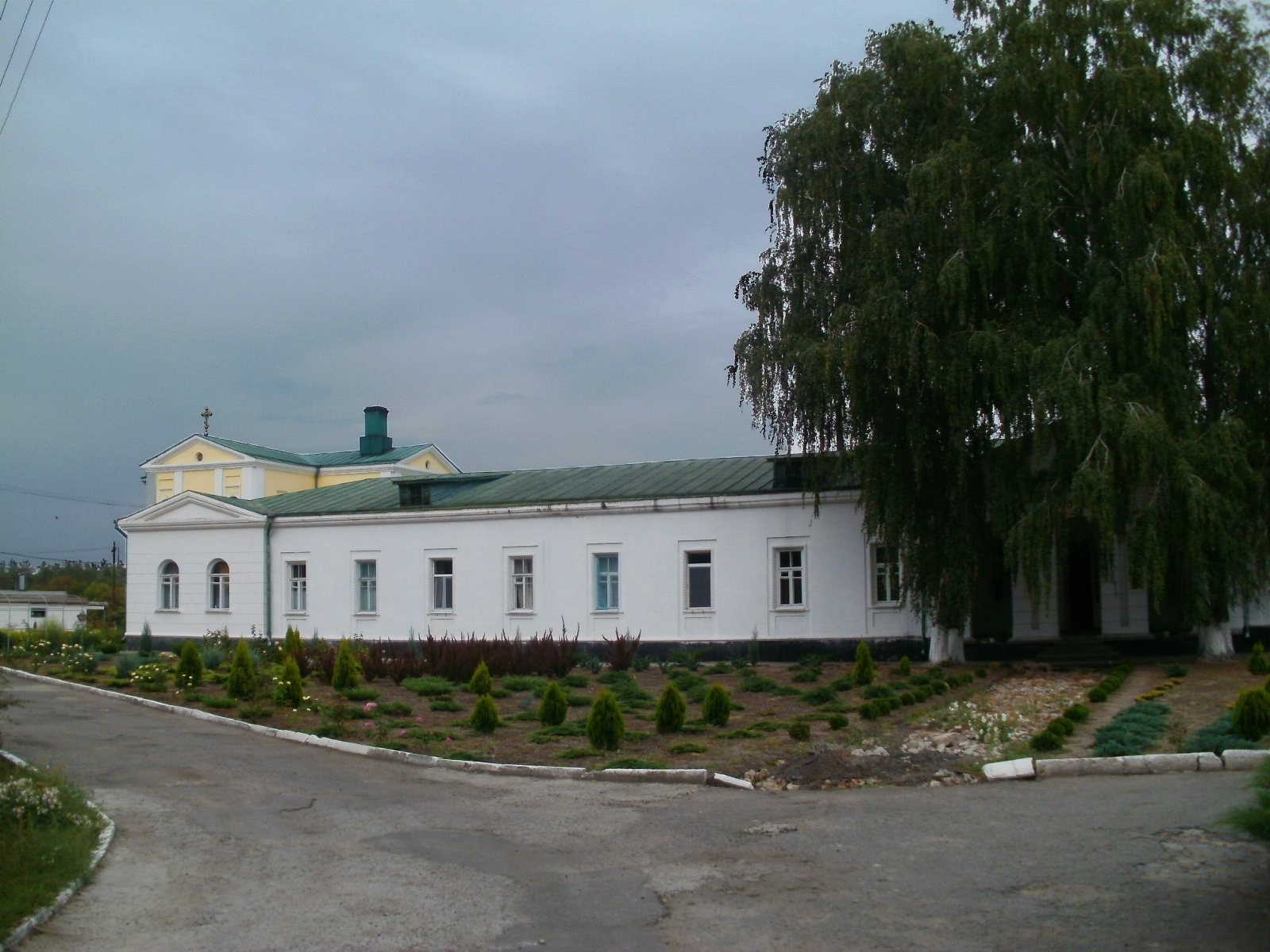
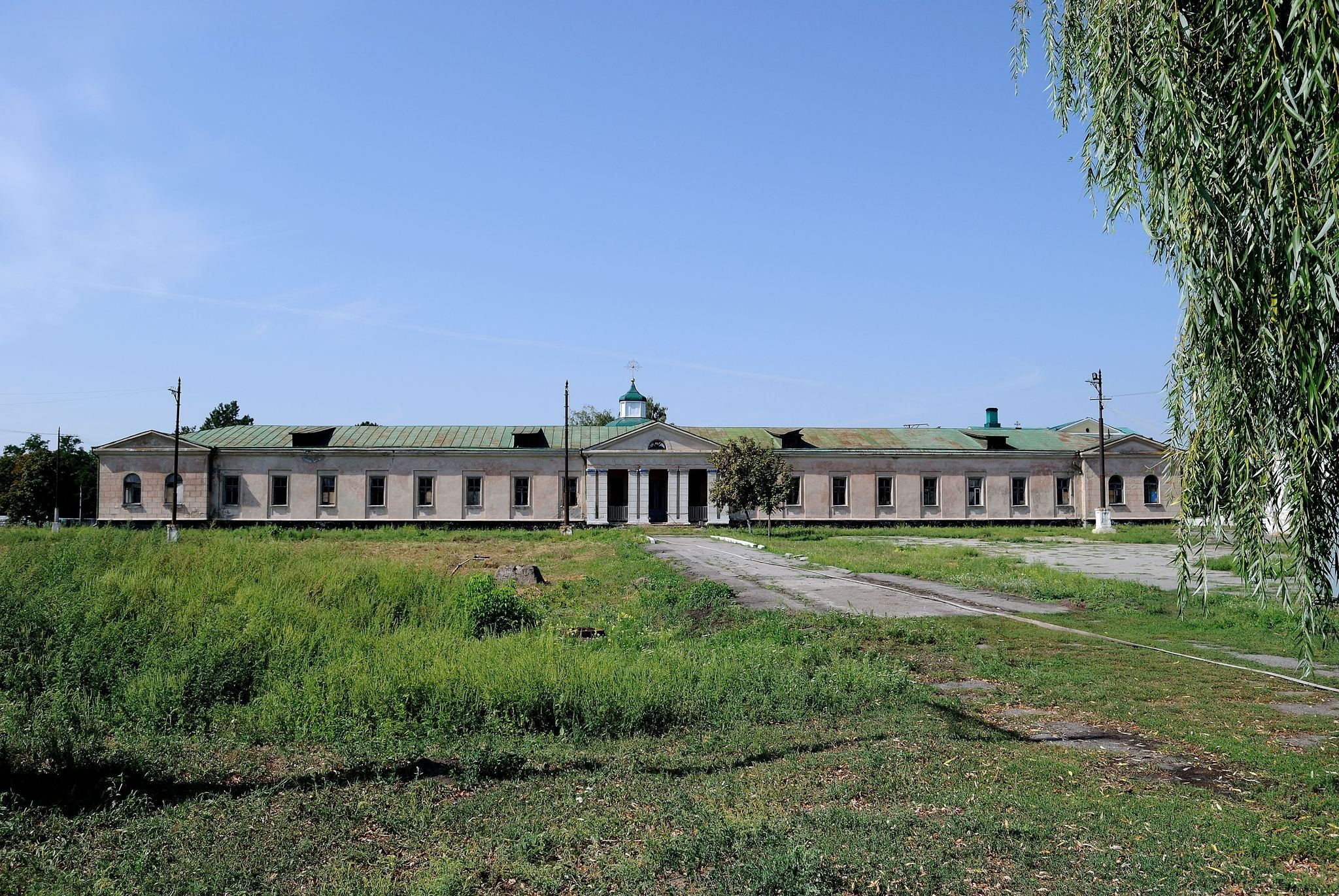
The brotherhood and abbot’s cells date from 1816–1820. They form part of the monastery complex dated 1782–1820, which is listed among the nationally significant architectural monuments of Ukraine. The associated buildings include the episcopal residence, refectory, churches, the site of the former bell tower, and service structures that developed around the religious and residential areas.
After the monastery’s closure, several churches were converted into economic and service buildings. Postwar additions in the Stalinist Empire style further altered the older fabric. The complex now includes the Saint Nicholas church with side chapels dedicated to Saint Nicholas, the Joy of All Who Sorrow icon, and the martyrs Cyricus and Julitta, together with surviving monastic, episcopal, refectory, and service buildings.
Venerated objects
Objects historically venerated at the monastery included the Akhtyrka icon of the Mother of God, also known as the Samara icon, an icon of Saint Nicholas the Wonderworker, and four Cossack crosses. These objects formed part of the monastery’s religious tradition alongside its churches, burial associations, and daily Orthodox worship.