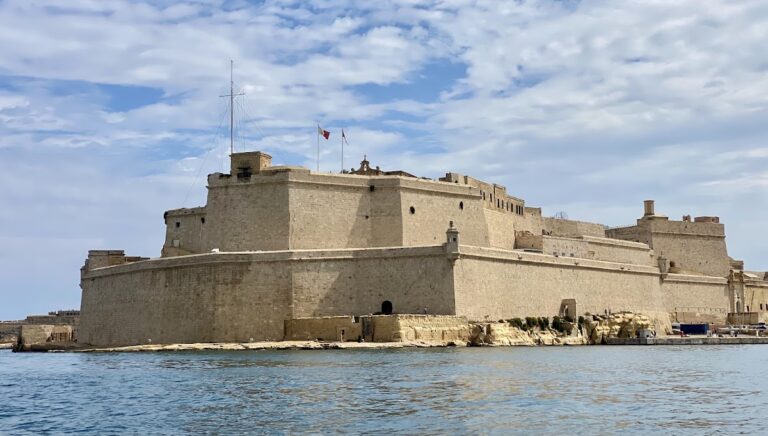
Rinella Battery: A British Coastal Artillery Battery in Malta
Site at a Glance
- Country
- Malta
- Primary era
- Modern
- Eras represented
- Modern
- Civilizations
- British
- Site type
- Military
On this page15 sections
History
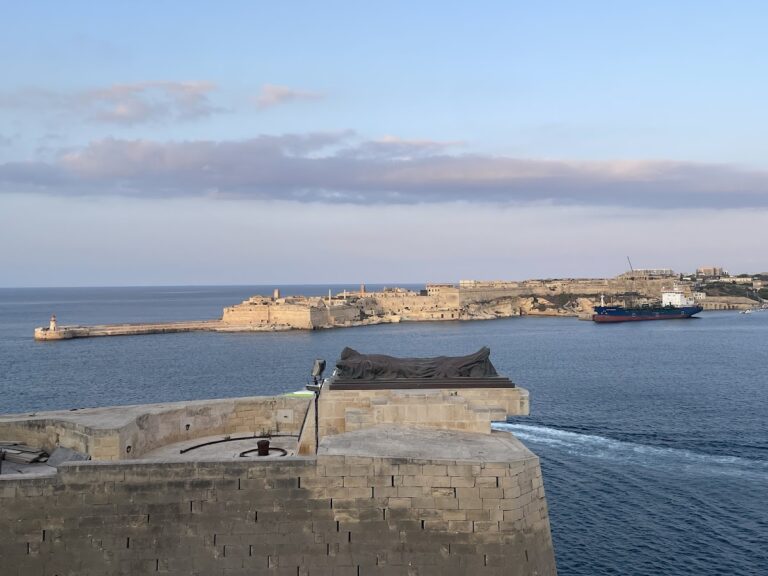
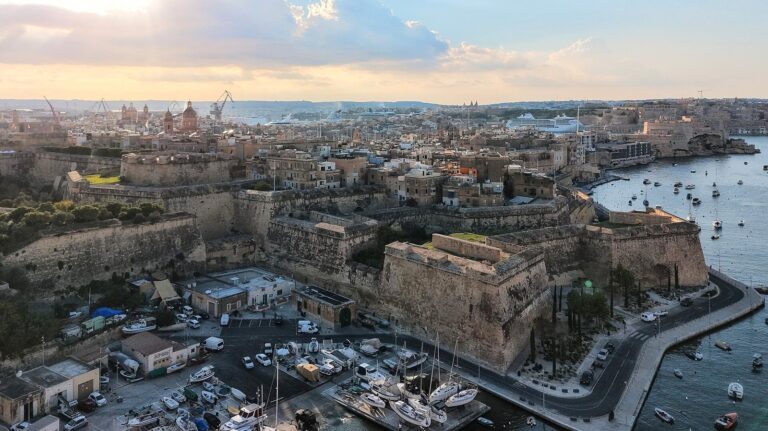
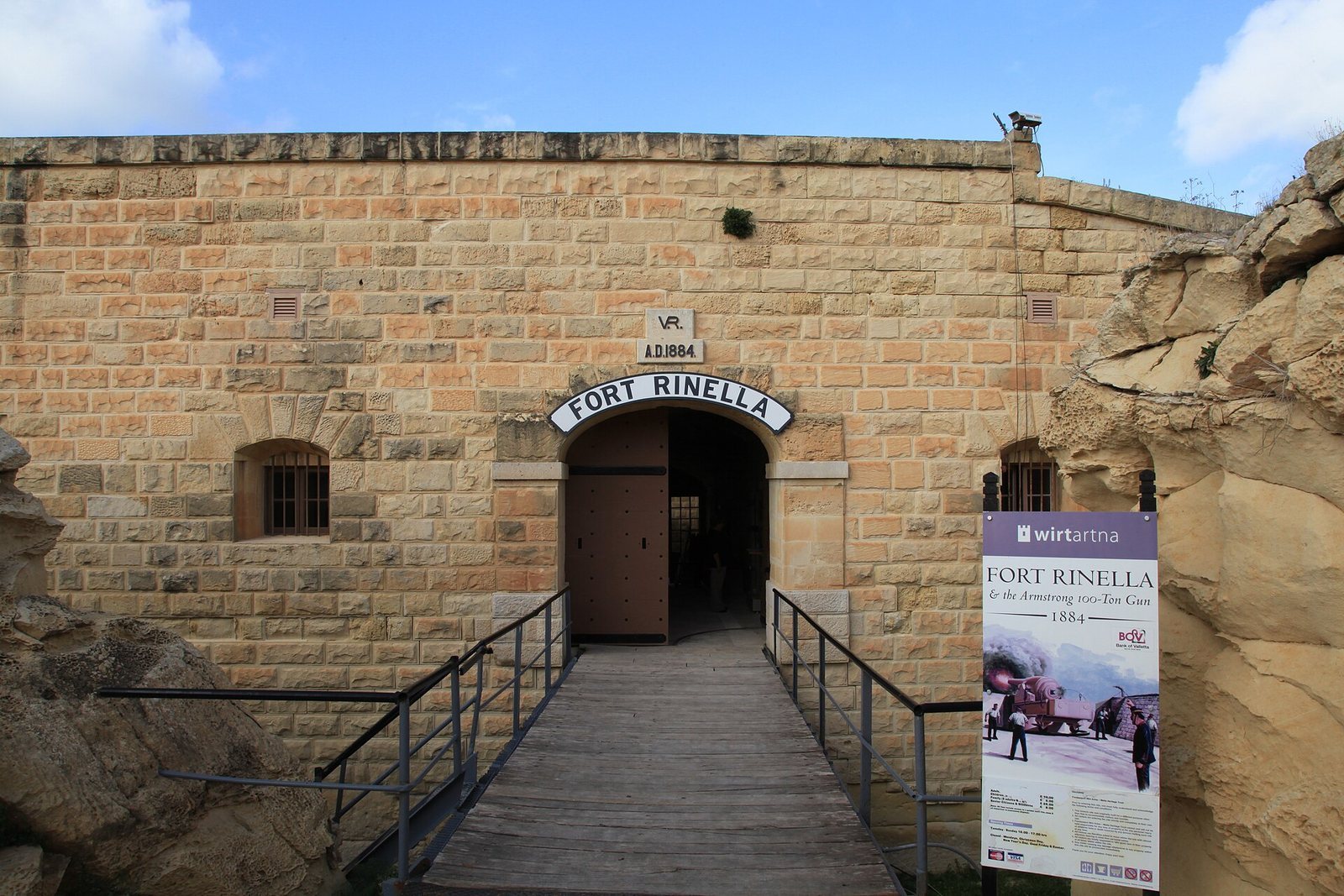
Rinella Battery is a British coastal artillery position at Kalkara, Malta, built by the Royal Engineers between 1878 and 1886. The Royal Engineers were the British Army’s military engineering corps. Designed for one 100-ton Armstrong gun, the battery formed part of the defenses of the Grand Harbour and was intended to protect British naval facilities and the sea route to India through the Mediterranean and Suez Canal. Although often called Fort Rinella, it was classified as a battery during its military service.
Construction and strategic purpose
British plans responded in part to Italy’s renewed naval building after the Battle of Lissa, a naval engagement in 1866. From 1873, Italy began constructing the ironclad warships Caio Duilio and Enrico Dandolo, each protected by 22-inch steel armor and armed with four Armstrong 100-ton guns. An ironclad was a warship protected by heavy armor. Britain built four batteries for guns of this size: Rinella and Cambridge in Malta, and Victoria and Napier of Magdala in Gibraltar. The Maltese batteries were positioned to cover approaches to the island’s harbors.
The gun reached the dockyards from Woolwich on 10 September 1882 and remained there for several months before being brought to Rinella Bay. One hundred Royal Artillerymen, members of the British Army’s artillery corps, hauled it by hand to the battery over three months. It was ready for service in January 1884.
Military service and wartime use
The battery served from 1886 to 1965. The gun fired its last shot on 5 May 1905 and left active service in 1906. It was never used in combat during its 20 years of active service. Practice was limited to about one shot every three months because a single shell cost as much as the daily wages of 2,600 soldiers.
After the gun’s retirement, Rinella became an observation post for Fort Ricasoli. Amid renewed concern about Italy, it was reactivated in the 1930s and used to store explosives and ammunition. During the Second World War, the battery also served as a Royal Navy supply depot, a civilian shelter and an air-defence observation point. Bombs struck it seven times.
In the early 1950s, Malta Garrison headquarters ordered artillery pieces dismantled as British forces adopted missiles for air and coastal defence. The order did not apply to Rinella, which remained under the Admiralty, the British authority responsible for the Royal Navy. The Navy left the battery in 1965, and it was transferred to the Maltese government.
Transfer and restoration
Rinella served as a film location in the 1970s, including in Zeppelin (1971), Young Winston (1972) and Shout at the Devil (1976). In 1991, care of the battery passed to Fondazzjoni Wirt Artna, also known as the Malta Heritage Trust. Following restoration, it opened as an open-air museum in 1996.
On 21 November 2005, the restored gun was fired for the first time in more than a century. Peter Caruana, then Chief Minister of Gibraltar, fired it.
Remains
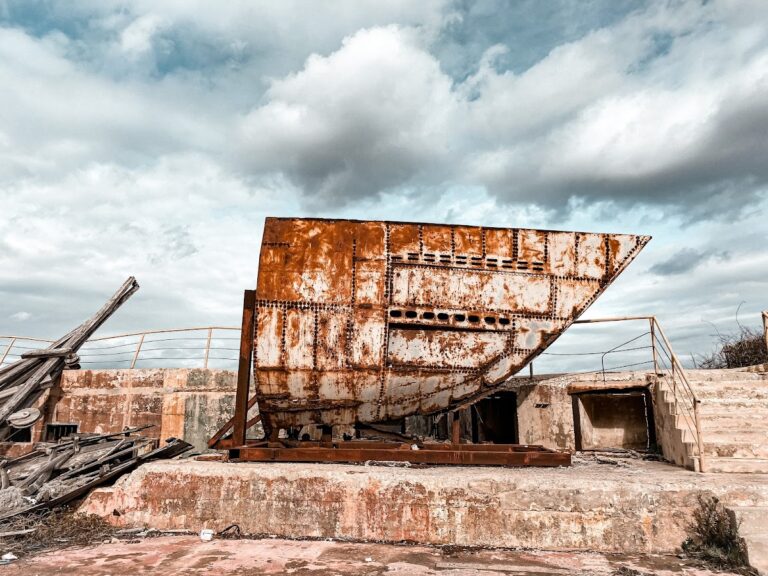
The pentagonal battery covers about 6,300 square metres. Its low profile and extensive underground spaces were designed to resist bombardment, while the gun, its protective wall and a courtyard remained exposed. Limestone, concrete, stone, earth and mortar were used in its construction. The battery is restored and largely intact, with wartime bomb damage, including damage to its left flank.
Outer defenses and entrance
Ditch and defensive positions
A dry ditch encircles the battery. Its inner face, called the scarp, is made of stone blocks and mortar. The outer face, or counterscarp, was left as exposed earth; excavation for the ditch also supplied stone for the structure. Three caponiers, protected positions from which defenders could fire along the ditch, occupy its seaward side. A gallery protects the counterscarp on the landward side, and a tunnel connects the caponiers.
The close defenses were arranged for infantry using portable weapons. They included loopholes in the caponiers, firing points and the landward gallery, as well as a loophole-protected wall along the approach. Metal shutters with loopholes protected barrack windows, and loopholes were also built into the entrance door.
Entrance and passage
The sole entrance lay beyond a retractable bridge across the ditch and a guardhouse. The bridge could be drawn inside the battery. A passage beyond the entrance connected the guardroom with the barrack rooms, latrines, washroom, kitchen and dining room, and with stairs leading to the ditch gallery.
Gun platform and loading system
Armstrong gun and platform
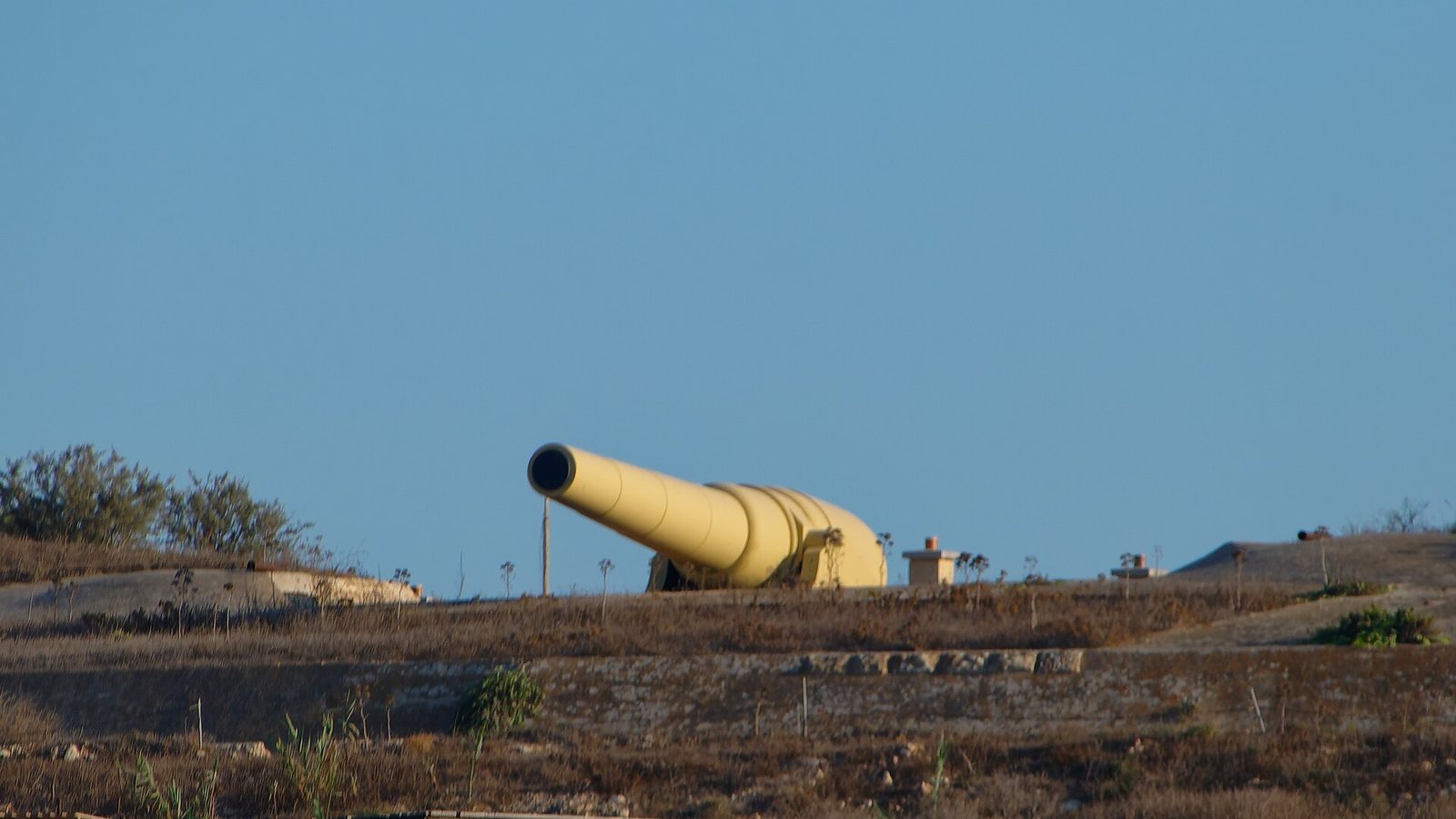
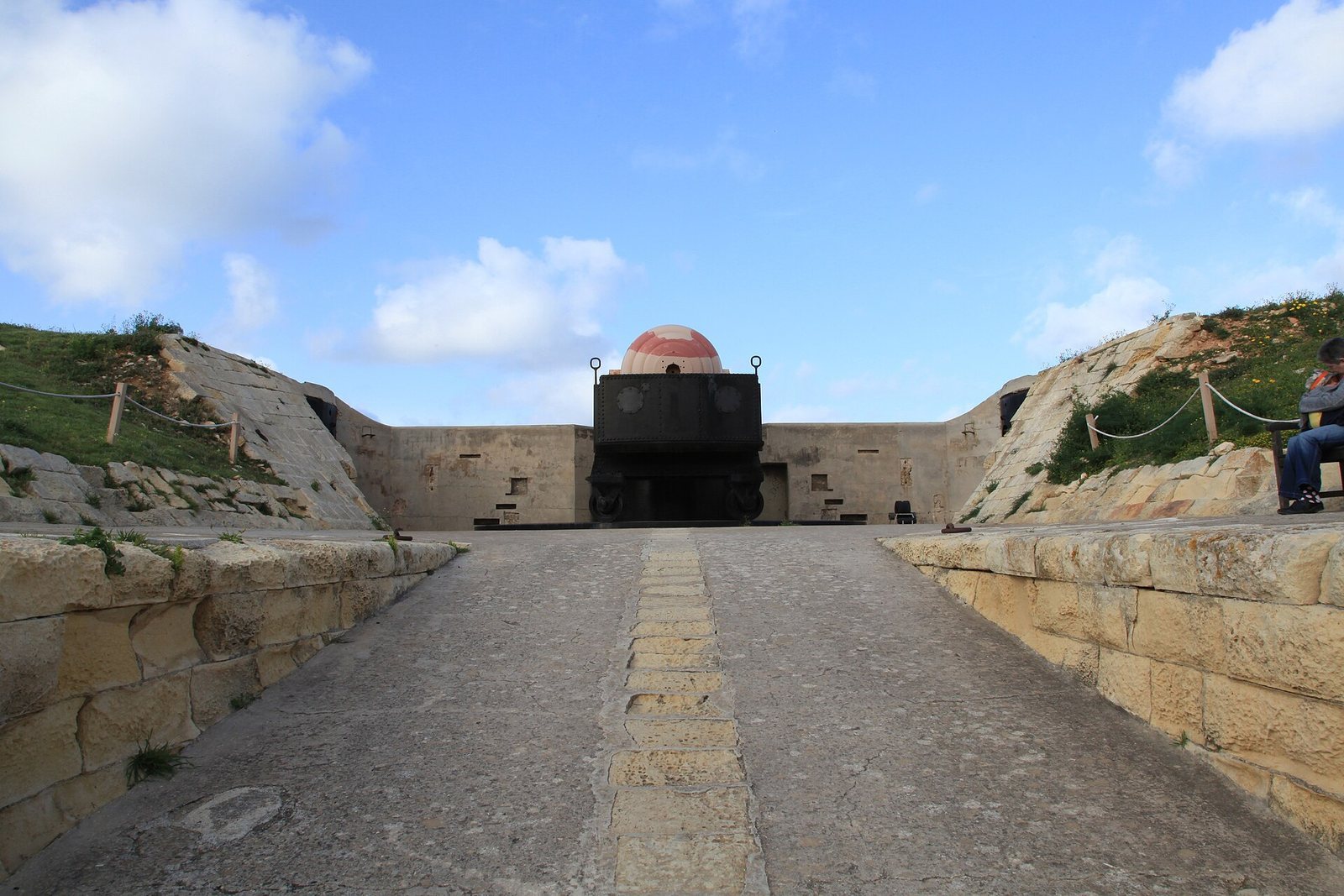
The restored gun is a rifled, muzzle-loading Armstrong piece, with a grooved barrel loaded from its open end. It is 17.72 inches (450 millimetres) in calibre and weighs 100 tons. It is one of two surviving Armstrong 100-ton guns; the other is at Napier of Magdala Battery in Gibraltar. The gun sat on a wrought-iron sliding carriage that absorbed recoil and allowed it to fire over the protective parapet. It could turn through 180 degrees and was intended to engage warships at a range of 7,000 yards, or about 6.4 kilometres.
A ramp links the courtyard to the gun platform. The seaward parapet slopes down to help disperse smoke from firing, while the landward parapet protects the route to the gun. Stairs give access to the parapet and roof. Two former platforms beside the ramp were covered with earth and vegetation, probably during the Second World War to make them less visible from the air.
Loading casemates
Armored casemates, or protected loading chambers, stand on either side of the gun and are served by ammunition elevators. After firing, the gun was turned toward a chamber, lowered and aligned with a water nozzle so its barrel could be flushed and cooled. The barrel was then brought level with the loading opening. A mechanical rammer placed and tamped the powder charge and shell before the gun was raised and returned to firing position. The designed rate was one shot every six minutes.
Accommodation and ammunition stores
Lower-level rooms and courtyard
The first level below ground held garrison accommodation, a kitchen, dining room, stores and an engine room, among other spaces. The rooms had bomb-resistant vaulted ceilings. At the same level, a courtyard connected the stores and underground areas with the gun and the ground-level approach. During British Army alterations in the early 1890s, a bedroom was converted into a dining room, which connected to the kitchen through a serving window. Barrack windows faced the ditch, while flues in the bedrooms, guardroom and dining room carried away gun smoke.
Ammunition level
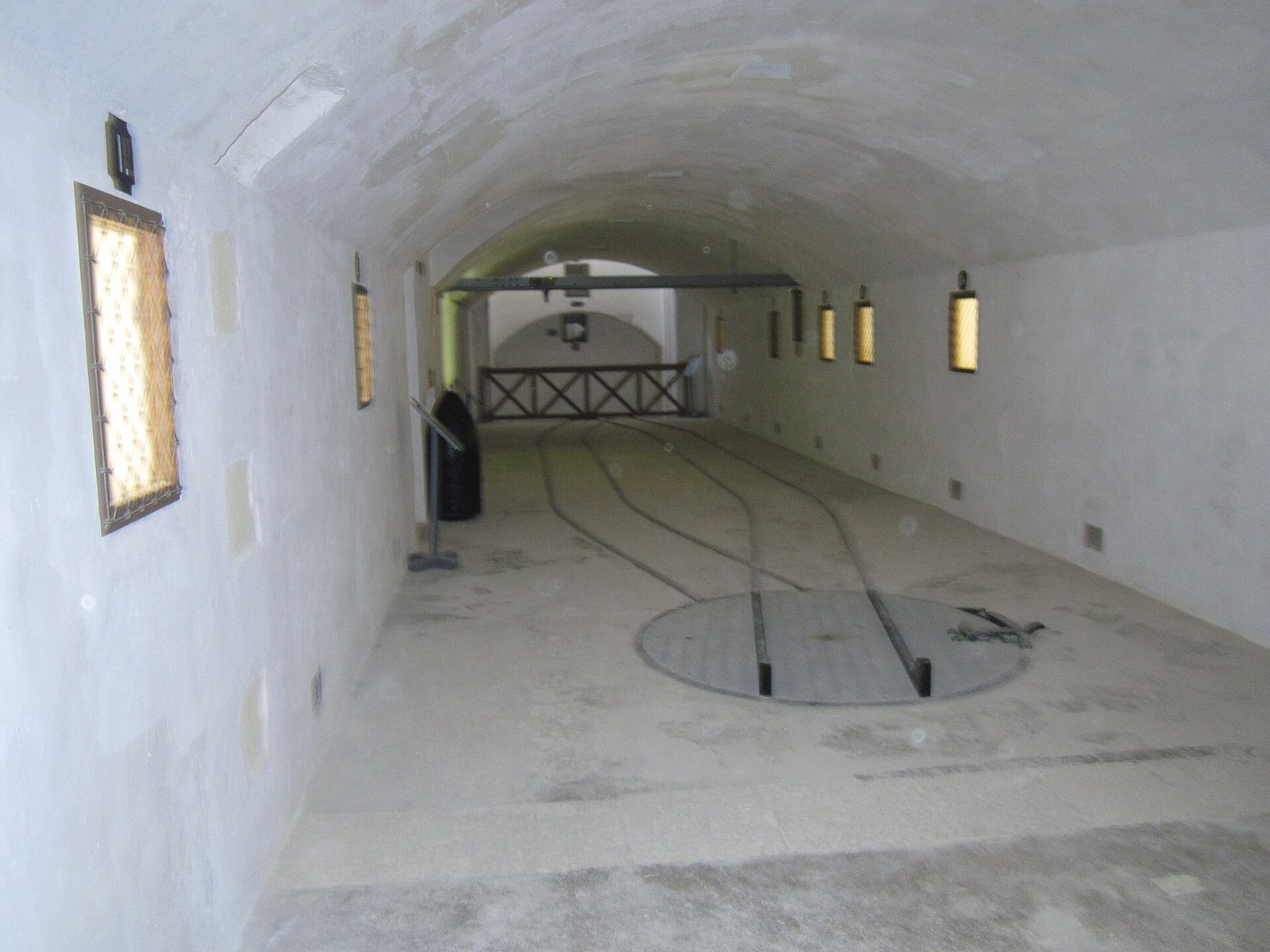
A separate lower level contained rooms for shells and powder charges, handling rooms and tracks for moving ammunition by cart to the elevators. A hoist on a ceiling rail carried shells from their store to the carts. Alterations expanded the shell store’s capacity from 33 to 100 projectiles. The battery held 100 shells, each weighing 2,000 pounds, and 107 black-powder charges stored in zinc containers. Each 450-pound charge was divided into four parts for handling.
Before entering the powder magazines, garrison members changed into clothing and footwear intended to reduce sparks from metal uniform fittings. A small room held spare parts and tools. A separate passage around the ammunition level allowed lamp maintenance. Openings between rooms housed the lamps, with glass and wire mesh protecting the powder stores.
Hydraulic machinery and water supply
A coal-fired steam engine powered the hydraulic system that operated and aimed the gun, ran its loading equipment and elevators, and supplied water for cleaning the barrel. The main hydraulic accumulator, a device that stores pressurized water, used an 85-ton slab that rose and fell with the water level. Water pressure reached 950 pounds per square inch and travelled through metal pipes. A smaller accumulator supplied water sprays above the loading chambers. Four hand pumps in the engine room could maintain pressure if the steam machinery failed; manual operation reduced the firing rate to about one shot every 15 minutes and involved a reinforcing crew of about 40 men. Water came from a cistern above the barracks and a main reservoir at the front of the battery, with a hand pump in the caponier tunnel transferring water to the cistern. The steam engine and hydraulic machinery were later removed and do not survive.