Resmo Church: A Medieval Fortified Saddle Church on Öland
Site at a Glance
- Country
- Sweden
- Primary era
- Medieval
- Eras represented
- Medieval, Early Modern, Modern
- Civilizations
- Swedish
- Site type
- Religious
- Remains
- Fortified Church
On this page16 sections
History
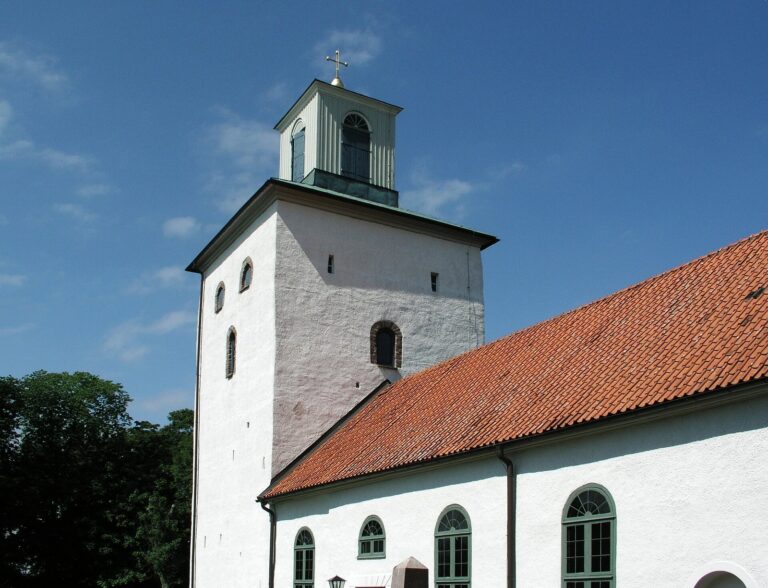
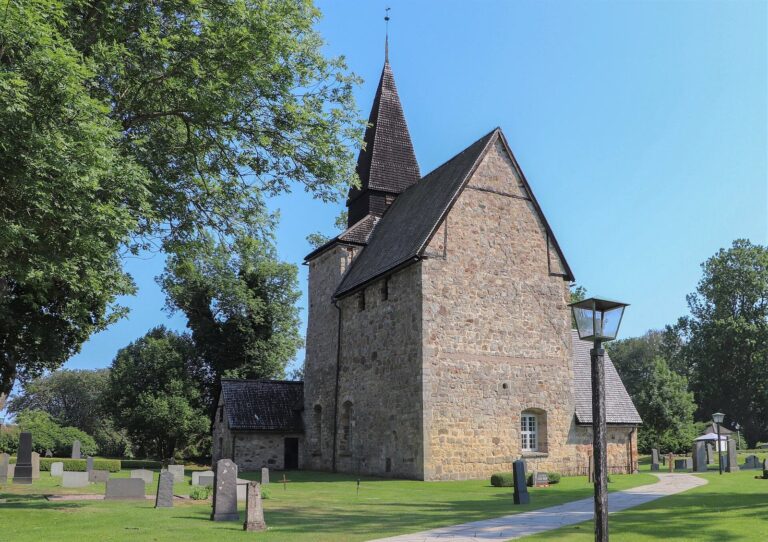
Resmo Church is a medieval church on Öland in Mörbylånga, Sweden. Its stone building began around 1070-1080, and it is the island’s only surviving saddle church, a church with towers above its western end and chancel, although its original form has changed.
Wooden predecessor and stone construction
A timber church built around upright wooden posts probably stood here before the stone building. It may have been among Sweden’s oldest church buildings. A man named Sueinu has been tentatively identified as its builder; a runic grave marker bearing his name is now represented by a cast in the church.
The stone church was built in stages while the wooden church continued to serve worshippers. The altar area, or chancel, and its end recess, the apse, came first, followed by the nave, the main body of the church. The lower part of the west tower was finished in the early 12th century, and the tower was completed by the middle of that century. The church was dedicated during the 12th century.
Fortification and later medieval use
Completion of the west tower was accompanied by a change to the south portal. The church was later strengthened against raids by pagan Baltic peoples and eastern Vikings. Between 1170 and 1240, it became one of 15 fortified saddle churches on Öland. A second, eastern tower was added around the turn of the 13th century. The space above the nave was sometimes used for living and storage; investigations there found food remains, tools, and game boards.
The village name appears around 1300 in the form Rysme and passed from the church village to the parish. Its origin is uncertain, but it may come from an Öland dialect word for a long strip or a scrap of cloth. The ending “-mo” appears from the 17th century, and the form Resmoo was recorded in 1644.
Early modern changes and destruction
In the 1580s, a tall spire was added to the west tower, the nave received a flat wooden ceiling, and additional paintings were applied to its walls. King John III may have paid for the work. The paintings have been tentatively attributed to Arendt Lambrechtz of Emden, who had served the king. In 1634, the Swedish antiquarian Johannes Haquini Rhezelius drew the church with both towers.
During the Scanian War, Danish forces occupying Öland plundered and burned the church in 1677. Rebuilding proceeded slowly. A sacristy was added in the early 1740s, when the interior and exterior walls were also plastered and painted. This treatment concealed older wall paintings, which were uncovered and restored in 1931.
Later alterations and parish history
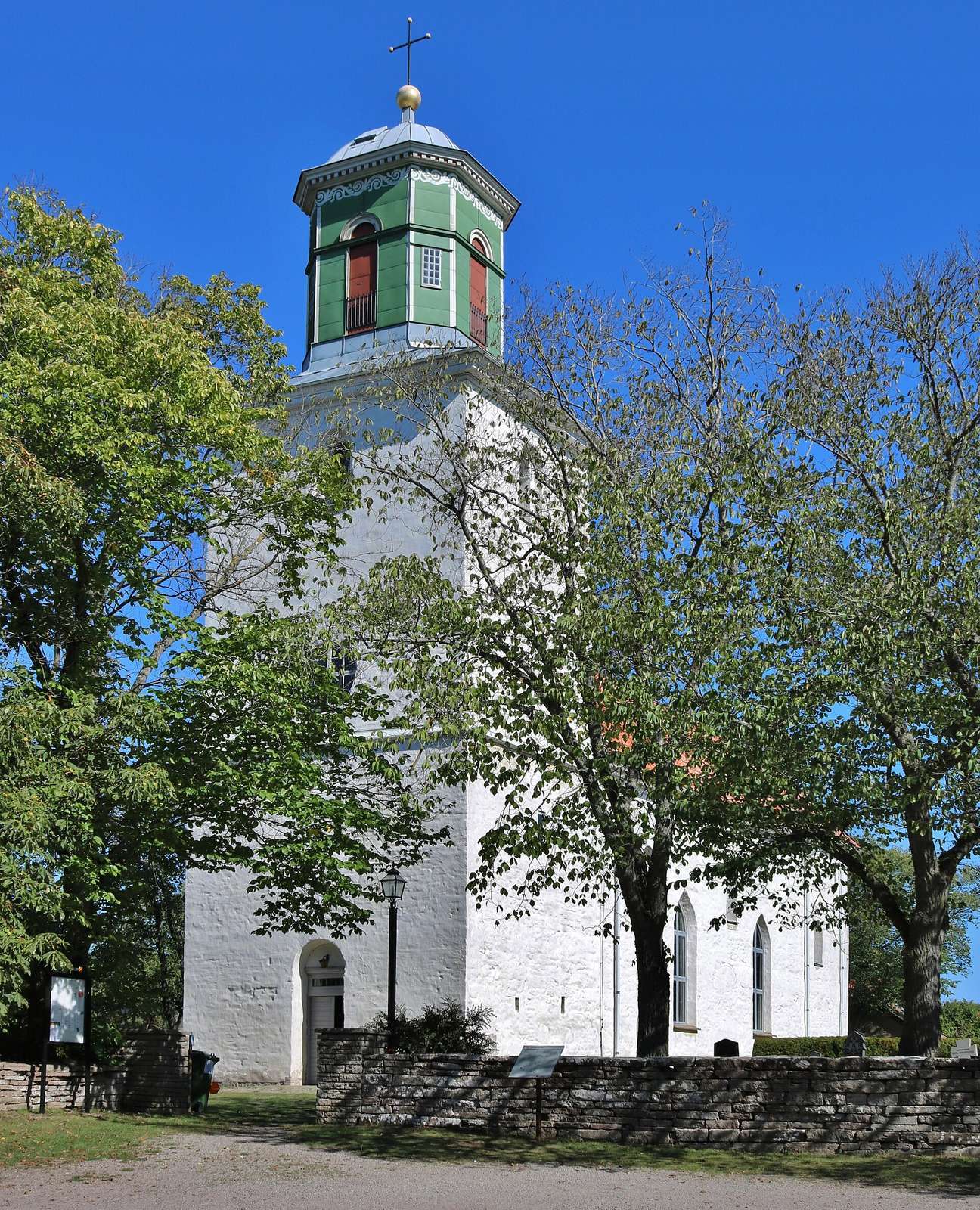
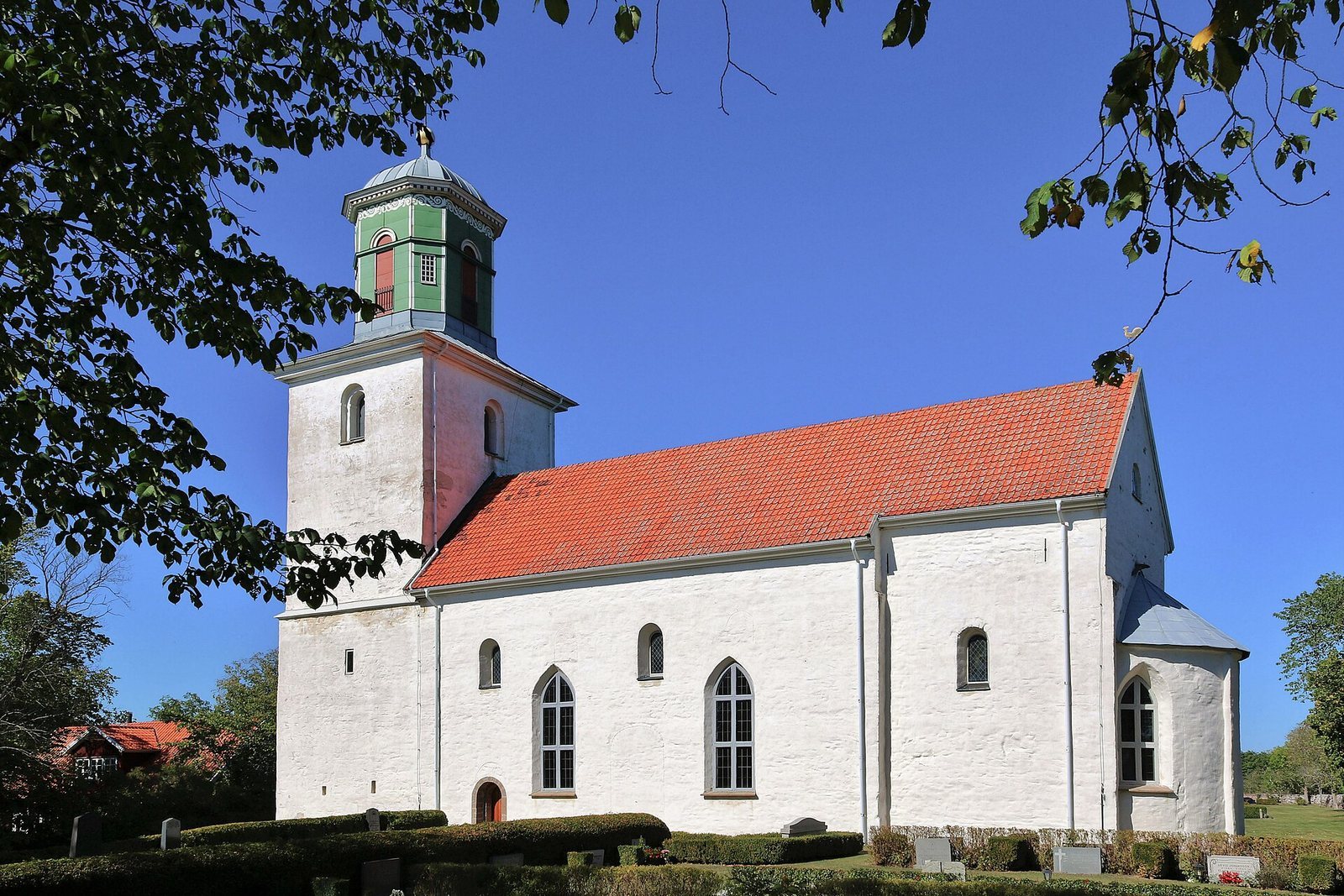
Major changes in the mid-1780s included enlarging the windows and replacing the nave’s flat ceiling with a wooden barrel vault, a continuous, tunnel-shaped ceiling. In 1826, the eastern tower was lowered to about the height of the nave, and the nave and tower were given a shared roof. The west tower’s spire was replaced by a lantern. Its appearance changed again around 1890. New pews were installed in the 1890s, and wooden floors were laid in the nave and chancel; the nave floor was set 63 centimetres above the original stone floor.
Architect Anders Ivar Roland designed exterior changes made in 1923, and the façade was restored in 1992. Resmo Church belongs to the Church of Sweden and the Diocese of Växjö. Since 1 January 2006, it has served the Resmo-Vickleby parish, formed by the merger of the Resmo and Vickleby congregations.
Remains
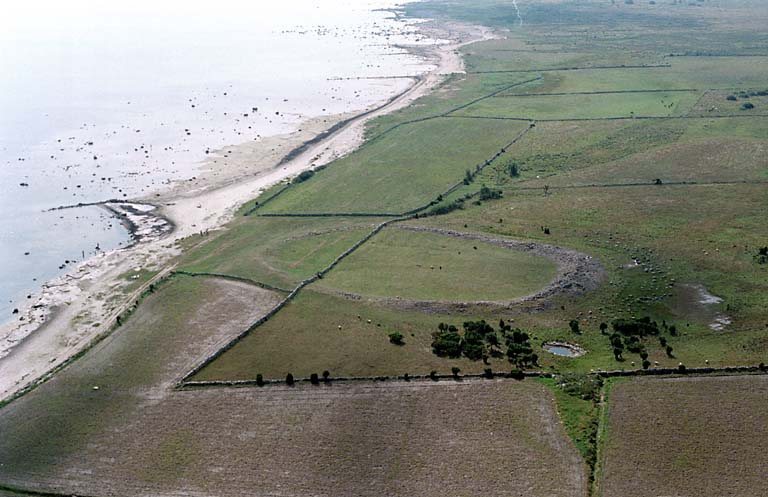
The church stands on Öland’s western land ridge beside Stora Alvaret, in a landscape rich in prehistoric remains. Its plan brings together a nave, a narrower chancel with an apse, a sacristy on the north side, and a west tower. The chancel and sacristy are set at slightly skewed angles.
Church structure and entrances
Plan, towers, and roof
The oldest surviving fabric dates to the late 11th century and includes the chancel and apse, nave, and parts of the west tower. The church’s former fortified arrangement had towers at both ends, with the nave between them. The eastern tower now rises to about the height of the nave. A shared roof covers the nave and chancel, with a shorter slope over the chancel.
Entrances and windows
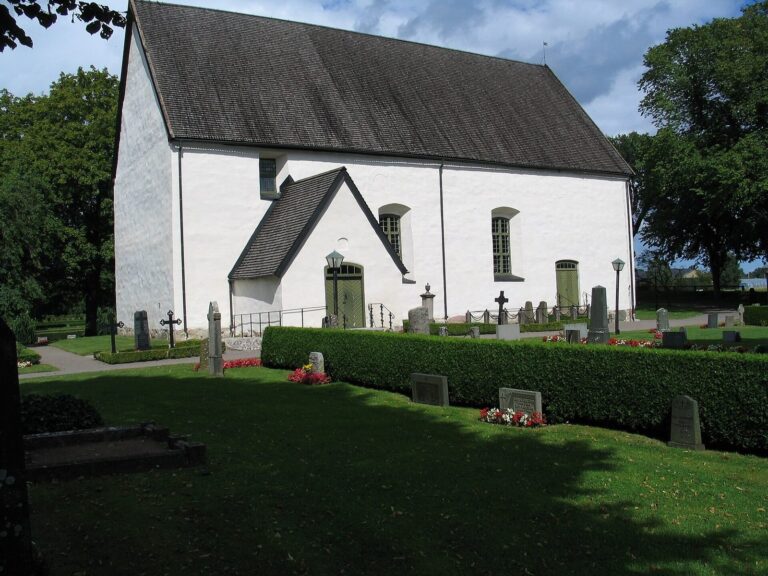
The church originally had north, south, and west entrances. The west portal opened into the tower’s ground floor, which served as a private chapel for the church’s patron. A large round arch connected this room to the nave. The west entrance and central south entrance now lead into the church.
The north nave portal retains its original form. Its rectangular doorway has a round-arched niche above it, sides that spread towards the bottom, and very long oak beams across the opening. The inner opening is now walled up. This type of portal is more common in early Danish churches than in Swedish ones, and its use here has been taken to suggest that the master builder came from Denmark. The south and west portals formerly shared this form. Inside, oak planks cap openings in the west tower. Large pointed-arch and smaller round-arched windows on the north and south sides light the tall, narrow interior.
Chancel and apse
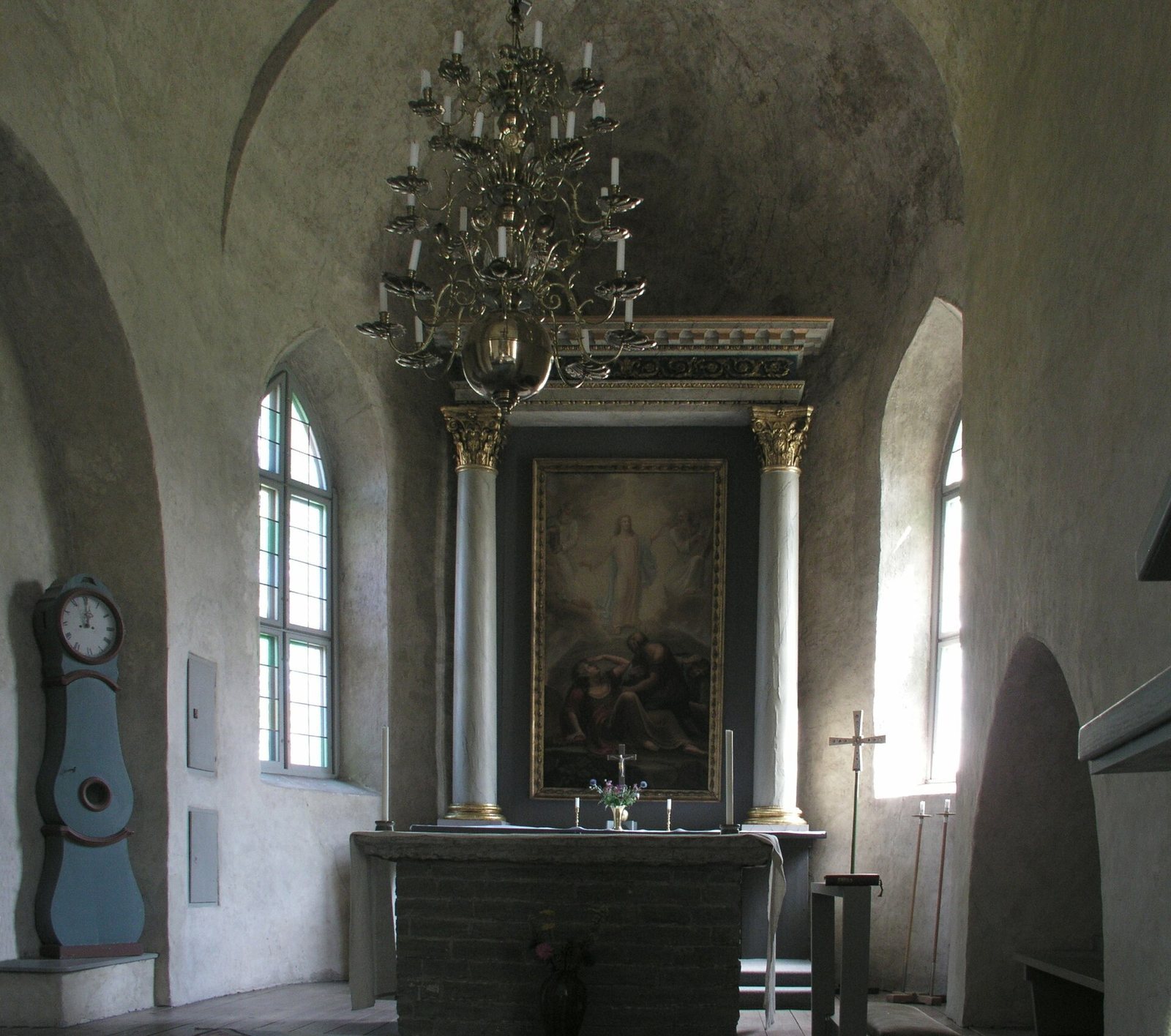
The apse alone has a half-dome, designed to improve acoustics, and contains a stone altar. A small Romanesque window with a round arch is set in the apse’s eastern side. Romanesque refers to a medieval artistic and architectural tradition associated with features such as rounded arches.
Wall paintings
Resmo Church contains the largest group of Romanesque wall paintings on Öland. The paintings in the apse’s domed vault include Maiestas Domini, a traditional image of Christ in majesty, and date to the 12th century. Paintings around the south chancel window are from the early 12th century. Those in the high arch separating nave and chancel, and on the nave’s east wall, date to around 1200. They portray Cain and Abel’s offerings, Cain killing his brother, God’s curse on Cain, and the Last Judgment, using blue and green against a black background. The church also has frescoes from the mid-13th and late-16th centuries, as well as isolated traces of late-medieval decoration on the nave walls.
Grave markers and church furnishings
Grave markers
The ground floor of the west tower contains grave markers, including an 11th-century gable from a funerary monument with a runic inscription. Its original is held by the Kalmar County Museum; a cast is in the church porch. Other original grave markers date to the 13th, 17th, and 18th centuries. A further marker in the chancel dates to around 1700. The Resmo runestone was also found at the church.
Furniture and liturgical objects
An oak chest in the porch dates to around 1700, and the nave gallery dates to 1787. Carpenter Christian Pilltz made the sacristy furnishings in the 1740s; its oak chest probably comes from the early 18th century. The oldest altar vessels date to the 18th century, and the altar frontal, a decorative covering for the front of an altar, dates to 1796.
The pulpit was designed by C. F. Sundvall and made by Andreas Högström. The same men made the altar, designed by Carl Fredric Sundvall and dated to 1799. The chancel also holds a painting of the Transfiguration by Anders Johan Hansson and a grandfather clock donated around 1830. The baptismal font dates to 1915. In 1965, Sven-Bertil Svensson made the dove above it and the crosses over the chancel and altar. A staff donated in 1783 is kept in the sacristy; the church attendant used it to wake worshippers who had fallen asleep.
Organ
The first organ, installed in 1892, was made by Åkerman & Lund of Stockholm. It had one hand keyboard, a foot keyboard, and four stops, each of which selects a set of pipes. Although three stops were originally planned, a fourth was added after the order was placed. A. Magnusson of Gothenburg altered the instrument in 1931, adding a second hand keyboard operated by pneumatic action, which transmits key movement through air pressure. The organ was modified again in 1965. The present instrument has ten stops, two hand keyboards, and a foot keyboard, with couplers that connect the keyboards to each other or to the pedal. It has three fixed combinations and one free combination.
Prehistoric remains nearby
The church parish contains about 100 prehistoric remains, including grave fields, individual graves, burial mounds, house foundations, round stone settings, stone circles, and cairns, which are mounds of stones. Four unusually large passage graves, burial chambers reached through narrow passages, lie among the nearby remains. The Mysinge grave field is south of the church. Its passage graves are the only ones on Öland and are the easternmost in Europe.