Rájec nad Svitavou Castle: An Early Neoclassical Aristocratic Residence in Czechia


Site at a Glance
- Rating
- 4.5
- Popularity
- Medium
- Country
- Czechia
- Primary era
- Early Modern
- External website
- Open
- Eras represented
- Early Modern, Modern
- Civilizations
- Habsburg, Holy Roman Empire
- Site type
- Domestic
- Remains
- Elite Residence
On this page11 sections
History
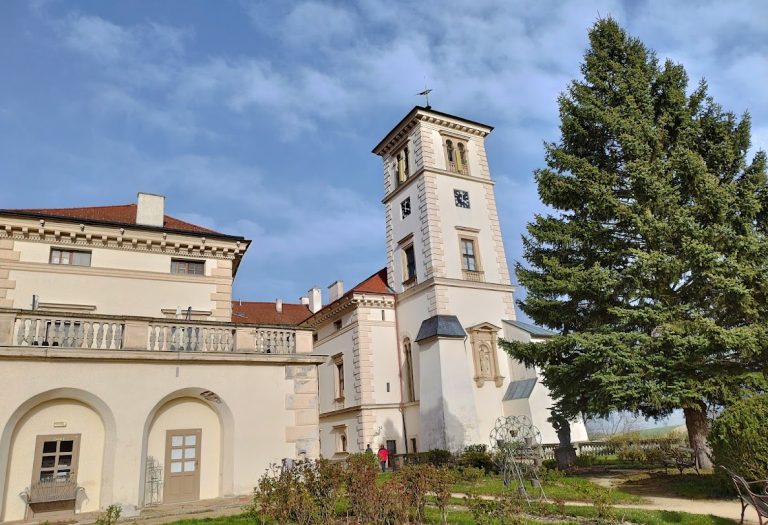
Rájec nad Svitavou Castle in Czechia is an early Neoclassical aristocratic residence built between 1763 and 1769 in the Louis XVI style, a late-eighteenth-century form known for symmetry, restrained classical ornament, and inspiration from ancient architecture. The present building occupies a hill known as Hradisko, where a medieval castle probably stood until its destruction by the end of the fourteenth century.
Medieval and Renaissance foundations
Hradisko, a name commonly used for a fortified hill or hillfort site, remained associated with the earlier medieval stronghold. In 1570, Bernhard Drnovský von Drnovice built a Renaissance castle on the site. The Drnovský estate later passed through marriage to the Austrian Roggendorf family, linking the property to a new noble lineage.
The Renaissance building was destroyed by fire in 1746. Its owners moved their residence to Sloup, and in 1763 they sold the property to Count Anton Josef von Salm-Reifferscheidt. The sale initiated a new phase in the history of the estate and led to the construction of the castle that survives today.
The Salm-Reifferscheidt-Raitz residence
Construction of the present castle began in 1763. Count Salm-Reifferscheidt established the headquarters of the Salm-Reifferscheidt-Raitz line there, making Rájec the administrative and residential centre of this branch of the Salm-Reifferscheidt noble family. The plans were prepared by Isidore Canevale, a French architect working in Vienna, and the building was completed between 1763 and 1769.
The new residence expressed the architectural preferences of the late eighteenth century through its early Neoclassical design and Louis XVI character. A garden was established beside the castle in 1767, and the estate developed into a composition of formal French-style gardens and a surrounding landscape park. The castle and its grounds were also associated with cast-iron decorations and sculptures made at the Salm ironworks and art foundry in Blansko.
State ownership and later conservation
In 1945, the Czechoslovak state confiscated the castle under the Beneš decrees. These post-Second World War presidential decrees provided, among other measures, a legal basis for confiscating property from certain groups and individuals. The ground floor opened to visitors in 1949, and a museum of the Moravian Karst operated in the castle for a short period.
After the fall of communism, the Salm-Reifferscheidt-Raitz family sought restitution of the property. In August 2005, the Czech Constitutional Court confirmed the Czechoslovak citizenship of Hugo, 5th Prince of Salm-Reifferscheidt-Raitz, who had died at Rájec in 1946. The decision overturned a Ministry of the Interior decree and created a legal basis for claims concerning the castle and approximately 7,000 hectares of associated land. The castle nevertheless remained in state ownership.
Long-term repairs to the interiors and French-style gardens continued over subsequent decades. From 2002, Rájec nad Svitavou Castle has been protected as a national cultural monument of the Czech Republic. The castle chapel, which initially served the Hussite Church, was later converted into a storeroom and reconstructed for public visitation from 2002.
Remains
Residence and landscape
Rájec nad Svitavou Castle is a two-story residence arranged around a courtyard of honor and covered by a mansard roof. This roof has two slopes on each side, with the lower slope steeper than the upper one. The building’s early Neoclassical form follows the Louis XVI preference for balanced composition and classical detailing. A dovecote built at the same time as the main castle stands among the associated buildings. It is an early example of Neo-Gothic design, which adapts medieval Gothic forms, combined here with the lighter ornamental character of Rococo.
Gardens and park
The grounds include the garden established beside the castle in 1767, French-style gardens, and a larger landscape park. Decorative elements include numerous cast-iron ornaments and partly almost life-size sculptures. These works were produced at the Salm ironworks and art foundry in Blansko, owned by the prince. The Svitava River flows approximately 600 metres west of the castle.
Interiors and collections
Representative rooms
The representative rooms on the ground floor date from the last quarter of the nineteenth century and have largely survived. The castle chapel forms another part of the interior history. It first served the Hussite Church, a Czech Christian denomination that emerged from the Hussite religious tradition and was formally established in the twentieth century. After later use as a storeroom, the chapel was reconstructed for public visitation from 2002.
Paintings and porcelain
A collection of Salm family paintings was installed on the first floor in the 1950s. It consists mainly of works by Dutch and Flemish masters. The castle also presents an extensive collection of oriental porcelain, adding a separate group of decorative and collecting objects to the surviving interiors.
Library
The castle library contains more than 60,000 books in eleven languages. It is described as one of the largest castle libraries in the Czech Republic, and its size reflects the continuing importance of the residence as a centre of aristocratic collecting and learning.
Nearby sites