Blansek: A Gothic Castle Ruin in Czechia


Site at a Glance
- Rating
- 4.5
- Popularity
- Low
- Country
- Czechia
- Primary era
- Medieval
- Eras represented
- Medieval
- Civilizations
- Holy Roman Empire
- Site type
- Military
- Remains
- Castle
On this page8 sections
History
Blansek is a Gothic castle ruin in Czechia, founded by Bruno of Schauenburg, bishop of Olomouc, during the second half of the 13th century. First explicitly recorded in 1275, it became the centre of a fief district containing more than 30 fief-holders. The castle formed part of the political and defensive organization of medieval Moravia under the authority of the bishops of Olomouc.
Foundation and episcopal administration
Blansek was granted as a fief from the end of the 14th century, during the margravial wars, conflicts connected with disputes over rule of the Moravian margraviate. In 1396, Bishop Nicholas of Riesenburg entrusted the castle to its first recorded fief-holder, Erhart of Kunštát and Skal. Aleš of Kunštát and Lysice held it in pledge from 1400, meaning that he possessed it as security rather than through a permanent transfer of ownership. Vilém Zajíc of Valdek held Blansek from 1417 to 1420, followed by the House of Studnice from 1420 to 1435.
Blansek during the Hussite Wars
The Hussite Wars were religious and political conflicts associated with the Hussite reform movement, fought mainly in Bohemia and Moravia during the 15th century. During these wars, Blansek served as one of the strongholds of Bishop John the Iron against the Hussites. It was reportedly attacked during the Hussite campaign of 1424 and again in 1431, but reliable evidence for these assaults is lacking. The castle was probably not captured, or it was not damaged enough to end habitation.
Blansek was later promised as a pledge to Vok V of Holštejn, although Bishop Paul of Miličín retained it for members of his own family. A meeting of the bishop’s fief-holders took place at the castle in 1440, showing that it still had an administrative role in the region.
Abandonment and later deterioration
By 1461, Blansek was recorded as abandoned, and the castle had been destroyed by fire. A later tradition holds that the ruin was temporarily adapted for defence against Swedish forces during the Thirty Years’ War, the European conflict fought from 1618 to 1648. This tradition forms part of the later history associated with the site.
Some deteriorating masonry was demolished in the 1930s for safety reasons because it threatened to collapse onto the road to the Punkevní Caves, which were then being opened to the public. The ruin’s unstable condition continued into the 21st century. Blansek has been protected as a cultural monument of the Czech Republic since 1964 and lies within the Moravian Karst Protected Landscape Area.
Remains
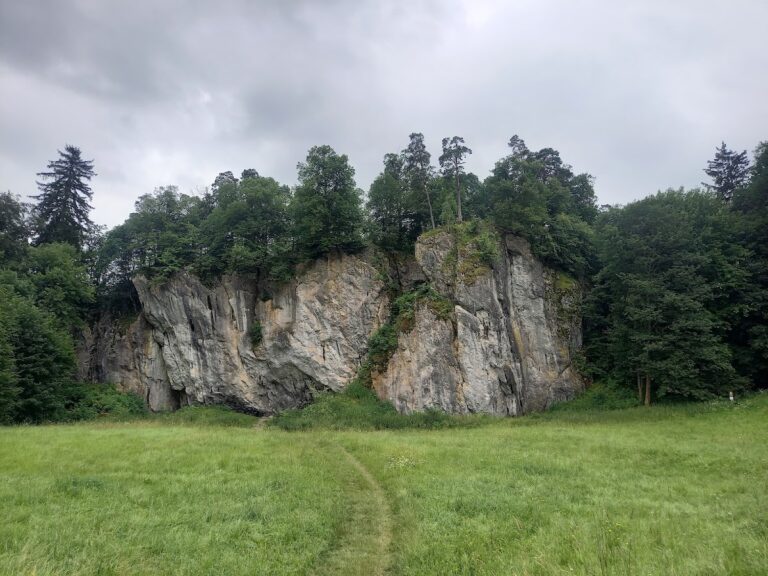
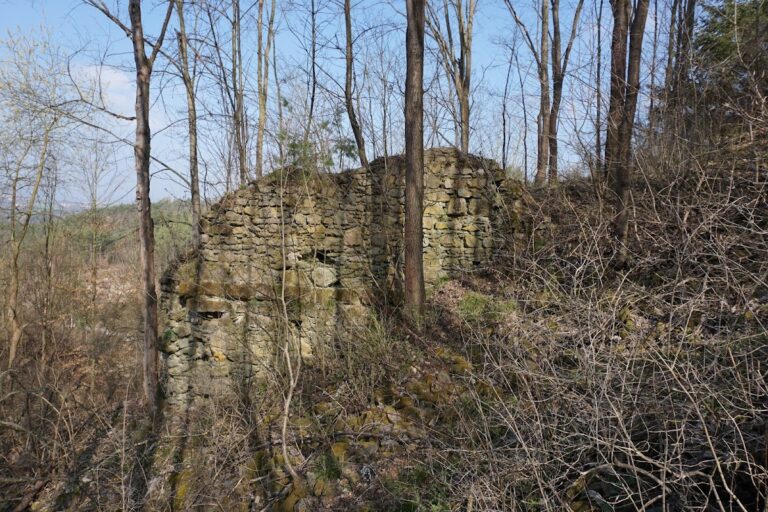
Blansek is an extensive Gothic ruin above the valley of the Punkva River in the Suchdol cadastral area of Vavřinec. The castle stands above the valley road leading to the Punkevní Caves, whose entrance lies directly opposite below the hill. The Macocha Abyss, a prominent karst geological feature, is approximately 0.5 kilometres north in a straight line. The surviving complex consists of a principal inner castle and the remains of an adjoining outer bailey, with parts of the palace and defensive walls still visible.
Principal castle
Inner core and palace
The inner core measures about 70 by 25 metres and contained the palace. Located directly above the valley road, this principal fortified area dates from the 13th century, during the period of Bishop Bruno of Schauenburg. Surviving masonry includes parts of the palace and sections of the curtain walls, the defensive perimeter walls enclosing the castle. The remains are fragmentary, and the upper edges of the walls became unstable by the 21st century.
Outer bailey
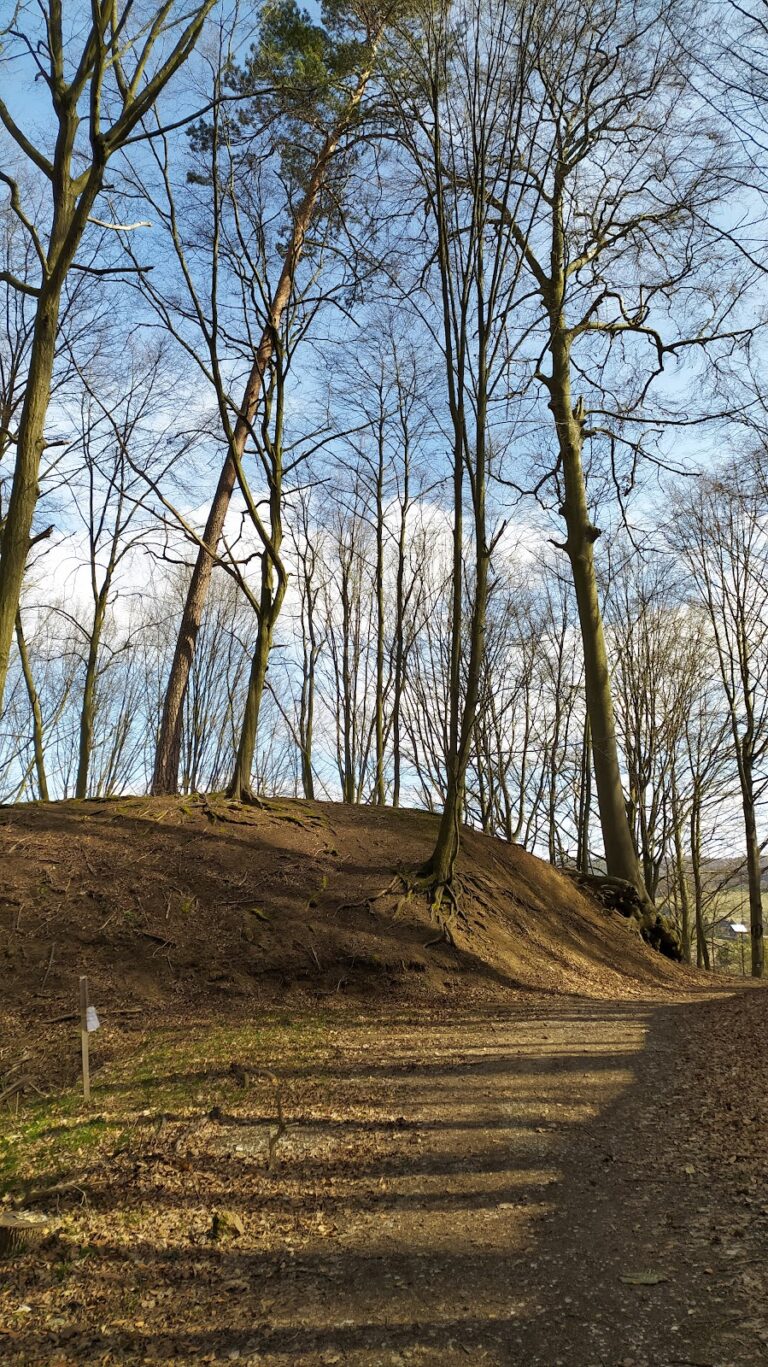
An extensive outer bailey, an adjoining fortified enclosure, was added sometime before 1349. It was separated from the main castle by a double ditch. Remnants of the outer-bailey perimeter wall and the front section of the castle wall remain clearly visible, preserving the distinction between the principal castle and its expanded defensive enclosure.
Nearby sites