Racot Palace: A Classicist Estate in Poland


Site at a Glance
- Rating
- 4.5
- Popularity
- Low
- Country
- Poland
- Primary era
- Classical
- External website
- Open
- Eras represented
- Classical, Modern
- Civilizations
- Polish–Lithuanian Commonwealth
- Site type
- Domestic
- Remains
- Palace
On this page11 sections
History
Racot Palace is an eighteenth-century palace in Racot, Poland, built in the second half of the eighteenth century in the Classicist style. Its development began with a manor owned by the Bronisz family and continued under Prince Antoni Barnaba Jabłonowski, voivode of Poznan, a high-ranking territorial governor in the Polish political system.
From Manor to Palace
Dorota of the Bronisz family, wife of a prince and the voivode of Rawa, expanded the original manor. It was later destroyed during fighting between Russian forces and the Bar Confederates, an eighteenth-century Polish-Lithuanian movement formed against Russian influence and the authority of King Stanislaus II Augustus.
Before Dorota’s death, the estate had acquired two wings and utility buildings. A former distillery was converted into a stable and coach house. Her son, Antoni Barnaba Jabłonowski, enlarged the manor into a palace and created an English-style park behind it, covering 10.95 hectares.
A Cultural and Princely Estate
Racot became an important cultural center. Józef Wybicki, a Polish writer and political activist who lived in the region, wrote plays for the local theater. Visitors included Ignacy Wyssogota Zakrzewski, the first president of Warsaw, Prince Józef Poniatowski, a military commander and statesman, and Tadeusz Kościuszko, a Polish-Lithuanian military leader associated with the American Revolutionary War and the 1794 Polish uprising.
In 1799 Antoni Barnaba Jabłonowski sold the palace and estate to William I of Orange, who later became king of the Netherlands. In the late nineteenth century, his granddaughter Sophie of the Netherlands brought Racot as her dowry to the princely family of Saxe-Weimar-Eisenach. Grand Duke William Ernest added the north wing in 1902, providing numerous guest rooms.
Polish State Ownership and the Stud Farm
Under the 1919 Treaty of Versailles, the Racot estate and palace passed to the Polish state. In 1921 the Council of Ministers designated the palace as a residence for the presidents of the Republic of Poland. President Ignacy Mościcki spent a two-week vacation there with his wife and adjutant general, Colonel Sergiusz Zahorski, in July 1927.
The State Stud Farm at Racot was established in 1928 as one of three Polish state stud farms operating before the Second World War. Experiments with Polish Konik horses, a small and hardy Polish breed known for retaining primitive equine characteristics, had been conducted there since 1968. During the 1980s, the stud farm had 700 horses and was the largest in Europe.
The palace was renovated between 1968 and 1970. In 1995 the State Stud Farm was transformed into a company owned by the State Treasury and supervised by the Agricultural Property Agency, a Polish state institution responsible for administering state agricultural property. A comprehensive renovation followed from 2000 to 2004, after which a training and recreation center was established at the palace.
Racot Palace has been protected as a monument since 1952. It is entered in the register of immovable monuments of the Greater Poland Voivodeship under registration number 355/A, dated January 31, 1952.
Remains
Palace and Associated Buildings
Main Palace
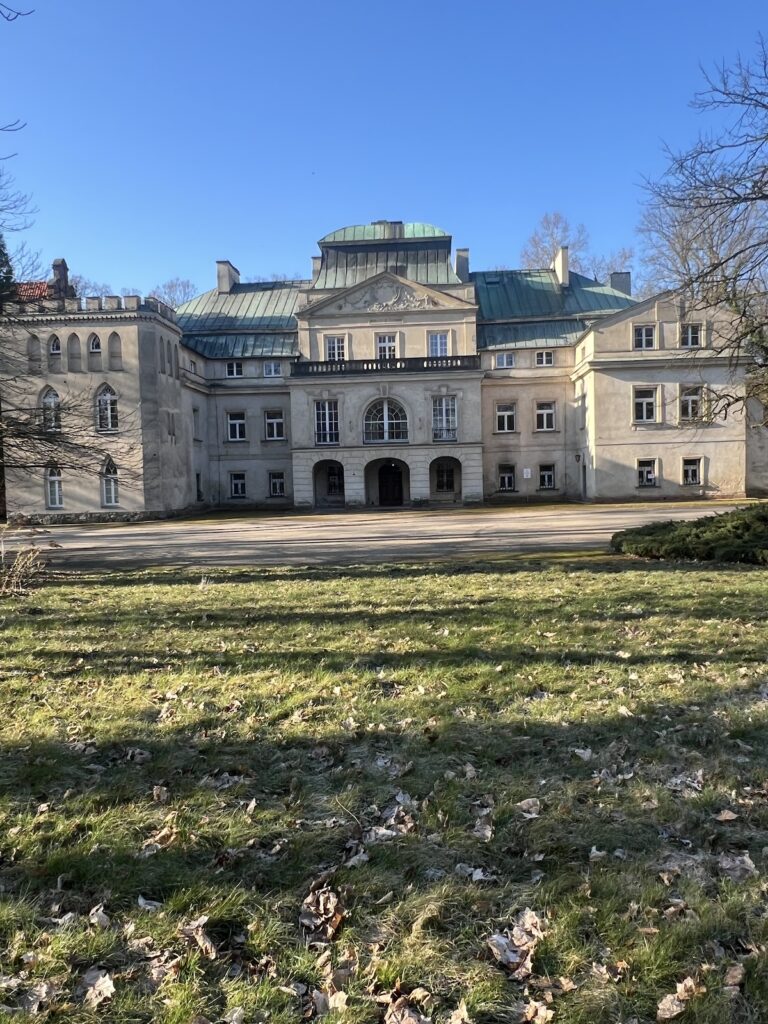
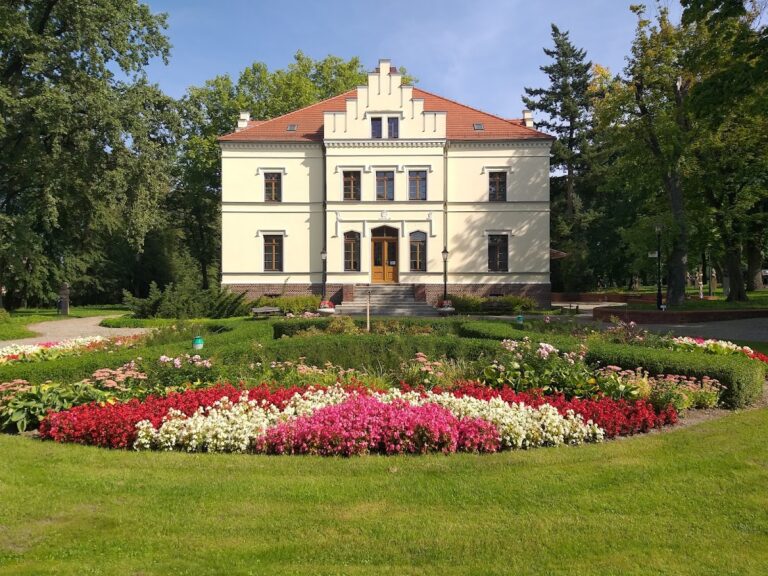
The palace is a two-storey Classicist building on a rectangular plan, covered by a hipped roof. Its front is defined by a portico with four Tuscan columns, a plain Roman column type with smooth shafts and simple capitals and bases. The columns support a pediment containing a cartouche with the Prus III coat of arms of Antoni Barnaba Jabłonowski and the Kierdeja coat of arms of his wife, Tekla Czaplic. The cartouche also bears the Orders of the White Eagle and Saint Stanislaus, major Polish orders of chivalry and merit.
Part of the original interior decoration survives, including stucco work and furniture. The palace and its associated buildings form a largely coherent architectural ensemble. Classicism dominates the main residence, while the outbuildings show Baroque influences, with the more elaborate and dynamic decoration associated with that style.
North Wing
The north wing was added in 1902 by Grand Duke William Ernest of Saxe-Weimar-Eisenach. It contains numerous guest rooms and forms part of the later development of the palace complex.
Stable and Coach House
The former distillery was converted into utility buildings identified as a stable and coach house. These structures belong to the estate’s earlier transformation from a manor into a larger residential and agricultural complex.
Park
An English-style park lies behind the palace and covers 10.95 hectares. It was established during Antoni Barnaba Jabłonowski’s expansion of the manor into a palace and remains an important component of the estate’s layout.
Architectural Attribution
The palace’s design is most commonly attributed to Dominik Merlini, who also created the Royal Łazienki complex, a historic park and palace complex in Warsaw, and designed the Jabłonowski residence in Warsaw and the palace at Rogalin. The attribution remains uncertain, since Jan Chrystian Kamsetzer may instead have designed the palace in its present form.
Nearby sites