Rabenstein Castle: A Medieval Hill Castle in Bavaria


Site at a Glance
- Rating
- 4.5
- Popularity
- Medium
- Country
- Germany
- Primary era
- Medieval
- External website
- Open
- Eras represented
- Medieval, Early Modern, Modern
- Civilizations
- German, Holy Roman Empire
- Site type
- Military
- Remains
- Castle
On this page7 sections
History
Medieval origins and expansion
Rabenstein Castle is a former high-medieval aristocratic castle in Ahorntal, Bavaria, Germany. Its oldest parts date from the 12th century, although the precise construction date is uncertain. The castle was built in the lordship of Waischenfeld by the Rabenstein ministerial family, members of the medieval service nobility who held offices and estates for higher-ranking lords. The family served the nobles of Waischenfeld and bore a raven on its coat of arms.
The castle stood in a strategically elevated position above the Ailsbach valley. Its outer ward, a secondary fortified enclosure for additional buildings and functions, was expanded in the early 13th century. During the following centuries, ownership and occupation changed several times. Rabenstein Castle was associated with the House of Schlüsselberg and with the burgraves of Nuremberg, noble officials who held authority over the burgraviate of Nuremberg.
War, rebuilding, and family restoration
The castle was destroyed in 1450 during the First Margrave War, a mid-15th-century conflict in the Holy Roman Empire. Conz of Wirsberg began rebuilding it in 1489. In 1557, the von Rabenstein family acquired the castle and reclaimed it as their ancestral seat. Daniel of Rabenstein remodelled the complex in 1570, incorporating the former outer ward into the main ward, the principal fortified enclosure.
During the Thirty Years’ War, the major European conflict fought from 1618 to 1648, imperial troops completely destroyed the castle. Its lord, Hans Christoph of Rabenstein, had sided with the Swedes. From 1648 to 1728, only small buildings and a farm were re-established beside the farmyard, preserving a limited form of occupation after the destruction.
Later remodelling and present use
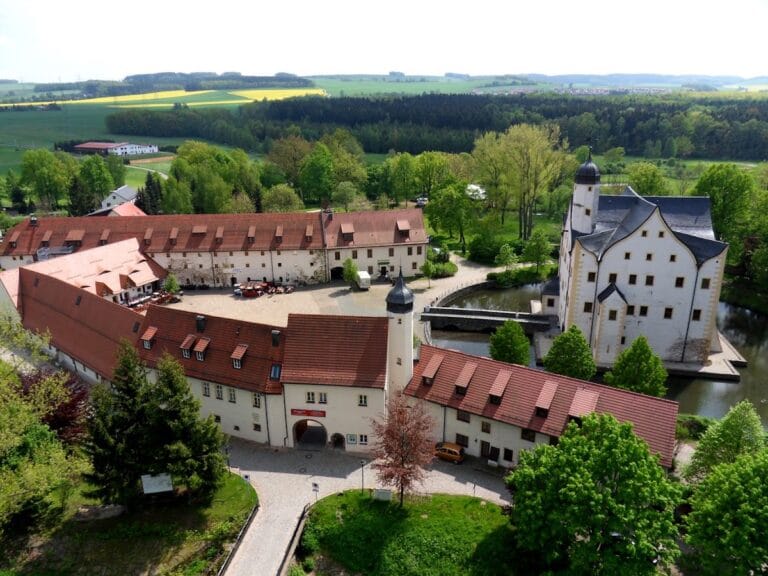
The von Rabenstein family died out in 1742, and the castle then passed to the counts of Schönborn-Wiesentheid. They remodelled the ruins in 1829 and 1830 for a royal visit by Ludwig I of Bavaria, who ruled as king from 1825 to 1848 and supported the arts and architecture. In the recent past, Rabenstein Castle was converted into a hotel used for events and conferences. The castle is preserved, with substantial parts of the complex surviving.
Remains
Hilltop setting and castle complex
Rabenstein Castle is a spur castle, a fortified site built on a projecting ridge or rocky spur, at approximately 420 metres above sea level. It occupies a rocky hill spur above the Ailsbach valley in Franconian Switzerland, within the Franconian Switzerland–Veldenstein Forest Nature Park and about 6.5 kilometres northwest of Pottenstein. The elevated setting forms part of the castle’s defensive position.
The historic complex consisted of a main ward and an outer ward. Daniel of Rabenstein’s remodelling in 1570 brought the former outer ward into the main ward, changing the relationship between the two principal parts of the castle. After the destruction of the Thirty Years’ War, small buildings and a farm stood beside the farmyard. The surviving ruins were remodelled in 1829 and 1830, producing the form in which substantial parts of the castle remain.
Associated cave and falconry centre
Sophie’s Cave, a dripstone cave, lies within walking distance of Rabenstein Castle. Beside the castle are a falconry centre and an estate tavern with a beer garden. The falconry centre keeps more than 80 species of birds of prey and conducts research and educational work, adding a continuing institutional use to the historic castle setting.