Rýzmburk: A Gothic Castle Ruin in Czechia


Site at a Glance
- Rating
- 4.1
- Popularity
- Very Low
- Country
- Czechia
- Primary era
- Medieval
- Eras represented
- Medieval, Early Modern
- Civilizations
- Habsburg, Holy Roman Empire, Kingdom of Bohemia
- Site type
- Military
- Remains
- Castle
On this page13 sections
History
Rýzmburk is a Gothic castle ruin in Czechia, in the settlement of Rýzmburk near Česká Skalice. Probably founded at the beginning of the fourteenth century by Albert of Rýzmburk, it formed part of the network of castles associated with the defense of medieval Bohemia. Its first written mention dates from 1319, when Albert was its known owner. He held the castle until 1346, when he died at the Battle of Crécy, a major English victory over France during the Hundred Years’ War.
The Rýzmburk family and medieval ownership
The castle remained with Albert’s descendants until the first half of the fifteenth century, although ownership was sometimes divided. Děpolt of Rýzmburk held it in 1355, while at least part of the property belonged to Pešek and Mladota of Stračkov in 1358. In 1395, Tas of Rýzmburk, a canon of Jaroměř, transferred the castle to his nephew Beneš of Rýzmburk.
In 1417 Beneš secured a dower for his wife Anna on Rýzmburk, the adjoining demesne farm, and the town of Žernov. A demesne farm was an agricultural estate operated directly for its lord. The dower amounted to 250 kop of groschen, each kop consisting of sixty groschen. Beneš died shortly afterward, beginning a period in which the estate changed hands amid the political upheavals of fifteenth-century Bohemia.
The Hussite Wars and royal control
During the Hussite Wars, the religious and political conflicts that followed the death of the reformer Jan Hus in 1415, Emperor Sigismund granted Rýzmburk to Oldřich of Černčice. Oldřich is recorded as its owner in 1426 and 1427. The castle then passed to Arnošt of Kácov, before returning to Beneš of Rýzmburk after the Battle of Lipany in 1434. That battle marked the defeat of the radical Hussite forces.
After Beneš died, Anna inherited Rýzmburk. When she later died, the property reverted to the ruler as escheated property. Jan Zajíc of Hazmburk sought the estate in 1456 despite opposition from another Beneš of Rýzmburk, and King George of Poděbrady granted Jan’s claim in 1463. Jan Zajíc sold the castle in 1487 to Henry of Münsterberg.
Sixteenth-century transformations
In 1502 Henry transferred Rýzmburk to Peter of Dubá and Adršpach, who made it his residence. Peter’s financial difficulties led him to sell villages from the estate. In 1508 he transferred Rýzmburk, Úpice, Žernov, Červená Hora, and other villages to his wife Eliška of Smiřice and their children, while placing Litoboř under mortgage. The remaining estate was eventually mortgaged to his principal creditors, Zdeněk Lev of Rožmitál and Jan Krušina of Lichtenburg.
In 1534 Zdeněk Lev and Jan Krušina sold the unrepaid mortgage estate to Jan of Pernstein for 5,950 kop of groschen. The holding included Rýzmburk and Skály, several castle ruins, the towns of Žernov, Červená Hora, and Stárkov, and numerous villages. Another interpretation holds that Jan acquired Rýzmburk by inheritance through the marriage of his father Vilém’s daughter to Peter of Dubá and Adršpach.
Under Jan of Pernstein, the lordly residences on the Rýzmburk estate fell into disuse. In 1544 Jan sold the Rýzmburk and Skály estates to Bernard Žehušický of Nestajov for 6,050 kop of groschen. Bernard moved from Tupadly to Rýzmburk and had the castle restored. He died childless in 1563, and the property passed to his uncle Jan Žehušický of Nestajov, who died the following year.
The estate then passed to Hertvík Žehušický of Nestajov. Hertvík and his wife Bohunka, née of Hustířany, normally lived at Svojanov but also used Rýzmburk from time to time. Hertvík died in 1578 or 1579, leaving Bohunka widowed. A settlement dated 6 April 1576 assigned Rýzmburk to Magdaléna, Alžběta, and Ludmila. Their identities are uncertain, since they are described either as Hertvík’s sisters or as Bohunka’s.
To pay debts, the women sold parts of the estate, and Rýzmburk passed to Magdaléna, the wife of Adam Úlibský of Újezdec and Kounice. Magdaléna sold most of the property. By the end of her tenure, the estate included a brewery, demesne farm, mill, sawmill, oil mill, game preserve, the towns of Žernov and Červená Hora, and the villages of Všeliby, Stolín, Mstětín, Víska, and Olešnice.
In 1589 Magdaléna transferred these holdings to Bedřich of Újezdec and Kounice, who lived at Kamenice. He secured a share of 9,500 Meissen groschen on the estate for his wife, Anna of Kounice. Bedřich sold the indebted property in 1595 to Vilém of Talmberk, the last lord to reside at the castle. After Vilěm’s death, his brother Jan inherited the estate and sold the castle and lordship on 12 April 1601 to Zikmund of Smiřice, acting as guardian for his ten-year-old ward, Albrecht Václav of Smiřice.
Abandonment and dismantling
Rýzmburk ceased to be maintained after 1601. The Smiřice possessions were confiscated after the family’s involvement in the Bohemian Estates Revolt of 1618 and the defeat at the Battle of White Mountain in 1620. The Habsburg monarchy suppressed the revolt, and confiscations of rebellious nobles’ property followed in 1621.
In 1623 the Bohemian Chamber sold Rýzmburk with Náchod to Maria Magdalena Trčka of Lípa. Náchod passed in 1628 or 1629 to her son Adam Erdmann, and after his death in 1634 the lordship was confiscated again. During the Thirty Years’ War, imperial troops plundered Rýzmburk in 1634, followed by Swedish troops in 1641. From the end of the seventeenth century, the abandoned castle was dismantled for building stone. Stone was used at a nearby agricultural court and, between 1705 and 1708, in the construction of Ratibořice Chateau. Dismantling continued after 1848.
In 1798 Duke Peter Biron had a pavilion built within the ruins. Rýzmburk is protected as a cultural monument of the Czech Republic and is owned by Lesy České republiky.
Remains
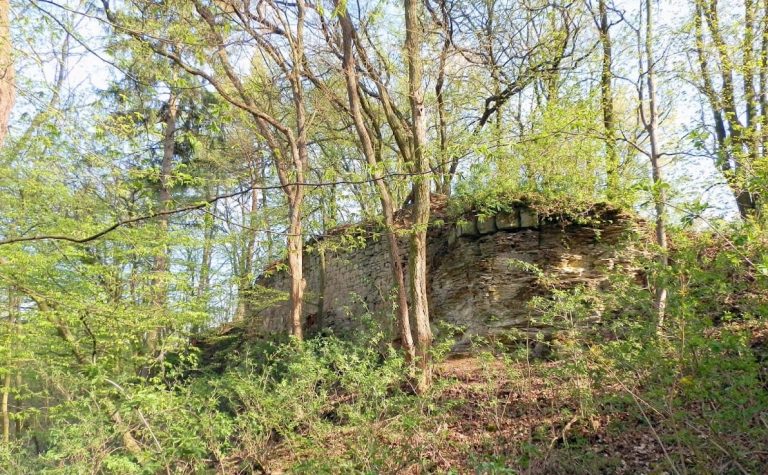
Rýzmburk occupies the edge of a marlstone plateau above the left bank of the Úpa in the area of Babiččino údolí. The castle originally had two parts, but the outer bailey has not survived. The remaining castle core was protected on its front side by two ditches, with a partly preserved rampart between them. Small masonry remains at the rampart’s northeastern end may represent a former bastion, a projecting gun platform.
Castle core and defenses
Ramparts and ditches
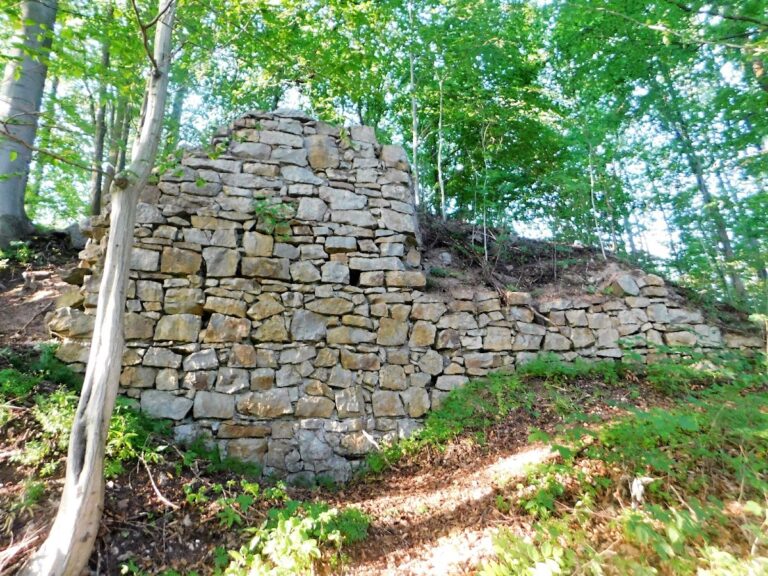
The surviving earthworks define the defensive approach to the castle core. Two ditches separated the front of the stronghold from the surrounding ground, while the rampart between them added another defensive line. Only terrain remains of these fortifications, accompanied by indistinct masonry fragments. The small remains at the northeastern end of the rampart may belong to a former projecting defensive structure.
Northern buildings
A range of buildings once stood along the northern side of the castle core. It is now represented by small masonry remnants of basement spaces with traces of barrel vaults. A barrel vault is a continuous curved ceiling shaped like the lengthwise half of a cylinder. Further buildings may have occupied the entrance side, although that area may instead have contained a curtain wall protected by a zwinger, an outer defensive space between fortifications.
The castle’s original form cannot be reconstructed precisely. It was probably built without a tower and may have belonged to the mantle-wall type, in which a high enclosing wall provided the main defense rather than a dominant central tower.
Economic building and later pavilion
Western three-storey building
A three-storey building closes the western end of the second ditch. It probably dates from the early modern period and was most likely connected with the castle’s economic operations, possibly including its brewery. The ground floor contains three rooms, while each upper storey consists of a single space. The rooms had barrel-vaulted ceilings.
Pavilion in the ruins
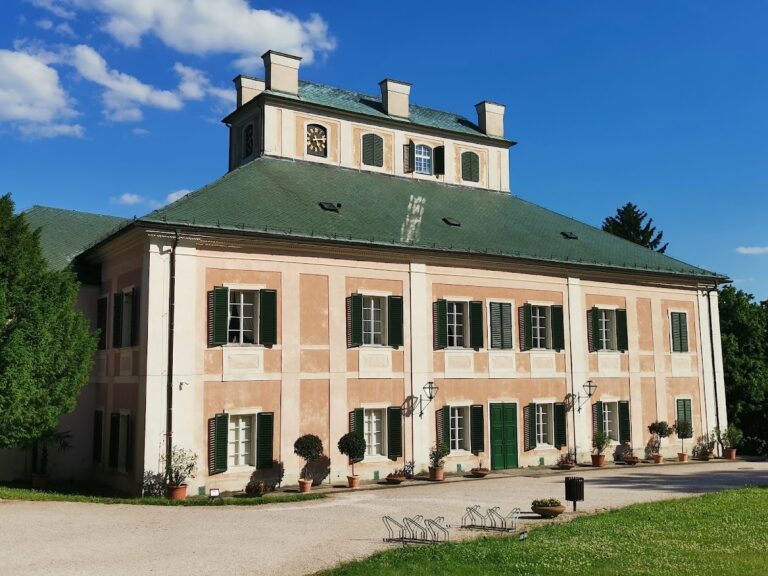
The pavilion built in 1798 by Duke Peter Biron stands within the castle ruins. It belongs to the later history of the site, after Rýzmburk had been abandoned and its masonry was being reused elsewhere.
Archaeological finds
Metal objects found on the western slope below the castle in 1994 and 1995 are deposited in the Museum of Eastern Bohemia. The assemblage consists mainly of building fittings, especially nails. Some nails indicate that shingles were used as roofing material. Military finds include an arrowhead for a bow and fragments of armor dating from the fourteenth to the beginning of the fifteenth century.
Other recovered objects include knives, a razor, a hinge from a small piece of furniture, and a small key from a spring lock, a lock operated by a spring mechanism. Earlier finds included fragments of Renaissance glazed stove tiles and other pottery. Together, these objects illuminate construction, domestic activity, and military use at Rýzmburk.
Nearby sites