Rūjiena Fortress: A Livonian Order Frontier and Grain-Storage Castle in Latvia


Site at a Glance
- Rating
- 4.2
- Popularity
- Very Low
- Country
- Latvia
- Primary era
- Medieval
- Eras represented
- Medieval
- Civilizations
- Livonian Order, Teutonic Order
- Site type
- Military
- Remains
- Castle
On this page12 sections
History
Rūjiena Fortress is a medieval Livonian Order castle in Latvia, built as an auxiliary, administrative, and economic stronghold on the right bank of the Rūja River. Its stone construction is uncertainly dated to 1257, 1263, or 1272, within the medieval period. The fortress formed part of the Order’s grain-storage network for the southern Sakala and northern Tālava regions and guarded the frontier between the Livonian Order and the Archbishopric of Riga.
Early foundations and Livonian administration
An earlier wooden castle called Metsepole stood on the right bank of the Rūja about 3 kilometres from the present town centre. Chronicles dating from 1125 state that forces from Saaremaa destroyed it. The connection between this predecessor and the later stone fortress forms part of Rūjiena’s early history. After the Battle of St. Matthew’s Day in 1217, the surrounding region, formerly associated with Metsepole or Sakala, came under the Sword Brothers and their allies. Rūjiena later became part of the territory controlled by the Livonian Order.
The date of the stone castle’s construction remains uncertain. One tradition attributes construction in 1263 to Burchard von Hornhausen, a senior Teutonic Order official who served as landmeister, or regional head, of the order. By the early fourteenth century, a stone castle and an associated Catholic church had been established. The fortress was administered by the bailiff of Karksi, an official responsible for governing an Order territory, together with the castles of Karksi, Trikāta, Burtnieki, and Helme. These sites supported the storage of grain for the surrounding regions.
Early fourteenth-century records preserve forms of the name including hove to Ruyen, Rugen hof, and Rujen. A 1414 document refers to the Rūjiena estate, while a record from 1442 places it on the road from Burtnieki Castle to the Order’s northern possessions. Livonian Order masters and other travellers frequently stayed at the fortress. A settlement beside it was recorded in 1461. By 1467, Rūjiena appeared in a list of Livonian castles, belonged to the bailiff of Karksi, and was administered by an Order official. During the fifteenth century, it also served frequently as a residence for the Livonian Order master.
Raids and the Livonian War
Russian forces under Ivan III, the grand prince of Moscow, raided the fortress in 1481. During the Livonian War, the conflict of 1558 to 1583 in which Russia, Poland-Lithuania, Sweden, Denmark, and local Livonian forces fought for control of Livonia, part of the Order’s army wintered at Rūjiena in 1558. The nearby town burned in May 1559 after a soldier’s negligence caused a fire.
On 2 February 1560, a Russian force of about 5,000 men reached Rūjiena but did not attack the fortress, where local German nobles had taken refuge. A separate Rūjiena commandery, an Order administrative and military district headed by a commander, existed in 1559 and 1560 under Heinrich von Galen, its only commander. Russian detachments raided the surrounding area in August 1560. On 3 September, Russian forces burned the fortress after its defenders surrendered. A contemporary chronicle described it as small and weak. During the wider war, the stronghold was also occupied, looted, and temporarily restored.
Polish and Swedish rule
In 1562, the Rūjiena region passed to Poland. King Sigismund Augustus pledged Rūjiena and six other castles to the Swedish prince John, later King John III, who placed them under Johann Artz. Gotthard Kettler began recovering the pledged castles for the Polish administration in 1563.
In 1574, Rūjiena’s starost, a Polish territorial administrator, was the cavalry officer Maciej Dembiński. The fortress remained in poor defensive condition after its recovery from Russian control, although the Poles probably repaired it. In 1575, it was voluntarily surrendered to forces led by Duke Magnus. Polish Livonian nobles and the Duke of Courland later failed to recover the group of castles, although Rūjiena was eventually retaken, probably in a heavily damaged state.
Magnus and his supporters controlled the fortress in 1578. After men serving the Polish starost of Burtnieki captured nearby Burtnieki Castle, Rūjiena was no longer defensible and lost its military importance. In 1582, or possibly 1587, King Stefan Batory granted Rūjiena Castle and the Karksi and Tarvastu starostships for life to Georg Fahrensbach. The fortress was in Jesuit hands in 1584. In 1596, the same rights were extended to Georg’s son Woldemar Fahrensbach, who served as Rūjiena’s starost from 1600 to 1623.
In 1622, King Gustavus Adolphus granted the Rūjiena starostship as a fief to Jasper Mattsson Krus, the royal financial administrator. It later returned to the Swedish crown during the reduction of estates and was subsequently granted again under Emperor Paul I of Russia. A Swedish inspection record from 1624 states that Polish forces had destroyed the fortress during the Polish-Swedish War. It was probably no longer habitable or usable during the seventeenth century.
Final destruction and protection
During the Great Northern War, the conflict of 1700 to 1721 in which Sweden fought a coalition led by Russia for control of the Baltic region, Rūjiena was occupied and destroyed in 1704. It was not rebuilt. The castle area became property of the Latvian state in 1922 and is protected as a state monument.
Remains
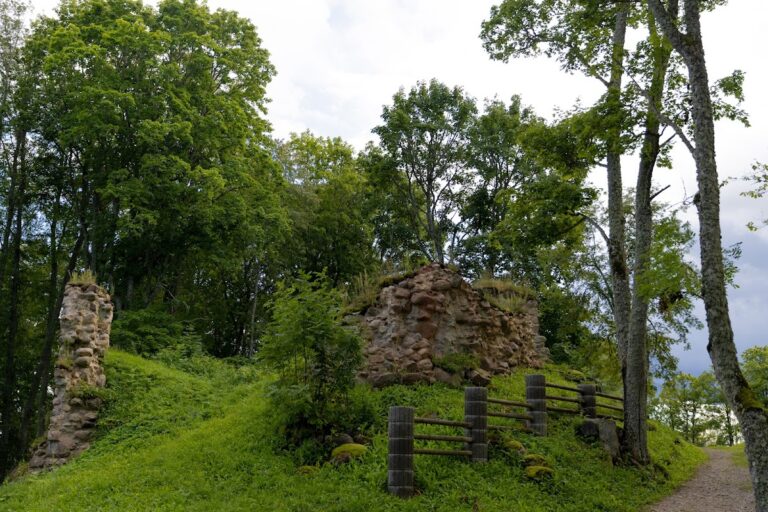
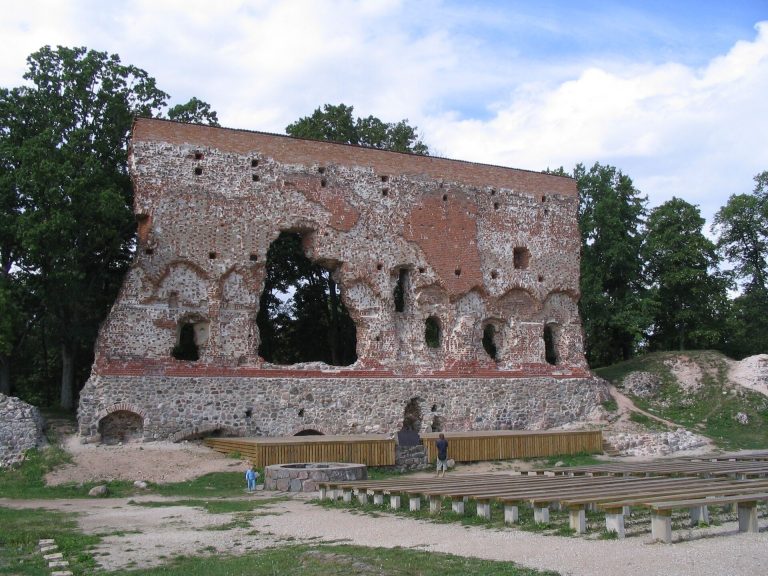
Rūjiena Fortress occupies a high hill on the eastern edge of present-day Rūjiena, above the right bank of the Rūja River. Its plan follows the natural terrain in an irregular polygonal or oval shape. The castle was a Mantelmauer fortress, a castle whose high enclosing wall formed the principal defensive shell around buildings set against its inner face. Deep ditches surrounded the hill, while a dam added water protection. A bridge crossed the ditch on the western side, and a small southern exit faced the mill dam on the river to the southwest.
Enclosure and defensive works
Ring wall and ditches
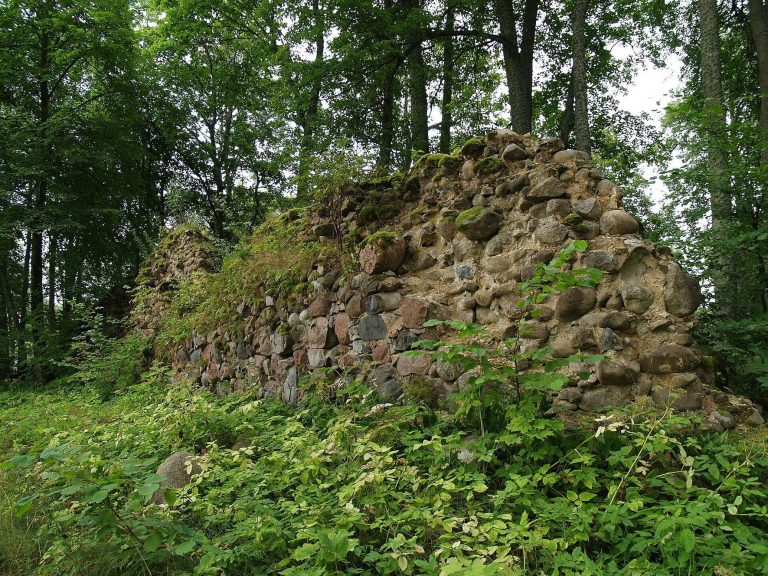
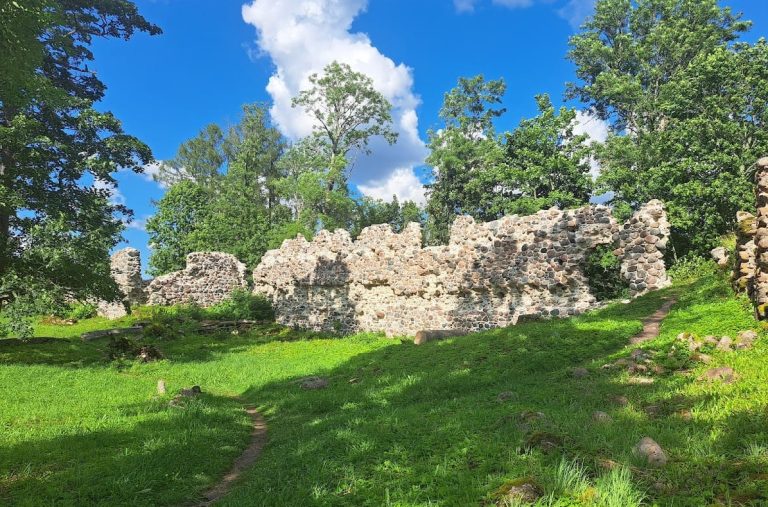
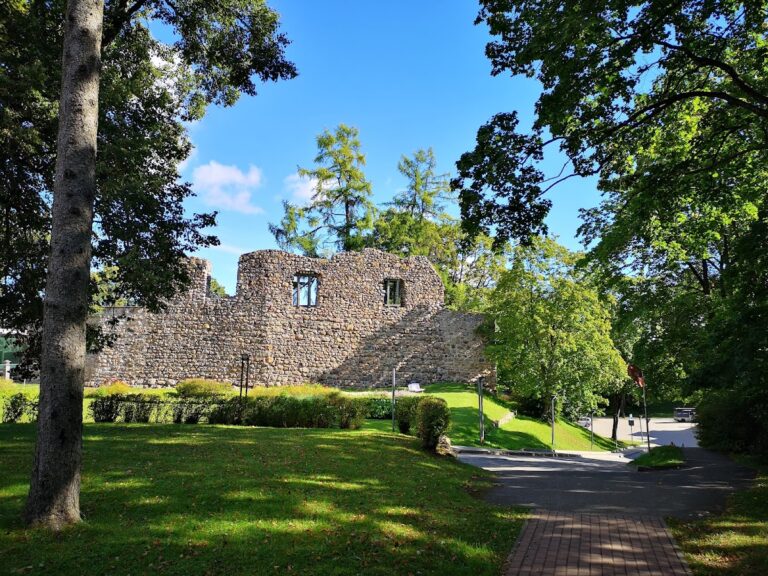
The defensive enclosure was built largely of fieldstone, with walls about 1.5 to 2 metres thick. Surviving fragments of the ring wall generally rise about 2 metres and are largely covered by fallen rubble, although some sections stand higher. The ditches remain relatively deep and are partly filled with fieldstones that fell from the walls. Stones were later removed from the fortress for construction of the mill dam.
Entrances and towers
The original western entrance lay within the ring wall. A gate structure was later added outside it, and the western gate area also contained a quadrangular defensive tower. On the northern side, another quadrangular tower rested against the massive outer wall. It did not originally provide flanking fire. A later semicircular tower, about 8 metres in diameter, was built against the northern exterior during the period when firearms had become important.
Internal buildings and surviving fabric
Building wings
Three masonry wings stood within the enclosure, arranged against the inner face of the surrounding wall and expanded as required. Their walls were approximately 1.3 metres thick. The surviving remains include fragments of the northern wing, its eastern wall, the foundation walls of the southwestern wing, and the southeastern corner of the castle.
Eastern and southern remains
Other surviving fabric includes sections of the eastern enceinte and portions of the wall south of the main gate. The southern side of the castle hill falls steeply toward the Rūja valley. The castle area is largely open, with few trees, so the remaining earthworks and wall fragments are broadly visible across the hilltop.