Château de Bourbilly: A Medieval Castle in France


Site at a Glance
- Rating
- 4.5
- Popularity
- Very Low
- Country
- France
- Primary era
- Medieval
- External website
- Open
- Eras represented
- Medieval
- Civilizations
- Duchy of Burgundy, French
- Site type
- Domestic
- Remains
- Castle
On this page8 sections
History
Château de Bourbilly is a fourteenth-century medieval and Gothic castle in France, in the commune of Vic-de-Chassenay. Known also as the Château of Madame de Sévigné, it developed from a modest fortress into a residence that passed through many of Burgundy’s leading families before undergoing major restoration in the nineteenth century.
From royal estate to feudal lordship
Under the Merovingian and Carolingian dynasties, successive Frankish ruling houses, the lands of Bourbilly belonged to the royal fisc, meaning land held directly by the Crown. The estate depended on Époisses, which was associated with Queen Brunehaut and her grandson Thierry. In 1032, the fief was transmitted to Robert of France, the first Capetian duke of Burgundy.
On 24 July 1189, Duke Hugues III exchanged Époisses, including Bourbilly, for Montbard, which André de Montbard ceded to him. Bourbilly later returned to André’s brother, Bernard of Époisses. At the beginning of the thirteenth century, Bourbilly was detached from the lordship of Époisses along with Vignes and Chevigny. Jean of Époisses then had a modest fortress built at Bourbilly.
In 1270, the fief passed through the marriage of Jean of Époisses’s eldest daughter, Haramburge, to Garnier of Traînel. Their daughter Alixande de Traînel inherited it, and around 1285 Bourbilly passed to Alixande’s daughter, Agnès de Marigny. Her inheritance brought the estate into the family of her husband, Poincet de Thil. A dispute later arose between Guillaume de Mello, lord of Époisses, and Guillaume de Thil. On 22 February 1320, Eudes III of Burgundy settled the matter by ending the claims of the lords of Époisses over Bourbilly.
The fourteenth-century residence
In 1333, the lordship passed through Marie de Thil to the Beaujeu family. After Édouard de Beaujeu died in 1353, it went to his son Antoine, who died without children on 12 August 1374. His sister Marguerite de Beaujeu, the wife of Jacques de Piémont, then inherited Bourbilly.
From 1375, Marguerite remodeled the castle as a pleasure residence and commissioned a chapel dedicated to Saint Margaret, a Christian saint. The works were completed in 1379. Her second son, Louis de Piémont, inherited Bourbilly, continuing its connection with the family of its builders and renovators.
From La Trémoille to the Rabutin family
On 4 October 1403, Bourbilly was sold to Pierre de La Trémoille, baron of Dours, counsellor to King Charles VI of France and chamberlain to Duke Philip the Good of Burgundy. In 1405, Pierre entrusted the castle to his nephews. From 1410, Guy de La Trémoille held the fief alone, and it later passed to his son Louis de La Trémoille, count of Joigny.
In 1448, Claude de Montaigu, lord of Couches, acquired the domain and left it to his illegitimate daughter Jeanne. Her marriage in 1467 brought Bourbilly to her husband, Hugues de Rabutin. The property remained associated with the Rabutin family for generations.
Bourbilly was connected with Jeanne de Chantal, who gave birth there to several of her children, including Celse-Bénigne de Rabutin and Françoise de Rabutin-Chantal. Her granddaughter, Madame de Sévigné, the seventeenth-century French aristocrat and celebrated letter writer, stayed at Bourbilly several times, including during her honeymoon. She later transmitted the castle to her daughter, Françoise de Grignan, after which it left the Rabutin family.
Later owners and restoration
After Madame de Grignan died in 1704, her daughter Pauline de Simiane inherited Bourbilly. She sold the domain to Guy Chartraire de Saint-Agnan on 16 July 1719. The Chartraire de Saint-Agnan family retained it until 1795.
Frédéric-Augustin Pomme acquired Bourbilly in 1795, demolished several parts of the castle, and remodeled what remained. He sold it to the Parisian notary Antoine-Joseph de Caux on 9 July 1814. Further demolitions followed, before the castle experienced an elegant revival during the Romantic period.
The property passed from Antoine-Joseph de Caux to his daughter and then to his granddaughter, Cécile Belle de Caux, who married Ernest de Franqueville. Their son Charles de Franqueville became the owner and directed a complete restoration of the building between 1867 and 1871. In 1862, Bourbilly was provisionally placed on the list of historic monuments. It was definitively listed as a French historic monument by an order dated 19 March 1992, a designation that provides legal protection to an important building or site.
The chapel had been partly destroyed by fire and was restored in 1952 through the combined efforts of the family, the sculptor Yencesse, the medievalist Surchamp, and the master glassmaker Wending. In the twenty-first century, ownership has been associated with the de Crépy family, with Raoul de Crépy identified as the current owner.
Remains
Castle and park
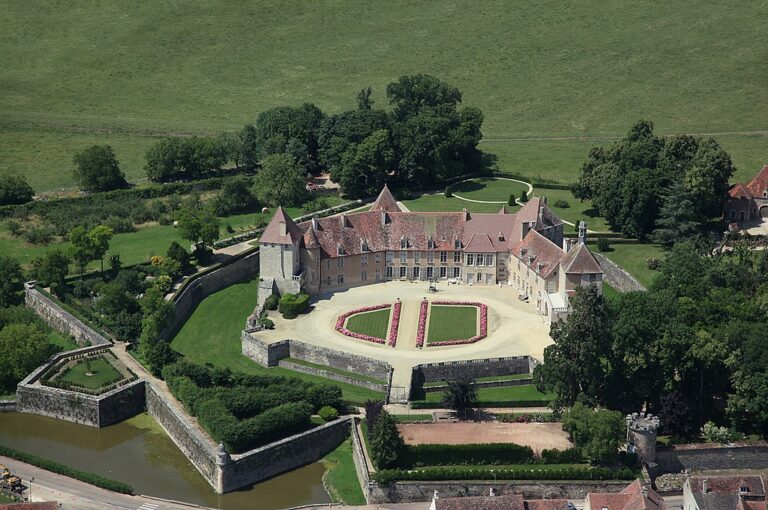
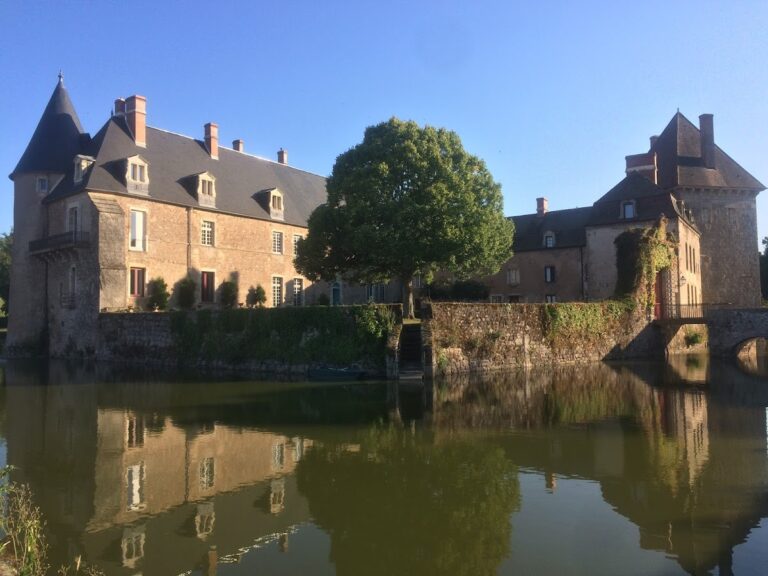
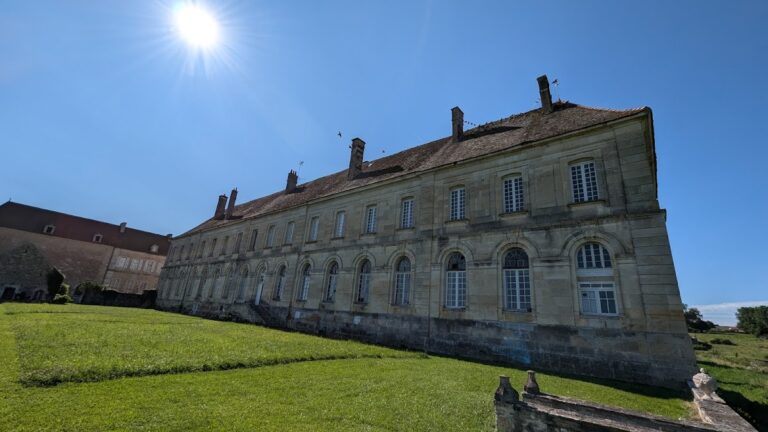
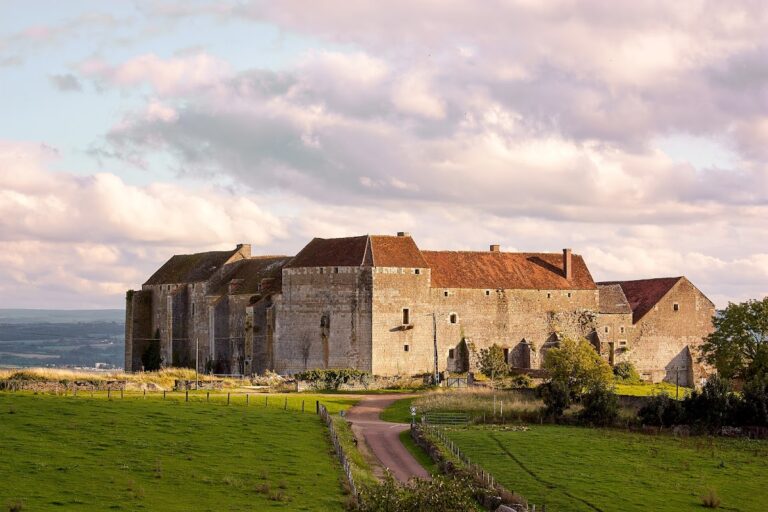
Château de Bourbilly stands in the valley of the Serein, within a secluded hollow surrounded by a park. The surviving castle combines medieval and Gothic character with rehabilitation carried out during the Second Empire, the French imperial regime of Napoleon III from 1852 to 1870. Its principal building consists of three wings arranged at right angles and flanked by round towers. High roofs and very fine cylindrical chimneys give the complex a distinctive profile.
The park was enlarged and redesigned under the supervision of Ernest de Franqueville by Alphand. In 1869, de Franqueville prepared the measured plan, carried out grading and hydraulic works, and directed new plantings. These interventions formed part of the nineteenth-century reshaping of the castle estate alongside the restoration of the main building.
Interiors and chapel
The guardroom contains a Louis XIII-style billiard table and a seventeenth-century Flemish tapestry. The term Louis XIII style refers broadly to French furniture and interiors associated with the reign of Louis XIII, from 1610 to 1643. The library has Neo-Gothic wood paneling, a nineteenth-century revival of medieval Gothic forms, and includes a portrait of Saint Jeanne de Chantal by Philippe de Champaigne.
The chapel, founded during Marguerite de Beaujeu’s transformation of the castle in the fourteenth century, contains the fresco of the Visitation created by Surchamp and a stained-glass window made by Wending. A fresco is a wall painting applied to wet plaster, while stained glass is colored or painted glass assembled into a window. Both belong to the chapel’s 1952 restoration after its partial destruction by fire.