Trikāta Castle Ruins: A Medieval Fortress in Latvia


Site at a Glance
- Rating
- 4.6
- Popularity
- Very Low
- Country
- Latvia
- Primary era
- Medieval
- Eras represented
- Medieval
- Civilizations
- Crusader, Livonian Order, Teutonic Order
- Site type
- Military
- Remains
- Castle
On this page8 sections
History
Trikāta Castle ruins are the remains of a medieval fortress in Trikāta, Latvia. The stronghold stood on the site of an earlier hillfort and became an important centre in the historical region of Talava, whose senior leader Talivaldis was killed there in 1215.
Talava and the Livonian Order
Trikāta is mentioned as early as 1208, while the castle itself appears in the Livonian Chronicle in 1215 as Talivaldis’s residence. After the 1224 Treaty of Partition of Talava, control passed to the Sword Brothers, a medieval military order that ruled parts of the eastern Baltic before its incorporation into the Livonian Order.
The Livonian Order, the Livonian branch of the Teutonic Order, is credited with constructing the castle, although its precise building date is uncertain. Hermann von Wartberge’s chronicle states that order master Wilhelm von Nindorf had a church built at Trikāta in 1284. Balthasar Rüssow’s Livonian chronicle also names Trikāta among three castles built by the Livonian Order, together with Valmiera and Burtnieki.
Order administration and wartime occupation
By 1429, Trikāta was the residence of an order vogt, an official who administered a district and could also oversee its castle. During the Livonian War, a sixteenth-century conflict over control of Livonia, the fortress served as a camp for troops of the Livonian Confederation before the Battle of Ermes. Russian forces occupied it from 1577 to 1582.
The 1582 Jam Zapolski Peace Treaty described Trikāta as the citadel of the Trikāta castle district. After the treaty, the area entered the political sphere of the Grand Duchy of Lithuania and later the Polish-Lithuanian Commonwealth. The castle was also assigned to the newly established Catholic Diocese of Wenden, an ecclesiastical district centred on present-day Cēsis.
Swedish rule and destruction
Swedish forces captured Trikāta in 1600 during the Polish-Swedish War. In 1622, King Gustav II Adolf, the Swedish monarch from 1611 to 1632, granted the castle to Chancellor Axel Oxenstierna, Sweden’s leading statesman and chancellor during the Thirty Years’ War.
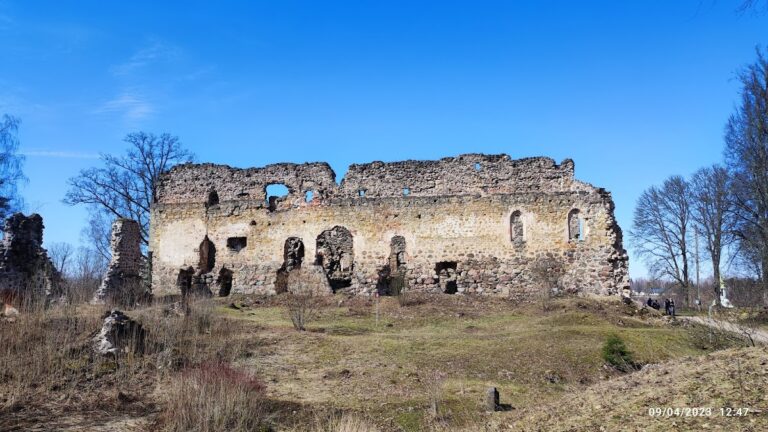
The castle was completely destroyed during the Great Northern War, a wider northern European conflict fought from 1700 to 1721. It survives today as a ruin. In the second half of the twentieth century, an open-air stage was built in the former castle courtyard, giving the site a later public use while retaining its archaeological character.
Remains
Hilltop fortress and enclosed areas
Trikāta Castle occupied a wooded mound rising about 30 metres above a steep bank between Lake Trikāta and the Abuls River. The principal fortress had an oval enceinte, meaning a fortified enclosure defined by its perimeter wall. To the north, a broad outer bailey, an adjoining enclosed defensive area, was separated from the main castle by a moat.
Main castle
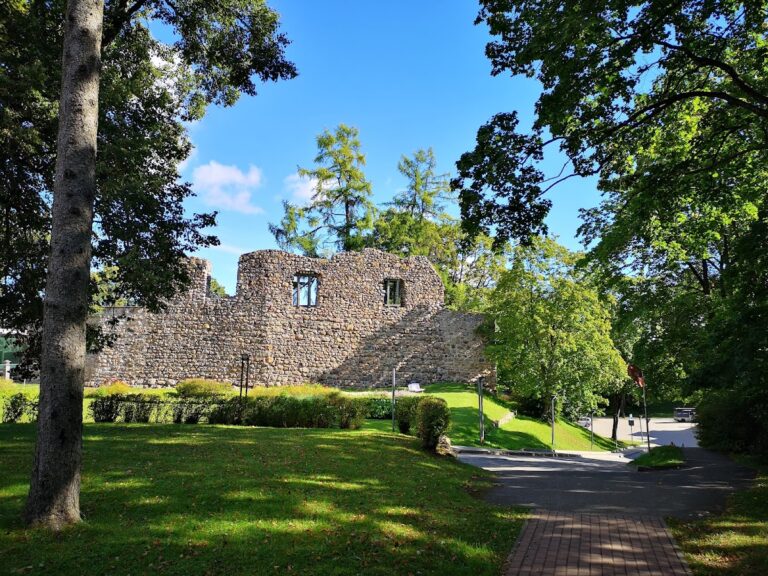
Early twentieth-century remains included sections of the main outer walls, foundations of chambers, and the remains of a residential tower on the eastern side. The surviving southeastern wall stands approximately 2 metres high. The fortress is preserved as a ruin, with its original enclosed form represented by the surviving wall sections and foundations.
Outer bailey
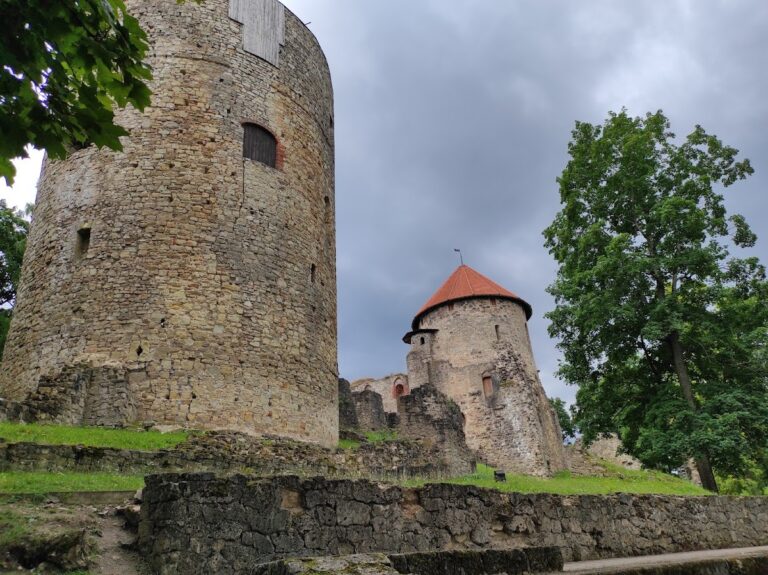
Foundations of the outer-bailey wall survive to the north of the main castle. Fragments of a ruined tower reach approximately 4 to 5 metres in height, providing one of the most substantial surviving elements of the fortified complex. The courtyard later acquired an open-air stage during the second half of the twentieth century.
Nearby sites