Quoile Castle: A Sixteenth-Century Tower House in County Down


Site at a Glance
- Rating
- 4.5
- Popularity
- Low
- Country
- United Kingdom
- Primary era
- Early Modern
- External website
- Open
- Eras represented
- Early Modern
- Civilizations
- Unclassified
- Site type
- Military
- Remains
- Castle
On this page7 sections
History
Quoile Castle is a sixteenth-century tower house in the United Kingdom, located in the townland of Quoile near Downpatrick, County Down, Northern Ireland. Its exact construction date and builder are uncertain, although the work has been associated with Captain Richard West, a military officer. The building combined domestic accommodation with defensive features and remained in use into the eighteenth century.
A fortified residence
Quoile Castle served as a tower house, a tall fortified residence common in Ireland from the fifteenth through the seventeenth centuries. Buildings of this type appear to have been designed chiefly to withstand attacks by small rival militias rather than extended sieges. The castle stood beside the road to Strangford, about 2.4 kilometres from Downpatrick.
Later history and protection
The castle continued in use into the eighteenth century before becoming a ruin. It is now a State Care Historic Monument, meaning that it is a protected historic site under the care of the government of Northern Ireland.
Remains
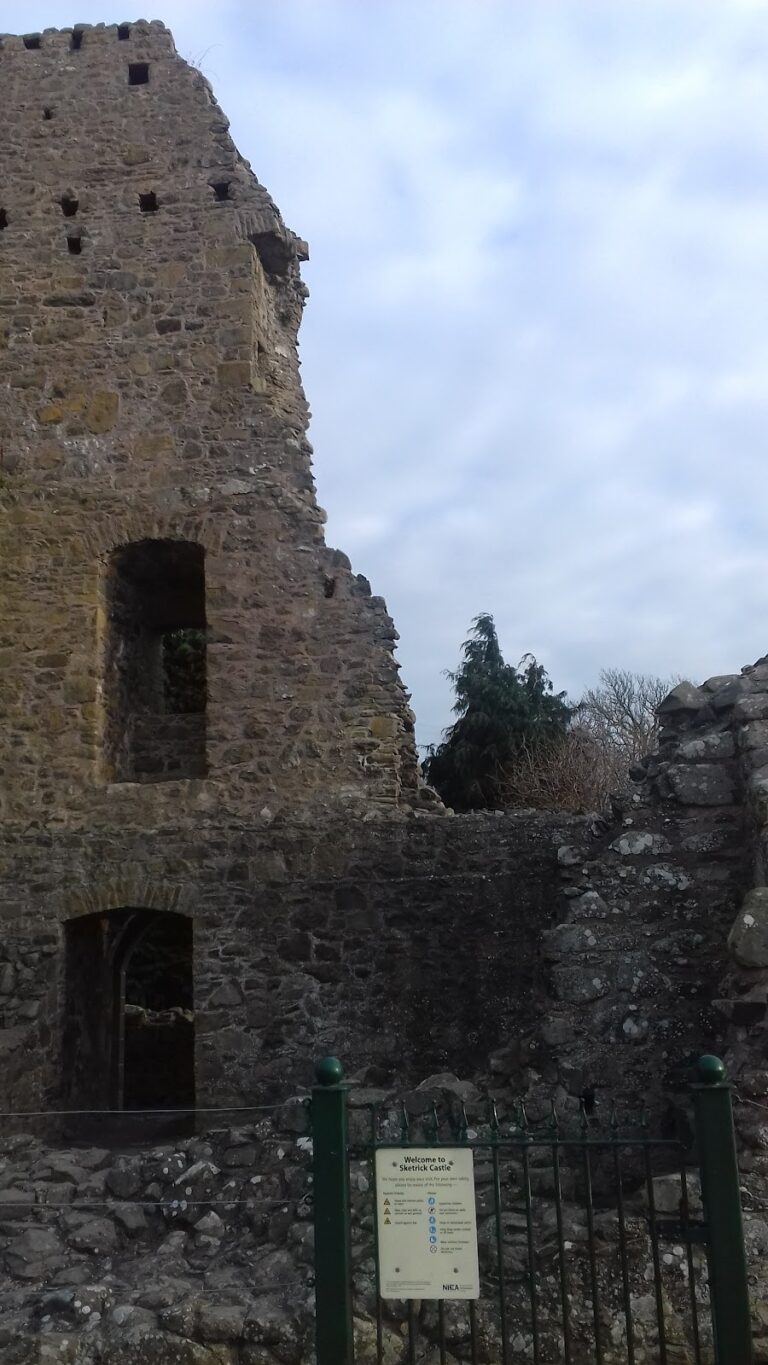
The surviving structure is a ruined tower house constructed from split-stone rubble with sandstone dressing. The southern part, described as the south wall or southeast corner, has collapsed, leaving a vertical section through the interior visible. The remaining fabric reveals a compact, vertically arranged building organized around wall staircases, defended entrances, and rooms on several floors.
Entrance and defensive features
A rebuilt entrance on the eastern side leads to a straight stair set within the wall. Narrow loopholes, or meurtrières, are preserved at both the upper and lower parts of the castle and guarded this approach. The ground-floor entrance opens into a stone-vaulted room containing numerous small loopholes, while a second room of similar size lies beyond it.
Upper-floor rooms
The first floor was divided into two rooms, including one with an open fireplace. Another straight stair in the northwest wall rises to the second floor, where further rooms and another open fireplace survived as part of the ruined structure.
Coins from the excavation
Archaeological excavation at the castle in 1986 uncovered seven silver sixpence coins dating from the reign of Elizabeth I, queen of England and Ireland from 1558 to 1603. Their recovery within the castle provides material evidence connected with the period of its occupation.