Pyramid of the Moon: Teotihuacan’s Ceremonial Temple and Platform
Site at a Glance
- Rating
- 4.8
- Popularity
- Medium
- Country
- Mexico
- Primary era
- Classical
- External website
- Open
- Eras represented
- Classical
- Civilizations
- Teotihuacan
- Site type
- Religious
- Remains
- Temple
On this page11 sections
History
Foundation and expansion
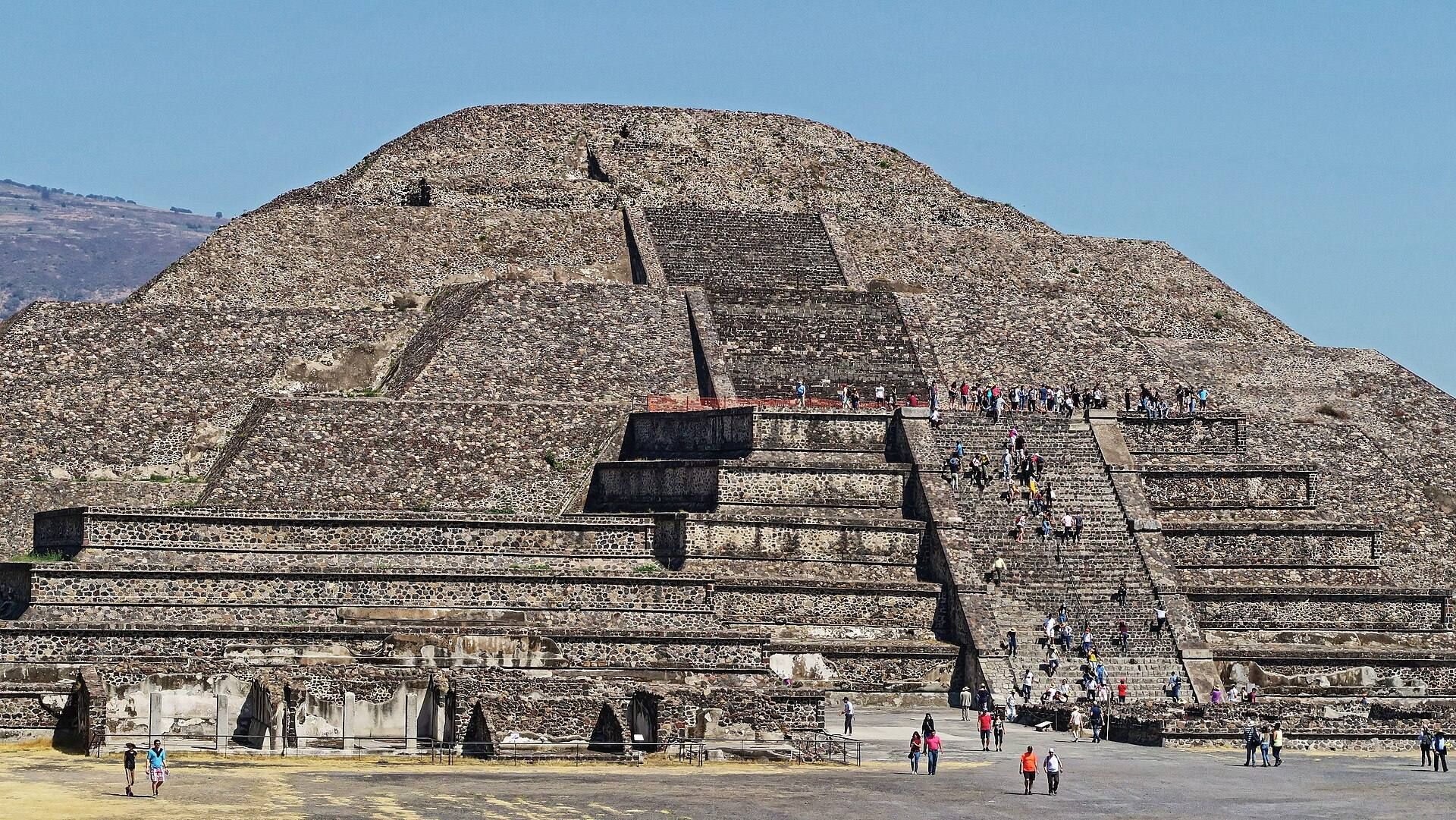
The Pyramid of the Moon is a Teotihuacan ceremonial pyramid and temple in San Martín de las Pirámides, Mexico. Built by the people of Teotihuacan between approximately AD 100 and 450, it formed part of the religious center of a major Mesoamerican city that flourished broadly from about 150 BC to AD 500–650. Its visible architecture uses the talud-tablero system, in which a sloping wall supports a vertical recessed panel. An earlier structure beneath the pyramid existed before AD 200.
The monument stood at the northern end of the Avenue of the Dead, beside Cerro Gordo, and successive additions completed the bilateral symmetry of the surrounding temple complex. Expansion was especially rapid between AD 250 and 400, when changes in construction accompanied the succession of rulers and major shifts in religious and political ideology. The pyramid, road, mountain, and city axes formed part of a cosmological urban plan associated with earth, water, astronomy, ritual movement, and the 260-day calendar.
The pyramid’s seven superimposed building layers show how the monument was repeatedly enlarged and renewed. Each new structure covered or extended an earlier one, allowing the building’s religious power to be renewed while preserving its place within the ceremonial center. The mountain’s form may have been imitated by the pyramid, and Cerro Gordo may formerly have been called Tenan, a Nahuatl name meaning “mother” or “protective stone.”
Ritual and political transformation
The Pyramid of the Moon served as a public ceremonial platform. Its upper area and a sculpture found at the base were connected with the Great Goddess of Teotihuacan, a female deity associated with water, fertility, the earth, creation, and the Moon. This identity is also linked with Chalchiutlicue, a Mesoamerican water goddess associated with water, fertility, and aquatic forces. The Moon Plaza in front of the pyramid functioned as a supra-regional ceremonial, political, and socioeconomic center, as well as a place for astronomical observation and calendar-related activities.
Public sacrifice formed a major part of the pyramid’s ritual use. Human and animal remains were placed during successive construction phases, and the deposits may have represented authority, warfare, femininity, and other parts of Teotihuacan cosmology rather than devotion to one ruler or deity. Five burial complexes, numbered according to their order of discovery, are associated with Buildings 4 through 6. Their appearance alongside the major enlargement of Building 4 has been interpreted by Saburo Sugiyama as evidence of substantial political and military change at Teotihuacan.
Burial 2, associated with Building 4 and dated to about AD 250, contained a west-facing man probably aged 40–50. The deposit included part of another person’s occipital bone, ornaments, figurines, obsidian blades, shells, storm-god vessels, a probable female greenstone figure, and animal remains. Isotopic analysis indicated that the complete skeleton probably originated outside Teotihuacan, supporting the possibility that the man was a war captive sacrificed at the site.
Burial 3, associated with Building 5 and dated to about AD 300, contained four males aged approximately 13–15, 18–20, 20–24, and 40–44. They were probably foreigners, and evidence that they had been bound suggests that they may have been captives. The deposit also held fibers possibly from a mat, greenstone figures, beads, shells, blades, ornaments, and 18 severed heads belonging to wolves, pumas, a jaguar, and a hawk.
Burial 4, associated with Building 6 and dated to approximately AD 350–400, contained 17 middle-aged male heads and fibers probably from material used to gag the victims. The violent character of the deposit has been interpreted as an indication that these individuals held relatively low status. Burial 5, also associated with Building 6 and dated to approximately AD 350–400, contained three individuals whose positions resembled representations of Maya elites. Their hands were unbound, two wore rectangular pectorals, and their ages were estimated at approximately 50–75, 40–50, and 40–45 years. Two pumas and a golden eagle accompanied them, and the burial has been interpreted as belonging to people of exceptionally high status.
Burial 6, associated with Building 5 and dated to about AD 300, contained 12 skeletons. All had bound hands. Two may have held higher status, while the other ten had been decapitated and deposited irregularly. Fragments of approximately 43 animals were also found. Leonardo López Luján and Saburo Sugiyama have proposed that these human and animal deposits formed cosmograms, symbolic arrangements representing the structure or order of the cosmos. The predominance of non-Teotihuacan sub-adult and adult males, together with carnivorous animals associated with warfare, has encouraged the interpretation that many victims were war captives. Sugiyama also linked sacrifice and large-scale construction with the growth of state and military power.
Excavation and interpretation
Excavation beneath the pyramid began in 1998. Tunnels revealed at least six renovations, each larger than and covering the preceding structure. That year, excavators found a tomb associated with the fourth construction phase and dedicated to the Great Goddess. It contained one male sacrificial victim, a wolf, jaguar, puma, serpent, and bird skeletons, together with more than 400 other offerings, including greenstone and obsidian figurines, ceremonial knives, and spear points.
In 1999, a team led by Saburo Sugiyama and Rubén Cabrera discovered a tomb apparently associated with the fifth construction phase. Dated to approximately AD 100–200, it contained four human skeletons, animal bones, jewelry, obsidian blades, and other offerings. These excavations clarified the relationship between the pyramid’s successive enlargements, its sacrificial practices, and its changing religious and political meanings. The archaeological zone of Teotihuacan, including the Pyramid of the Moon, is protected as UNESCO cultural heritage.
Remains
Monument and ceremonial setting
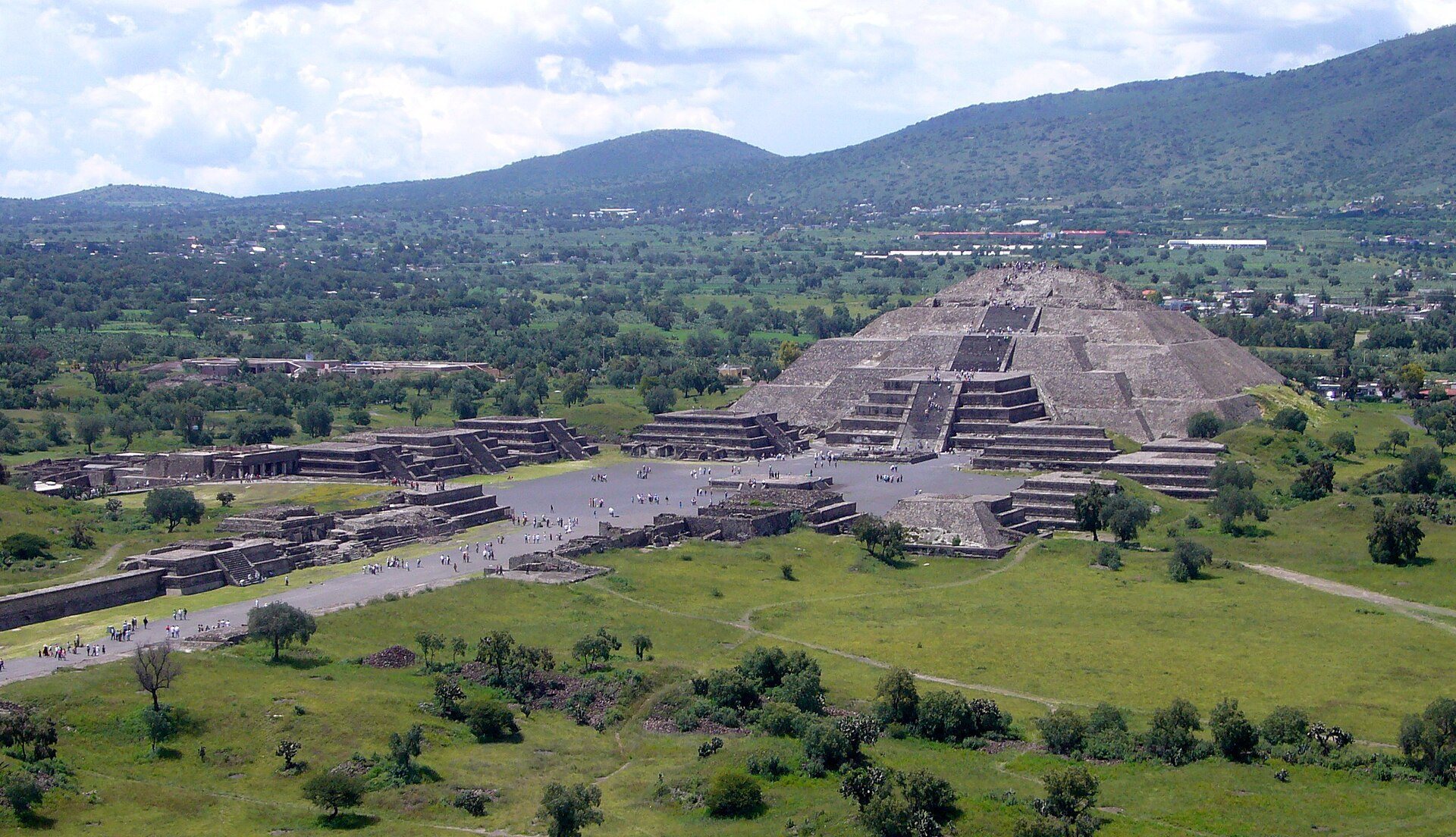
The Pyramid of the Moon is a truncated pyramid and temple at the northwestern end of Teotihuacan’s broader ceremonial center. It rises approximately 43 meters and has a rectangular base measuring about 147 meters from east to west and 130 meters from north to south. Its outline probably imitates Cerro Gordo, while its position at the northern end of the Avenue of the Dead connected the monument with the mountain, the city’s principal ceremonial axis, and the plaza at its base.
Successive pyramid buildings
Building 1, dating to approximately AD 100, was a square pyramidal platform with talud side facades about 23.5 meters long. Building 2 covered it, made a minor enlargement, and corrected its slightly misaligned orientation. Its east–west walls measured approximately 29.3 meters. Building 3 again covered the earlier structure while adding little to the monument’s overall size.
Building 4 greatly enlarged the pyramid to approximately 89.2 meters east to west by 88.9 meters north to south and was completed around AD 250. Building 5 slightly increased the size but introduced a major stylistic change. Its east–west dimension remained unchanged, while its north–south wall reached approximately 104 meters. Talud-tablero construction appeared on both the main body and an attached adosada platform, meaning an additional platform joined to the pyramid. The structure continued to serve as a ritual stage rather than a temple residence.
Building 6 extended the pyramid to approximately 144 meters east to west while leaving its north–south dimension unchanged. It was constructed to contain Burials 4 and 5 around AD 350. Building 7, the final structure and the one visible today, was built around AD 400. The marked stylistic change among the first three buildings may indicate an ideological shift.
Front platform and Moon Plaza
Between approximately AD 210 and 450, a four-body talud-tablero structure was added in front of the staircase facing the Avenue of the Dead. Its upper platform supported ceremonies, and the temple associated with it was dedicated to the water goddess represented by the sculpture found at the pyramid’s base.
The Moon Plaza lies directly opposite the Great Goddess’s altar. It contains a central altar and a distinctive construction divided into four rectangular and four diagonal bodies, an arrangement known as the Teotihuacan Cross. The plaza at the pyramid’s base connected the monument with the Avenue of the Dead and served as a ritual or sacred space. The wider complex included smaller pyramids, rooms, porticoes, patios, corridors, and low platforms.
Burials and offerings
The pyramid’s foundations and internal layers contain human and animal remains, figurines, obsidian and greenstone objects, ceramic artifacts, shells, beads, ornaments, ceremonial knives, spear points, storm-god vessels, and serpent knives. The excavated deposits include felines, canids, birds of prey, snakes, mollusks, and other animals, linking the monument’s physical fabric with its ceremonies and cosmological imagery.
Fourth-phase tomb
The tomb associated with the fourth construction phase contained a male sacrificial victim together with the remains of a wolf, jaguar, puma, serpent, and birds. More than 400 additional objects were placed in the deposit, including greenstone and obsidian figurines, ceremonial knives, and spear points.
Fifth-phase tomb
The tomb associated with the fifth construction phase contained four human skeletons, animal bones, jewelry, obsidian blades, and other offerings. Its contents provide physical evidence for the ritual deposits placed within the pyramid as successive building phases transformed the monument.
The pyramid’s symbolism has been interpreted as connecting the Moon with water, the rainy season, femininity, fertility, and the earth. Its relationship with Cerro Gordo and the Avenue of the Dead has also been theorized as an architectural representation of the watery underworld and an earthly mountain anchor.