Polnoon Castle: A Medieval Stone Fortification in Scotland
Site at a Glance
- Popularity
- Medium
- Country
- United Kingdom
- Primary era
- Medieval
- Eras represented
- Medieval
- Civilizations
- Kingdom of Scotland
- Site type
- Military
- Remains
- Castle
On this page12 sections
History
The Montgomery lordship and castle
Polnoon Castle is a stone fortification near Eaglesham in East Renfrewshire, Scotland, probably completed by Sir John Montgomery in the 1390s. The territory of Eaglesham formed part of a grant from David I to Walter fitz Alan, royal steward and founder of the House of Stewart. The Montgomery family later held Eaglesham. Robert of Montgomery, probably an ancestor of the family, was a prominent tenant of Walter and witnessed a charter to Paisley Monastery around 1160.
In 1368, John de Montgomery married Elizabeth, heiress of the Eglinton family. After the Battle of Otterburn in 1388, Sir John Montgomery captured the English knight Henry Percy, known as Hotspur, and received ransom for his release. Montgomery probably used the money to build Polnoon Castle. Percy may also have helped with the fortification’s design and construction.
A changing family seat
The Montgomerys’ later acquisition of the Eglinton and Ardrossan lordships, along with Eaglesham, reduced Polnoon’s importance. Eglinton Castle became the family’s principal seat. In 1503, James IV raised Hugh, fifth Lord Montgomery, to the high-ranking title of Earl of Eglinton, reinforcing the family’s shift away from Polnoon.
In 1586, Hugh, fourth Earl of Eglinton, was murdered while travelling to Stirling. The exact date and place of the attack are uncertain. He may have been shot at a bridge over the Annick Water by the lairds of Robertland and Aiket and other members of the Cunninghame family. The killing arose from a long-running feud between the Montgomerys and Cunninghames, which included 22 raids on the Montgomerys recorded in 1523.
Decline and later ownership
The castle was refurbished for occupation in 1617, but was described as a ruin by 1676. A map from about 1654 shows it intact, while John Ainslie’s map of 1796 depicts it as a ruin. After the castle’s abandonment, Alexander, ninth Earl of Eglinton, established Polnoon Lodge as a hunting lodge in the early eighteenth century. Its original house dates to 1733, and the present house belongs to the later eighteenth century.
The Earl of Eglinton’s new village of Eaglesham was built around 1769, and castle masonry may have been reused there. In 1844, the Earl’s trustees sold the Eaglesham Estate, including the castle, to meet costs associated with the Eglinton Tournament held in 1839. The ruin has had statutory protection in Scotland as a Scheduled Monument since 1992.
The name Polnoon
The origin of the name is uncertain. One proposed explanation links it to the Scots word poinding, meaning ransom; another connects Pol with a pool in the river. The castle’s name appears as Pounuyn around 1654 and Punoon in 1840, among other recorded forms.
Remains
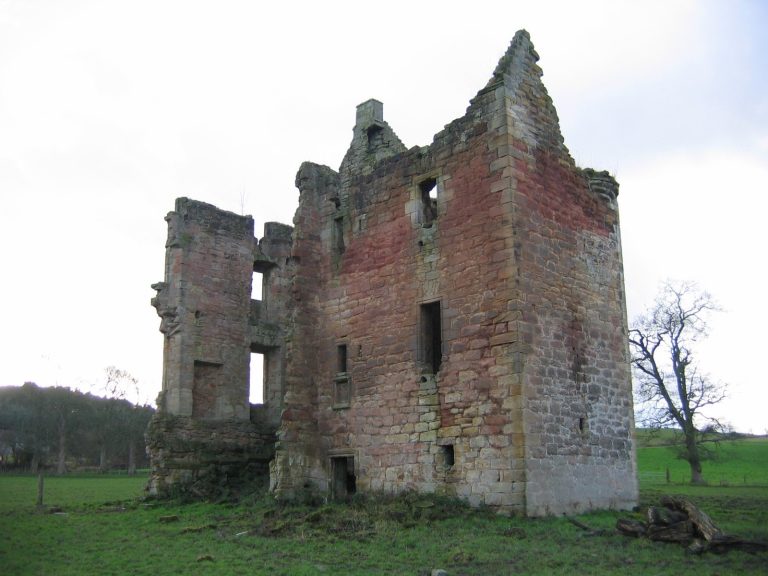
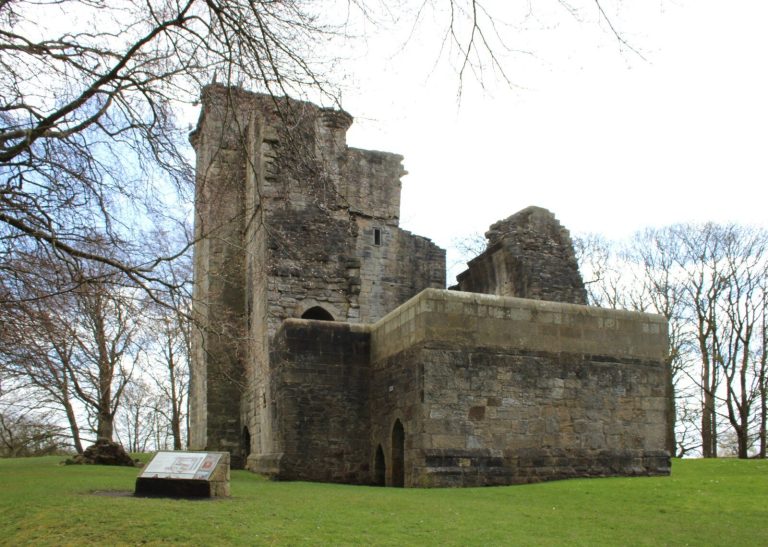
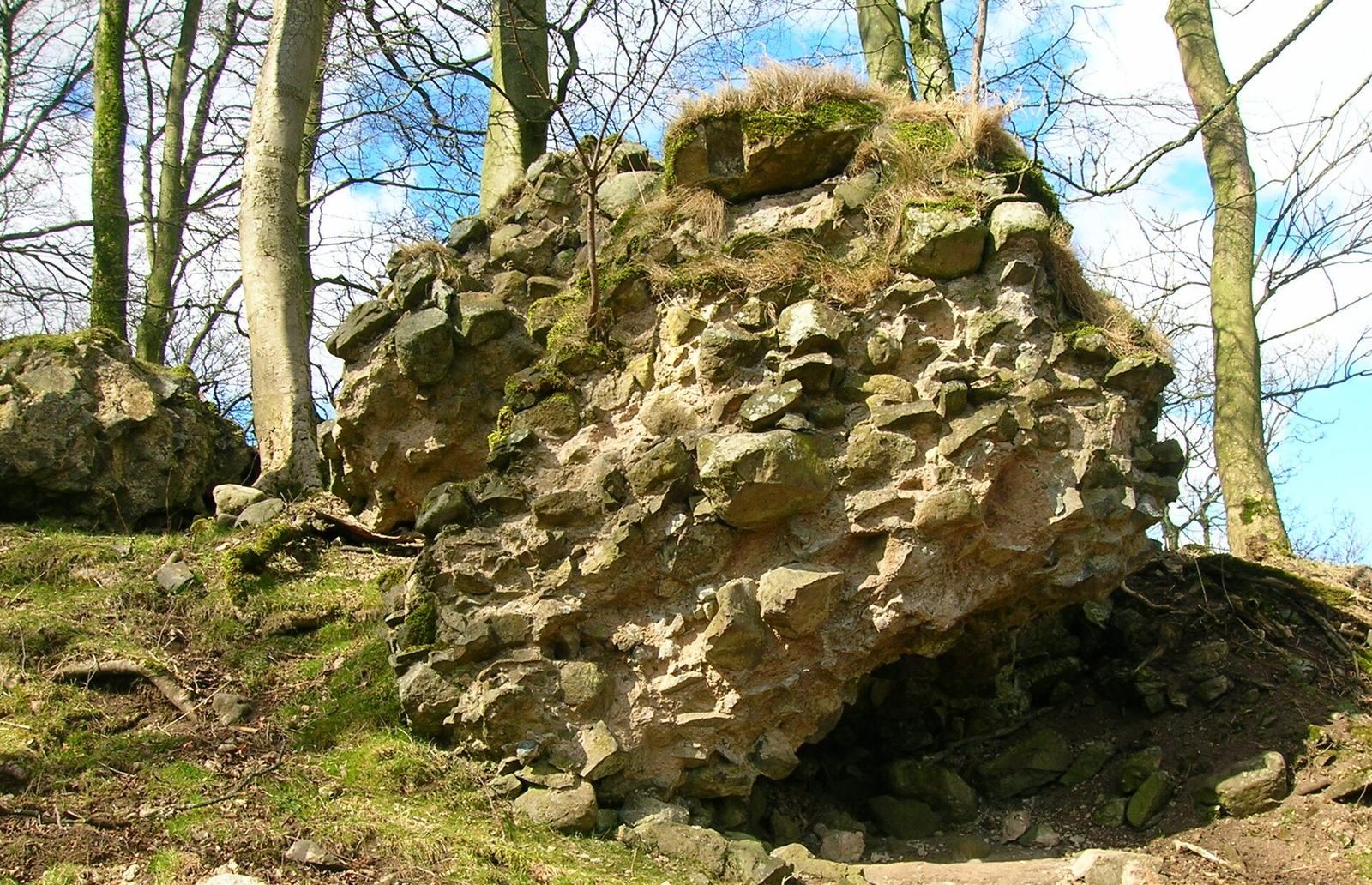
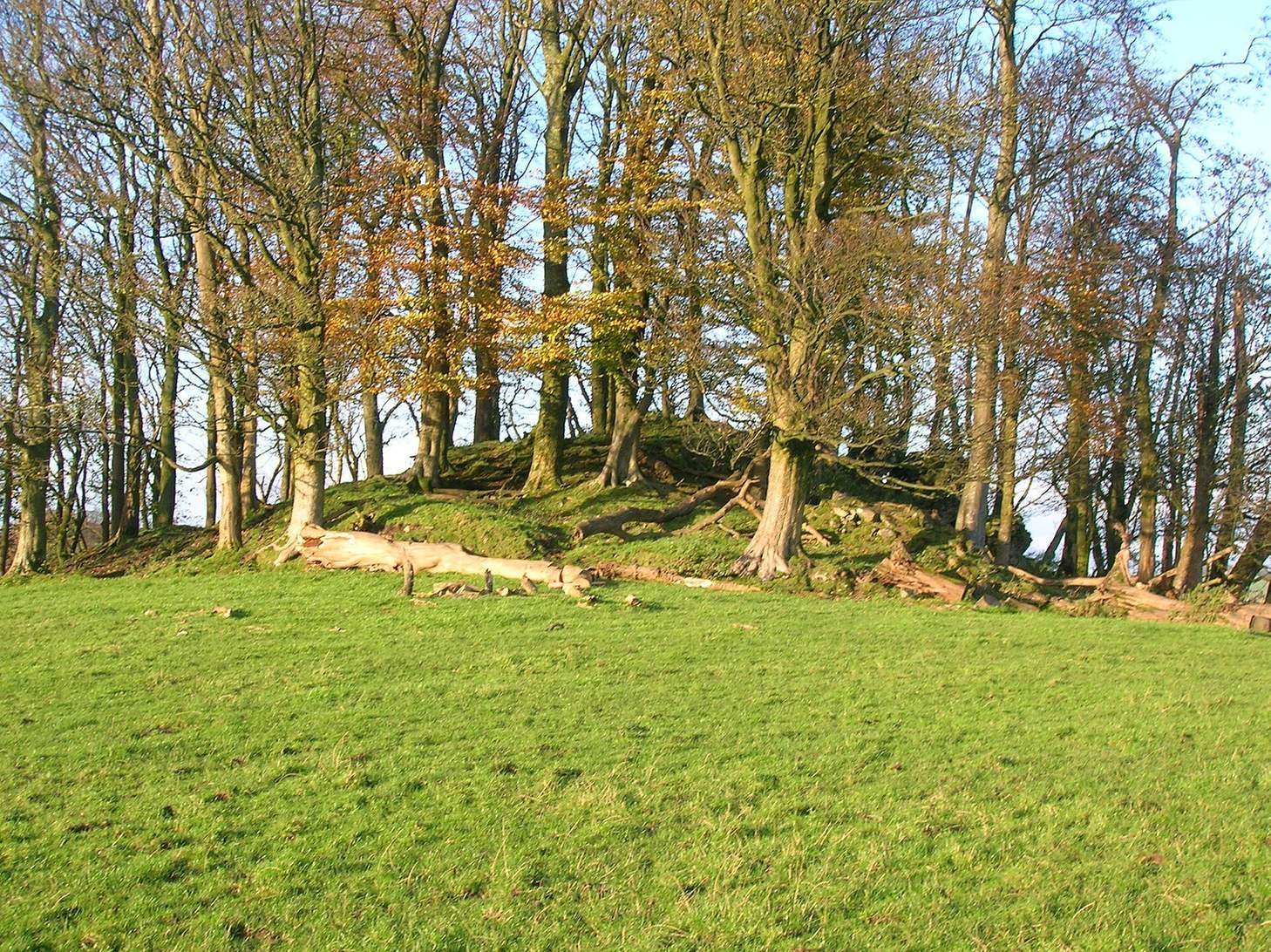
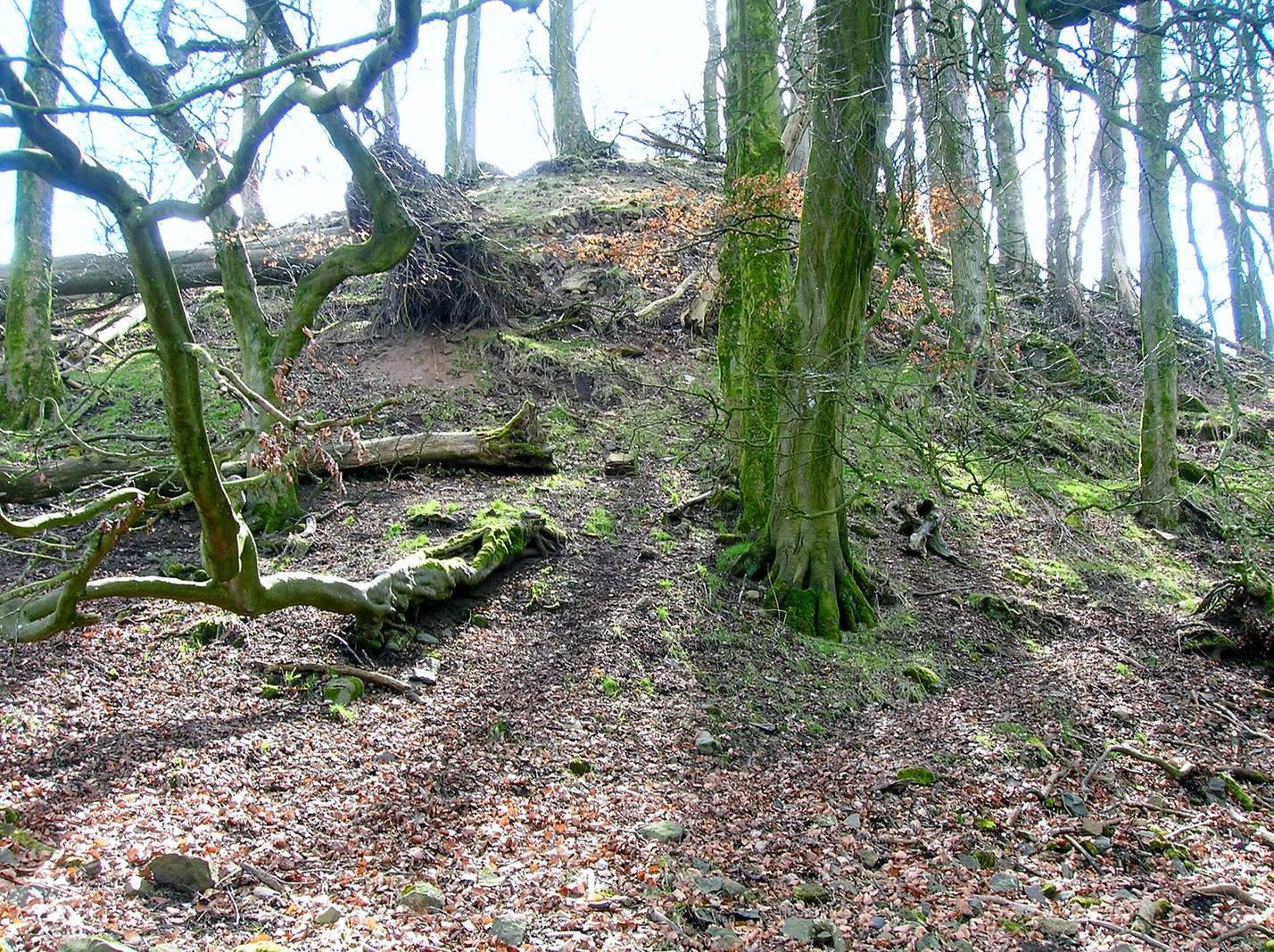
The castle occupied a projecting spur of land beside the Polnoon Water, close to its meeting with the White Cart. A steep slope falls west toward the stream. The stone fortification was arranged around a rectangular motte, a raised earth base for a fortified building, with the later structure enclosing the mound. Its earth-covered remains extend across the mound’s levels.
Motte and building arrangement
The motte measures about 30 by 22 metres at its base and 18 by 10 metres at the top, and stands at least four metres high. It may have been made for an earlier Montgomery castle. A tower stood separately on bedrock; its northwest corner and the north range were founded about three metres below the motte’s base. Johan Blaeu’s 1654 map depicts a central, single-storey building flanked by two buildings, with fence-like structures joining them to the centre.
Earthworks and surviving masonry
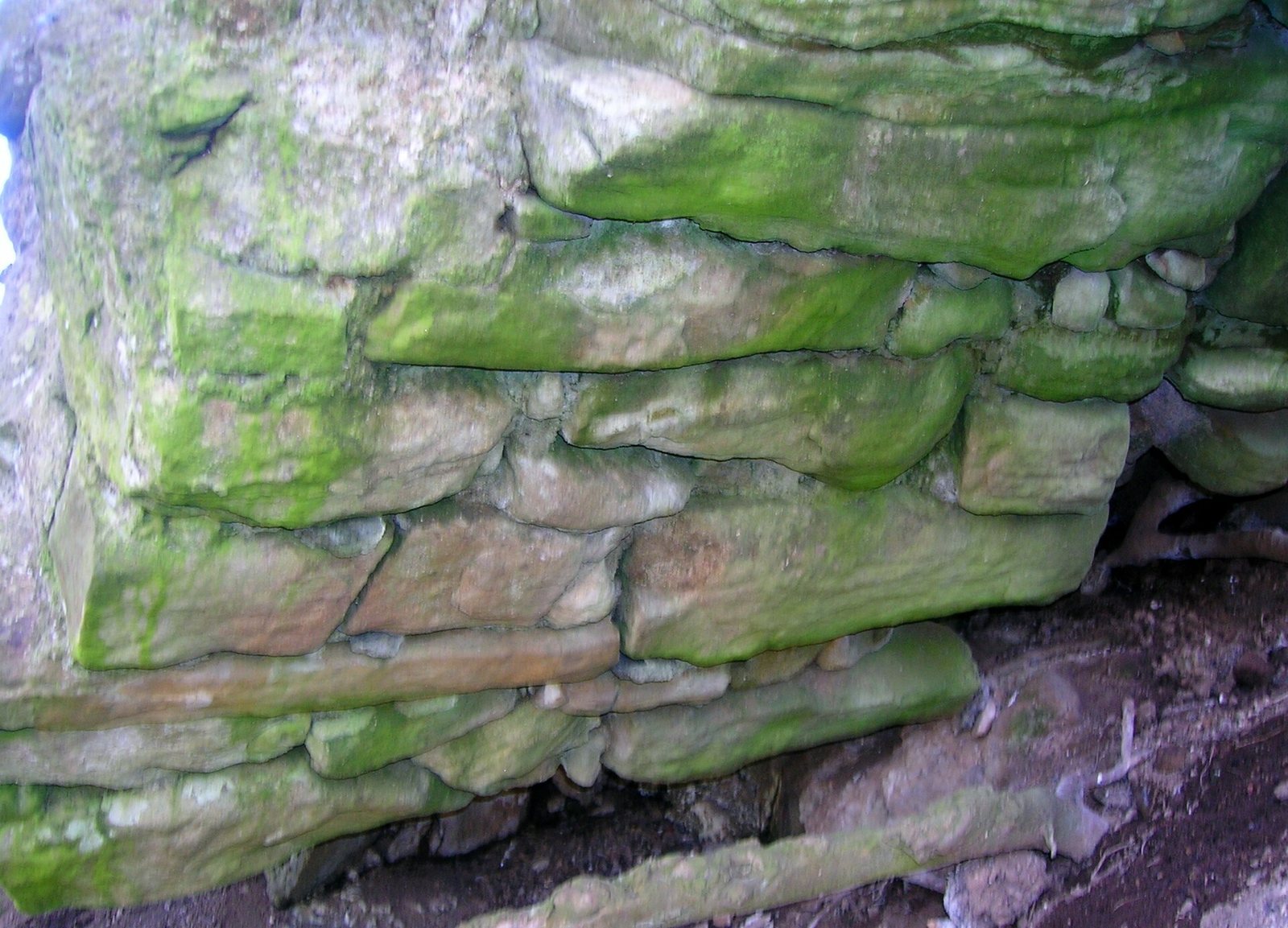
A ditch appears to have crossed the eastern side of the spur, and the main entrance may have been east of the enclosure, toward the south range. A sloping stone base can be traced along the south wall. The northwest corner of the mound preserves an angle of what was probably a massive wall, while a stretch of walling 1.6 metres thick at the southeast foot of the slope may have belonged to a courtyard. Much of the masonry is scattered across the site and into the Polnoon Water; the earth-covered remains are overgrown with trees.
Later use and depictions
The castle shows signs of use after the medieval period, possibly as a freestanding dwelling. Ainslie’s 1799 survey of the Eglinton Estates includes a small illustration of the ruins. The castle’s structure remained preserved into the nineteenth century.
Heraldry and associated objects
The heraldic panel
A carved stone panel combines the Montgomery family’s lily emblems with the Eglinton family’s ring emblems. It was probably placed in a recess above the entrance, perhaps during the seventeenth-century improvements. After its removal, the panel was set above the door of the Cross Keys Inn on Montgomery Street in Eaglesham. John Montgomery’s seal showed the Eglinton emblem only as a ring at the centre of the Montgomery shield; his son later divided the family arms into sections. The fuller Montgomerie arms also incorporated Seton crescents and Buchan sheaves, with a central shield showing a sword supporting an imperial crown beside a twelve-pointed star.
Objects and tradition
A tradition attributes to Sir John Montgomery a carved spur placed above the castle door in memory of his encounter with Henry Percy. The old castle doors were once held in Edinburgh Museum. A stone bearing a Freemasonry emblem has been reused as a gravestone in a churchyard, and a piece of furniture associated with the castle is held by Glasgow Art Gallery.