Pielenhofen Abbey: A Cistercian Nunnery and School Complex
Site at a Glance
- Popularity
- Medium
- Country
- Germany
- Primary era
- Early Modern
- Eras represented
- Medieval, Early Modern, Modern
- Civilizations
- Electorate of Bavaria, Holy Roman Empire, Kingdom of Bavaria
- Site type
- Religious
- Remains
- Monastery
On this page8 sections
History
Pielenhofen Abbey is a former Cistercian nunnery in Pielenhofen, Germany, founded in 1240 by the lords of Hohenfels and Ehrenfels. Dedicated to the Assumption of the Blessed Virgin Mary, the community belonged to the Cistercians, a monastic order that follows the Rule of Saint Benedict. The abbey buildings were remodeled in the Baroque style in the early eighteenth century, and the church was consecrated in 1721.
Foundation and medieval activity
A letter issued by Pope Gregory IX on 27 January 1237 provides the abbey’s earliest record. A charter from that year proposed Pollenried as the community’s original location, before it was established at Pielenhofen. In 1239, the Cistercian general chapter, the order’s governing assembly, placed the nuns under the pastoral care of the abbot of Kaisheim.
The abbey’s work also included water-powered industry. A mill on the Naab with four waterwheel installations was recorded in 1397, and a hammer work, where heavy hammers shaped metal, operated from the fifteenth century.
Reformation and early modern industry
In 1542, during the Reformation, a religious movement that led to the formation of Protestant churches, the abbey passed into secular administration in the Duchy of Palatinate-Neuburg. The nuns were permitted to stay for the rest of their lives, and the community probably persisted into the early seventeenth century. From 1559, a secular provost, or lay supervisor, oversaw the house. Count Palatine Ottheinrich is also recorded as dissolving the monastery that year. Even after the Upper Palatinate returned to Catholicism, the abbey remained under secular control.
Industrial production continued to develop. The first charcoal-fired blast furnace in the Upper Palatinate was established at Pielenhofen, and in 1604 the rulers of Palatinate-Neuburg founded a steelworks there. Its ore came from a small mine near Krachenhausen and, in larger quantities, from Sulzbach and Amberg. The furnace operated for nine or ten weeks each year and produced about 610 kilograms of pig iron per day. Workers made wrought iron, bar iron and steel at Pielenhofen and Edlhausen, as well as at a bar-iron works in Laaber. A sales depot for the ironworks opened in Ulm in 1611.
Commissioner Hainrich Kheckh described the furnace as 18 historical feet high and said four workers operated it. Each reportedly earned about one florin a week. The furnace ran continuously for periods of three to ten weeks, stopping when a component broke or another fault required it to be extinguished. Kheckh recorded three iron masses produced every 24 hours, each weighing 3 to 3.5 historical centners. The foot and centner were measures whose values varied by place.
The Thirty Years’ War, a major European conflict from 1618 to 1648, stopped work at the hammer works. In 1652, the smith Joseph Türckh was working there as a bar-iron and weapons smith. Territorial authorities then paid for a new hammer works, constructed in 1653–54 on a mill site using stones from the old furnace. The project cost 1,894 florins and included plans for a hearth to refine pig iron, another for welding, a stamping mill and other equipment. Kaisheim Abbey disputed the use of its land and refused to repay the authorities, so the works never began operating. Flooding damaged the site in 1657, and much of the equipment had been stolen.
On 8 September 1655, Kaisheim Abbey bought the complex and restored its monastic role as a subpriory, a dependent house governed by a larger abbey. Kaisheim was an imperial abbey, a religious house with a direct relationship to the Holy Roman Emperor.
Baroque rebuilding and new communities
In the early eighteenth century, the complex was remodeled in the Baroque style. Franz Beer designed the abbey church, which was consecrated in 1721. During Bavaria’s secularization in 1803, a reform that dissolved religious institutions and transferred their property, the abbey was suppressed for a second and final time. Its property was divided among fourteen purchasers, while the church became the local parish church.
In 1806, Carmelite nuns from Munich and Neuburg an der Donau moved into the complex and formed a joint convent. In 1838, the Visitandines, also known as Salesian Sisters and members of the Order of the Visitation of Holy Mary, acquired it and established a girls’ school. The school developed into a girls’ secondary school, and a boarding school for girls opened there in 1912.
Schools and later use
From 1941, the complex served as an evacuation camp for children and a military hospital. The school reopened in 1946 as the Chantalgymnasium, an academically oriented German secondary school, and closed in 1980. From 1981 to 2013, the buildings housed the primary school and boarding school of the Regensburg Cathedral Choir. That school moved to Regensburg in 2013.
In 2010, the five remaining sisters left to join the Visitandine community at Zangberg. The buildings were sold to the Herder School Association in 2013. The association operates a secondary school and an upper-secondary school specializing in design there.
Remains
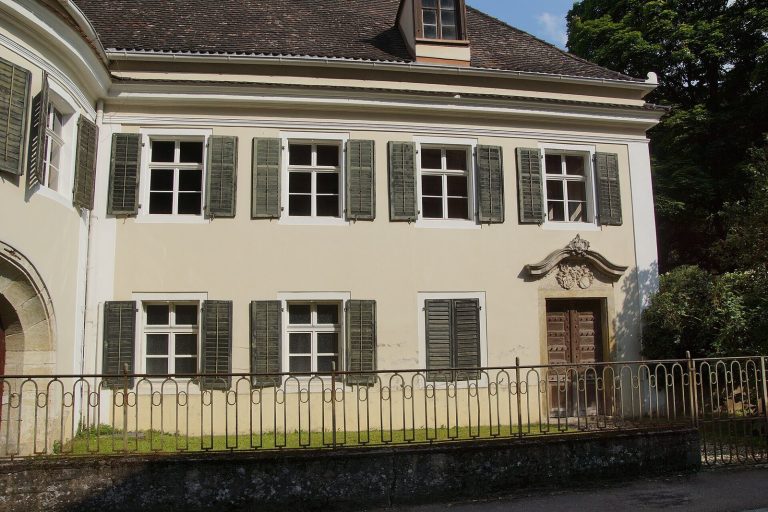
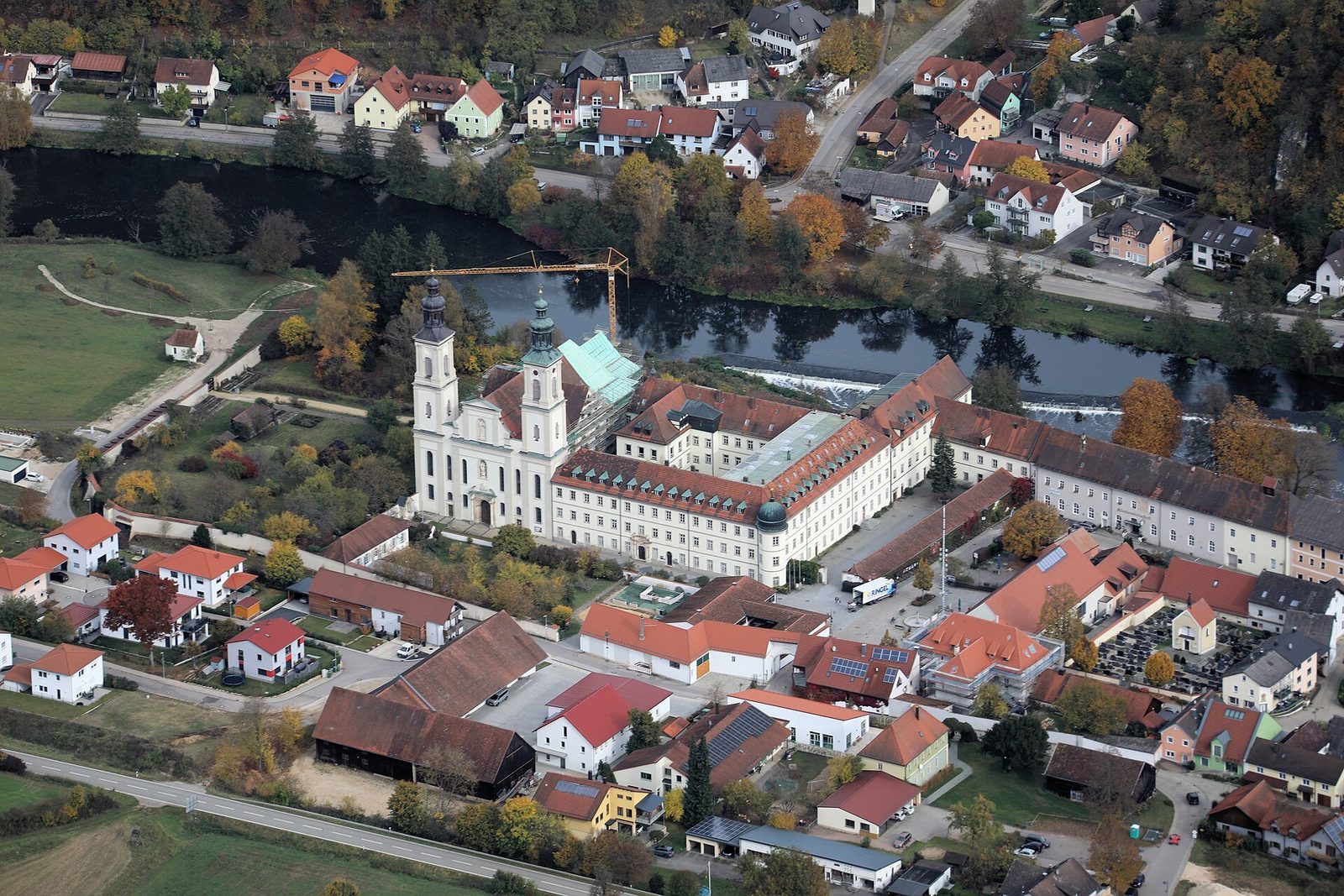
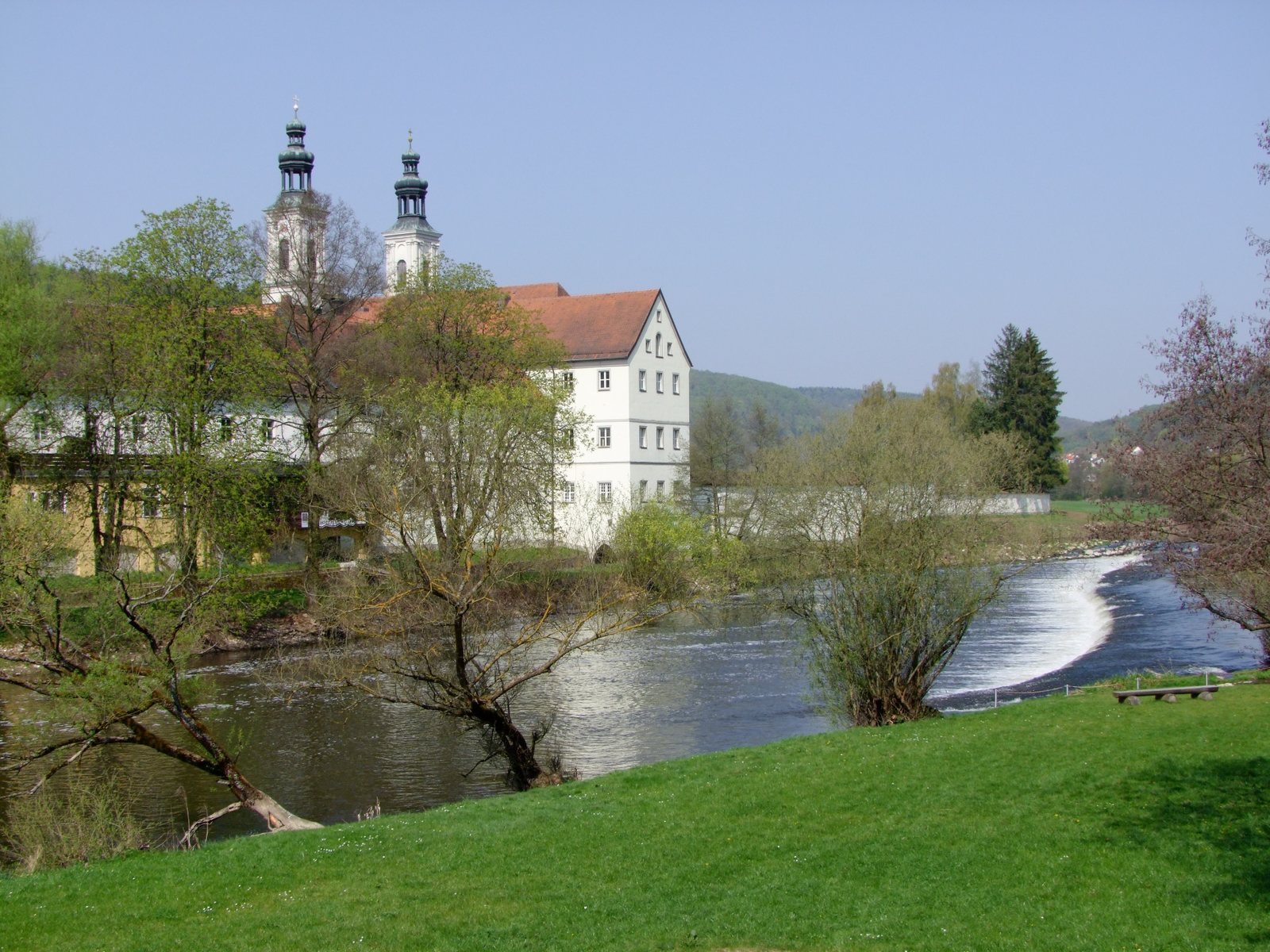
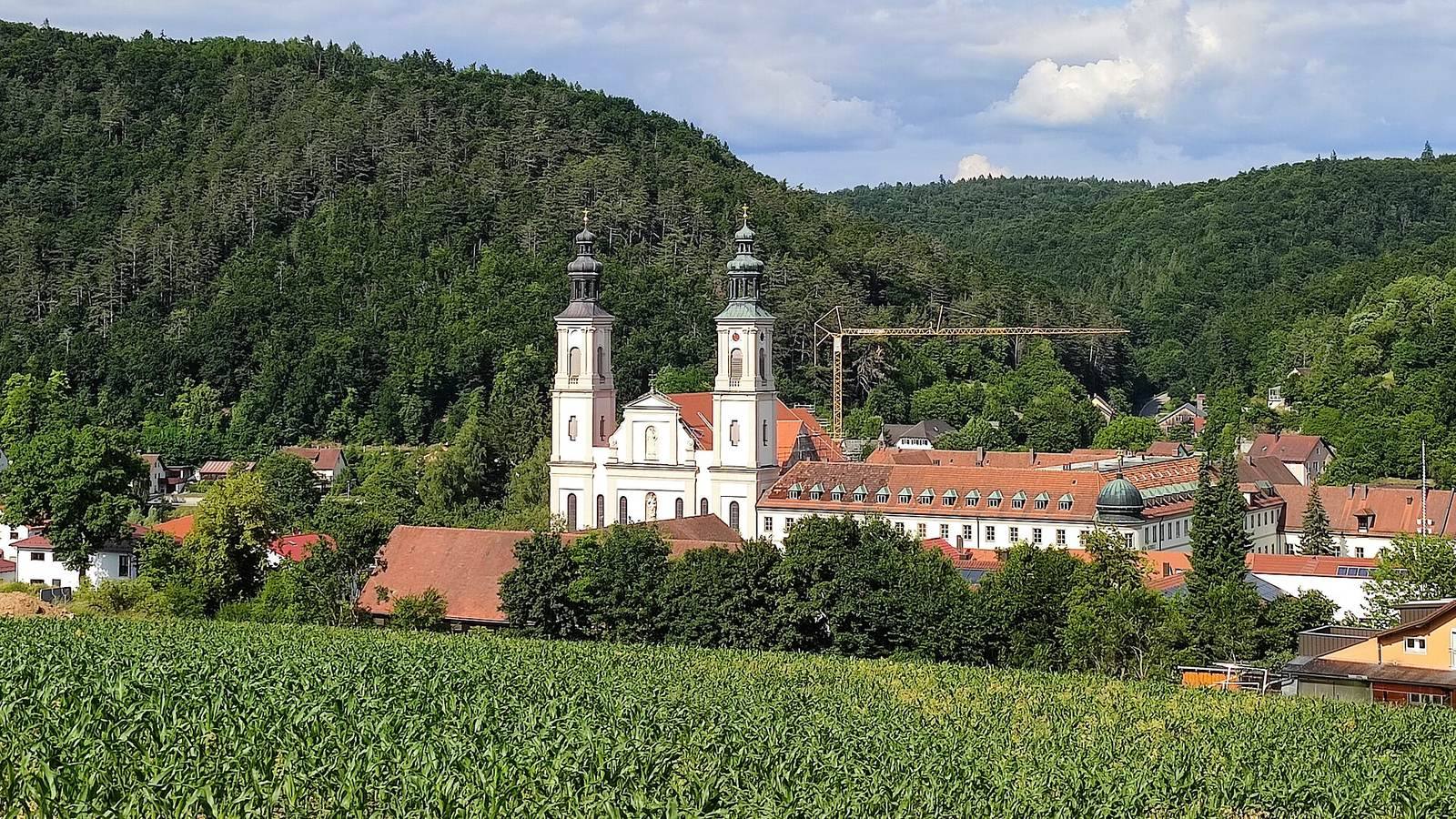
The surviving complex includes a Baroque abbey church, a sixteenth-century mill and water-management features on an island in the Naab. Together, these buildings and structures reflect the site’s religious and industrial history.
Church and devotional image
The church has two three-storey towers, two side aisles and a crosswise transept beneath a central dome-shaped vaulted ceiling. Its late Baroque high altar has eight columns. A ceiling painting of the Holy Trinity is by Jacob Carl Stauder, while Johann Gebhard of Prüfening Abbey painted the twelve images of the apostles. The abbey’s devotional image depicts the weeping Christ. Carmelite nuns brought it from Munich in 1806, and it was venerated as miraculous.
Mill and water management
The surviving abbey mill dates to the sixteenth century and has undershot waterwheels, turned by water flowing beneath them. It is distinct from the mill with four waterwheel installations recorded in 1397. On an island in the Naab, visible water-management structures associated with former mills and hammer works include ponds, a millrace and a chamber lock dating to 1837. A chamber lock is a gated stretch of waterway that lets boats pass between different water levels.