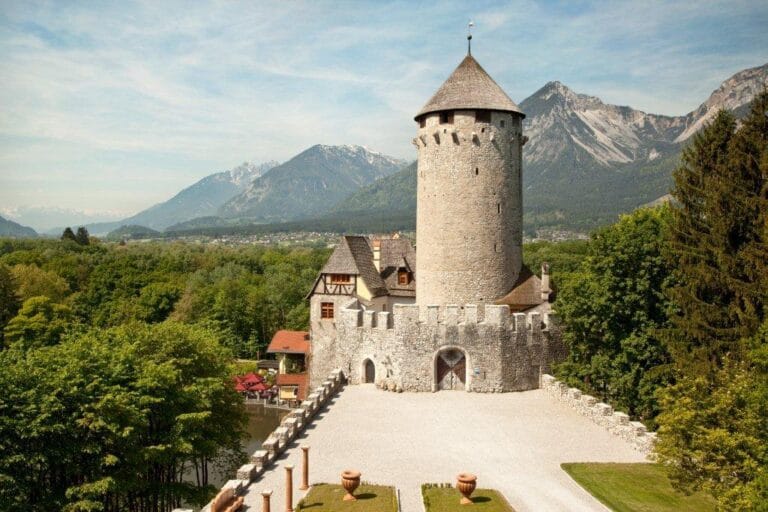
Rottenburg Castle Ruins: A Medieval Hilltop Castle in Austria


Site at a Glance
- Rating
- 4.6
- Popularity
- Very Low
- Country
- Austria
- Primary era
- Medieval
- Eras represented
- Medieval, Modern
- Civilizations
- Habsburg, Holy Roman Empire
- Site type
- Military
- Remains
- Castle
On this page9 sections
History
Rottenburg Castle Ruins are a hilltop castle ruin in Austria, first documented in 1149 as the ancestral seat of the Rottenburg family. The family belonged to the medieval service nobility, whose members held administrative, military, or court offices for higher-ranking lords, and served the Counts of Andechs, a powerful dynasty associated with Bavaria and neighboring Alpine territories.
The Rottenburg Family and the Feud
The Rottenburg family retained the castle until its extinction in 1411. Its last count, Heinrich VI, came into sharp opposition with his territorial lord, Duke Friedrich IV. The conflict, known as the Rottenburg Feud, ended with Heinrich VI’s death and the siege, capture, and destruction of the castle. Friedrich IV ordered the complex demolished, but his successor, Duke Sigmund, later commissioned its reconstruction, incorporating parts of the earlier castle.
Later Lords and Decline
In 1468, the castle became a Tyrolean pledged fief held by Mathias Türndl. It passed to Lichtenstein in 1474, Tänzl in 1502, Schurff in 1515, and Schidenhofen in 1567. When the seat of the court moved to Thurneck-Rotholz in 1594, Rottenburg began to decline. Ownership then passed to Margrave Karl N. Burgau in 1596, Pechio in 1613, Wolfsthurn in 1672, the Counts of Tannenberg in 1704 as a fief inheritable through the male line, the Counts of Enzenberg in 1846, and the episcopal mensa of Brixen in 1860. An episcopal mensa was the institutional property and revenue estate used to support a bishop or bishopric.
St. Notburga and Heritage Protection
St. Notburga of Rattenberg, a medieval Tyrolean Catholic saint associated with service and charitable devotion, lived at the castle as a maidservant of its lords. A chapel dedicated to her was built among the ruins in 1956 and 1957 by the architect Josef Menardi. Rottenburg Castle Ruins are listed as a protected heritage object in Austria.
Remains
The ruin occupies a rocky, wooded hilltop in the municipality of Buch in Tyrol. Its surviving layout consists of a rectangular main building at the summit, a lower bailey to the north, and the Chapel of St. Notburga within the castle ruins. Together, these remains represent a hilltop castle with an upper complex and a historically separate lower defensive area.
Castle Structures
Summit Building
The rectangular main building stands at the hilltop summit. Sections of older masonry were incorporated into the reconstruction commissioned by Duke Sigmund. On the southeast side of the upper floor, the remains of a projecting bay survive, supported by corbels made of tuff.
Lower Bailey
The lower bailey stood north of the main building and dates from the thirteenth century. Four shell towers defended it, each open toward the interior courtyard so that its curved outer wall formed the principal defensive structure. The last surviving shell tower was demolished at the beginning of the twentieth century.
Chapel of St. Notburga
The Chapel of St. Notburga stands within the castle ruins. Its south side contains a round-arched niche with the Notburga Legend fresco by Carl Rieder. The chapel also contains a crucifix made by the sculptor Hans Buchgschwenter.
Nearby sites