Petroglyphs along the Bangucheon Stream: A Prehistoric and Historic Rock-Art Property
Site at a Glance
- Popularity
- Medium
- Country
- South Korea
- Primary era
- Stone Age
- Eras represented
- Stone Age, Bronze Age, Iron Age, Medieval
- Civilizations
- Silla
- Site type
- Civic
- Remains
- Rock Art
On this page13 sections
History
Petroglyphs along the Bangucheon Stream is a rock-art property in South Korea, comprising the Bangudae and Cheonjeon-ri sites along the Bangucheon. A petroglyph is an image or mark carved, pecked, or scraped into rock. Together, the sites preserve a tradition extending from around 5000 BCE to about the ninth century CE, joining prehistoric imagery with later inscriptions. Bangudae contains the earliest known depictions of whaling, while Cheonjeon-ri reflects artistic and cultural change across a long span.
Bangudae and early whaling
Bangudae’s carvings are broadly dated to about 6000 to 1000 BCE. Their whale-hunting scenes are the earliest known depictions of whaling, and their chronology accords with evidence for early whaling elsewhere in southeastern Korea. A net impression at Dongsam-dong points to Neolithic use of nets to hunt marine and land animals. The Neolithic is a broad archaeological period distinguished in part by tool technology.
A wooden boat found at Bibong-ri in 2005 and a harpoon-pierced whale bone discovered at Hwangseong-dong in 2010 are broadly dated to 6000 to 1000 BCE. Animal and whale remains in southeastern Korean shell middens, deposits of discarded shells and food remains, indicate whale presence from about 5000 to 1500 BCE. Large rocks around Bangudae may also have served as gathering places for rituals, although this interpretation is uncertain.
Cheonjeon-ri and the Silla period
Carving at Cheonjeon-ri continued from the late Neolithic into the Silla period. Its Iron Age imagery, from a broad archaeological era distinguished partly by tool technology, probably dates to the fifth or sixth century CE. The latest inscriptions concern Silla’s Hwarang, aristocratic youths who trained in military and civic service. They record personal names and training activities, as well as information about the royal family. Silla was a Korean kingdom that lasted until 935 CE.
Discovery and preservation
An academic survey team from Dongguk University Museum discovered Cheonjeon-ri in December 1970. Korean scholars found Bangudae in 1971 during follow-up research. South Korea designated Cheonjeon-ri a National Treasure in 1973 and Bangudae in 1995. National Treasure is a national heritage classification for culturally important properties.
The Sayeon Dam, built between 1962 and 1965 and expanded between 1999 and 2002, supplies industrial and drinking water to the Ulsan region. Its reservoir periodically covers the Bangudae carvings, exposing them to repeated flooding and exposure. Conservation discussions began in 2000. A 2003 study considered lowering the reservoir, diverting the watercourse, or building protective walls, but disagreements among water-resource, heritage, and regional authorities delayed a decision. Lowering the water level was promoted, though it would have reduced water resources.
In 2009 the prime minister pledged to preserve the sites and pursue World Heritage listing, and a measure to prevent inundation was adopted. A barrier made from polycarbonate panels was tested, then abandoned in 2016 because of visual concerns and difficulties preventing leaks. Since 2013, the reservoir level has been kept at 52 metres or below, rather than its high-water level of 60 metres. Heavy rain and typhoons nevertheless caused flooding in 2016, 2018, and 2019. In July 2025, UNESCO inscribed the two sites together as a World Heritage property under criteria (i) and (iii), recognizing the imagery’s artistic achievement and its evidence of a long-lived rock-art tradition and cultural development in Korea’s southeastern coastal region.
Remains
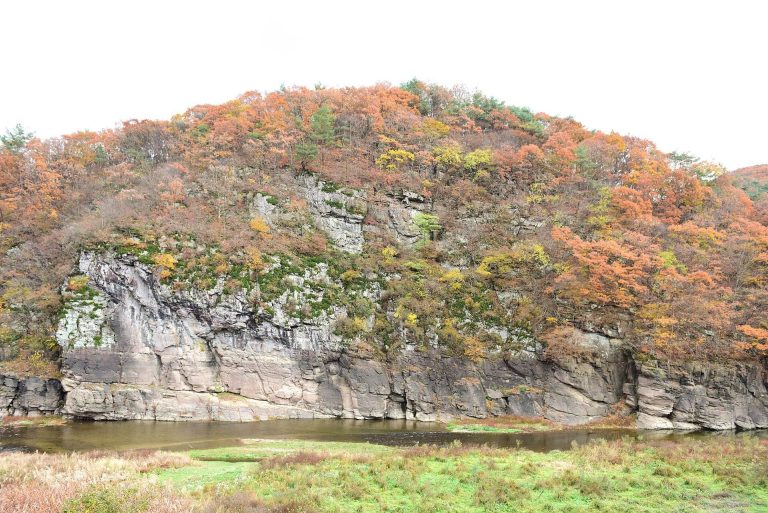
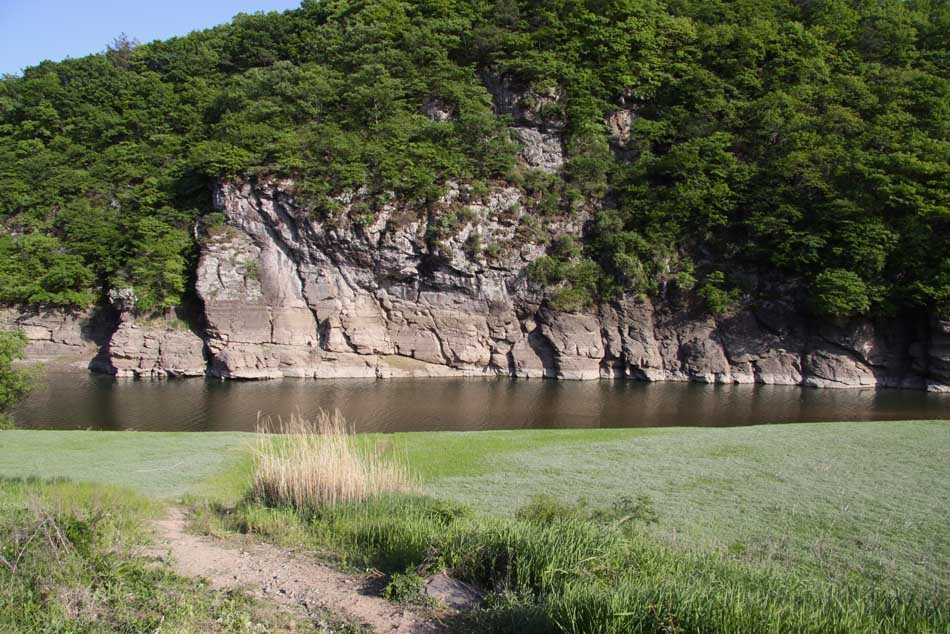
The property follows about three kilometres of the winding Bangucheon through rugged, cliff-lined terrain, with the two rock-art areas at opposite ends of this stretch. Both are carved into Cretaceous-period sedimentary rock of the Daegu Formation, a named geological unit. Bangudae occupies a midstream cliff on Daegokcheon, a tributary of the Taehwa River; Cheonjeon-ri lies farther upstream along Daegokcheon. The inscribed area covers 43.69 hectares, and its buffer zone covers 144.15 hectares, for a combined area of 187.84 hectares. The buffer boundary follows nearby ridgelines and includes the surrounding landscape and views from near and far.
Bangudae
Panel and composition
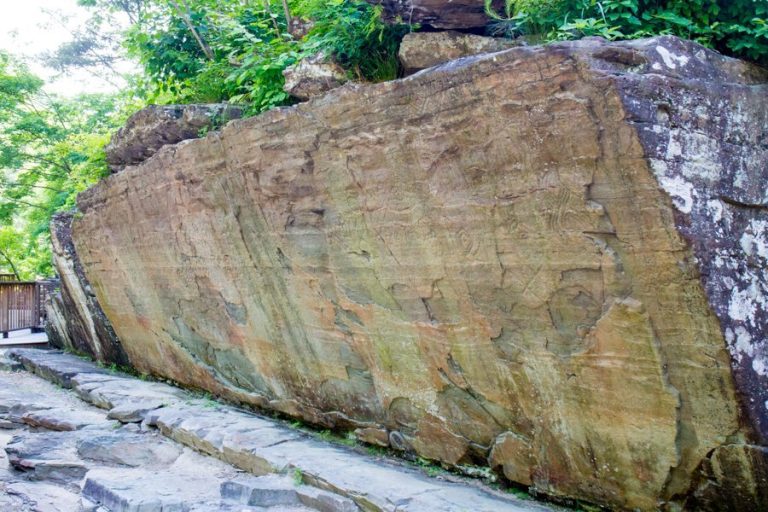
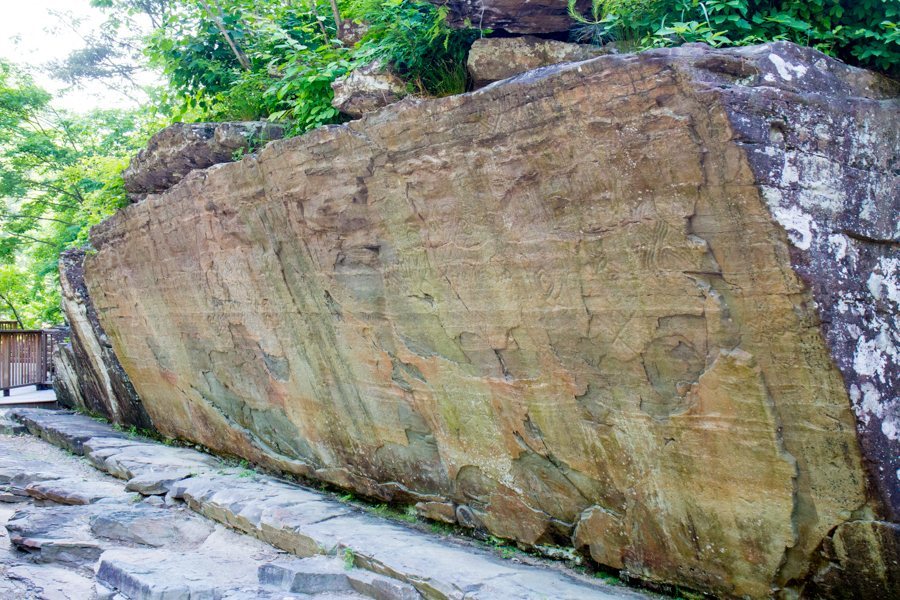
Bangudae’s three principal panels occupy a flat, vertical rock face and together measure about five metres high and eight metres long. A projecting ledge shelters the carvings from rain and other weather. About 300 images were made mainly by pecking or scraping the stone, using lines and dots.
Animals and human figures
Animals make up most of the images. Marine subjects include North Pacific right, humpback, gray, and sperm whales, as well as sea turtles, seals and related mammals, salmon and other fish, and seabirds. Land animals include red deer, water deer, roe deer, tigers, leopards, wolves, foxes, and wild boar; cattle and rabbits also appear. The detail allows many species and behaviours to be distinguished. People are mostly shown nude and in profile, hunting with bows or raising their arms to blow into a stick-like object that may be a musical instrument.
Marine animals, particularly whales, occupy the left side of the panel, while deer and other land animals appear to the right. This arrangement corresponds to the landscape: the river flows left toward the sea, with mountainous terrain on the opposite side.
Marine scenes and hunting
Whale images show pods from above, a whale carrying its calf on its back, animals leaping with their undersides exposed, and whales breathing in profile. Some horizontal or upside-down figures may represent dead whales. Lines cut across certain images in patterns resembling those used by Indigenous peoples of North America to divide whale carcasses. Three turtles above the pods appear to guide them; turtles are also understood as linking aquatic and terrestrial worlds.
Near the lower part of the panel, fish with carefully rendered heads and bodies covered in small depressions appear in a leaping scene. A cormorant-like bird flies near the whales with a fish in its beak. Other images show harpoons, nets, floats, dams, bows, fish traps, and curved boats. Hunting scenes include whales and tigers caught with nets. Boats carry groups of 17, 7, or 5 people; some are shown with whales and floats, and a harpoon is carved on a whale.
Cheonjeon-ri
Layered surface
The carved surface measures about 2.8 by 9.7 metres and carries 625 images and inscriptions layered over one another. Red deer are especially common among the animals. The overlapping carvings make the panel a record of activity extending across several periods.
Early patterns
Neolithic imagery includes concentric circles and overlapping diamond shapes. Patterns from the middle Bronze Age include diamonds and spirals. These geometric designs are unusual on the Korean Peninsula and resemble patterns found in Siberia and northern China.
Iron Age and Silla imagery
Some Iron Age lines were made with very sharp tools and are so fine that they can be difficult to see. Later images show processions of people traveling by boat or on horseback in Silla-period clothing, alongside the inscriptions associated with the site’s later use.