Petrikirche in Mülheim an der Ruhr: Historic Evangelical Parish Church


Site at a Glance
- Rating
- 4.4
- Popularity
- Very Low
- Country
- Germany
- Primary era
- Medieval
- External website
- Open
- Eras represented
- Medieval, Modern
- Civilizations
- Duchy of Berg, German, Holy Roman Empire
- Site type
- Religious
- Remains
- Church
On this page8 sections
History
Petrikirche is a historic Evangelical church in Mülheim an der Ruhr, Germany, developed from a medieval manor chapel on the Kirchenhügel, the town’s historic settlement core. Dedicated to Saint Peter, it was expanded into a Romanesque church around 1200 and became the parish church of the Mülheim district.
Medieval origins and growth
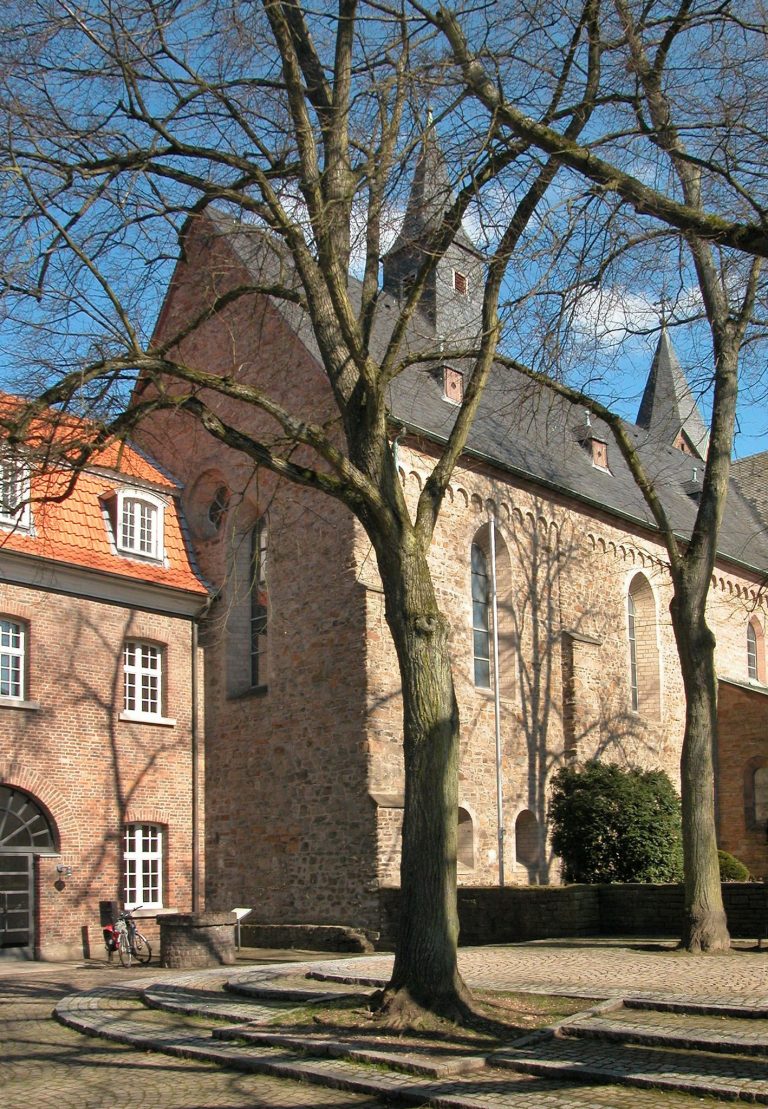
The church’s beginnings are connected with the medieval manor whose owners, the Lords of Mulinhem, are first recorded in 1093. Around 1200, their chapel was enlarged into a Romanesque church. The building was extended again around 1250, when it received a four-storey western tower. At the end of the fifteenth century, the parish church gained a Gothic choir and the chapel was extended to the north.
Petrikirche served the Mülheim parish district and also functioned at times as a burial place for the Lords of Broich. Its position on the Kirchenhügel reflects the way the church and manor formed the core of the historic settlement.
Reformation and later rebuilding
Around the middle of the sixteenth century, the congregation adopted the Reformation, the movement that divided Western Christianity and led many German congregations to Protestant worship and church organization. Later additions changed the modest parish church into a large hall church, a form in which the nave and side spaces have broadly comparable interior heights.
Between 1870 and 1872, the nave was rebuilt in the Neo-Gothic style, a nineteenth-century revival of medieval Gothic forms. The medieval tower and choir were retained. The interior was then extensively redesigned in 1912 and 1913 under Pastor Ludwig Wessel, whose plans encountered resistance from members of Mülheim’s strongly Reformed and Pietist congregations. Pietism emphasized personal devotion, religious experience, and disciplined Christian practice. Wessel served as pastor of the Altstadt congregation from 1 April 1908 until 9 October 1913.
War damage and twentieth-century community
Petrikirche was severely bombed during the Second World War. Sections of wall and the ruin of the bell tower were essentially all that remained. Reconstruction took place from 1949 to 1958 under the Gelsenkirchen architect Denis Boniver, altering the church’s exterior and interior appearance.
Ernst Barnstein, a pastor of the Confessing Church, worked at Petrikirche from 1922 until his retirement in 1961. The Confessing Church was a Protestant opposition movement that rejected the subordination of German Protestant churches to Nazi state ideology. In 1989, the square around the church was named Pastor-Barnstein-Platz in his honour.
Church music has also formed part of Petrikirche’s modern history. The composer and church music director Siegfried Reda served as organist from 1952 to 1968 and designed the plans for the church’s organ. Today, the United Evangelical Congregation in Mülheim uses Petrikirche for worship, musical performances, and other artistic events. The church is one of eight buildings in the An der Ruhr church district protected under heritage law.
Remains
Medieval and Neo-Gothic fabric
Petrikirche stands on the Kirchenhügel, where the medieval manor chapel and the historic settlement core of Mülheim were located. Its surviving architectural history brings together the four-storey western tower built of coal sandstone around 1250, the late-medieval Gothic choir, and the northward extension made at the end of the fifteenth century. The nave belongs to the Neo-Gothic rebuilding of 1870 to 1872, while the postwar reconstruction introduced a wooden coffered flat ceiling and changed the building’s appearance.
Interior features and artistic work
The rebuilt interior includes new choir windows, a new pulpit, and a new altar added during late twentieth-century alterations. The chandeliers, crucifix, and lamps were given a lighter appearance. The portal doors carry bronze reliefs created by Rika Unger between 1959 and 1960, showing scenes from the life of the Apostle Peter, one of Jesus’s twelve apostles and a traditional early leader of the Christian church. Petrikirche also contains stained-glass windows by Ernst Rasche.
Organs and bells
The principal organ was built from 1955 to 1959 by the Berlin workshop Karl Schuke, following plans by Siegfried Reda. It has 59 stops, each a selectable set of pipes with a particular tonal character, and is protected for its intonation and richness of tone. A small organ museum occupies a room behind it and includes the former electromechanical registration system, preserved as a technical monument. The instrument was renovated in 2001 by the Muhleisen organ workshop of Strasbourg. Its couplings are I/II, III/II, IV/II, IV/I, I/Pedal, III/Pedal, and IV/Pedal.
Since 2016, the choir has contained a Westenfelder organ made in 1995 and transferred from the Kreuzkirche. It has 13 stops on two manuals and a pedal. The manuals are the keyboards played by the hands, while the pedal is played by the feet. Its action is mechanical, transmitting the player’s movements mechanically to the valves that control the pipes.
Three cast-steel bells hang in the tower. Made by the Bochumer Verein, they are harmonically tuned with the bells of the neighbouring Catholic Church of St. Mariae Geburt. “Queen Luise” was cast in 1955 and has the pitch B-flat. “Gerhard Teerstegen” and “Wyrich VI” were both cast in 1921, with pitches D-flat and E-flat respectively.