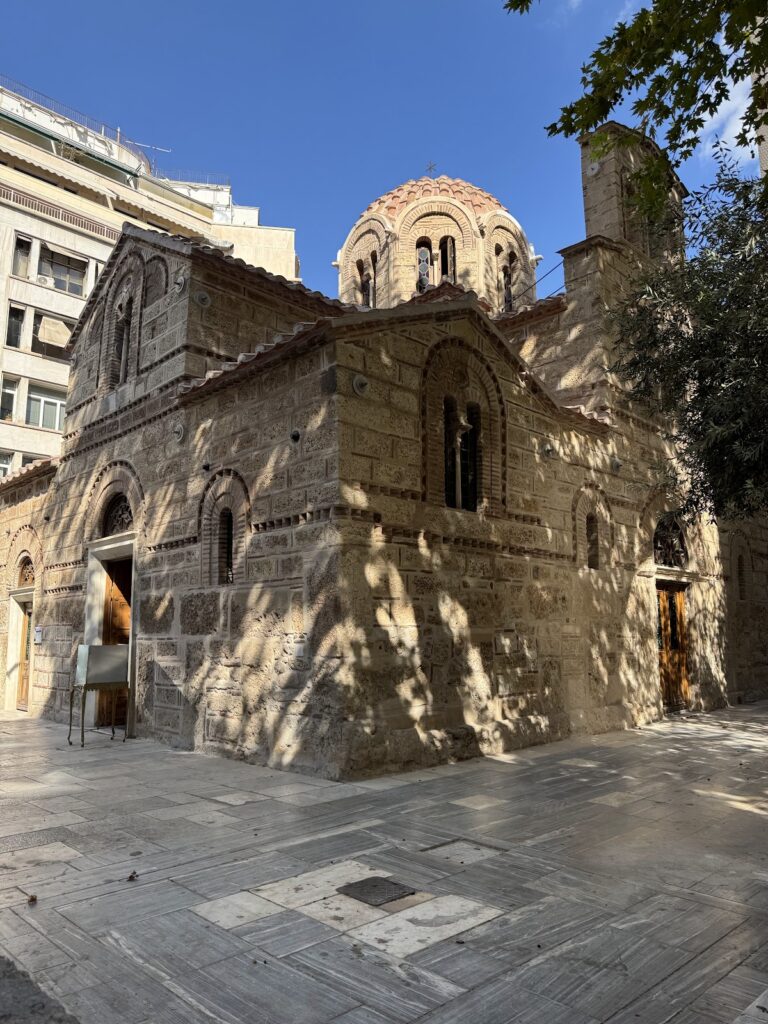
Petraki Monastery: A Byzantine Orthodox Monastery in Athens


Site at a Glance
- Rating
- 4.7
- Popularity
- Low
- Country
- Greece
- Primary era
- Medieval
- External website
- Open
- Eras represented
- Medieval, Early Modern, Modern
- Civilizations
- Byzantine, Greek, Ottoman
- Site type
- Religious
- Remains
- Monastery
On this page11 sections
History
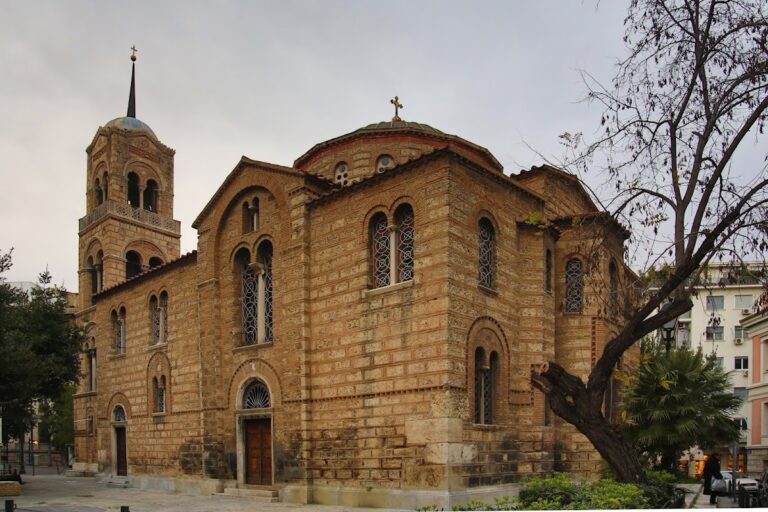
Petraki Monastery is an Orthodox Christian monastery in Athens, Greece, dedicated to the Archangels Michael and Gabriel. The institution probably originated in the first half of the tenth century, although the archaeologist Anastasios Orlandos placed its foundation in the thirteenth or fourteenth century. Its principal church, or katholikon, is a Byzantine domed cross-in-square building, and the monastery is regarded as the oldest surviving Byzantine church in Athens that remains in use.
Origins and Byzantine phases
The date of the original monastery and church remains uncertain. Most specialists consider that the katholikon underwent a major rebuilding during the Middle Byzantine period, probably in the twelfth century. The sanctuary area, entrance hall, and upper parts of the church were reconstructed during this phase. Between the twelfth and fifteenth centuries, at an uncertain date, the monastery also became connected with the Monastery of the Confessors.
The monastery was abandoned from about 1500. By the early seventeenth century it was known as the Monastery of Koukoupoúlis and functioned as a metochion, a dependent monastic establishment, of the Monastery of Karéa.
The Petrakis refoundation
In 1673, Parthenios Petrakis, a hieromonk and physician from Dimitsana whose birth name was Petros Papastamatis, substantially renovated the monastery and its church. His successors as abbots, who also belonged to the Petrakis family, continued the work, notably in 1716. The institution subsequently became known as Petraki Monastery.
In 1777, Petraki was recognized as a stavropegic monastery, meaning that it was placed directly under patriarchal authority rather than the ordinary jurisdiction of a local bishop. The monasteries of Karéa and the Confessors were among its dependencies. A wall enclosing the monastery was built in 1798.
Ottoman wealth and political privileges
During the Ottoman period, particularly from the mid-seventeenth to the mid-eighteenth century, Petraki was among the wealthiest monastic institutions in Attica and Greece. Through purchases from the faithful, it acquired extensive land around Athens, including the Marathon plain. Its revenues and privileges also included supplying honey and olives to the Ottoman imperial family.
In the late eighteenth century, Abbot Dionysios Petrakis led a secret delegation to Constantinople with Níkos Zitounákis and three other members. They sought exemption from levies imposed by Hadji Ali Haseki, the voivode, or Ottoman provincial governor, of Athens. After prevailing in 1795 and 1796, the monastery was incorporated into a vakif, an Islamic charitable endowment, associated with an imaret in Constantinople. It was placed under the protection of Mihrişah, the mother of the reigning Ottoman sultan.
From the Greek War of Independence to the modern state
During the Greek War of Independence and the decades that followed, the monastery supported the local population and provided public instruction. After Athens became the capital of Greece in 1834, its conversion into a military hospital was proposed. Instead, the complex served as barracks and a gunpowder depot until 1858. Enlargement and modernization of the katholikon during this period altered its original Byzantine character.
Land acquisition continued during the early Greek state. After the assassination of Ioannis Kapodistrias, the first governor of independent Greece, Petraki acquired former Ottoman properties sold by the provisional government. Later donations and transfers of its land helped facilitate the expansion of Athens and the construction of public institutions during the reign of King George I. These included the University of Athens, the Byzantine and Christian Museum, Evangelismos Hospital, Alexandra Hospital, the children’s hospital in Goudi, the American School of Classical Studies, the Gennadios Library, and the British School at Athens.
During the dictatorship of Theodoros Pangalos, the government demanded the nationalization of all the monastery’s landed property on grounds of national defense. After the regime fell, the titles were returned to the Church of Greece, although changed land uses and irregularities complicated administration of the estate for many years. The property later became the subject of litigation between the monastery and the Greek state before the European Court of Human Rights in the 1990s.
Twentieth-century uses and restoration
In the early twentieth century, part of the monastery was made available without charge for the activities of the Russian Archaeological Institute of Constantinople. After the 1923 population exchange between Greece and Turkey under the Treaty of Lausanne, the monastery’s cells housed refugees from Anatolia for three years. During the German occupation of Greece in the Second World War, the complex also served as a military hospital.
Major restoration in the 1960s sought to recover the church’s Byzantine appearance. The frescoes were restored and modern additions from the mid-nineteenth century were removed. In 1970, the katholikon became a synodal chapel, while the offices of the Holy Synod of the Church of Greece were established immediately to the east and behind the monastery. Petraki is protected as an archaeological site in Greece.
Remains
The katholikon
The katholikon is a Byzantine domed cross-in-square church, a plan in which four arms of a cross are incorporated into a roughly square interior beneath a central dome. The original naos, or main worship space, measures approximately 9.5 by 10 metres, and the dome rests on four Corinthian columns. The building was initially close to the Constantinopolitan style.
The church originally had a small bema, the sanctuary area, and a narrow narthex, an enclosed entrance space west of the main church. Twelfth-century rebuilding produced upper walls in cloisonné masonry, a technique in which stone blocks are framed by bands of brick. This work altered the interior volumes and the position of the openings, giving the church a provincial style common in southern Greece during that period.
Carved interior decoration includes marble cornices at the bases of the vaults. Georgios Markou, an important late post-Byzantine painter, created the frescoes in the naos in 1719. The frescoes in the exonarthex, the outer entrance space beyond the narthex, belong to the later development of the church.
The later entrance spaces
The narrow Byzantine narthex was rebuilt on a larger scale in the fifteenth century and received a tall dome supported by a drum, the cylindrical or polygonal structure beneath a dome. An exonarthex was added in 1804. Further extensions and modernization followed in the 1830s, creating a later double-narthex complex attached to the original church.
Courtyard and monastic buildings
The monastery courtyard contains a well, a fountain, a Byzantine sarcophagus, assorted architectural remains, and the tomb of the scholar Konstantinos Oikonomos. Several ancient objects are also displayed there. The monks’ cells and communal areas occupy the northern and southern sides of the complex, while the offices of the Holy Synod of the Church of Greece adjoin it on the eastern side.
Carved stone and archaeological objects
A marble lintel from the southern refectory dates to the eleventh century and is decorated with a central cross and vegetal motifs. It is now exhibited in the Byzantine and Christian Museum of Athens. The monastery also stored ancient funerary stelae during the twentieth century. The stela of Mnesagora and Nikochares remained there until 1927 before moving to the National Archaeological Museum of Athens, while the stela of Xanthippos was later transferred to the British Museum.
Nearby sites