Petra Monastery (Karditsa): An Eastern Orthodox Monastery in Greece
Site at a Glance
- Rating
- 4.8
- Popularity
- Low
- Country
- Greece
- Primary era
- Early Modern
- External website
- Open
- Eras represented
- Early Modern
- Civilizations
- Ottoman
- Site type
- Religious
- Remains
- Monastery
On this page13 sections
History
Petra Monastery (Karditsa) is an Eastern Orthodox men’s monastery in Greece, founded in the mid-sixteenth century in the Agrafa region of central Greece. Dedicated to the Dormition of the Virgin Mary, it belongs to the Thessaliotis and Fanariopharsala Metropolis of the Church of Greece. Construction began around 1550, and the monastery’s first recorded mention appears in a 1557 manuscript entry concerning the death of a master involved in building its church. The name Petra means “rock” and refers to the monastery’s position on a prominent rocky summit, rather than to the name Peter.
Foundation and early development
Foundation tradition links the monastery to a cave beneath the rock. Inhabitants of the nearby village of Sotira saw a light coming from the cave and found an icon of the Virgin Mary known as the Glycophilousa. When the icon was taken to the village church, it repeatedly returned to the cave. The villagers interpreted this as a divine sign and decided to establish a monastery at the site. The first monks lived in the cave while construction progressed.
The katholikon, the principal church of an Orthodox monastery, was completed in 1593. In that year, priests and inhabitants from neighboring villages took part in the ceremonial transfer of the icon from the cave into the church. The monks moved from the cave into the nearly completed monastery complex in 1595. A commemorative register from 1600 names Philaret, Daniel, Lawrence, and Zosimas as the monastery’s first founders. Later records mention the hieromonks Parthenios, Neophytos, and Savvas. A hieromonk was a monk who had also been ordained as a priest.
The identity of the founder remains uncertain. One tradition names Panagiotis Kouskoulas, described either as a former military commander of Crete or as an imperial interpreter of the Ottoman Porte. Another identifies Panagiotis Morfesis, a leading inhabitant of Neochori. A portrait of the founder forms part of the katholikon’s painted program. The church interior was frescoed in 1625 by a painter influenced by the Cretan School, a post-Byzantine tradition known for formal compositions and continued Byzantine artistic conventions.
Petra under Ottoman rule
During the seventeenth to nineteenth centuries, Petra flourished partly because its location in the mountainous Agrafa region placed it effectively outside regular Ottoman administrative control. The monastery sought support beyond the local area. In 1666, monks traveled to Constantinople to request assistance from Ecumenical Patriarch Parthenios IV. Petra later received substantial support after Dionysios, then Metropolitan of Larissa, became patriarch. Under Ottoman rule, monks also traveled repeatedly to Russia to collect donations.
One result of these connections is the wooden choros donated by Empress Catherine II of Russia, who ruled from 1762 to 1796. A choros is a hanging circular lighting fitting, similar to a large chandelier, and the one associated with Catherine survives in the katholikon.
During Kosmas of Aetolia’s second journey through Ottoman-ruled Greek lands, from 1763 to 1773, he visited Petra and praised its church, frescoes, and library. At the nearby hill called Three Trees, he preached to inhabitants of three villages and planted an iron cross in one of the trees. The cross was still visible when this tradition was recorded. Petra also maintained a clandestine school for local inhabitants during the Ottoman period. Its recorded teachers were the priests Gregory Pavrola and Avvakum, both from the neighboring village of Katafygio.
Revolution and nineteenth-century change
Petra was connected with the Greek struggle against Ottoman rule. The Filiki Eteria, a secret society that organized resistance and prepared for the Greek War of Independence, included the hieromonk Kyrill among its members. In 1821, Kyrill took part in the uprising in Moldavia under Alexander Ypsilantis. After the revolt was suppressed, Kyrill and 1,002 people, accompanied by the hieromonk Gideon of the Great Lavra on Mount Athos, fled toward the Russian city of Orhei, where local authorities detained them.
The revolutionary leader Georgios Karaiskakis arrived at Petra with his forces in 1822 and celebrated Easter with the monks there in 1823. Several of his letters were sent from the monastery, including one concerning the uprising of the Souliotes and disputes among rival factions.
Petra also played a role in the Epirus and Thessaly uprising of 1869 to 1886, when monasteries served as centers of insurgent activity. In April 1878, Bishop Nikolaos of Kitros and his remaining forces withdrew into Thessaly after an unsuccessful attempt to begin an uprising in western Macedonia. Petra sheltered the bishop’s insurgents.
Decline, destruction, and modern renewal
After Thessaly was incorporated into the Kingdom of Greece in 1881, Petra entered a period of decline and its monastic population fell sharply. Redina Monastery was transferred to Petra in 1907. Petra was placed under the authority of nearby Korona Monastery in 1909 and regained its independence in 1925.
A major fire in 1927 destroyed the eastern residential wing and left the bell tower in ruins. The monastery was deserted until around 1920 to 1930, when it was re-established under Metropolitan Ezekiel, although its community later declined again. During the German occupation and Greek Civil War, from 1941 to 1945, Petra served as a concentration center for the communist partisan groups of Gavras, Logothetis, and Lambetas. Church relics were stolen during this period and afterward. Surviving items are now held by the ecclesiastical museum of the Thessaliotis Diocese, Korona Monastery, and the Byzantine Museum in Athens.
The last abbot, Kosmas Koukouzelis, died in 1946. The last monk, Leontios, lived almost alone at Petra from 1953 until he died in a fire in his cell in 1981. By then, most of the cells had been demolished or had become uninhabitable, leaving the katholikon as the principal surviving part of the complex.
Greece declared Petra a protected historic monument in 1967. In 1982, researcher P. M. Mylonas recorded the architectural and historical value of the monument, and a conference marking the monastery’s four-hundredth anniversary took place in 1993. From 1996 to 2000, the church council of Saint Nicholas Church in nearby Katafygio worked with the Greek Ministry of Culture and Lazaros Derizeti of the National Byzantine Archaeology department in Larissa to strengthen the katholikon’s walls and dome and restore its frescoes.
The monastery’s brotherhood was restored in 2003 after correspondence between Metropolitan Theoklitos of Thessaliotis and Fanariopharsala and Metropolitan Ieronymos of Thebes and Livadeia. A new brotherhood was installed under the leadership of the schema-archimandrite Dionysios Kalambokas. A schema-archimandrite is a senior monastic cleric holding the higher rank associated with the great habit. The present brotherhood numbers about thirty monks, including members from Russia, Belarus, the United States, Israel, and Cyprus. Services may include Church Slavonic, and the Gospel is read in twelve languages at Easter. The monks place strong emphasis on spiritual education, with nearly all studying at universities in Athens or Thessaloniki. Because the old residential wing was destroyed, the community lives in prefabricated metal units and containers.
Remains
Rock, cave, and surviving complex
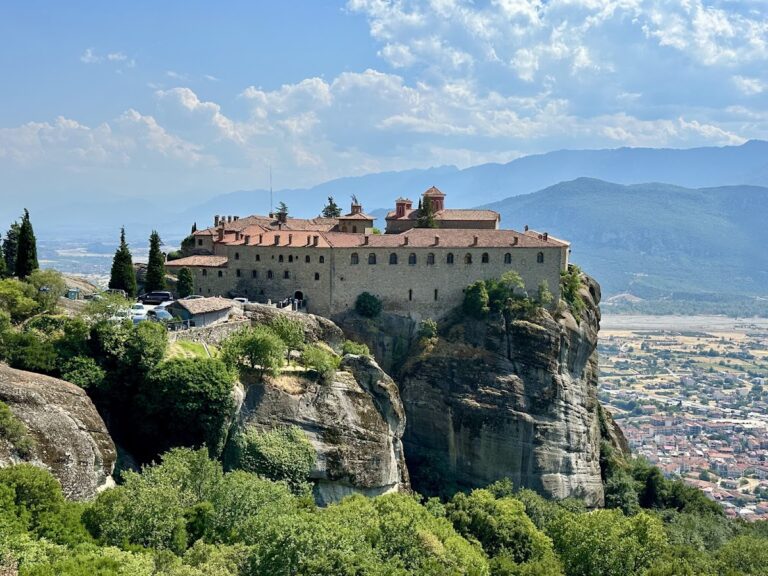
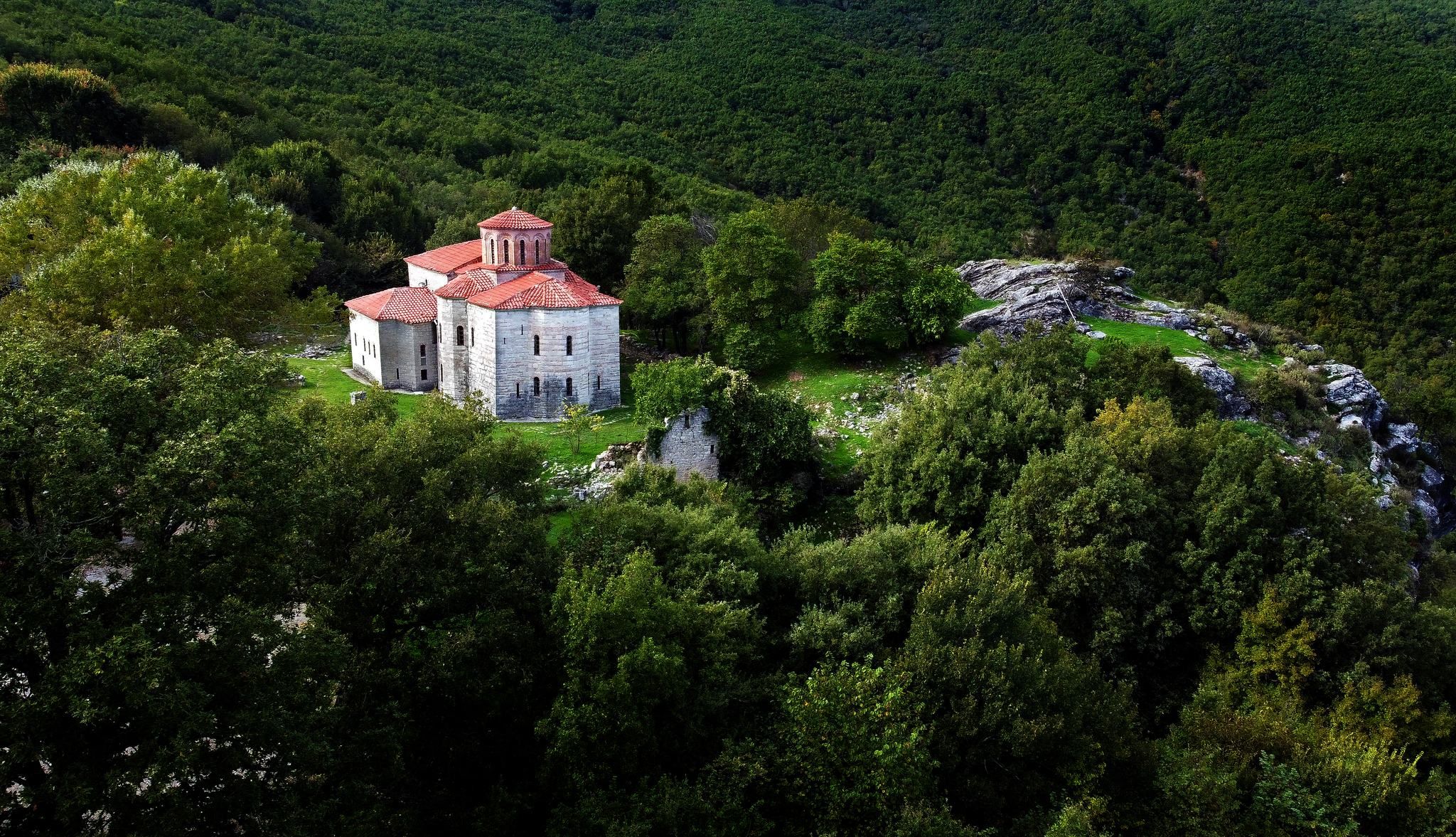
Petra stands on the summit of a broad, high rock above a mountain gorge, on the southern foothills of the Pindus range at approximately 600 meters above sea level. The monastery lies about 27 kilometers from Karditsa and about four kilometers from Lake Plastira, on the road from Katafygio toward Agios Athanasios near Lamperon. A large cave at the foot of the rock’s eastern side served as the first residence of the monks and housed the venerated icon before it was transferred to the katholikon in 1593.
Fortified enclosure
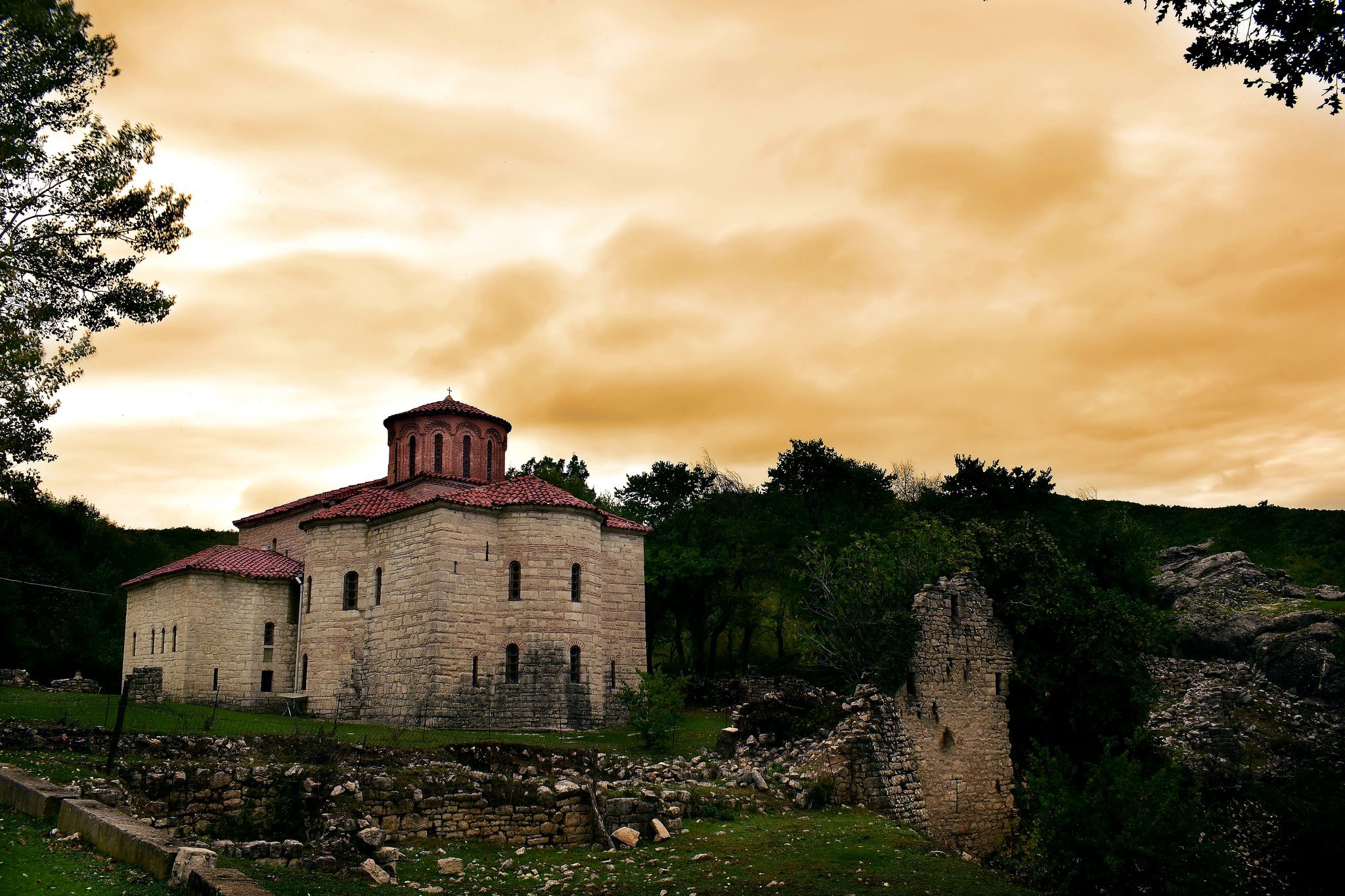
Until 1968, the monastery was enclosed by a fortified perimeter with a gateway and machicolations, projecting openings through which defenders could observe or attack people below the walls or gateway. The enclosure contained cells, a hearth, a bakery, a stable, and other auxiliary spaces. The surviving complex now consists principally of the katholikon, its attached chapel, and a ruined cell building to the east. The old residential wing has been destroyed, while most of the other cells and buildings were demolished or destroyed after the monastery’s decline.
Churches and interior decoration
Katholikon
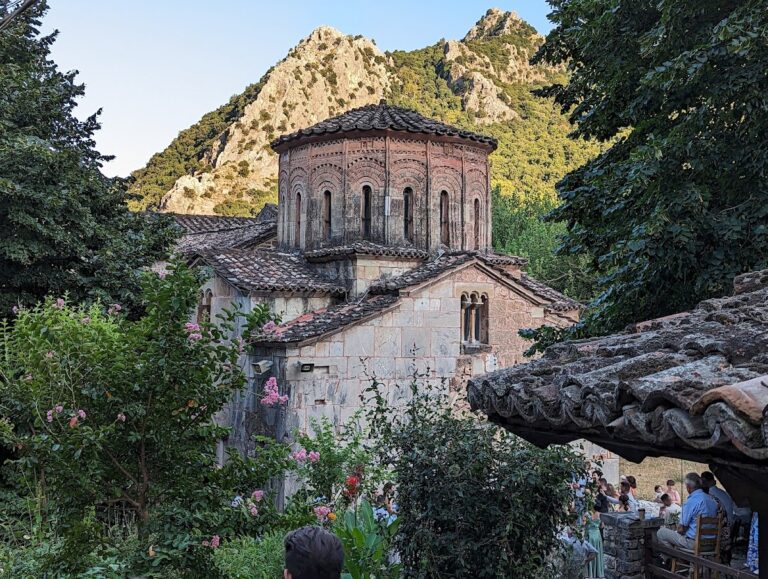
The katholikon is a four-column church of the Athonite type, a plan associated with Orthodox monastic churches modeled on the architecture of Mount Athos. It has shallow apses and a spacious litē, or narthex used as part of the church’s liturgical space. Comparison with other churches of the same type places its construction in the mid-sixteenth century. The interior was covered with frescoes in 1625 by a painter influenced by the Cretan School, particularly the decoration of the monasteries of Dousikos and Korona.
The frescoes underwent extensive restoration between 1996 and 2000 after cracks appeared in the dome and walls and sections of painting flaked away. The finely carved wooden iconostasis, the screen separating the sanctuary from the nave and carrying icons, was made several years before the fresco decoration. Its icons were painted in 1608 by Lambos, a painter known in the region, and are now held in the Collection of the Thessaliotis and Fanariopharsala Metropolis in Karditsa. The litē was decorated in 1789 by the painter Konstantinos at the expense of the monk Pachomios.
Chapel of the Transfiguration
The chapel attached to the southwest side of the katholikon is dedicated to the Transfiguration of the Savior and was built at approximately the same time as the main church. It is a single-aisled cross-in-square church. The painter Ioannis, known as “the humble,” frescoed it in 1673 and made its iconostasis at the expense of the monk Anthimos.
Wooden choros
The katholikon preserves the wooden choros donated by Empress Catherine II. This hanging polykandilion, or chandelier, is one of the objects associated with the monastery’s long-standing links to Russian support.
Three Trees hill
The nearby hill known as Three Trees preserves the iron cross associated with Kosmas of Aetolia. It stands at the place where he preached to inhabitants of three villages during his visit to Petra in the eighteenth century.