Agios Stefanos Monastery: A Greek Orthodox Monastery at Meteora


Site at a Glance
- Rating
- 4.7
- Popularity
- Medium
- Country
- Greece
- Primary era
- Early Modern
- Eras represented
- Early Modern
- Civilizations
- Ottoman
- Site type
- Religious
- Remains
- Monastery
On this page8 sections
History
Agios Stefanos monastery is a Greek Orthodox monastery in Greece, at Kalambaka in the Pineios Valley of Thessaly. Founded in the fourteenth century on a rocky site inhabited since the twelfth century, it is one of the six surviving monasteries of Meteora, where twenty-four monasteries were originally established. The monastery stands apart from the principal northern group, together with the Monastery of Holy Trinity, and remains part of the Meteora complex inscribed on the UNESCO World Heritage List in 1988.
Foundation and patriarchal status
Tradition identifies the founder as the monk Anthony, who was described as a descendant of the Kadakuzinos family. The monk Philotheos later restored the old katholikon, the principal church of an Orthodox monastery, and is therefore also remembered as a second founder. His work formed an important phase in the monastery’s religious and architectural development.
Around 1545, Patriarch Jeremias I declared Agios Stefanos patriarchal and independent. This status placed the monastery directly under patriarchal authority rather than under an ordinary diocesan authority. The privilege continued for more than two centuries and shaped the institution’s position within the Orthodox religious world.
Patronage and continuing religious use
Since the seventeenth century, Saint Charalambos had been regarded as the monastery’s second patron after Saint Stephen. Saint Stephen is traditionally regarded in Christianity as the first martyr, a deacon who was stoned to death for his faith. Saint Charalambos was an early Christian martyr who became especially venerated in Eastern Orthodox Christianity. A new cathedral dedicated to Saint Charalambos was built in 1798.
Agios Stefanos functioned as a monastery until 1961, when it was converted into a nunnery. It remains active. The continuing religious life of the complex is associated with its two cathedrals, preserved monastic buildings, and collections of manuscripts, icons, liturgical vessels, and carved woodwork.
Remains
Rock setting and monastic layout
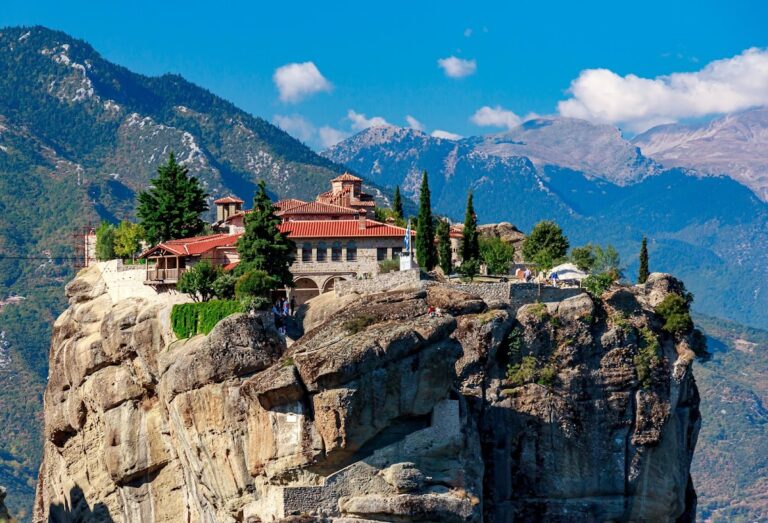
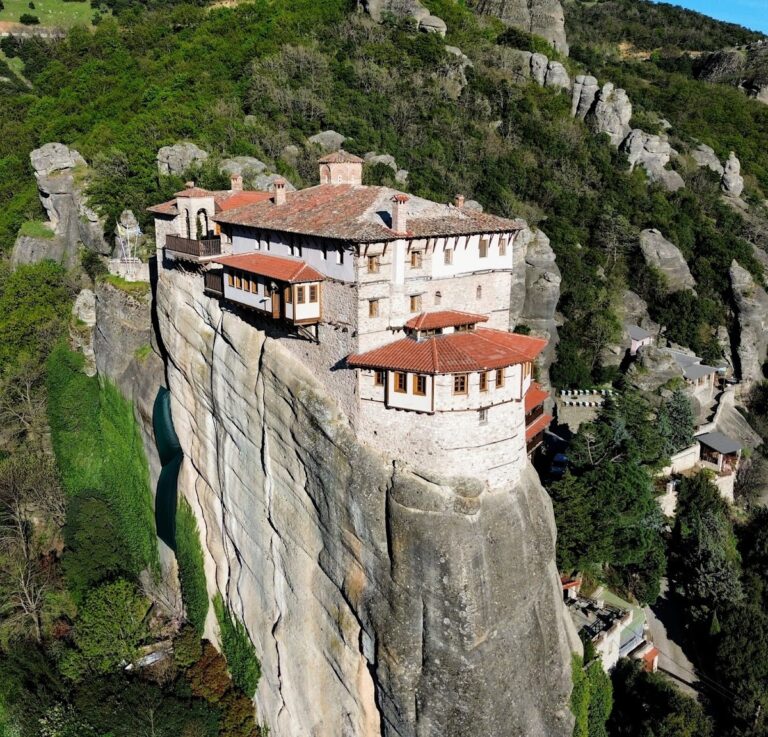
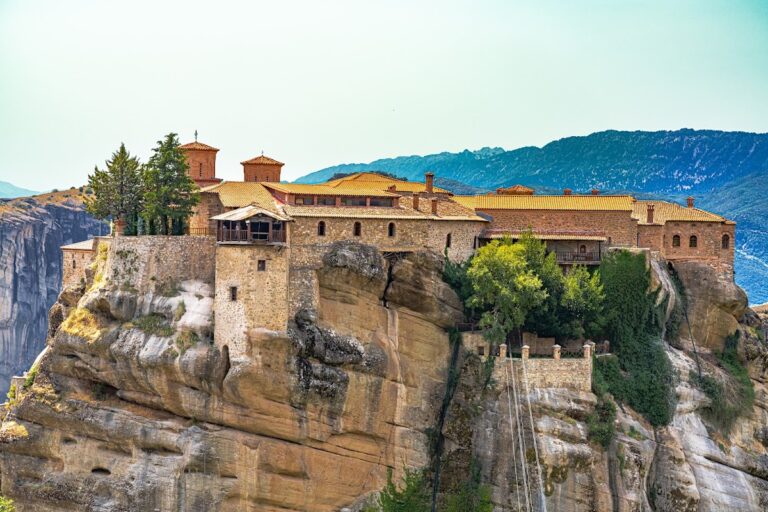
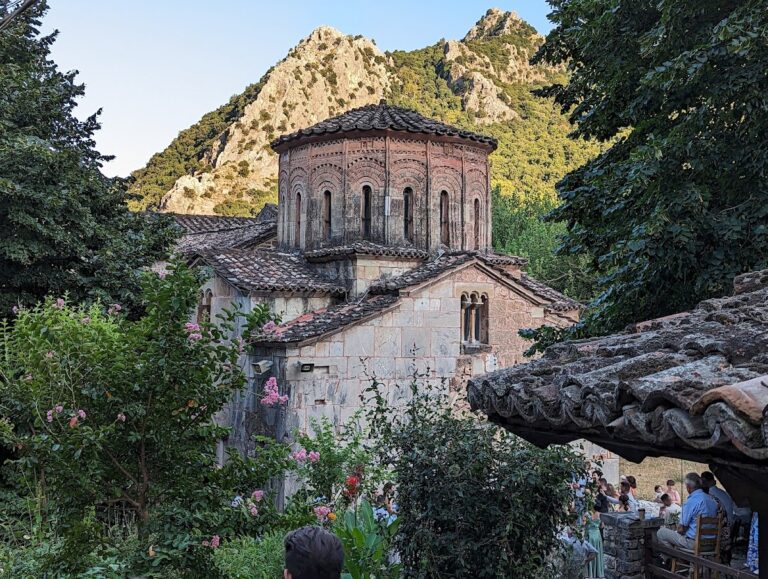
The monastery occupies a rocky height below Kukulas Peak, northeast of Kalambaka. Its precipice forms part of the Meteora landscape, whose cliffs consist of sandstone and conglomerate created by fluvial erosion. Chemical analysis places the formation of these rocks at approximately 60 million years ago. The complex preserves the old and new cathedrals alongside monastic cells, a hearth, stables, and an ancient altar. These structures have been restored, and the monastery is reached by a modern approach road and a stone bridge built at the same level as the rock.
The old cathedral
The old cathedral, restored by Philotheos, contains a main church and a nave, the principal longitudinal space of a church. The nave is a square room joined to the rest of the building by three vaults extending across its full width. The spacious main church has a wooden roof and ends on the eastern side in a three-sided apse, a projecting termination commonly found at the eastern end of a church.
The cathedral’s murals have been cleaned and restored. An inscription on the west wall of the nave names the church as dedicated to Saint Stephen, the Protomartyr and Archdeacon. It attributes the construction to the efforts and financial support of the abbot and hieromonk Mitrofan, a monk ordained as a priest, together with the hieromonk Gregory. The same inscription associates the painting of the Dormition of the Virgin Mary with Gregory and the priest Nikolaos Kastrisio of Stagon.
The inscription indicates that the decoration was carried out in two stages. The first covered the altar, the main church, and most of the nave through the work and patronage of Mitrofan and Gregory. The second added the west wall and the lower part of the columns connecting the nave with the main church, and is associated with Nikolaos Kastrisio. Only the first letter of the date survives, and the earlier interpretation of the date as 1510 is now considered incorrect.
The first mural phase belongs to the post-Byzantine tradition, an Orthodox painting tradition that continued Byzantine religious forms after the political decline of the Byzantine Empire. Researchers date it to the first half of the seventeenth century and attribute it to mainland painters from Linotopia. The scenes use many figures and elaborate architectural settings, with static and asymmetrical arrangements. Isolated figures in the lower wall zones are more monumental than the smaller narrative scenes. Earthy colors dominate the strongly saturated palette, with bright red used repeatedly.
The second phase has more modeled figures and a stronger tendency toward ornament. These qualities suggest a painter with extensive artistic training and place the work in the last decade of the seventeenth century.
The dome vault over the altar shows the Virgin Blachernitissa between two archangels, with priests below. Other scenes in this area include the Conversation of the Apostles, Christ and the Samaritan Woman, the Nativity, Mid-Pentecost, Moses before the Burning Bush, the Giving of the Law to Moses, and a martyrdom.
The main church contains scenes from the life of Christ. On the south wall are the Presentation, Baptism, Raising of Lazarus, and Entry into Jerusalem. The inner face of the south-wall window shows the prophets Elisha and Habakkuk. The west wall depicts the Last Supper, Washing of the Feet, and Prayer in Gethsemane, with the Evangelists below; the apostles Paul and Peter appear on two columns.
The north wall presents the Betrayal of Judas, Pilate Washing His Hands, the Crucifixion, and the Lamentation. The next zone contains Saint Azarias and the Resurrection, while the lowest zone shows Saints Artemius, Eustathius, Niketas, Mercurius, Procopius, Nestor, Demetrius, and George. The prophets David and Solomon appear on the inner face of the north-wall window.
The east wall of the nave contains the Evangelists, the Supplication of the Virgin Mary, Christ the Merciful, Saint John the Theologian, and Saint Adrian. Saint Orestes and Saint Luke are painted on the north column. The west wall shows scenes from the life of the Virgin Mary, including her Birth, the Nativity, and the Dormition. Two archangels, two ktetors, or founders and patrons represented in connection with a church, and the Martyrdom of Saint George appear below. Only Saint Constantine survives among the figures in the lowest zone.
The Cathedral of Saint Charalambos
Built in 1798, the Cathedral of Saint Charalambos is the principal church of the nunnery and is closed to visitors. Its large nave extends along the north wall from the entrance. The roof is formed by nine cross-shaped vaulted domes, a system comparable to that of the nave of the Great Meteoron.
The main church follows a domed plan with four columns and cross-vaulting. It has three apses, while its eastern end closes with three semicircular vaults and domes. The building represents the later architectural phase of the monastery and remains central to its continuing religious function.
Older buildings and the sacristy museum
Other surviving structures include the monastic cells, a small square hearth building, stables, and the ancient altar. The altar is a small structure covered by two ellipsoidal domes. It now houses the sacristy museum, where the monastery’s religious and artistic collections are preserved.
The museum contains manuscripts, liturgical vessels, and ancient icons attributed to the Cretan painter Emmanuel Tzanes. It also preserves examples of highly accomplished woodcarving, bringing together objects that illuminate the monastery’s liturgical traditions and artistic history.
Nearby sites