Coliboaia Cave: A Prehistoric Cave-Art Site in Romania
Site at a Glance
- Popularity
- High
- Country
- Romania
- Primary era
- Stone Age
- Eras represented
- Stone Age
- Civilizations
- Unclassified
- Site type
- Civic
- Remains
- Rock Art
On this page10 sections
History
Coliboaia Cave lies on the western slope of the Sighiștel Valley in Apuseni Natural Park, Bihor County, Romania. Its prehistoric animal paintings have been associated with the Upper Paleolithic, the later part of the Old Stone Age, and may be among the oldest known cave art in Central Europe.
Early references and discovery
The cave appeared in written literature before 1900. A discovery date of 1903 has also been proposed, although it is uncertain. Cave researcher Gabor Halasi carried out an extensive investigation in 1981.
Speleologists Tudor Rus, Mihai Besesek, Valentin Alexandru Radu, Roxana Laura Țociu, and Marius Kenesz discovered the prehistoric paintings in September 2009. On May 16, 2010, a French team examined the images and confirmed their authenticity. Its members included speleologists Marcel Meyssonnier and Valérie Plichon, cave-bear specialist Michel Philippe, prehistorian Françoise Prudhomme, and cave-art specialists Jean Clottes and Bernard Gély.
Dating and protection
The paintings’ age remains disputed. Estimates range from about 23,000 to 35,000 years, while radiocarbon results place them at approximately 32,000 to 35,000 years BP, a dating convention that counts back from 1950. Proposed dates have been linked to the Aurignacian and Gravettian, two Upper Paleolithic cultures. Cave bears and rhinoceroses were scarce during those periods, making the proposed associations difficult to reconcile with the images. Differences among the paintings also suggest that they may have been made at separate times.
After the discovery, the Romanian Federation of Speleology placed the cave under protection.
Remains
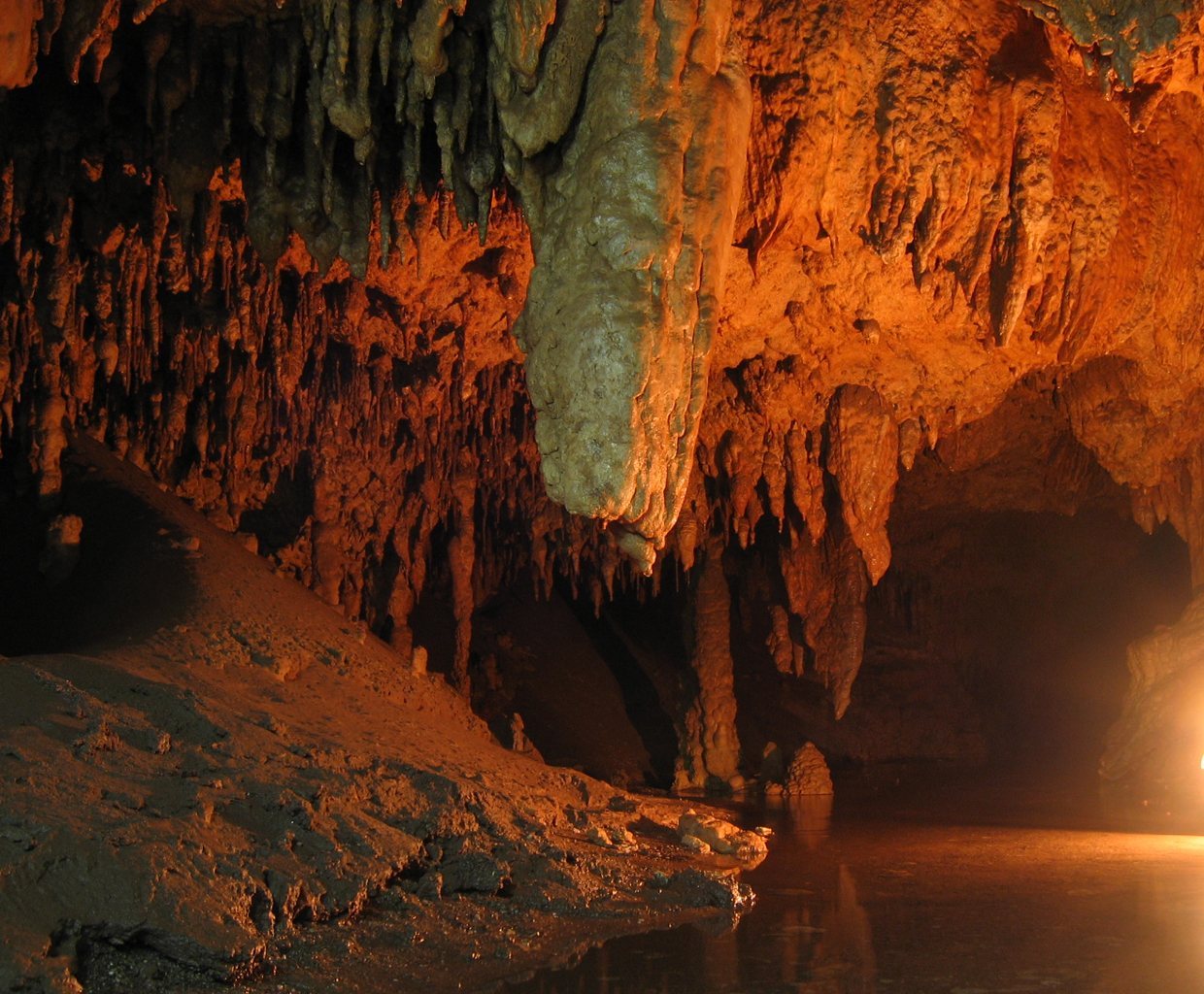
The limestone cave extends for 750 metres and has a single entrance. It is 560 metres above sea level, about five kilometres upstream from Sighiștel village and 120 metres upstream from Măgura Cave.
Entrance and underground passages
Entrance and river passage
The entrance is a triangular opening about two metres high at the base of a rock face, with its portal extending from east to west. A passage descends from it to an underground river that runs through the cave. At several points, the passage ceiling reaches the water, forming submerged sections that make the route difficult.
Mineral formations
In the cave’s final third, flowstone, a mineral deposit formed by flowing water, coats the walls. Stalactites hang from the ceiling, while stalagmites rise from the floor. The cave remains active, and difficult passages occur along its length.
Painted gallery and cave traces
Paintings and engravings
The Art Gallery lies seven metres above the cave floor. Reaching it involves passing through a large chamber, a natural lake, and the main gallery, then crossing an underwater section. Black paintings, probably made with charcoal, cover both walls without a symmetrical arrangement. They show animal heads, including a bison, a horse, a feline, one or two bears, and two woolly rhinoceroses; some images remain unidentified. A few engravings are also present. On the right wall, a bison drawing with bluish-gray lines is between 1.43 and 2.02 metres above the ground. A rhinoceros head on the left wall is between 58 and 89 centimetres above the floor.
Bear remains and wall markings
Bear bones lie scattered across the cave floor. Bears also scratched and polished the walls, with these marks crossing over the paintings. This physical relationship has been used as evidence for the paintings’ authenticity. Two bat species have also been identified in the cave.