Pessinus: An Ancient City and Sanctuary of Cybele
Site at a Glance
- Popularity
- High
- Country
- Turkey
- Primary era
- Classical
- Eras represented
- Classical
- Civilizations
- Roman
- Site type
- Settlement
- Remains
- City
On this page18 sections
History
Pessinus was an ancient city and sanctuary at modern Ballıhisar in Turkey. Archaeological evidence places its development no earlier than about 400 BC, although tradition credited the legendary Phrygian king Midas with founding the city and establishing an early sanctuary of Cybele, the Phrygian Mother Goddess. That early history remains unconfirmed. An ancient explanation for the name linked it to a divinity said to have fallen from the sky.
Sanctuary and Galatian rule
By the third century BC at the latest, Pessinus was a temple-state and an important destination for pilgrims who worshipped Cybele. A small priestly elite, the Galloi, administered her cult. These eunuch priests were also described as members of the ruling family, and their authority and privileges gradually weakened under Roman rule. Whether the sanctuary initially fell under Galatian control remains uncertain.
Celtic groups arrived in Asia Minor in 278/277 BC. After their defeat by the Seleucid king Antiochus I at the Battle of the Elephants, probably around 268 BC, they settled in the region later known as Galatia. The Tolistobogii, one of the Galatian peoples, occupied the Phrygian territory between Gordium and Pessinus. Seleucid kings showed devotion to the sanctuary, while Pergamon gained influence over the city by the late third century BC. The Attalid rulers of Pergamon appear to have endowed the sanctuary, perhaps after 183 BC, when Galatia came under Pergamene rule.
In 205/204 BC, after a series of portents including meteor showers, Rome consulted the Sibylline Books, prophetic texts used by Roman authorities in religious and civic crises. Acting with the support and guidance of its ally Attalus I of Pergamon, a Roman mission took Pessinus’s principal image of the goddess to Rome. The large black stone was believed to have fallen from the sky, and its removal established the worship of the Great Mother of Ida at Rome. A throne associated with the cult was also taken there. Fires destroyed it in 111 BC and AD 3; it was rebuilt after each, with the later reconstruction carried out under Augustus.
Roman rule and urban transformation
Political and economic turmoil marked the first century BC, including the Mithridatic Wars of 89–85, 83–81, and 73–63 BC. The priests’ privileges declined during this period. When Deiotarus, ruler of the Tolistobogii and an ally of Rome, became king of Galatia in 67/66 or 63 BC, Pessinus ceased to be an independent sacred principality.
In 36 BC Mark Antony transferred control of Galatia to King Amyntas. After Amyntas died, Augustus annexed the kingdom as a Roman province, and Pessinus became the administrative center of the Tolistobogii. Its development as a Greek-style city began soon after 25 BC. Pessinus and other Galatian cities may have received constitutions modeled on those of Pontus-Bithynia under the Lex Pompeia, a Roman law associated with the organization of provincial civic institutions.
Around AD 45, Emperor Claudius sold the temple lands to Brogitarix, a Galatian ruler. The sale reflects how Roman officials raised revenue by disposing of sanctuary property. Pessinus also served as a major trading center, the largest west of the Halys River. Grain and wool from the Anatolian highlands were probably among its goods. By the end of Tiberius’s reign, two citizens of Pessinus, M. Lollius and Q. Gallius Pulcher, held the chief priesthood of the provincial imperial cult at Ancyra.
Christianity and Byzantine Pessinus
Christianity reached the area in the third century AD. During the fourth century, the temple of Augustus ceased to serve the imperial cult and was reused for Christian worship. Emperor Julian, who supported traditional Roman religion, visited Pessinus on pilgrimage to Cybele’s sanctuary and complained about its poor treatment.
Around 398, Pessinus became the capital of the Roman province of Galatia Salutaris, also called Galatia Secunda, and the seat of a metropolitan archbishop, the senior bishop of an ecclesiastical province. Around 640 it ranked eighteenth among the metropolitan sees under the Patriarchate of Constantinople and had seven subordinate dioceses. In a later list from the reign of Leo VI (866–912), it ranked nineteenth, again with seven subordinate dioceses. Its archbishops are known into the eleventh century: Demetrius, the earliest named, was exiled around 405, and Nicolaus is named in 1054.
The surrounding area later belonged to the Byzantine Anatolic Theme, a military and administrative district in Asia Minor. In late 715, an Arab raid destroyed Pessinus and neighboring Orkistos. Byzantine control continued until the Seljuk Turks took the area in the late eleventh century. Pessinus then declined into a small, gradually depopulated settlement in the mountains. The later village of Ballıhisar occupied a higher and smaller area.
Rediscovery and later church titles
In 1834, French architect and archaeologist Charles Texier identified the temple foundations as the sanctuary of Cybele. Later excavations disproved that identification. Ghent University excavated Pessinus in 1967–1973 and again in 1987–2008. M. Waelkens studied the temple in the 1980s, and Angelo Verlinde analyzed and reconstructed its architecture between 2006 and 2012. Since 2009, a University of Melbourne team led by Gocha R. Tsetskhladze has investigated the city. The temple area and the Acropolis are the only parts studied thoroughly.
The Latin Catholic titular see, a historical church title without a resident bishop, was restored by 1901 and remains in use as a title. An Armenian Catholic titular archbishopric was established in 1905 and suppressed in 1915.
Remains
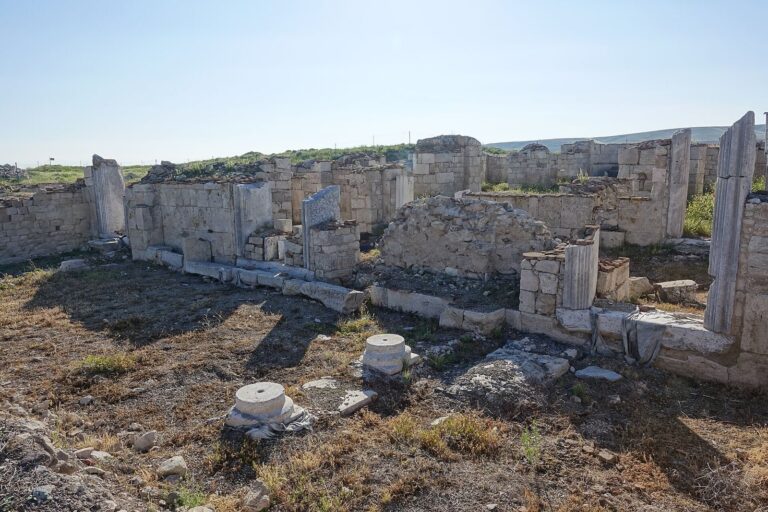
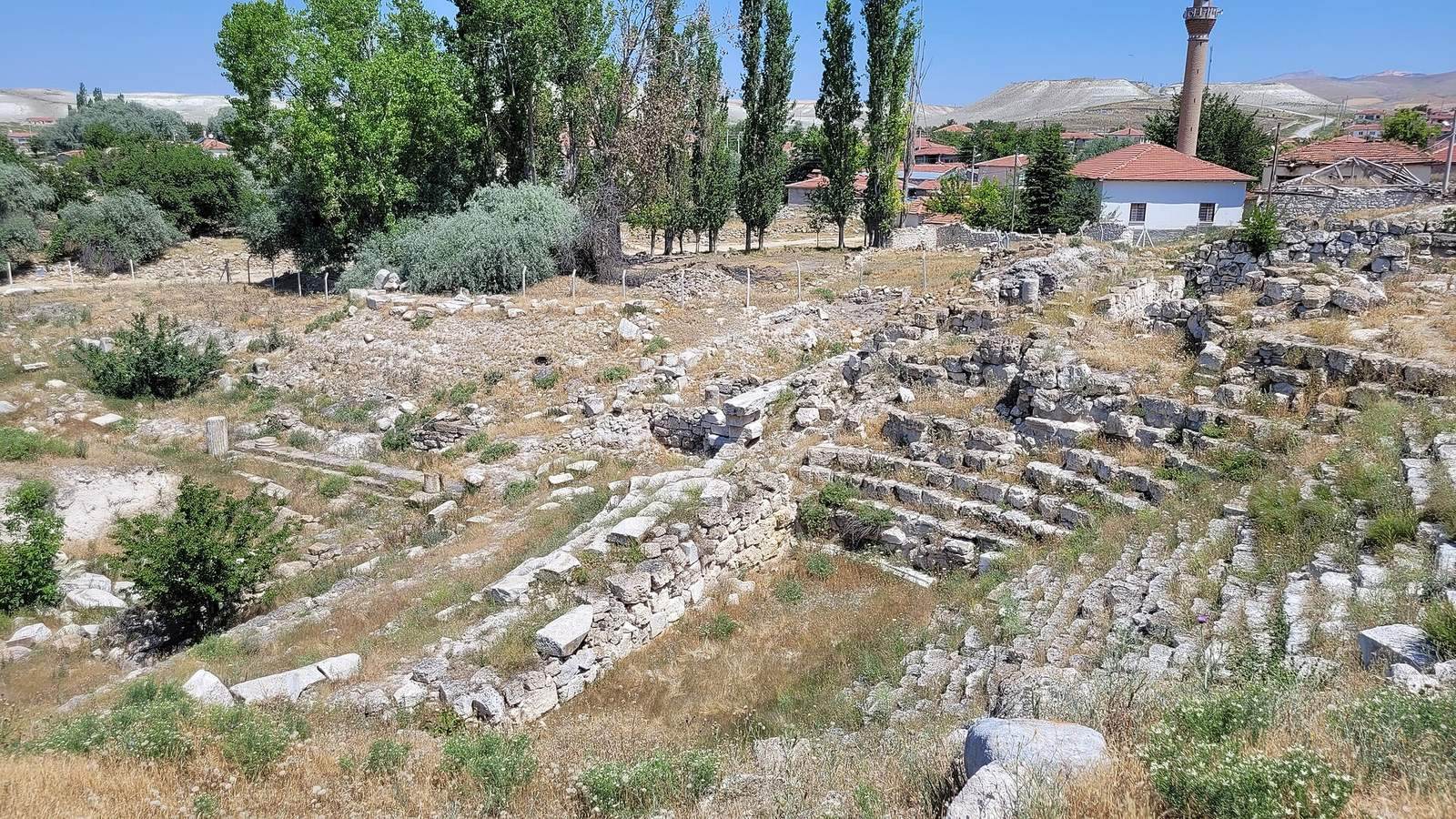
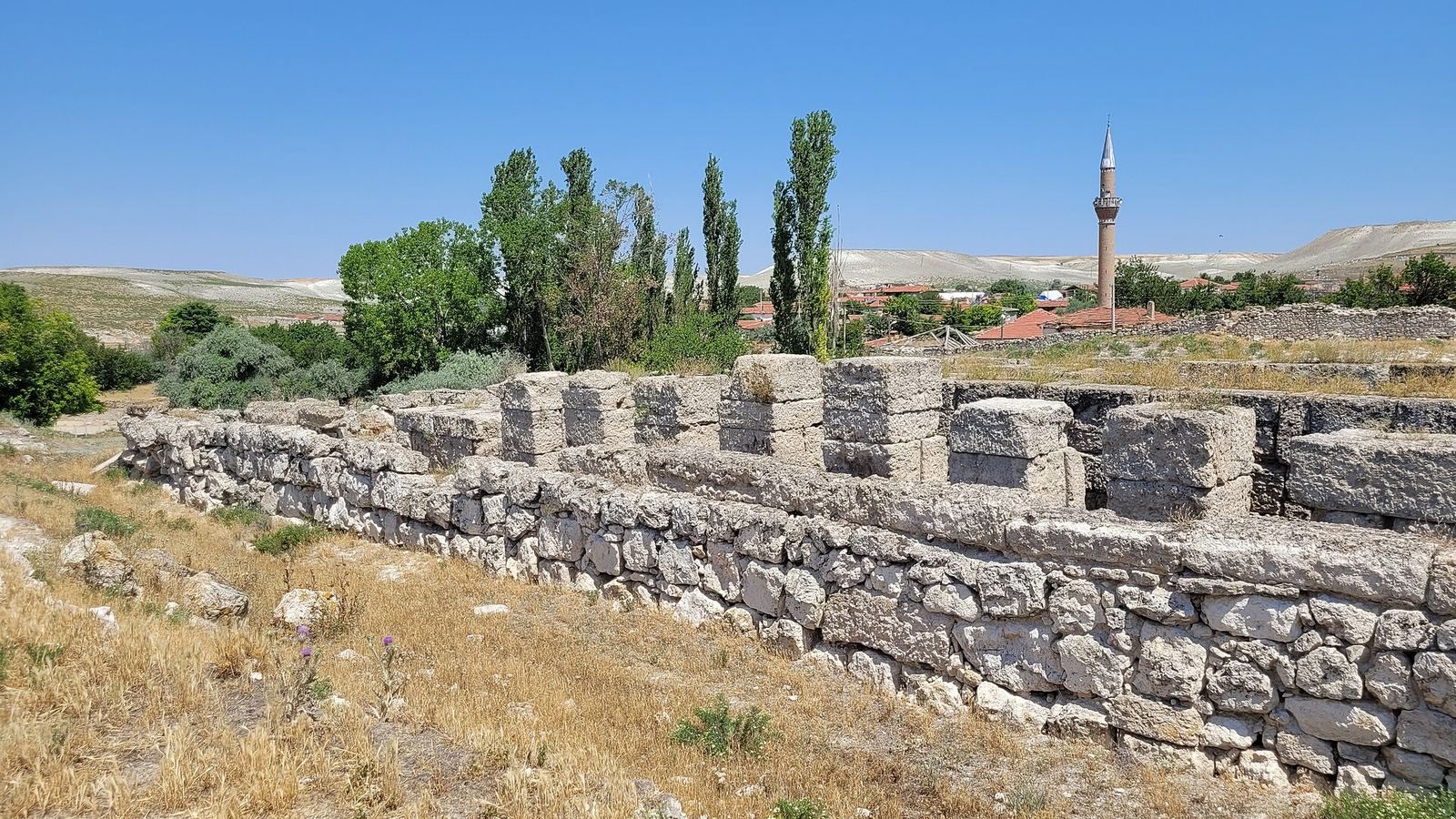
The ruins lie in a tributary valley of the Sakarya River on the high Anatolian plateau, about 950 metres above sea level. The seasonal Gallos River passes through the city. The temple district lies south of modern Ballıhisar beside the river, while the Acropolis stands near the valley’s northern entrance. The surviving features include an imperial-cult temple, performance spaces, public complexes, a principal street, waterworks, and remains of civic buildings.
Imperial-cult temple and theatres
Temple of the imperial cult
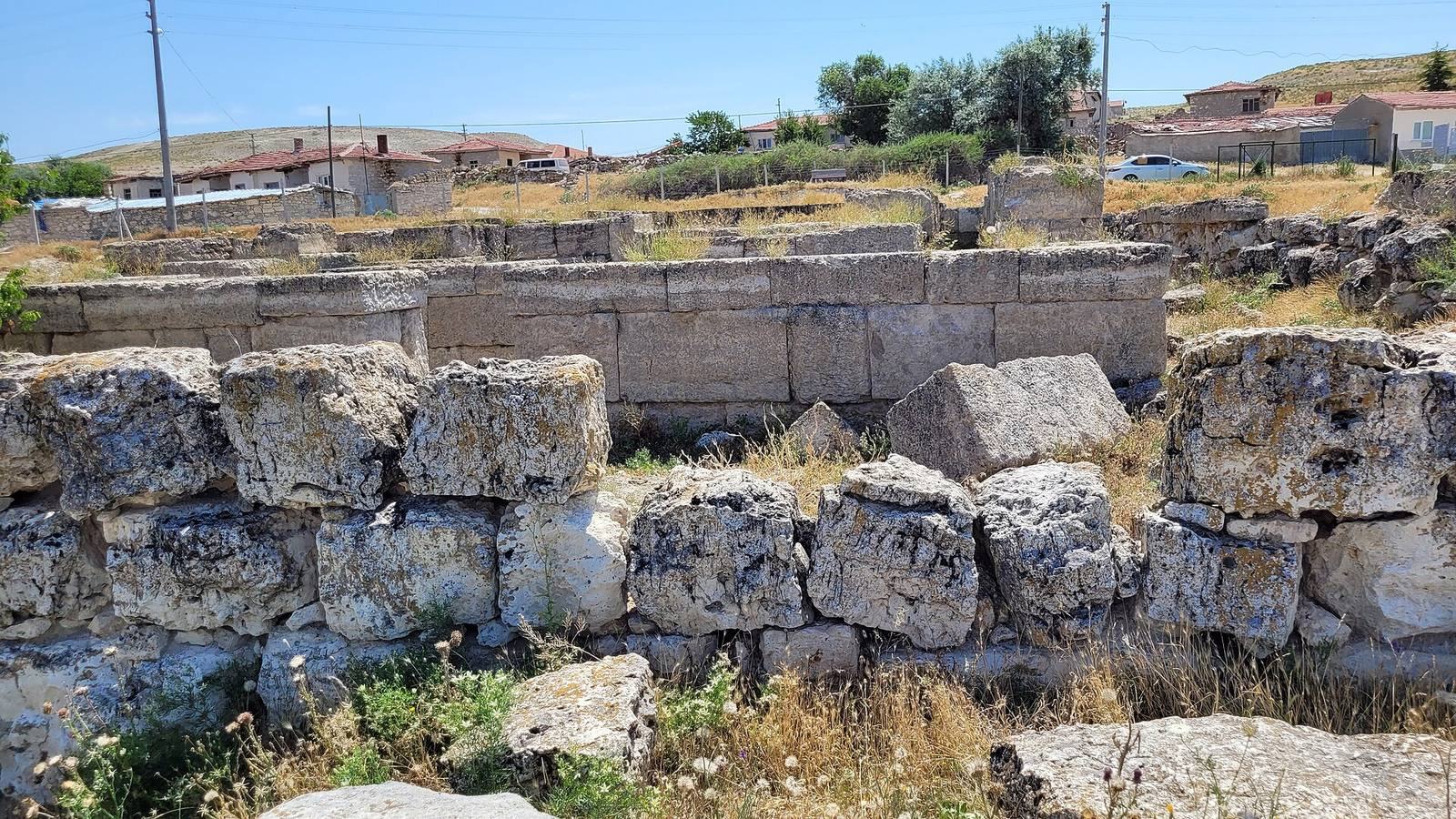
Built between AD 25 and 35, the temple was dedicated to the imperial cult, the worship of Roman emperors and sometimes their deified predecessors. It was a Corinthian-style building surrounded by a colonnade, constructed in marble on massive foundations. Its sculptural decoration followed a conservative style associated with Augustus, suggesting that the design may have been prepared around AD 15. The building stood on an unusually large stepped platform, and its plan followed a measured grid: the columns’ lower diameter was 0.76 metres, while the gaps between them measured 1.52 metres. A separate image of Cybele has also been found among the city’s ruins.
Stairway and theatre in front of the temple
A combined stairway and theatre stood before the temple, which rose behind it. A central staircase divided two seating wings, with a performance area between them. The space served religious and other performances, including gladiatorial contests. Raised seats bordered by protective walls resemble arrangements used for gladiatorial theatres in the Greek East. Its possible use as a setting for ritual combat has been proposed in connection with the association between such contests and the imperial cult.
Separate theatre
A second, large theatre is known from the surviving emplacement of its seating area. Its construction date is unknown. It was repaired or embellished under Emperor Hadrian.
Hellenistic public spaces and later monuments
Colonnaded court
In the valley, in front of the stairway-theatre, stood a four-sided colonnaded court dated to the late second or early first century BC. Its north side had a high colonnade, while the other three sides had lower columns. Built of limestone and finished with polished stucco, the complex resembled Hellenistic buildings used for exercise. It formed an annex to the Hellenistic citadel on the eastern promontory.
Exercise complex and later additions
The associated exercise complex was destroyed by fire in the late Hellenistic period, a date supported by ceramic and radiocarbon evidence. The complex was not rebuilt, and the area may later have served as an unpaved arena for gladiatorial contests. In the third century AD, the space was developed with an elliptical theatre, a large marble square, and a monumental funerary crypt associated with honored dead.
Streets, waterworks, and civic buildings
Principal north–south street
The city’s main north–south route followed the Gallos River. Its colonnade was made with marble from quarries at İstiklalbağı, about six kilometres north of Pessinus. Monumental arched gates marked the route’s northern and southern ends.
Water channels and supply
A canal system managed the Gallos’s seasonal waters, retaining and carrying them away. The earliest section dates to the Augustan period, and extensions made between the first and third centuries AD brought the system to about 500 metres long and 11–13 metres wide. Gutters and terracotta pipes also formed part of the city’s water supply.
Other civic and defensive remains
Inscriptions refer to a gymnasium, an archive or administrative building, baths, and a theatre. A wall strengthened an existing fortification. The last building from antiquity to survive at Pessinus was demolished in the nineteenth century.
Archaeological finds
A stamped handle from a Thasian wine jar, probably dating to the first quarter of the third century BC, is the earliest written document found at Pessinus. It also provides evidence for trade at the city during that period.