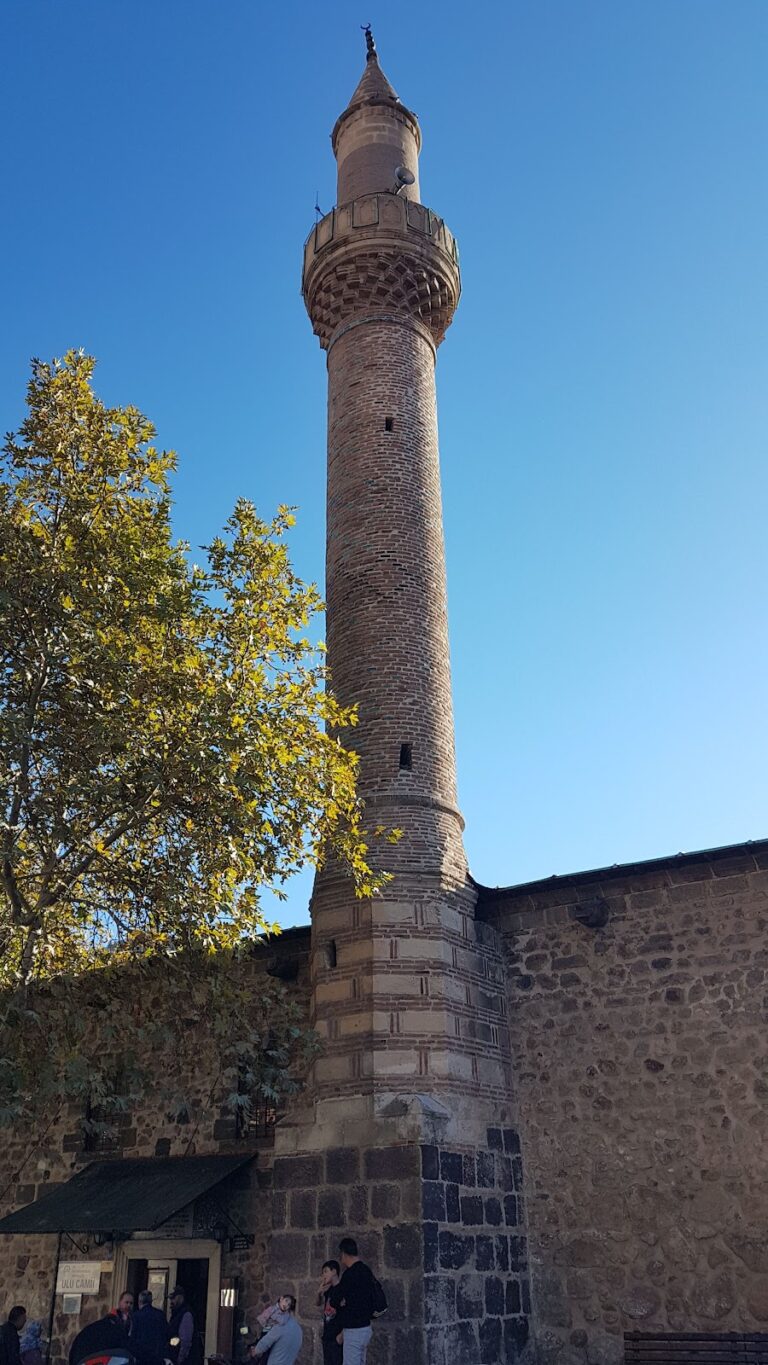
Amorium: An Ancient City and Byzantine Stronghold
Site at a Glance
- Popularity
- Very High
- Country
- Turkey
- Primary era
- Medieval
- Eras represented
- Classical, Medieval
- Civilizations
- Ancient Greek, Byzantine
- Site type
- City
On this page10 sections
History
Amorium was an ancient city in Phrygia, at modern Hisarköy in Türkiye. It was founded during the Hellenistic period, an era of Greek cultural influence between classical Greece and the Roman imperial period. Its position on the military road between Constantinople and Cilicia, a region in southeastern Asia Minor, later made it an important strategic stronghold. The city began issuing its own coins at some point between 133 and 27 BCE, and its coinage continued into the third century CE. The latest known issues date to 211–217 CE, evidence that Amorium had become an established settlement with military importance before Byzantine rule. The ancient writer Strabo briefly mentioned the city.
Byzantine prominence
Amorium flourished under the Byzantine Empire, the medieval continuation of the eastern Roman Empire, and was prominent by the seventh century. Emperor Zeno had the city fortified in the fifth century. It later became the capital of the Anatolikon, a Byzantine military-administrative district.
Arab forces attacked in 646. Amorium surrendered to the Umayyad commander Abd al-Rahman ibn Khalid in 666, and the Umayyad caliph Yazid I occupied it in 669. The Byzantine general Andreas subsequently recovered the city. Raids into Asia Minor continued for roughly two centuries, although Amorium repelled major attacks in 716 and 796. In 742–743, Emperor Constantine V made it his principal base in the campaign against Artabasdos, a Byzantine general who tried to seize the throne.
The city’s standing rose further when its native son Michael II became emperor in 820 and established the Amorian, or Phrygian, dynasty, which ruled until 867. Amorium entered a period of exceptional prosperity and became the largest city in Asia Minor.
The sack of 838 and later decline
In 838, the Abbasid caliph al-Mu’tasim led a campaign directly against Amorium. After a two-week siege, his forces captured the city on 23 September, plundered it, and set it on fire. The city’s close association with the ruling dynasty contributed to its selection as a target. The sack began a lasting decline, and Amorium never regained its former prosperity or importance. The Arabic poet Abu Tammam commemorated the destruction in verse.
Captives from Amorium were among the Christians and Muslims exchanged at Tarsus in 840. Forty-two leading inhabitants captured in 838 were taken to Samarra in Iraq and executed in 845. Tradition says they refused to convert to Islam; they were later honored as the 42 Martyrs of Amorium and continue to be commemorated in religious services.
Amorium was rebuilt after the sack, but the military leader Thamal al-Dulafi burned it in 931. The city remained active at least into the eleventh century. In 1068, the Turkmen leaders Afshin and Ahmed Shah attacked and sacked it, killing most of its inhabitants. Following the Byzantine defeat at Manzikert in 1071, the Seljuks, a Turkic Muslim dynasty that ruled parts of the Middle East and Anatolia, devastated the city again. Emperor Alexios I Komnenos defeated the Seljuks at Amorium in 1116. Substantial Turkmen settlement followed in the wider region after the conflict.
Geographers al-Idrisi and Hamdallah Mustawfi continued to describe Amorium as an important place during the twelfth to fourteenth centuries. The upper city later served as a fortress under the Seljuks and again in the late Ottoman period. Under Ottoman rule the site was called Hergen Kale, and the settlement name Hisarcık appears in records from 1516. Modern Hisarköy was established in 1892 for refugees of war.
Church and religious traditions
Amorium was a bishopric by 431, when its bishop, named Abraham or Ablabius, attended the Council of Ephesus, a Christian assembly concerned with doctrine and church discipline. Earlier, the priest Tyrannus of Amorium had signed the proceedings of the First Council of Constantinople in 381. Later representatives included Mysterius at Chalcedon in 451, Theodorus at the Council of Trullo in 692, Theodosius at the Second Council of Nicaea in 787, and Bessarion at Constantinople in 879. Around 859, Theophilus accompanied a mission to Rome sent by Photius, the patriarch of Constantinople.
In seventh-century church lists, Amorium was a suffragan see, a subordinate bishopric, under Pessinus, then the capital of Galatia Salutaris. It retained that status in a late-eighth-century list, before becoming a metropolitan see, an ecclesiastical centre with authority over subordinate sees. This change probably followed Amorium’s rise to imperial prominence. An early-tenth-century list names five sees under its authority: Philomelium, Claneus, Docimium, Polybotus, and Pissia. Amorium no longer appears as a see in fourteenth-century lists. Although it has no resident bishop, the Catholic Church retains it as a titular see, a church title without a resident bishop.
Traditions also associate Amorium with Aesop, the ancient Greek fabulist, although his birthplace is disputed. An Islamic tradition links Salman al-Farsi to a church at the city: he is said to have worked there under a monk before travelling to Medina and embracing Islam.
Rediscovery and archaeological work
Although Amorium’s name appeared on maps in the eighteenth and nineteenth centuries, the location of the ancient city had long been uncertain. The English antiquarian Richard Pococke rediscovered the site in 1739. Geologist William Hamilton made the first visit by a Western scholar in 1836, after which maps placed Amorium more accurately.
Martin Harrison of Oxford University surveyed the site in 1987, and systematic excavations began in 1988, concentrating mainly on its Byzantine and later history. An international team led by Chris Lightfoot of the Metropolitan Museum of Art continued the work from 1993. Fieldwork resumed in 2014 under Zeliha Demirel Gökalp of Anadolu University, with international collaboration. Before the site was protected, extensive digging by treasure hunters caused substantial damage.
Remains
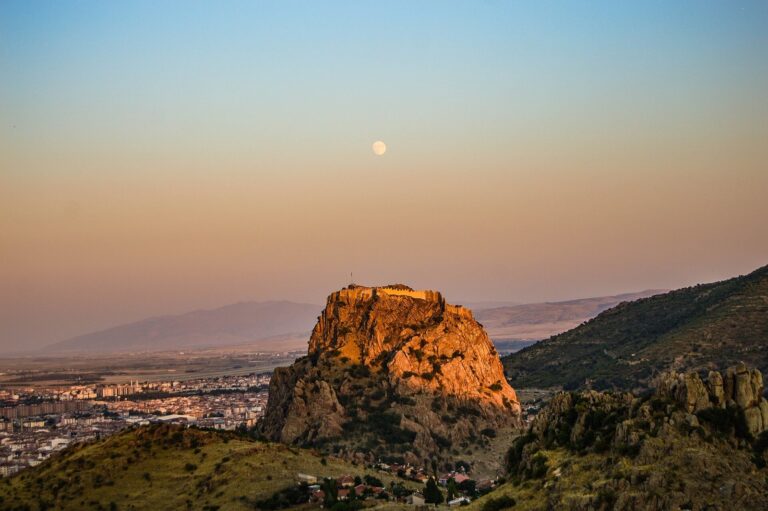
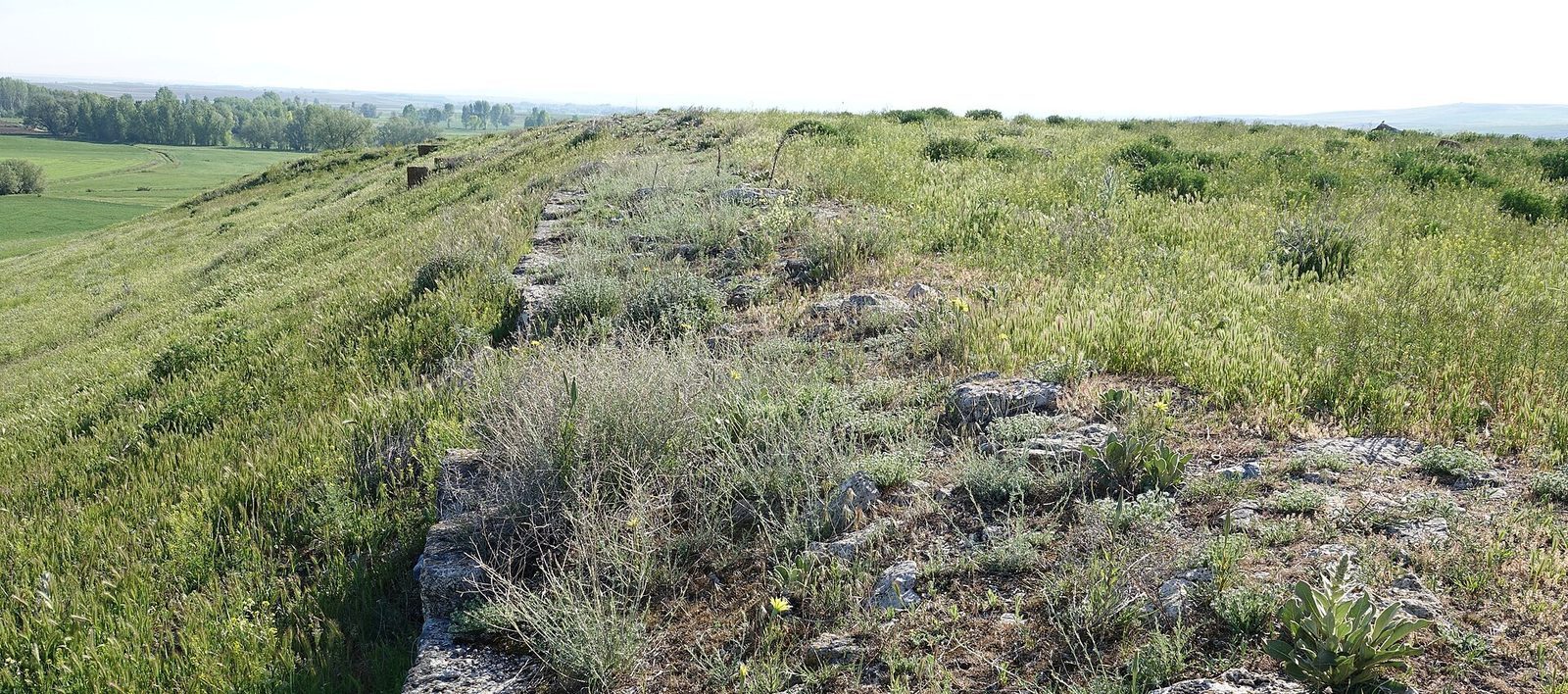
The archaeological area lies beneath and around modern Hisarköy, about 13 kilometres east of the district centre of Emirdağ. It is organized as an upper city and a lower city. A man-made settlement mound occupies the upper city, while a further fortification wall enclosed the lower city.
Buildings and archaeological finds
Baths, basilica, and tomb
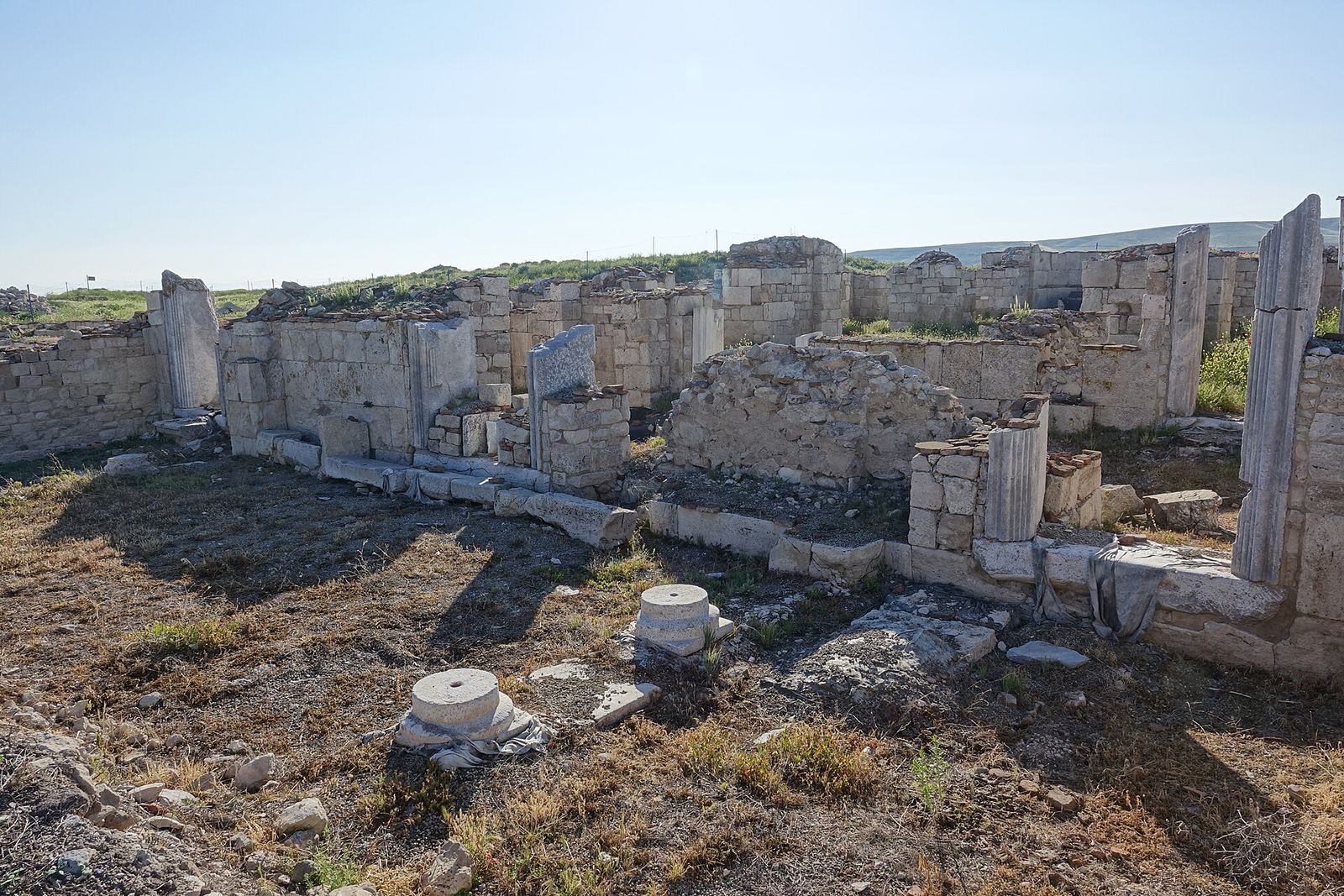
The remains include baths, a basilica, and a monumental tomb. A basilica is a church with a long central nave, often flanked by aisles. Wall remains and column capitals, the upper parts of columns, also survive.
Upper-city church
A church in the upper city was surveyed using geophysical methods in 2001 and has been partly excavated.
Other archaeological evidence
Pottery fragments, coins, and a Greek inscription form part of the finds from Amorium. Mosaics and frescoes are also among the remains.