Peniche Fortress: A Portuguese Coastal Stronghold and Political Prison


Site at a Glance
- Rating
- 4.4
- Popularity
- Low
- Country
- Portugal
- Primary era
- Early Modern
- Eras represented
- Medieval, Early Modern, Modern
- Civilizations
- Portuguese, Spanish
- Site type
- Military
- Remains
- Fort
On this page14 sections
History
Peniche Fortress is a Portuguese coastal stronghold in Peniche, Portugal, built between the sixteenth and seventeenth centuries as the town’s harbour and peninsula became an important defensive position. Its origins lay in the need to protect the former harbour of Atouguia da Baleia and the approach to the mainland from repeated attacks by English, French, and Barbary pirates.
From medieval harbour to coastal fortress
Peniche was once an island, separated from the mainland by a channel near the mouth of the São Domingos River, at the former Ribeira de Atouguia. Currents and winds gradually deposited silt and sand, joining the island to the mainland and causing the former harbour of Atouguia da Baleia to disappear. The harbour had been one of Portugal’s important medieval ports, with access to Lisbon, Óbidos, Torres Vedras, Santarém, and Leiria.
Repeated attacks encouraged King Manuel I to place four armed ships at Peniche and support the creation of a permanent coastal defence. In 1544, King João III recommended building a castle on the peninsula, and a suitable position for protecting the harbour was identified. Initial work took place in 1557 and 1558 under the supervision of D. Luís de Ataíde. The northeastern and northwestern walls continued until 1567, and the first fortification was completed around 1570.
The new position controlled the narrow entrance to the peninsula, while the rocky coast helped shield the town from recurring pirate incursions. The design is believed to have been influenced by coastal castles built under King Henry VIII of England, particularly Pendennis Castle at Falmouth. Work was suspended during D. Luís de Ataíde’s appointments as Viceroy of India, from 1568 to 1571 and again after his departure for India in 1578.
Spanish rule and the seventeenth-century expansion
During the period of Spanish rule in Portugal, King Philip II sent a military engineer to Peniche in 1589 to consolidate the fortress and examine possible improvements. That year, English troops landed at Peniche and began an unsuccessful march towards Lisbon in an attempt to restore Portuguese sovereignty. Peniche was elevated to town status in 1609, when repairs were also made to the walls.
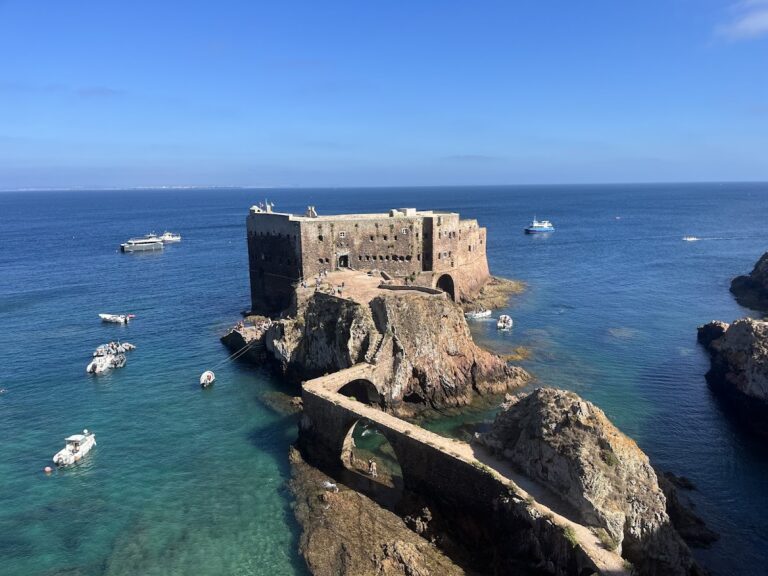
The fortress formed part of a wider defensive system supported by the forts of Praia da Consolação and São João Baptista das Berlengas. In 1625, King Philip IV urged the construction of a fort on the Berlengas Islands and proposed reopening the channel between Peniche and the mainland. Peniche nevertheless remained connected to the mainland.
During the Portuguese Restoration War, the conflict that restored Portugal’s independence from the Spanish monarchy, further strengthening was considered necessary. An engineer sent to Peniche in 1642 reported inadequate accommodation, food, garrisons, and artillery. The ensuing expansion created the irregular, star-shaped fortress completed in 1645. King João IV inspected it in 1652.
Earthquake damage and the end of military effectiveness
The major Portuguese earthquake of 1755 damaged the fortress, which was subsequently repaired. The chapel of Santa Bárbara was remodelled in 1773. A later inspection criticised the condition of the defences, leading to new batteries in 1800, a raised seaward parapet, and further improvements in 1807. The expense placed local inhabitants under financial pressure, and Queen Maria I provided assistance.
The fortress proved ineffective when Franco-Spanish troops landed at Peniche in December 1807 during the Peninsular War, the wider conflict against Napoleonic France and its allies in the Iberian Peninsula. In 1810 it was briefly considered as a possible embarkation point for British troops. After the Congress of Vienna in 1815, it was abandoned as a military position, and parts were later dismantled as Peniche expanded.
Prison, military decline, and changing uses
In 1824, the fortress was temporarily converted into a prison. During the Portuguese Civil War of 1828 to 1834, it held political prisoners from both the Liberal and Absolutist sides. The fortress was reoccupied during the conflict, although Absolutist forces left Peniche after Liberal forces occupied the Berlengas Fort in 1833.
In 1836, stored gunpowder exploded and caused a violent fire that completely destroyed the Governor’s House. The building was never recovered. Restoration continued in later decades, including work undertaken after the governor reported the fortress’s poor condition in 1871. Military use continued until 1897.
The fortress later served several custodial and institutional purposes. During the Second Boer War, it accommodated Boer refugees returning from the Portuguese colony of Mozambique after the British victory in South Africa. German and Austrian nationals were detained there during the First World War. From 1928, the buildings were used as a tuberculosis sanatorium.
The Estado Novo prison and the Carnation Revolution
In 1934, under the Estado Novo, Portugal’s twentieth-century authoritarian regime, Peniche became a maximum-security political prison. It remained in that role until 1974 and held opponents of the regime, including members and supporters of the Portuguese Communist Party and other political organisations.
António Dias Lourenço escaped in December 1954 after sawing an opening measuring 20 by 40 centimetres in his cell door. He tried to descend about 20 metres towards the sea on a rope made from torn sheets or cloth. When the rope broke, he fell into the water, reached land despite the waves, and escaped with help from fishermen.
On 3 January 1960, Álvaro Cunhal, leader of the Portuguese Communist Party, escaped with Francisco Martins Rodrigues, Joaquim Gomes, Carlos Costa, Jaime Serra, Francisco Miguel, José Carlos, Guilherme Carvalho, Pedro Suenes, and Rogério de Carvalho. A member of the National Republican Guard incapacitated a fellow guard with chloroform, allowing the prisoners to descend the walls using a rope made from torn sheets or cloth.
The Carnation Revolution, the military-led revolution of 25 April 1974 that overthrew the Estado Novo, made the fortress one of the principal targets of the revolutionary action. The political prisoners were released on the morning of 27 April after negotiations over the terms of their release.
Museum and memorial complex
After the revolution, parts of the fortress temporarily housed Portuguese settlers returning from African overseas territories during decolonisation. When the last returnees had left, Peniche residents, civic groups, and the city council developed a museum devoted to antifascist resistance and the history of Peniche.
From 1984, the fortress functioned as the Peniche Municipal Museum, with archaeological, historical, and ethnographic collections. Its resistance displays were arranged to recreate the political prison through individual cells and the cell associated with Álvaro Cunhal’s detention and escape. All the fortress buildings had been classified as a national monument in 1938, a status that encouraged later repair work, sometimes using prisoners as labour. Further repairs took place in the 1990s and from 2010 to 2013, although the fortress was still described as being in an advanced state of degradation.
A proposal to convert part of the complex into a hotel was not implemented, while a 2016 proposal to transfer it to private tourism interests was withdrawn after public opposition. In April 2017, the Portuguese Council of Ministers provided for the former Estado Novo prison to house the National Museum of Resistance and Freedom. The fortress closed in November 2017 for restoration and museum works directed by the architect João Barros Matos. An exhibition presenting the future museum’s contents opened on 2 May 2019, and the museum formally opened on 27 April 2024.
Remains
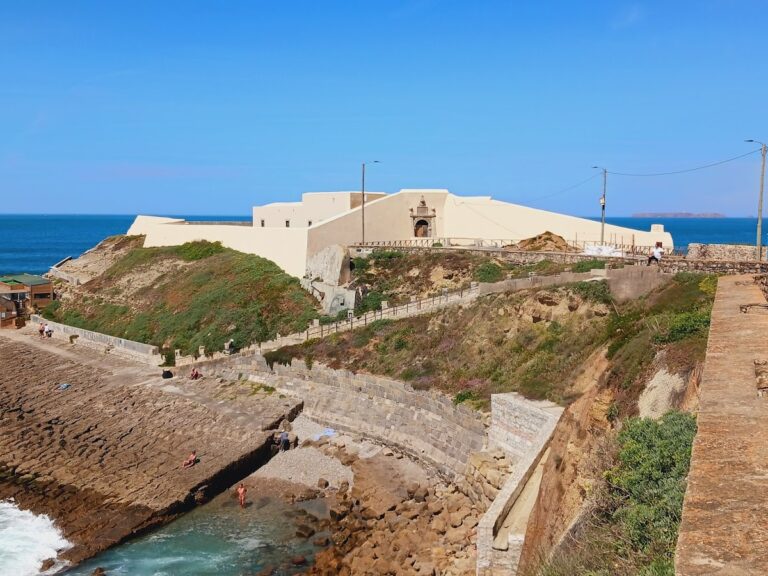
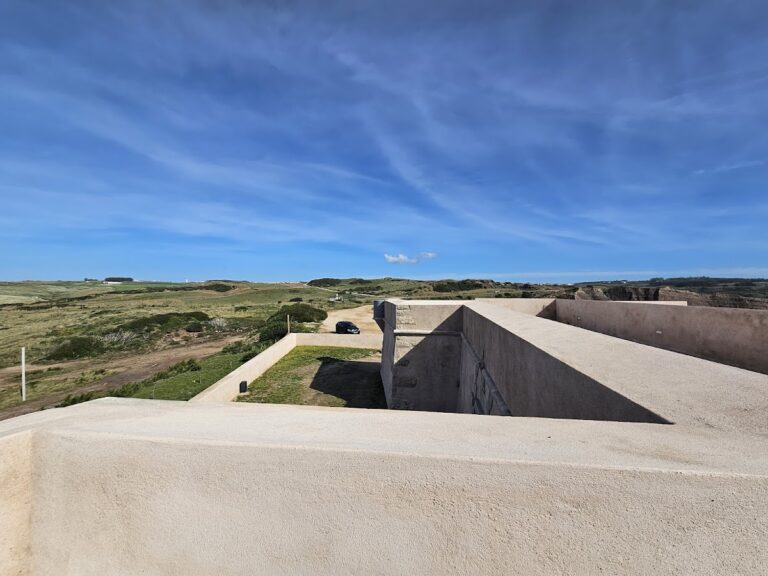
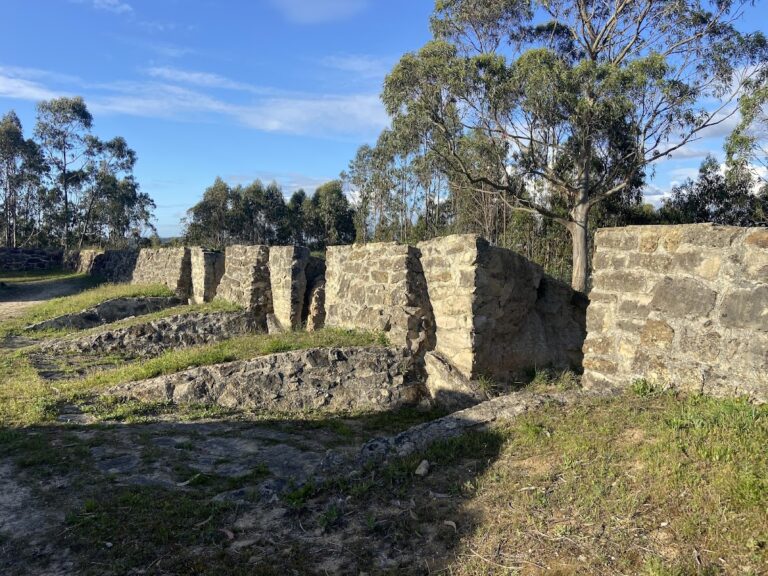
The fortress occupies the southern part of Peniche, between the fishing port to the east and Furninha Cave to the west. Built on the site of the former Castle of Atouguia da Baleia, it covers about two hectares. Its walls enclose upper and lower sectors in an irregular, star-shaped polygonal plan adapted to the terrain, with bastions, curtains, ravelins, moats, covered ways, esplanades, batteries, earthworks, gates, and a watchtower.
Defensive sectors and entrances
Fort of Luz and the northern sector
The northern sector at Peniche de Cima was dominated by the Fort of Luz. It had a polygonal plan with bastions, projecting defensive works that allowed fire along adjoining walls, at its corners. Circular sentry boxes and cannon positions stood on the seaward earthwork, while a triangular ravelin, a detached outer defence, protected the monumental gate from the landward side. The sector also included the Round Bastion, the Watchtower, and the chapel of Santa Bárbara, which was remodelled in 1773.
Citadel and the southern sector
The southern sector at Peniche de Baixo was dominated by the Citadel. A ravelin protected its entrance on the Campo da Torre side, near the former fishing harbour. Along the eastern wall, a moat filled with water at high tide. Additional curtains, or wall sections linking defensive projections, and moats protected the western side. Two further northern curtains and eastern and western bastions were associated with several rectangular buildings.
Gates and internal defences
Four gates are identified within the fortress: the Cabanas Gate, New Gate, Punta Gate, and Peniche de Cima Gate. Cannons, covered ways, and esplanades formed part of the defensive arrangement. The Governor’s House belonged to the complex until the gunpowder explosion and fire of 1836 destroyed it. The building was not recovered, while other courtyards, batteries, earthworks, and defensive walls continued to form the surviving structure.
Prison buildings and commemorative spaces
Later prison buildings were incorporated into the southern defensive complex around a watchtower. The former individual cells include the one associated with Álvaro Cunhal, and a memorial commemorates the political prisoners detained at Peniche. The museum preserves prisoners’ notebooks, letters, paintings, handmade objects, games, books, drawings, poems, notes, postcards, photographs, cell furniture, uniforms, and material from earlier exhibitions.
Museum collections and local heritage
The museum complex contains archaeological collections connected with Furninha Cave, underwater archaeology, malacological material, the study of molluscs, shipbuilding-related objects, and local crafts. Historical and ethnographic displays include fishing equipment, shipbuilding objects, handmade lace, and objects produced by prisoners. The collections also present Peniche’s archaeological heritage and historic shipwrecks.
A monument near the fortress commemorates local women who traditionally made complex bobbin lace on cylindrical pillows. The former fortress museum maintained a permanent display devoted to this handmade lace tradition, placing local craft history alongside the military, archaeological, and political history represented within the complex.