Fort of Paimogo: A Portuguese Coastal Defence Fort


Site at a Glance
- Rating
- 4.3
- Popularity
- Very Low
- Country
- Portugal
- Primary era
- Early Modern
- Eras represented
- Early Modern
- Civilizations
- Portuguese
- Site type
- Military
- Remains
- Fort
On this page7 sections
History
The Fort of Paimogo, also known as the Fort of Our Lady of the Angels of Paimogo or the Fort of Lourinhã, is a Portuguese coastal defence fort near Lourinhã, Portugal. Construction began in 1674 as part of the military architecture of the period, following a decision by António Luís de Meneses, 1st Marquis of Marialva and Count of Cantanhede. Meneses was a Portuguese military leader associated with the Restoration War, the conflict through which Portugal regained independence from the Spanish Habsburg monarchy.
Coastal defence in the seventeenth century
The fort belonged to a defensive chain along the coast between the fortress of Peniche and the Tagus estuary at Cascais. Its position above Paimogo Beach helped guard a stretch of coast where an invading force could land easily. The fort faced continuing maritime dangers from Spanish forces and Barbary pirates. In 1675, its garrison consisted of six gunners and six other soldiers, supported by six artillery pieces. By 1735, the armament had increased to eight guns.
War and military decline
An inspection in 1796 found the fort in generally poor condition. By 1804, its garrison had been reduced to five gunners and five marines. During the Peninsular War, the 1807–1814 conflict in which France and its allies fought Spain, Portugal, and Britain, the fort supplied covering fire for British troops landing at Paimogo in 1808. These forces reinforced the Anglo-Portuguese army commanded by the Duke of Wellington and took part in the battles of Roliça and Vimeiro, early victories for the Anglo-Portuguese forces.
The fort was still lightly manned during the Portuguese Civil War of 1828–1834, with only five soldiers assigned to it. It lost its military role in 1834, after the Liberal Wars and advances in military technology. The abandoned building was later used by a local farmer.
Protection and restoration
The Fort of Paimogo became a Property of Public Interest in 1957. A plan developed in 1980 to turn it into a centre for visitors interested in the region’s dinosaur fossils was not carried out. Repairs and measures to limit erosion followed in the late 1990s and early 2000s. In the second half of 2004, the Municipality of Lourinhã obtained the building from the Directorate-General for Heritage through a renewable 25-year transfer agreement. The municipality intended to restore the fort and include it in a proposed Dinosaur Route linked to the Institute for Nature Conservation and Forests. Restoration began in the first half of 2006.
Remains
Fortification layout
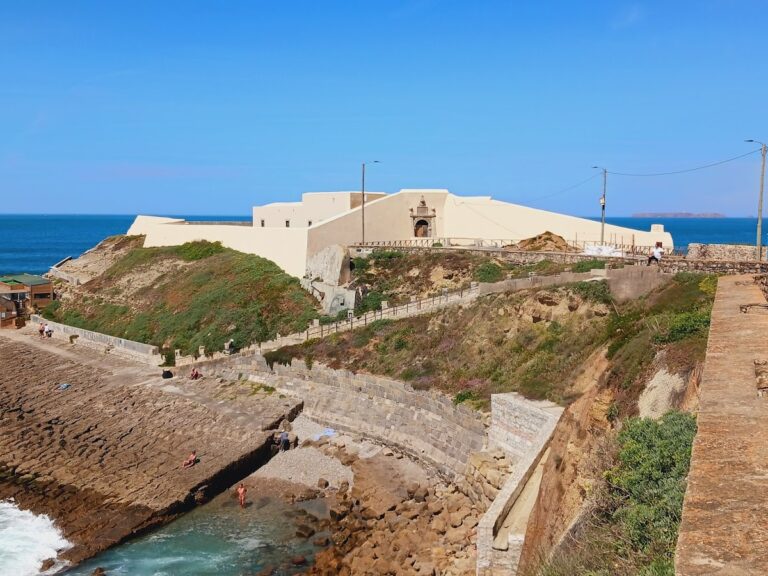
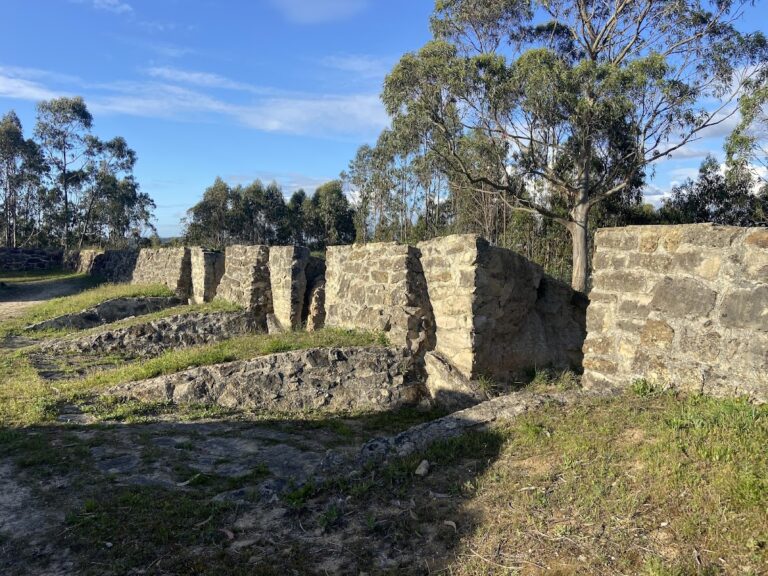
The fort occupies a dominant position above Paimogo Beach, near Lourinhã in Portugal’s Lisbon District. It has a rectangular plan with towers strengthening the corners. These towers are capped by conical vaults, while the overall arrangement follows the principles of a bastion fort, a defensive design with projecting elements that allow artillery to cover the walls and approaches. The form resembles that of the contemporary Fort of Milreu at Ericeira. Paimogo is described as an almost unique surviving example from its period because it avoided later modification. Its surviving elements include a cistern, doors and windows, a roof covered with slabs, and a staircase leading to the terrace.
Conservation and surrounding fossils
Restoration work cleaned the cistern, replaced the doors and windows, repaired the roof slabs, and worked on the staircase to the terrace. Erosion protection has also been undertaken, but coastal erosion continues to threaten the structure. The foundations on the southwest side have been worn away, creating a risk of collapse.
The fort stands close to cliffs associated with dinosaur nesting during the Upper Jurassic, the late phase of the Jurassic geological period about 163 to 145 million years ago. Fossilized eggs, theropod embryos, the sauropod Zby atlanticus, and remains of other animals have been found in the surrounding area. Some of these fossils are displayed at the Lourinhã museum.