Fishermen’s Gate: A Medieval Defensive Gate in Bratislava


Site at a Glance
- Rating
- 4.3
- Popularity
- Very Low
- Country
- Slovakia
- Primary era
- Medieval
- Eras represented
- Medieval, Early Modern
- Civilizations
- Habsburg, Hungarian
- Site type
- Military
- Remains
- Gate
On this page9 sections
History
Fishermen’s Gate is a medieval defensive gate in Bratislava, Slovakia, probably built in the middle of the fourteenth century. It was the smallest and latest of Bratislava’s four medieval gates, connecting the walled city with suburbs and fishing settlements along the Danube.
A Gate for the Danube Suburbs
The communities outside the gate included fishermen, artisans, butchers, and other residents. Fishermen mainly used the entrance to bring their daily catch into the city for sale. It was not a principal entrance, and Bratislava’s chamber accounts consistently called it a “little gate,” or Pförtlein. Its first recorded mention dates from 1403, when the suburbs beyond it were developing.
By 1407, stone guns had been installed in the gate. In 1529, fears of an attack from the Danube side during the Ottoman wars led to its closure. The opening was walled up, leaving only a pedestrian passage measuring 7 Schuh in height and 4 Schuh in width.
Reopening under Maria Theresa
Plans to restore and reopen the gate were made in 1717. Renaming it Belgrade Gate was considered, but the older name was retained. The restoration was completed between 1754 and 1756, during the reign of Maria Theresa, the Habsburg ruler who was Queen of Hungary and Archduchess of Austria from 1740 to 1780. The gate was then also known as Maria Theresa Gate, or Theresian Gate.
A commemorative plaque above the entrance referred to Maria Theresa and stated that she had ordered the gate reopened through the city magistrate in 1756, after peace had followed its closure after the defeat at Mohács in 1526. The inscription ended with the warning, “If God does not guard the gate, men guard it in vain.”
Demolition and Rediscovery
Maria Theresa ordered the gate demolished in 1776, after the medieval city walls were torn down. The remains of its masonry were discovered in 1990. The street crossing the former entrance is now called Fishermen’s Gate Street.
Remains
Gate Structure and Passage
Outer and Inner Gates
Fishermen’s Gate consisted of an outer gate and an inner gate. Both were square in form and each had a tower, while small projecting, oriel-like structures stood at the corners. Together they formed a square tower projecting from the city wall, in an arrangement comparable to Weidritz Gate. A covered arched passage ran beneath the gate.
Defensive Approach
Rounded defensive projections, known as rondels, protected both sides of the gate. Additional corner projections and a fortified outer enclosure strengthened the approach. A heavy drawbridge, suspended on chains, provided access, and both the outer and inner gates had vertically descending barriers called portcullises. One tower contained a brass bell that was rung on stormy nights.
Surviving Underground Masonry
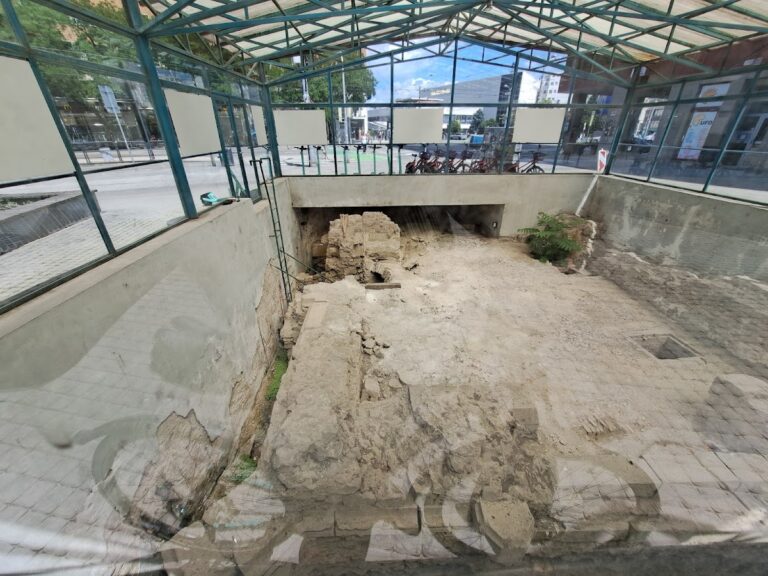
The surviving masonry lies below street level at Hviezdoslav Square. It is displayed beneath a Plexiglas cover and can be viewed through glazing at the square’s surface, allowing the physical remains of the former entrance to be seen in their archaeological setting.