Panticapaeum: Greek City and Capital of the Bosporan Kingdom
Site at a Glance
- Popularity
- Very High
- Country
- Ukraine
- Primary era
- Classical
- Eras represented
- Iron Age, Classical
- Civilizations
- Ancient Greek, Bosporan Kingdom, Roman, Scythian
- Site type
- Settlement
- Remains
- City
On this page26 sections
History
Panticapaeum was an ancient Greek city founded on the western shore of the Kerch Strait in present-day Ukraine, probably in the late 7th or early 6th century BC. Settlers from Miletus established it, and it later became the leading city of the Bosporan kingdom, an ancient state centered on the strait and nearby territories. Stories about its beginnings linked the settlement to a grant from a Scythian king or to the Argonaut legend and a son of Aeetes. Some ancient writers also named Panticapaeum as the birthplace of Heracles. The origin of the city’s name remains uncertain. It is often connected with the river Panticapes, named by Herodotus, while proposed meanings include ‘fish-path,’ ‘hill by the strait,’ ‘five hills,’ and ‘sea water.’
Greek city and Bosporan power
By about 480 BC, Panticapaeum led a confederation of Greek settlements formed to resist the Scythian population of the region. It was probably the confederation’s earliest and most powerful city-state. The city began minting silver coins in the later 6th century BC. In 479 BC, Archaeanact, a member of a prominent Milesian family, was elected archon, or civic magistrate, to lead the confederation. The Archaeanactids presided over the alliance for about 42 years. Although the historian Diodorus later called them kings, they led a confederation rather than a kingdom.
From 438/437 BC, the Spartocid dynasty ruled, and the former confederate cities came under Panticapaeum’s authority. The Bosporan kingdom expanded into eastern Crimea and the Taman Peninsula by the mid-4th century BC. Its greatest prosperity is associated with Leucon I, who ruled from 389 to 349 BC, his sons, and Eumelus, who ruled from 309 to 304 BC. Panticapaeum’s own prosperity reached a high point between the 5th and early 3rd centuries BC. It remained the kingdom’s political, commercial, craft, and cultural center until 109 BC.
The city’s position on routes linking Europe, Central Asia, China, and the Mediterranean supported extensive commerce. Grain and salted fish were among its exports, and wine-making was widespread. Together, Panticapaeum and Phanagoria controlled passage through the Kerch Strait and collected tolls from foreign merchants. The city first fought Scythian groups from the interior, then developed trade with them and exchanged cultural influences. Its ties with its founding city, Miletus, continued, while Athens became increasingly important in Black Sea trade during the 5th century BC, especially after the Persians destroyed Miletus in 494 BC.
The Athenian orator Demosthenes claimed that two-thirds of Athens’ grain imports came from the Pontus, a Hellenistic kingdom centered in Asia Minor, and that at least half of that supply came from the Bosporan kingdom. Athenian merchants and sailors received privileges at Bosporan ports. A decree of 350 BC extended the same privileges to merchants from Mytilene, and imports of Athenian pottery increased especially in the 4th century BC. Economic decline began during the 4th–3rd centuries BC and accelerated in the 3rd century. Sarmatian control of the steppes and competition from Egyptian grain contributed to the downturn.
Mithridates and Roman rule
Around 110–107 BC, the last Spartocid ruler, Paerisades V, was preparing to transfer power to Mithridates VI Eupator, king of Pontus. A revolt led by Saumacus broke out during the transition, and Paerisades was killed. Mithridates’ general Diophantus later returned with forces, suppressed the revolt, and brought the Bosporan kingdom under Mithridates’ rule. For a time, Panticapaeum also served as the capital of Mithridates’ wider realm.
After Rome defeated Mithridates VI, he took refuge at Panticapaeum. In 63 BC, his son Pharnaces II and citizens of the city turned against him. Mithridates asked a bodyguard to kill him. Pharnaces, who had rebelled against his father, was later recognized by the Roman general Pompey, and the Bosporan kingdom remained a Roman client kingdom. After Scribonius was killed in 14 BC, it became a Roman dependency for roughly three centuries. In AD 14, Emperor Tiberius confirmed Aspurgus as king. Aspurgus received Roman citizenship and the title ‘friend of Caesar,’ and later Bosporan rulers used the dynastic name Tiberius Julius.
After Aspurgus’ death, Emperor Caligula installed Mithridates VIII as ruler at Panticapaeum. Mithridates sought independence but was deposed by Rome during the Bosporan War of AD 45–49 and fled to the Asian side of the strait. He was executed in Rome in AD 68 after an unsuccessful plot against Emperor Galba.
Late antiquity and archaeological work
Gothic attacks struck Panticapaeum and the Bosporan kingdom in the 3rd century AD. The Hun invasion of the 370s ended the city’s role as a state capital and left extensive areas in ruins. Panticapaeum later revived as a major trading and craft center, but the ancient city had ceased to exist by the 5th century. It entered Byzantine rule under Emperor Justin I, who reigned from 518 to 527.
Excavations begun in the mid-19th century brought ancient buildings and other remains to light, and work at the site has continued. Panticapaeum is designated a monument of national significance in Ukraine and is also listed as a cultural heritage site of federal significance in the Russian register.
Remains
Terraced settlement and acropolis
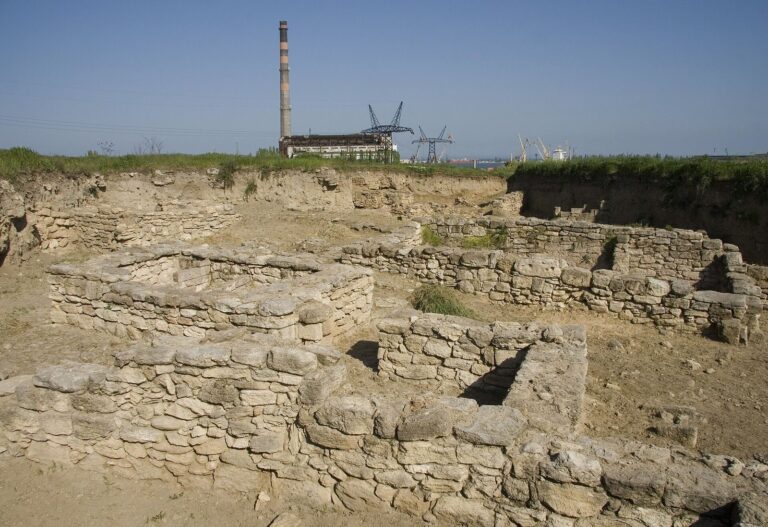
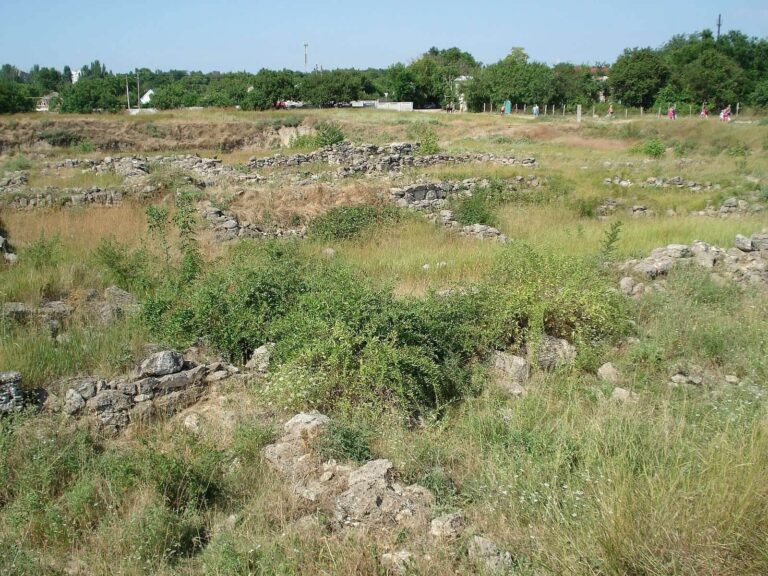
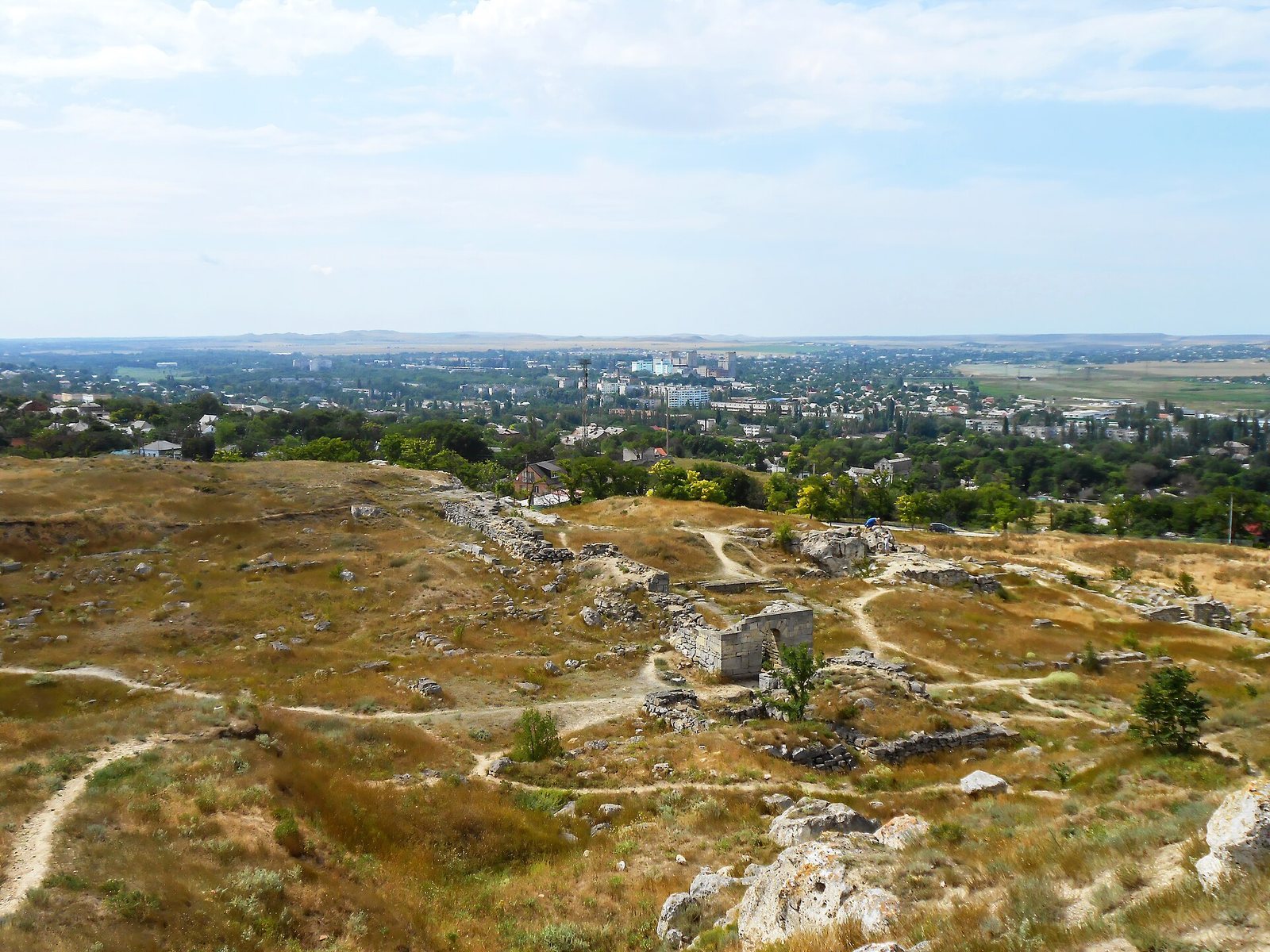
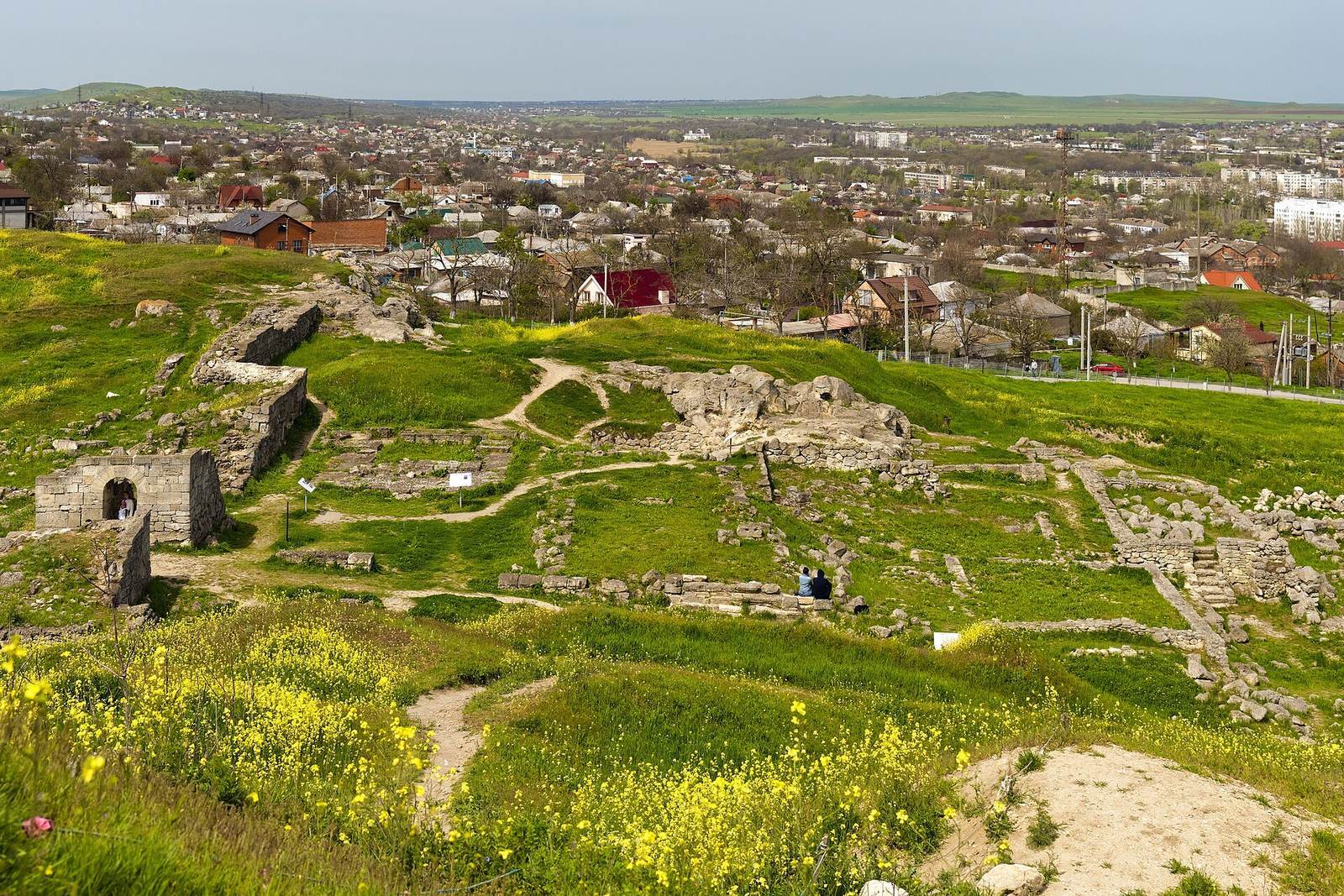
At its greatest extent, the city covered about 100 hectares on the slopes and lower ground of the hill now called Mount Mithridat. Retaining walls supported terraces around the hill. The acropolis, the elevated center of the city, occupied its summit above residential districts. Temples and Bosporan rulers’ palaces stood there, while a seaside district contained the public marketplace and port.
Sanctuaries
Apollo Ietros
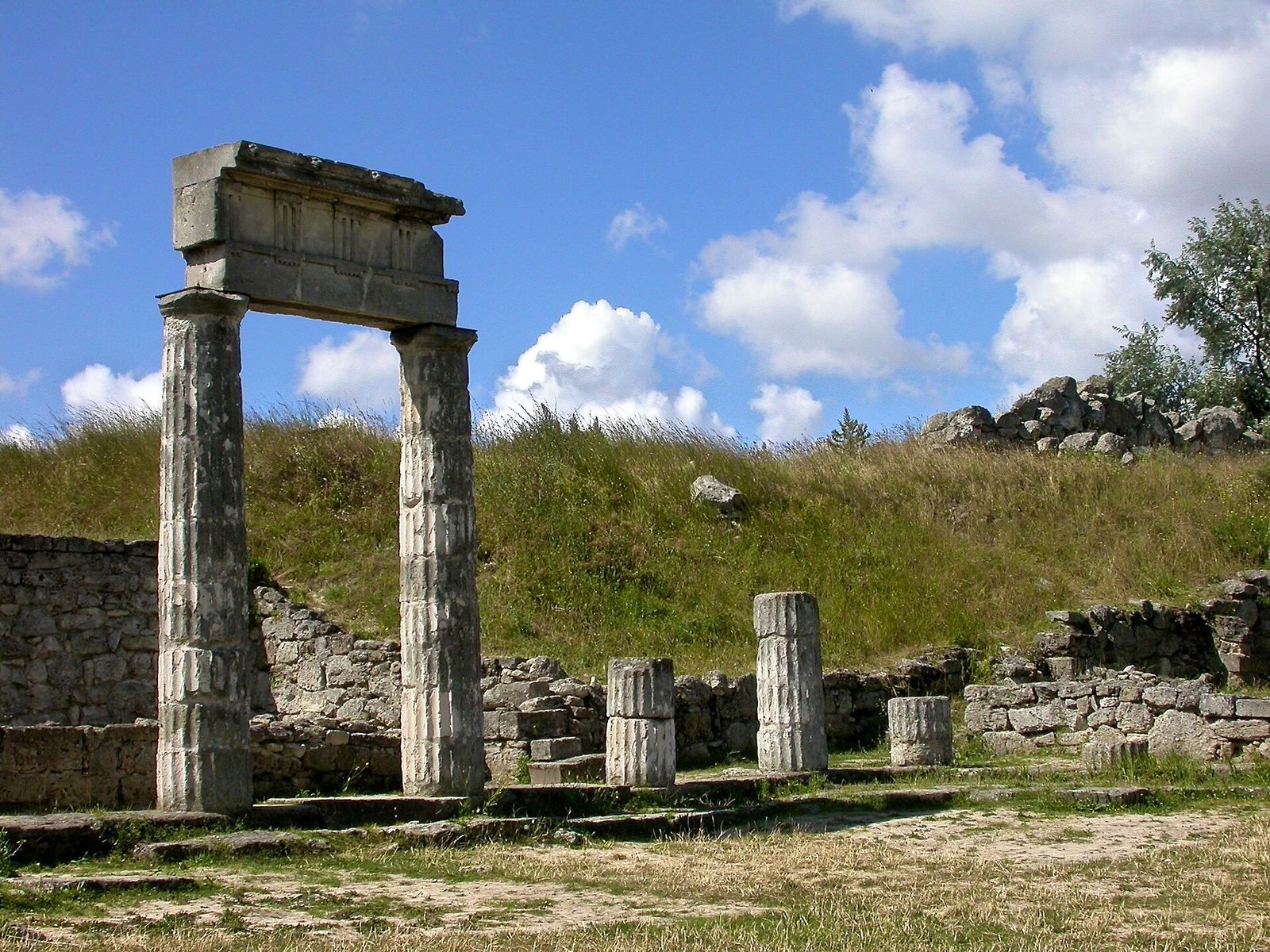
The principal sanctuary was dedicated to Apollo Ietros, meaning Apollo the Healer. A building about 40 by 20 metres is proposed as the temple, although its identification remains an archaeological hypothesis. It was probably built in the 6th century BC and was complete by the end of that century. The temple was surrounded by a single row of columns and used the Ionic style of Greek architecture.
Aphrodite and Artemis
A temple of Aphrodite stood near the Spartocid palace. A Greek dedication inscription and graffiti praising the goddess are associated with its identification. Another sanctuary, dedicated to Artemis Ephesia, was identified through a Greek inscription on a bronze-handle fragment dated to the 6th century BC.
Defenses, harbor, and civic building
Stone defenses
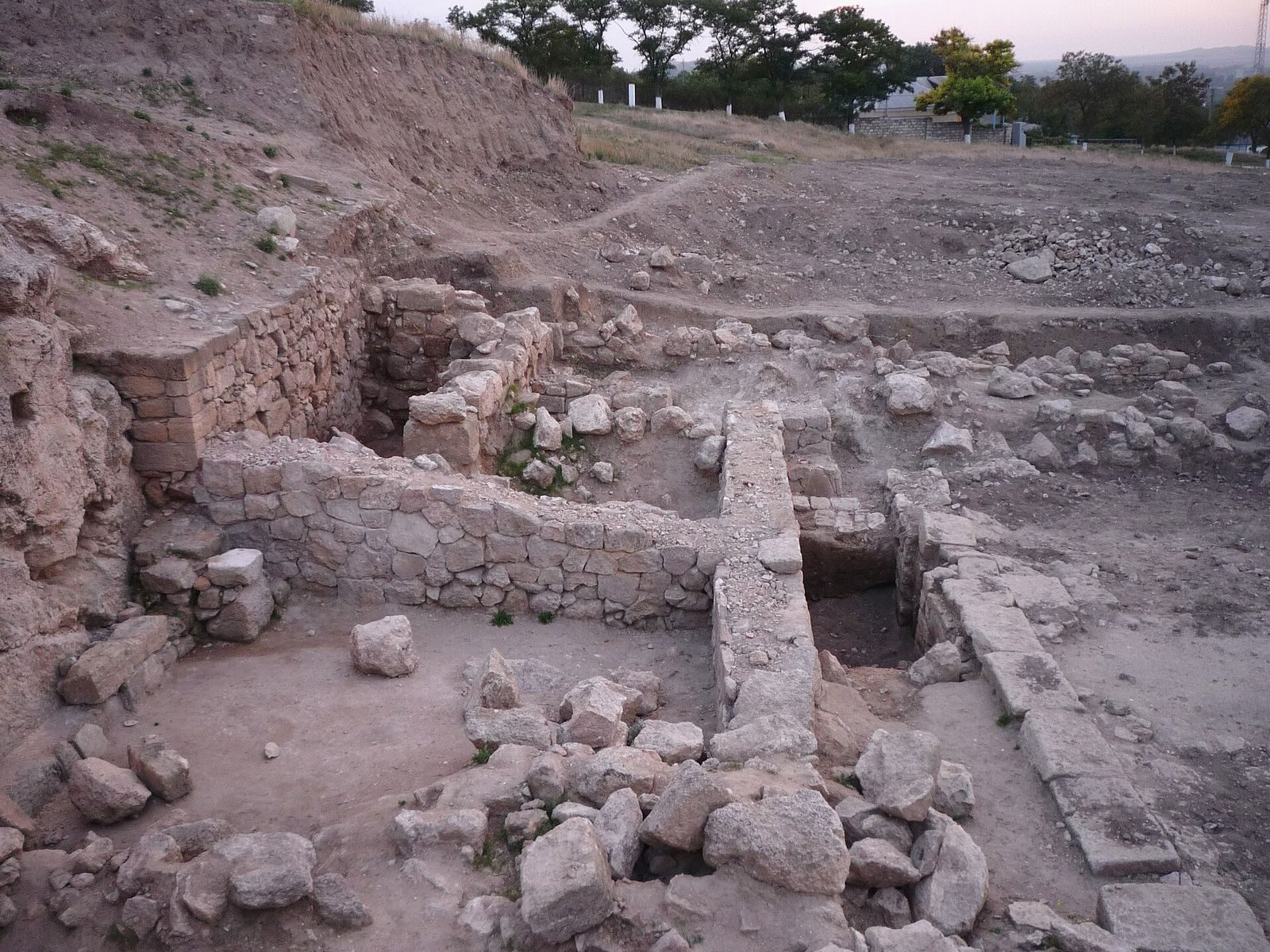
A stone wall enclosed the city, and surviving sections date to the 5th century BC. In parts of the acropolis defenses, projecting bedrock formed the foundations of walls and towers. Builders cut the mountain rock vertically to a height of about three metres to resist siege engines. The city’s stone fortifications were considered exceptionally strong even in comparison with those of Athens.
Agora and port
The seaside district included an agora, or public marketplace, and a large harbor. The geographer Strabo described a harbor and shipyard capable of holding 30 ships. The port served a city that received Mediterranean goods such as olive oil, wine, and pottery, as well as grain, fish, and hides from Scythian lands.
Prytaneion
A civic building known as a prytaneion dates to the 2nd century BC. Such a building was associated with a Greek city’s public hearth and magistrates.
Homes and workshops
Residential districts
The oldest excavated houses date to the late 7th century BC. Early homes had a simple square plan, usually with one room. Houses grew larger during the 6th century BC, sometimes gaining two or more rooms, and some wealthy residences had frescoed rooms. Homes became particularly large in the 4th century BC. From the 3rd to 2nd centuries BC, some were built around colonnaded courtyards. Their walls could carry modeled reliefs, plaster decoration, and fired-clay friezes. Workers’ homes clustered near the outskirts, while wealthier residences occupied the hill slopes.
Representations on coins and reliefs show steeply pitched roofs with gable ends, a characteristic form in the city’s architecture.
Metalworking
Workshops in the ancient district processed iron and bronze. Their output included fine goods and ornaments commissioned by Maeotians, Scythians, and later Sarmatians. Portable possessions suited the mobile way of life of these groups.
Necropolis and tombs
Burial landscape
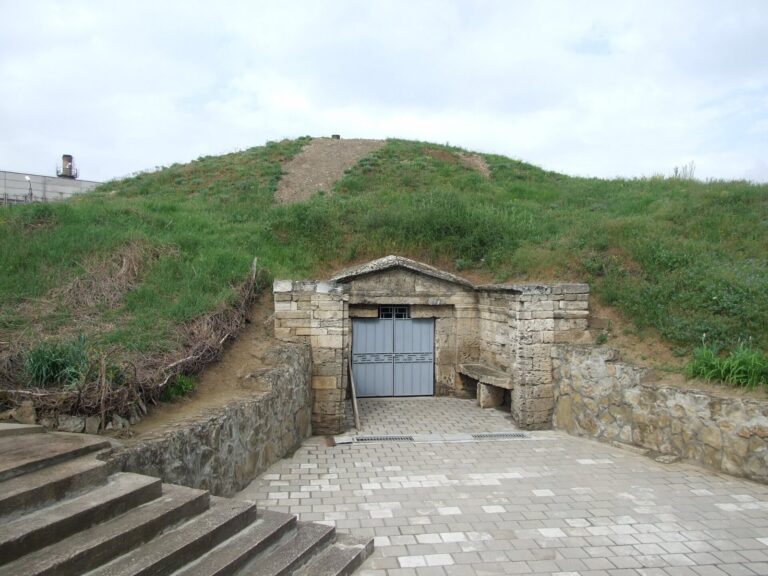
A necropolis, or burial ground, extended beyond the city to the north, west, and south. It contained ordinary graves and lines of burial mounds beside roads leading from the city into the steppe. The southern group, translated as ‘Hundred Hills,’ held elite Scythian burials. The leaders buried there are described as having provided military and political protection for the city. Notable mounds in the area include Kul-Oba, Melek-Chesme, the Golden Mound, and the Royal Mound.
Stone tombs
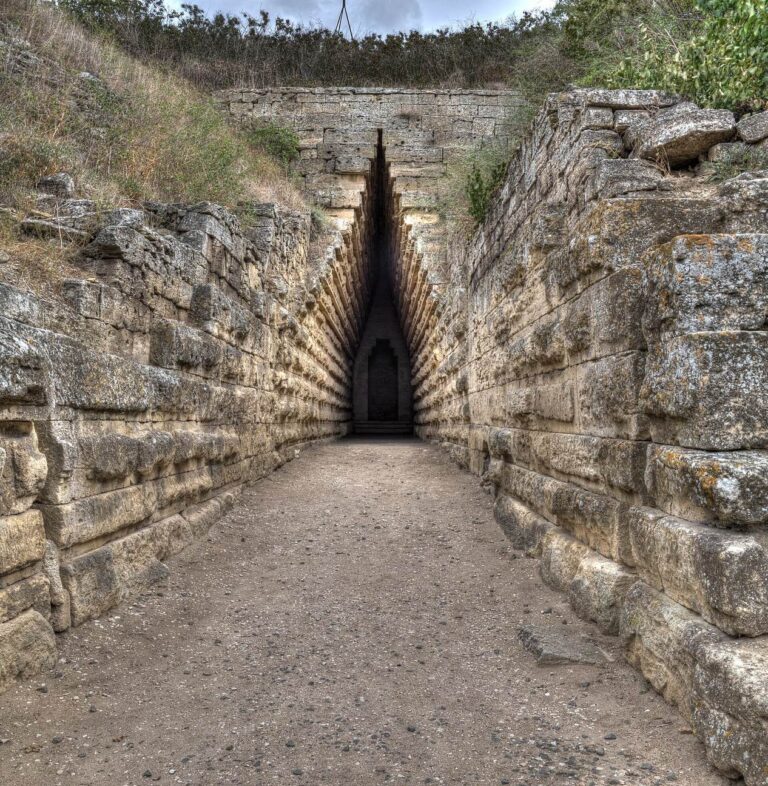
Many 4th-century BC burial mounds contained large stone tombs. A common design used a passage leading to a square or rectangular burial chamber, often with a vaulted roof. The Royal Mound near Kerch has a long passage leading to a square chamber with a stepped roof. Stones laid from the chamber’s corners form a circular ceiling. Other tombs had semicircular roofs built from wedge-shaped stones.
Painted tombs and reliefs
Painted tombs mostly date to the final centuries BC and the first centuries AD. In the tomb of Anfesterio, son of Hegesipo, square designs decorate the lower walls. Scenes above show the deceased in the steppe with his family, armed and accompanied by grooms as he travels toward his home, a tent dwelling. A small tomb from the first half of the 1st century AD has a semicircular roof. A ceiling medallion depicts Demeter; a curved panel opposite the entrance shows Pluto carrying off Kore, while Hermes and Calypso appear beside the entrance.
Reliefs from 1st- and 2nd-century AD tombs often show the deceased reclining at a funerary banquet, sometimes armed or dressed in Scythian clothing. Other examples portray the deceased with his wife and servants. Earlier burial mounds could be marked by simple inscribed stone slabs.
Burial objects
A richly furnished Scythian tomb excavated near Kerch in 1870 contained gold earrings showing the head of Athena Parthenos, the cult image sculpted by Phidias. Finds also included a pale-gold vessel with scenes of Scythian life and a gold relief of a stylized stag. A hare, lion, and griffin appear in smaller relief on the stag, and an accompanying inscription supports a Greek attribution for the work.
A sarcophagus from the late 1st or early 2nd century AD, now in the Hermitage, has painted interior walls. One scene depicts a painter in a studio with a paint box, a brazier for heating tools, and an easel; finished pictures and circular-framed portraits hang nearby. Fragmentary wooden funerary objects include a sarcophagus showing Hera and Apollo, tableware, and a banquet table.
Coins, pottery, and inscriptions
Coinage
Panticapaeum’s coins display changing images over several centuries. Early issues show a lion’s head on the front and a square on the back; another series from the late 6th century BC pairs an ant with a square. Coins from the second quarter of the 5th century BC combine a lion’s head and square with an inscription to Apollo. By the century’s final quarter, reverses could show a bull’s head and a six-pointed star, alongside shortened forms of the city’s name such as PA, PAN, and PANTI.
Later coins include beardless or bearded satyrs and the moon goddess Selene, with a grain ear and griffin above the inscription PAN. Some early satyr coins instead show a bow and arrow on the reverse. A mid-3rd-century BC series pairs Apollo’s head with a tripod, while coins from the century’s third quarter show the city’s name beside a head of Poseidon. The tripod, griffin, and lyre also served as city symbols. A gold stater, an ancient coin denomination, weighed 9.4 grams. It showed a bearded Pan wearing an ivy wreath on the front and a winged griffin holding a spear above a grain ear on the back.
Pottery and local craft
Finds from the settlement include pottery, terracotta figures, and metal objects, both imported and locally made. Imported pieces probably came from workshops in Rhodes, Corinth, Samos, and Athens. Local potters copied Gnathia-style decorated bowls and Megarian bowls with relief designs. Special bowls made for the city became known as Kerch ware. Imported pottery from Athens was especially plentiful in the 4th century BC. Objects from the site are held by the Hermitage and Kerch museums.
Jewish inscriptions
Inscriptions from the 1st and 2nd centuries AD refer to a local synagogue, sometimes shared by Jews and ‘God-fearers,’ non-Jews who revered the Jewish God. The synagogue acted as a supervising body in legal transactions that freed enslaved people. A 3rd-century Hebrew funerary inscription for Isaac carries a blessing for peace. Menorah images, showing the Jewish ritual lampstand, are associated with Hebrew names including Seimon and Samouelos.
Rural villa
A fortified villa dating to the 1st or 2nd century AD was excavated on a hillside about eight kilometres northeast of Kerch. It included a complex installation for producing wine. A burial mound on the hilltop may have been associated with the villa.