Panionium: Sanctuary and Meeting Place of the Ionian League
Site at a Glance
- Popularity
- High
- Country
- Turkey
- Primary era
- Iron Age
- Eras represented
- Iron Age, Classical
- Civilizations
- Ancient Greek, Carian
- Site type
- Religious
- Remains
- Sanctuary
On this page11 sections
History
Panionium was the central sanctuary and meeting place of the Ionian League in western Turkey, although the location of its original sanctuary remains disputed. The Ionian Greeks used it as a shared religious center from at least the seventh century BC, and a temple was built there around 540 BC during the Archaic period. The League was a confederation of twelve Greek-speaking city-states in Ionia, the coastal region of western Asia Minor.
The Ionian League and its sanctuary
Ionians migrated from mainland Greece to Asia Minor during the eleventh or tenth century BC. The League probably existed by the eighth century BC. Its members included Miletus, Myus, Priene, Colophon, Lebedus, Teos, Clazomenae, Erythrae, Phocaea, Chios, and Samos. Smyrna had joined by the time of Herodotus, a fifth-century BC Greek historian, though the date of its entry is uncertain.
In the mid-seventh century BC, the Ionians destroyed the Carian city of Melia during the Melian War. Melia had been a center of a local cult involving bull sacrifices, and the Ionian worship at Panionium may have taken up elements of that tradition. The temple was built over Melia’s ruins around 540 BC.
The sanctuary was dedicated to Poseidon, the Greek god associated with the sea, under the title Helikonios. League members gathered there for ceremonies and sacrifices and celebrated the annual Panionia, a religious festival that included games. Priene organized the festival, administered the sanctuary, and led its rites; the priesthood was reserved for men from Priene. Although Priene and Samos disputed the surrounding area, the sanctuary belonged to Priene.
Destruction and later use
Persian forces destroyed the sanctuary in 494 BC, and Persian rule restricted activity there. By about 426/425 BC, the Panionia were being held at Ephesus. Thucydides records the festival there, while Diodorus links its move to fighting in the surrounding region.
The festival later returned to Mycale, probably around 373 BC, and was celebrated again under Alexander the Great and Roman rule, though it did not regain its earlier importance. After Alexander’s conquests of the Persian Empire, the sanctuary was re-established at a lower site during the second half of the fourth century BC. This later complex remained modest, apparently unfinished, and may have been abandoned before it was used.
Rediscovery and disputed location
An inscription found near Güzelçamlı in 1673 provided an early clue to the sanctuary’s location. Theodor Wiegand identified the later site in the late nineteenth century, and Gerhard Kleiner, Peter Hommel, and Wolfgang Müller-Wiener excavated it in 1958. It was long identified as the original Panionium, but the location of that sanctuary became contested.
In 1900, Ulrich von Wilamowitz-Moellendorff argued that Panionium should be associated with older Carian remains. In 2004, Hans Lohmann proposed a high mountain site as the more likely location of the original sanctuary. Alexander Herda disputed that identification and suggested that the site was instead the ancient city of Mykalessos. The proposed temple at the high site was investigated further in 2005 in a salvage excavation with the Aydın Museum, prompted by damage from unauthorized digging.
Remains
Remains associated with Panionium are linked to two places: a high mountain site proposed as the original sanctuary and a lower site used for the later sanctuary. The mountain site includes a fortified settlement and temple, while the lower site has an enclosed precinct and a separate council building.
Proposed original sanctuary at Çatallar Tepe
Mountain settlement
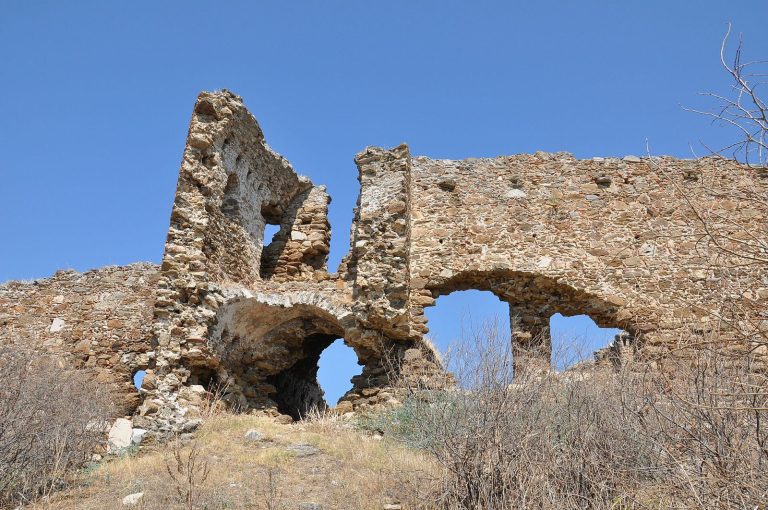
Çatallar Tepe lies on the northern side of Mount Mycale, in the eastern part of the range, at a summit about 780 m above sea level. The mountain divides northern and southern Ionia, and the high site has views toward both. Priene stood on the southern slope, about 15 km away. The remains include a fortified Carian mountain settlement, with walls about 3 m thick enclosing an area of roughly five hectares. Numerous houses and Archaic-period pottery have been found there; finds from the site are displayed at the Aydın Archaeological Museum.
Ionic temple
The ruined temple is an example of the Ionic style, a Greek architectural tradition especially associated with scroll-shaped column capitals. It measured about 28.8 m long, making it roughly a hundred-foot temple. Its front porch was about 8.7 m deep and divided into three aisles by two rows of four columns. The main inner room measured about 8.1 by 7.6 m and contained two columns. A third room at the western end was about 10.4 m long, with three columns in a central row. The building had thirteen interior columns, no outer colonnade, and an estimated height of about 6 m. Its design has been compared with the Sanctuary of Dionysus on Naxos.
Later sanctuary at Otomatik Tepe
Sacred precinct and altar
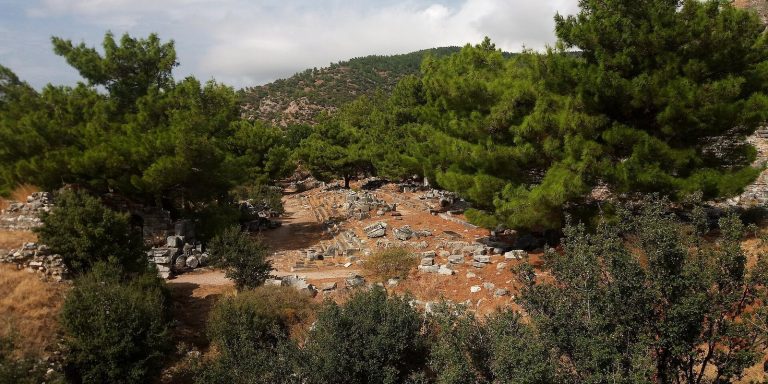
The lower site occupies a low hill about 1 km east-southeast of Güzelçamlı, now called Otomatik Tepe. In modern Greek usage it was also known as Profítis Ilías, after a chapel there dedicated to the prophet Elijah. Strabo, an ancient geographer, placed the sanctuary less than 600 m from the ancient coast; the present distance is about 1 km following changes to the shoreline. A boundary wall enclosed the sacred precinct, with an entrance on its western side. Within it, a rectangular stone measuring about 17.5 by 4.25–4.3 m is thought to have served as an altar to Poseidon. It probably dates to the late sixth century BC.
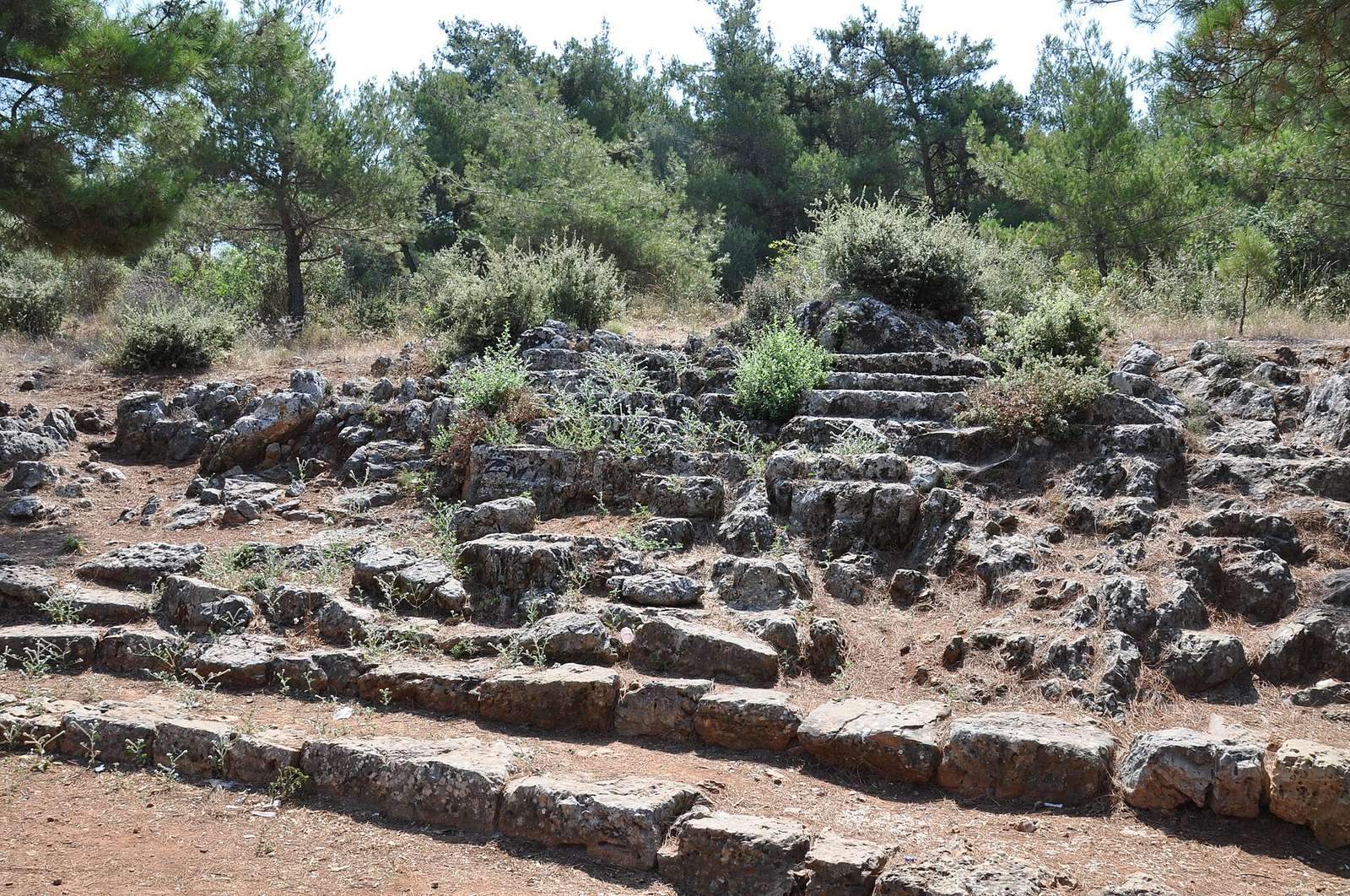
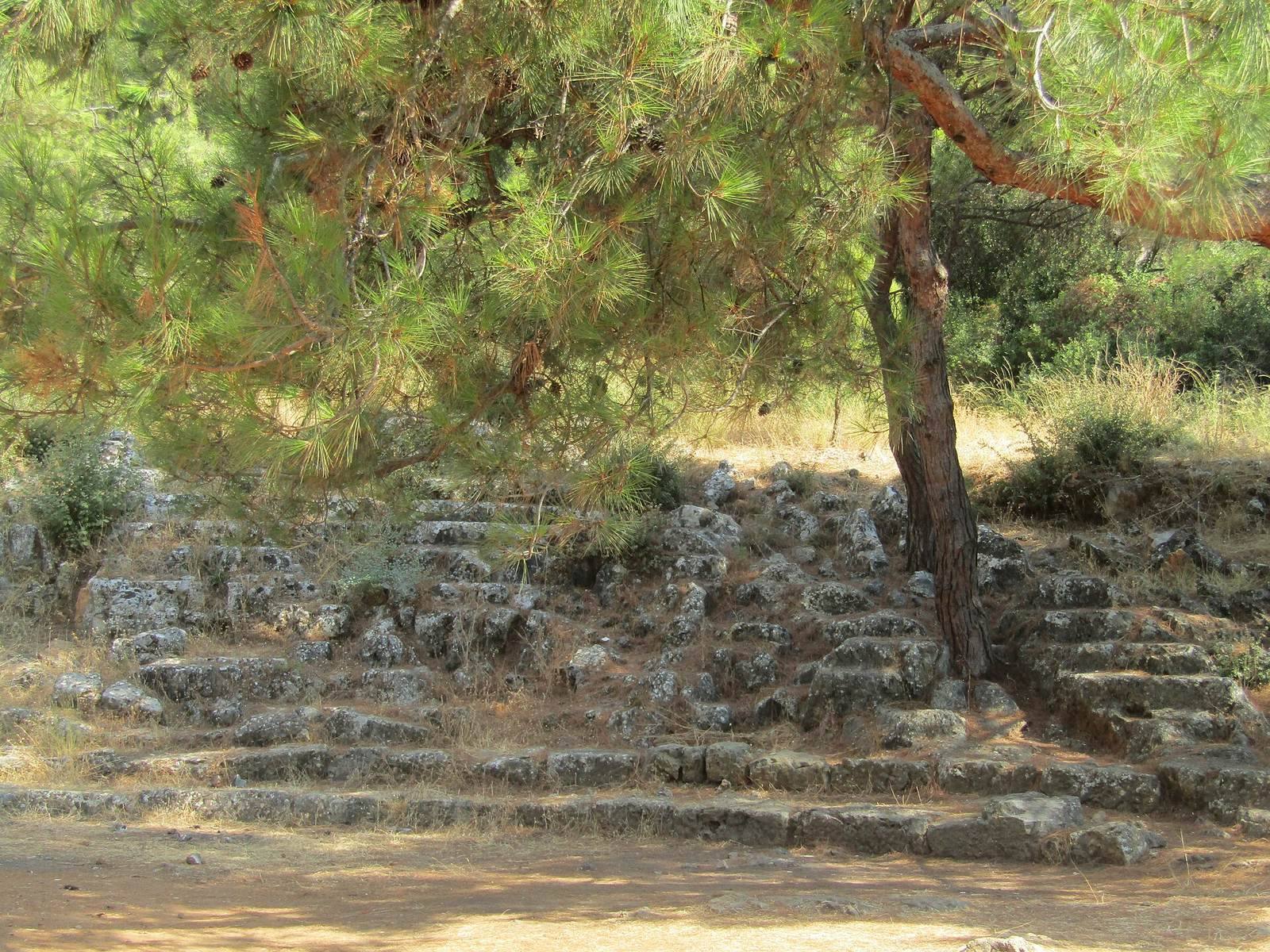
Council building
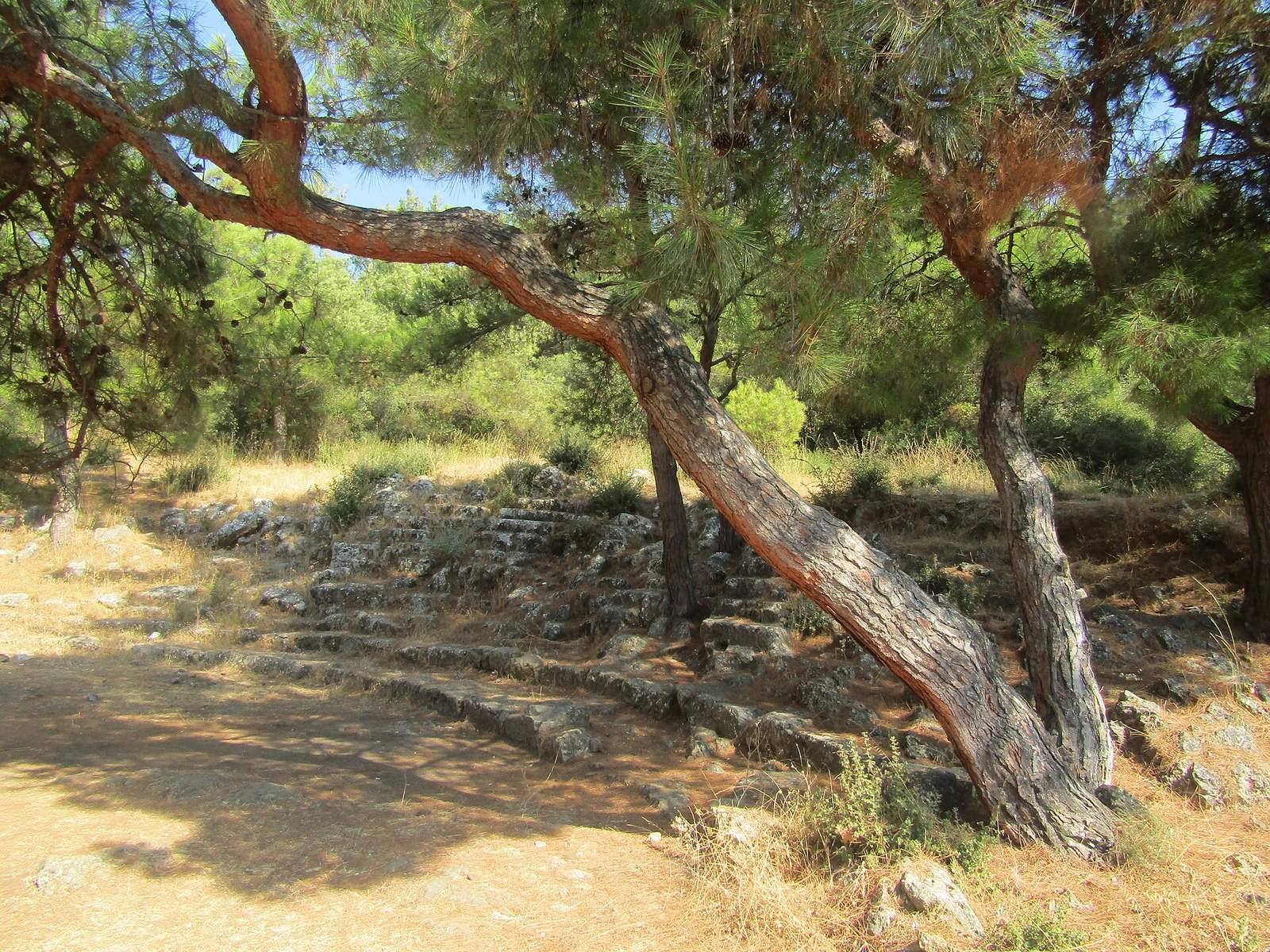
Outside the precinct, on the hill’s southwestern slope and about 50 m southwest of the altar, stood a small structure described as a theatre or an odeon, a building for musical performances. It was slightly more than semicircular, about 32 m in diameter, and opened to the west. Its eleven rows of seats include sections cut into the rock. The remains date to around 300 BC, and the building is thought to have served as the League’s council chamber. It appears to have been left unfinished and has similarities to the theatre at Priene, built at about the same time.