Santa Maria dell’Orto: A Renaissance and Baroque Church in Rome
Site at a Glance
- Popularity
- High
- Country
- Italy
- Primary era
- Early Modern
- Eras represented
- Medieval, Early Modern, Modern
- Civilizations
- Papal States
- Site type
- Religious
- Remains
- Church
On this page23 sections
History
Santa Maria dell’Orto is a Renaissance and Baroque church in Rome’s Trastevere district, Italy. Construction began in 1489 and was completed in 1567. The church became a religious center for trade associations linked to Rome’s food supply and developed a distinctive history of devotion to Mary.
Origins and construction
Before the church was built, the area was known as the Fields of Mucius from about 508 BC. Local tradition connected the name with the Etruscan king Porsena, said to have camped there, and with Mucius Scaevola, a legendary Roman hero. In the story, the Senate granted Mucius the land in gratitude for his courage.
The church’s beginnings are associated with a healing said to have taken place around 1488. A farmer suffering from severe paralysis reportedly prayed before an image of the Virgin Mary painted inside the entrance to his garden, where passers-by could not see it, and recovered. Devotion to the image led first to a small chapel and then to a larger church.
The original design called for a Greek-cross plan, with arms of roughly equal length, and four apses. Guidetto Guidetti changed it to a Latin-cross plan, with a longer main body, and three naves, the central part of a church. The architect responsible for the initial design is unknown. The façade is attributed either to Vignola or to Martino Longhi the Elder.
Confraternity, guilds, and commerce
Twelve trade associations helped furnish the church and provide funds for worship. In 1492 Pope Alexander VI authorized a confraternity, a lay religious association. Pope Sixtus V raised it to an archconfraternity in 1588, giving it authority to affiliate other associations. He also granted it the unusual privilege of asking for one person condemned to death to be released each year at the church’s annual feast.
The archconfraternity welcomed women and brought together thirteen trade groups. They represented grocers and greengrocers, fruit sellers, gardeners, poultry sellers, millers, merchants, brokers in local trade, pasta makers, winegrowers, delicatessen sellers, cobblers, coopers, and young workers and shop assistants. In 1600, during the Jubilee, it affiliated the Confraternity of the Oratory of Our Lady of Castello, founded in Savona in 1260.
The church served as a meeting place for trades connected with food supplies to Rome and with vessels travelling along the Tiber to and from Ostia. The surrounding district remained agricultural and commercial, especially in wholesale trade, until the end of the nineteenth century. Its position near the city walls, Porta Portese, and the port of Ripa Grande supported that commercial activity.
During the Jubilee of 1825, the church received the title of Venerable. It remains in the care of its archconfraternity, the oldest active Roman confraternity dedicated to the Virgin and among the earliest confraternities overall.
The Japanese embassy and continuing devotions
Pope Sixtus V established Santa Maria dell’Orto as Rome’s national church for Japan in recognition of the Tenshō embassy, a Japanese mission to Europe. In 1585, four Japanese delegates came to Rome to meet the pope. Tradition relates that, during a celebratory voyage by river from Ripa Grande toward Ostia, a storm arose. The delegates had visited the church before setting out; they prayed to the Virgin, and the storm subsided.
The story became the basis for a sung Mass held on 8 June, attended by representatives of the Japanese embassy to the Holy See and the Japanese community in Rome. Since 2007, the commemoration has been held during the church’s October feast. The Japanese ambassador to the Holy See traditionally serves as an honorary guardian of the association. In October 2009, a portrait of Giuliano Nakaura, one of the delegates, was placed in the church for veneration. Nakaura was martyred in 1633 and beatified in 2008.
The feast of Mary of the Garden falls on the third Sunday of October. Worshippers receive blessed apples in memory of the fruit sellers’ association and as a devotional sign of unity in diversity within the Church. The head of each household divides an apple into as many pieces as there are family members.
Remains
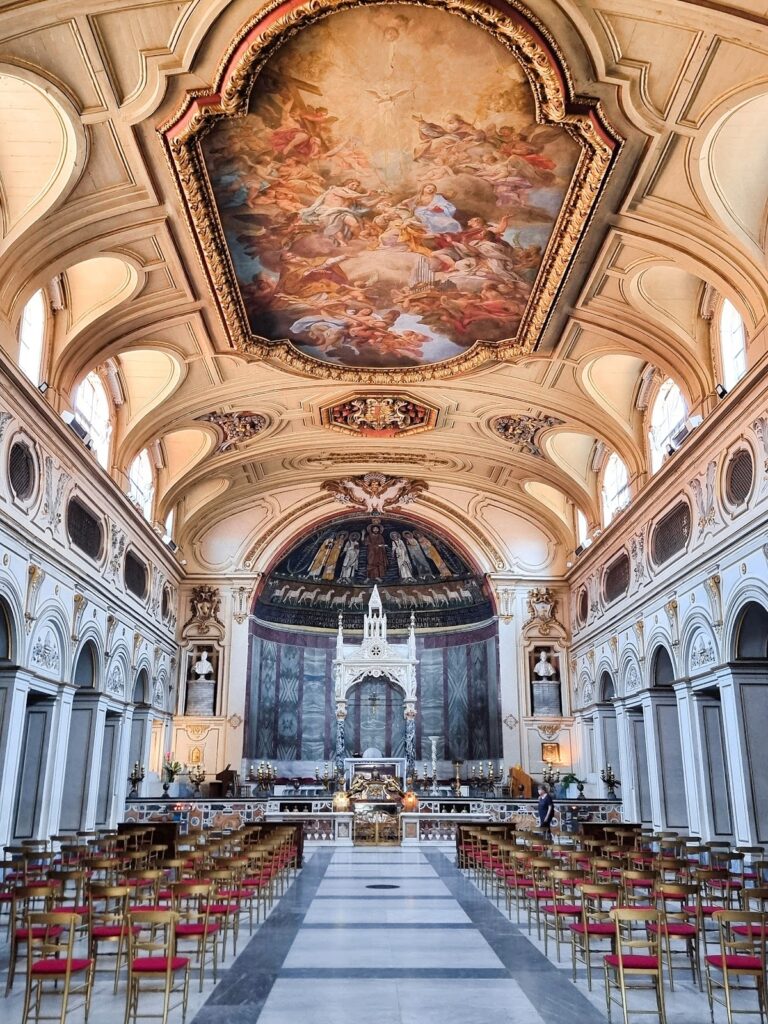
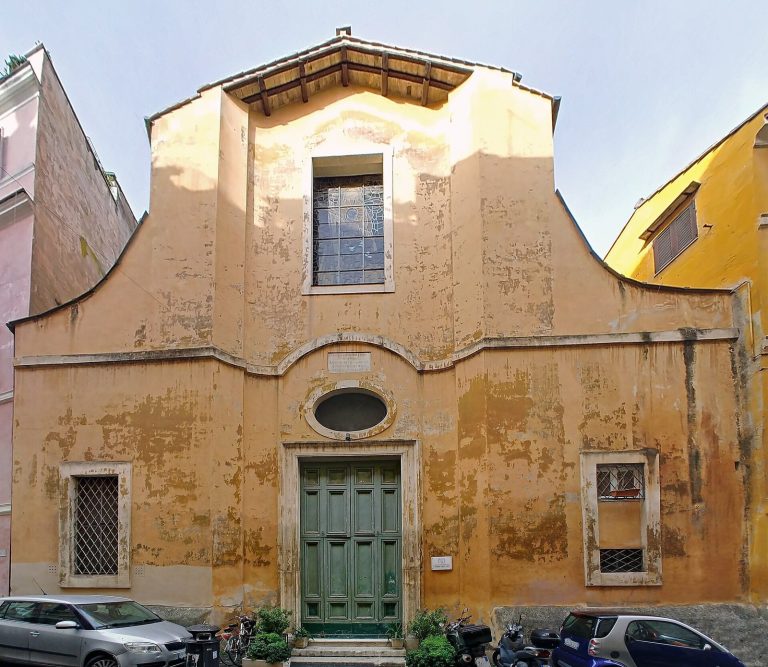
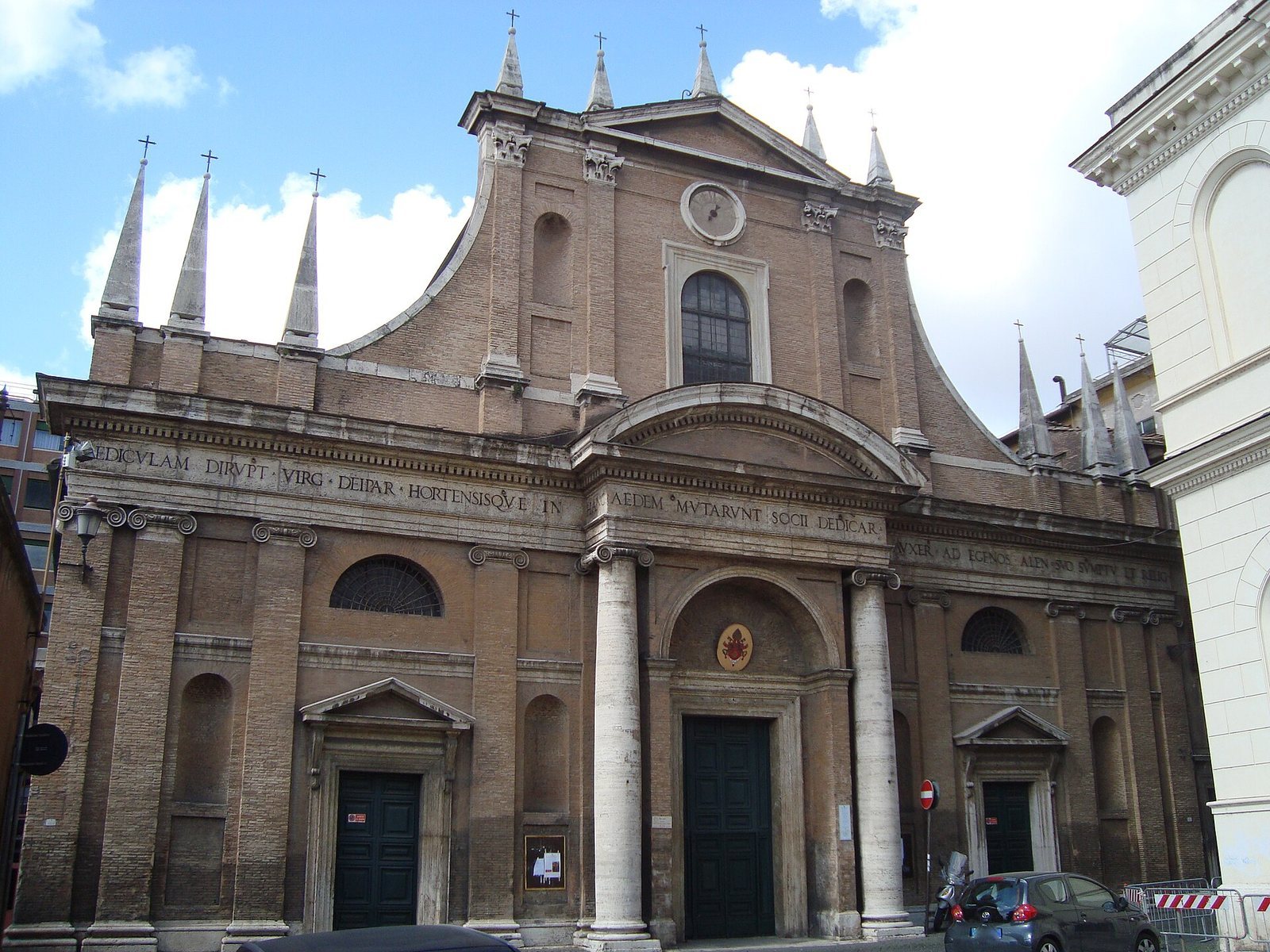
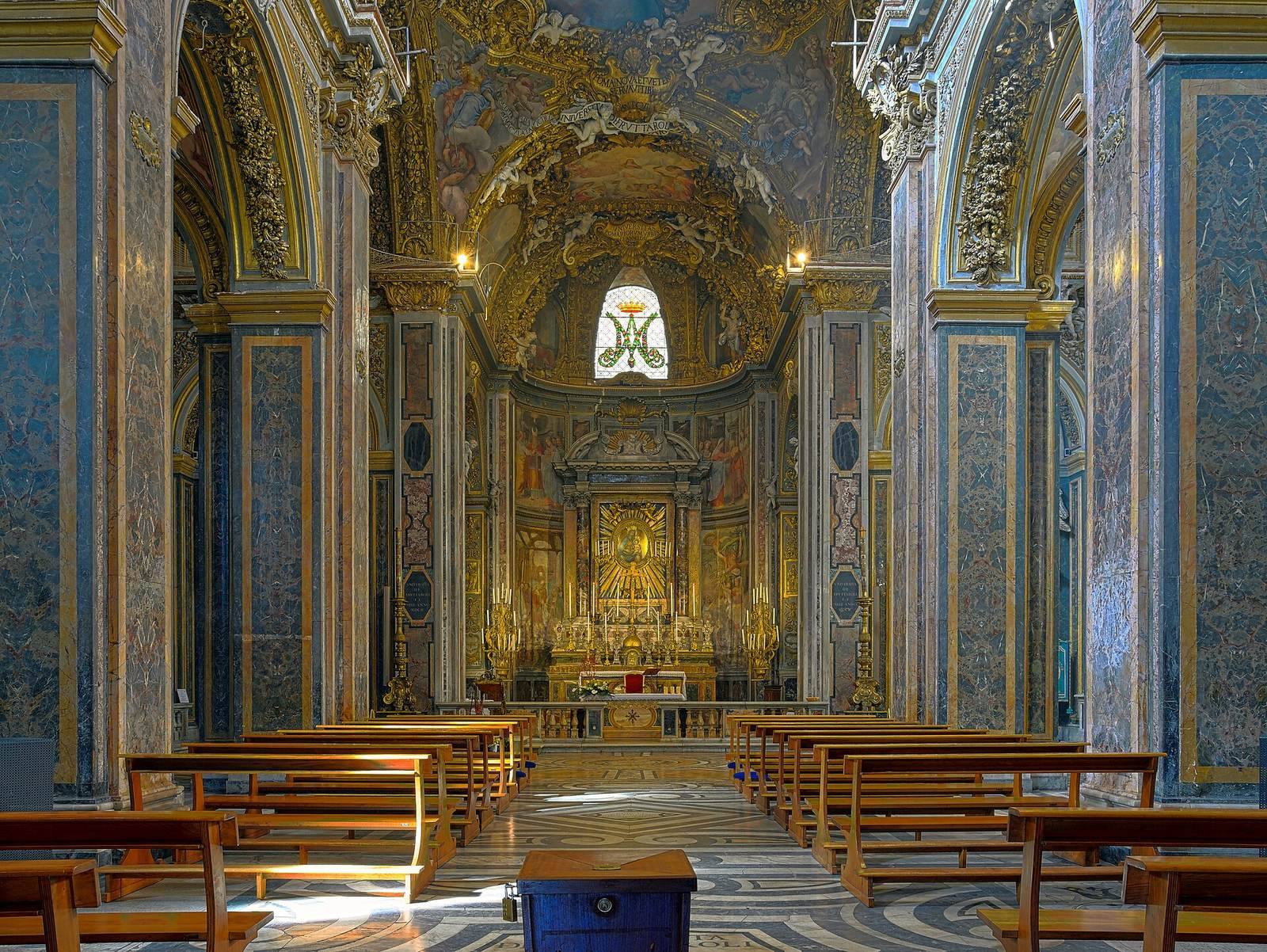
At the intersection of Via Anicia and Via Madonna dell’Orto, the church combines Renaissance and Baroque elements. Its interior is arranged around a nave, the main body of the church, crossed by a transept, or cross-arm, and ending in an apse, the space at the far end. Six chapels line the side aisles, with two more in the transept. The façade is crowned by obelisks, while the interior decoration extends from the entrance through the crossing to the apse.
Entrance, nave, and aisles
Façade and entrance wall
The façade is attributed to Vignola or, alternatively, to Martino Longhi the Elder. Its upper outline is marked by obelisks. Inside, the wall opposite the façade is divided into three parts corresponding to the church’s three naves. The middle section holds a choir loft and organ, with panels depicting mills on the organ gallery. Giuseppe and Andrea Orazi painted the side sections: the Adoration of the Shepherds on the left and the Dream of Saint Joseph on the right. A wooden confessional stands in each side section, and a fifteenth-century marble holy-water basin is on the left.
Central nave and Marian decoration
The central nave’s ceiling vault carries Giacinto Calandrucci’s Assumption of Mary, dated 1706, surrounded by molded plaster decoration by Camillo Rusconi. Together with imagery on the lower walls and in the upper parts of the church, the painting forms a Marian program, meaning a sequence of images devoted to the Virgin Mary. It moves from scenes of Mary’s earthly life toward her heavenly glory.
Six windows, three on each side of the nave, have gilded plaster shells above festoons, with emblems and inscriptions. On the right are a door labeled “Gate of Heaven,” a sun with a steelyard, a balance used for weighing, and a star labeled “Star of the Sea.” On the left are a tower labeled “Make the Way Safe,” a moon with a steelyard, and an ark labeled “Ark of the Covenant.” The tower, ark, door, and star are symbols associated with Mary. Most of the inscriptions echo the hymn Ave Maris Stella. The sun and moon refer to the heavenly lights and to Mary as reflecting the light of Christ. The steelyard also served as the emblem of the grocers’ association, which paid for the window decoration. Marian shells and other symbols appear elsewhere in the church.
Side-aisle ceiling paintings
The right-aisle ceiling vaults contain three paintings by F. and A. Orazi: the Glories of Mary, Saint Catherine, and Saint Bartholomew. Giovanni Battista Parodi painted the corresponding series on the left, with the Glories of Saint Sebastian, Saint John the Baptist, and Saint Charles Borromeo.
Side chapels
Right-aisle chapels
The first chapel on the right is dedicated to the Annunciation. Its 1561 wall painting of the Annunciation is attributed to Taddeo Zuccari, though it is also attributed to his brother Federico. A semicircular panel above it depicts God the Father; Virginio Monti painted the Archangel Gabriel and Saint Joseph on the side walls. The next chapel honors Saint Catherine of Alexandria. Filippo Zucchetti’s 1711 painting above the altar shows the Mystic Marriage of Saint Catherine, with Saints Peter and Paul on the side walls. Bernardino Cametti made the two childlike figures on its upper frame, and Tommaso Cardani painted the ceiling. The third chapel is dedicated to Saints James, Bartholomew, and Victoria. Giovanni Baglione’s 1630 painting shows the Virgin and Child with the three saints; his side paintings depict the Martyrdom of Saint Andrew and the Martyrdom of a Deacon. Mario Garzi painted the ceiling’s Glorification of Saint Bartholomew.
Left-aisle chapels
The first chapel on the left is dedicated to Saint Sebastian. Its altar painting, Saint Sebastian Healed by Angels, and side paintings of Saints Anthony of Padua and Bonaventure are by Giovanni Baglione. Parodi painted the ceiling’s Glorification of Saint Sebastian. The altar has red decorative marble columns with Composite capitals, column tops combining classical forms. The chapel of Saint John the Baptist was restored by Gabriele Valvassori in 1750, the same year Corrado Giaquinto painted its Baptism of Christ. Giuseppe Ranucci depicted the Preaching and Beheading of John the Baptist on the side walls, and Parodi painted the ceiling’s Glorification of the Baptist. The third chapel honors Saints Charles Borromeo, Bernardino of Siena, and Ambrose of Milan. Baglione painted the Virgin and Child with the three saints and the side scenes of Saint Ambrose Defending Milan against the Arians and Saint Charles Borromeo Visiting Plague Victims. Parodi painted the ceiling, and Luigi Barattone designed the altar, which has gilded, grooved Corinthian columns with ornate classical tops.
Transept and crossing
Crossing and floor
At the junction of the nave and transept, a 1703 ceiling painting by Giuseppe and Andrea Orazi depicts the Immaculate Conception. In Catholic teaching, this refers to Mary’s conception without original sin. Luigi Barattone designed the surrounding plaster decoration. The floor has a 1747 inlay of multicolored marble showing garlands of apples, pears, white and red grapes, oranges, and cherries. The fruit decoration commemorates a donation by the fruit sellers’ association.
Right transept
The right transept chapel is dedicated to the Holy Crucifix and contains a seventeenth-century wooden crucifix. Nicola Trometta painted scenes of the Passion on its walls. Beneath the transept ceiling, Giacinto Calandrucci’s 1703 painting of the Resurrection of Christ is accompanied by pairs of angels and symbols of the Passion. Above a wooden doorway in this part of the transept, Andrea Procaccini’s 1704 painting depicts the Descent of the Holy Spirit; the plaster angels around it are attributed to Leonardo Retti.
Left transept
The arch beneath the left transept ceiling bears Mario Garzi’s seventeenth-century Glorification of Saint Francis. The chapel of Saint Francis of Assisi contains a seventeenth-century statue of the saint on its altar and wall paintings of episodes from his life by Nicola Trometta. Above the sacristy doorway, Andrea Procaccini’s 1704 work depicts Saints Joachim and Anne, accompanied by plaster angels.
Apse and high altar
High altar
The high altar dates to the sixteenth century and is attributed to Giacomo Della Porta. Gabriele Valvassori restored it in the eighteenth century. Its structure behind the altar has two grooved Corinthian columns of pale marble with purple veining, supporting a broken, curved crown. A fifteenth-century icon of the Virgin and Child sits within a radiating frame.
Apse paintings
Giovanni Baglione’s 1598 ceiling painting in the apse shows the Death, Assumption, and Coronation of Mary. On the left wall, a semicircular painting depicts an angel urging the Holy Family to flee to Egypt, with two prophets; below are Baglione’s Presentation in the Temple and Announcement to Saint Joseph, both from 1598. On the right, another semicircular painting shows Saints Anne and Joachim with two prophets, above Baglione’s 1598 Nativity of Mary. Paintings by Federico and Taddeo Zuccari also depict episodes from Mary’s life. Seventeenth-century ornamental painting survives on a pilaster in front of the balustrade.
Devotional structure and adjoining buildings
Forty Hours devotional structure
The church’s large structure for the Forty Hours devotion, a period of prayer and adoration associated with the Eucharist, is made of carved, gilded wood with floral decoration. Its design follows a seventeenth-century model, while the structure itself dates to the nineteenth century. It has 213 candleholders and was used with more than two hundred candles during Holy Week.
Adjoining oratory
An adjoining oratory, a small place of prayer, was built in 1563 and restored in 1702 and 1822. Paintings of the Virgin Mary, the Christ Child, and saints cover its walls and ceiling. During the 1822 restoration, led by Paolo Anzani, Giovanni Maria Burri enhanced the coloring of the paintings and Carlo Sampieri added decoration.
Inscription
An inscription on the church’s horizontal architectural band commemorates its construction and states the purpose of the adjoining hospice.