Palstrup: A Danish Manor Estate
Site at a Glance
- Popularity
- Low
- Country
- Denmark
- Primary era
- Early Modern
- Eras represented
- Early Modern, Modern
- Civilizations
- Danish
- Site type
- Domestic
- Remains
- Manor House
On this page10 sections
History
From monastic farm to estate
Palstrup is a manor estate in Denmark whose origins as a monastic farmstead date to the fourteenth century. It belonged to Tvilum Monastery before passing to Las Braad and, in 1574, to Frans Dyre. Dyre’s grandchildren sold it to Ove Juul, who later transferred ownership to Joachim Gersdorff, a noble cavalry captain.
Oluf Parsberg established Palstrup’s large rampart complex and double moat between about 1640 and 1661. In 1663, the king transferred the estate to Corfitz Ulfeld, a Danish nobleman and statesman, who soon sold it to Mogen Friis. In 1672, Otte Pogwisch sold Palstrup to county governor Peder Charius, Baron Marselis of Marselisborg’s son-in-law. Charius transferred the estate to pharmacist Daniel Friedenreich in 1697.
The manor house and nineteenth-century owners
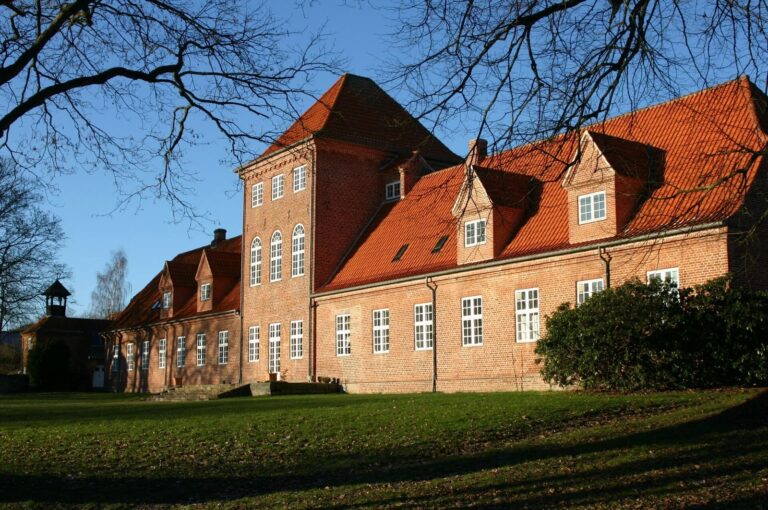
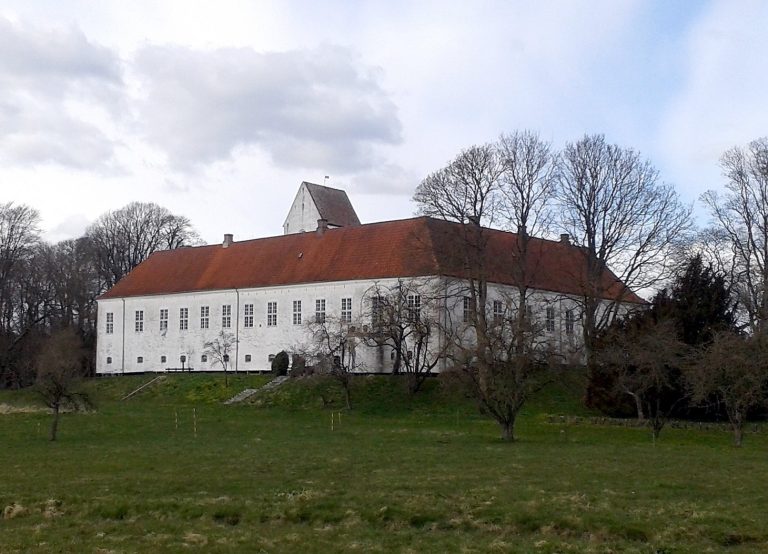
Major Janus Friedenreich commissioned Palstrup’s present manor house, built between 1722 and 1736 by architects Johan G. Hödrich and Nicolaus Hinrich Rieman. Ownership changed frequently in later centuries: the estate was sold eleven times between 1780 and 1871.
Hans Christian Andersen travelled to Palstrup after staying at Asmild Monastery in Viborg from 2 to 6 September 1859. He remained at Palstrup until 8 September, then continued to Silkeborg. In his diary entry for 7 September, he described the cold, a night disturbed by the housekeeper’s crying child, the early meal bell, the clatter of wooden clogs and other noise. He also recorded a visit at about 2:30 to Provost Bendixen, a former fellow student. A provost was a senior clergyman responsible for a church district. Andersen noted a cordial lunch with Mrs. Sporon and von Brachel, followed by reading. The entry also says that at nine Hjalmar went home to damp Palstrup, where Mogens Munk had lived.
Modern ownership and remodeling
Court master of the hunt J. Ræder acquired Palstrup in 1871 and owned it until 1906, when he sold it to physician V. E. Schejerup for 202,500 kroner. Wholesaler Chr. J. Kampmann bought the estate in 1918 for 600,000 kroner and commissioned his brother, architect Hack Kampmann, to carry out extensive remodeling and modernization the following year. After Chr. J. Kampmann’s death in 1937, the estate passed to his son. Ole Philipsen has owned Palstrup since 2001.
Remains
Estate grounds and ramparts
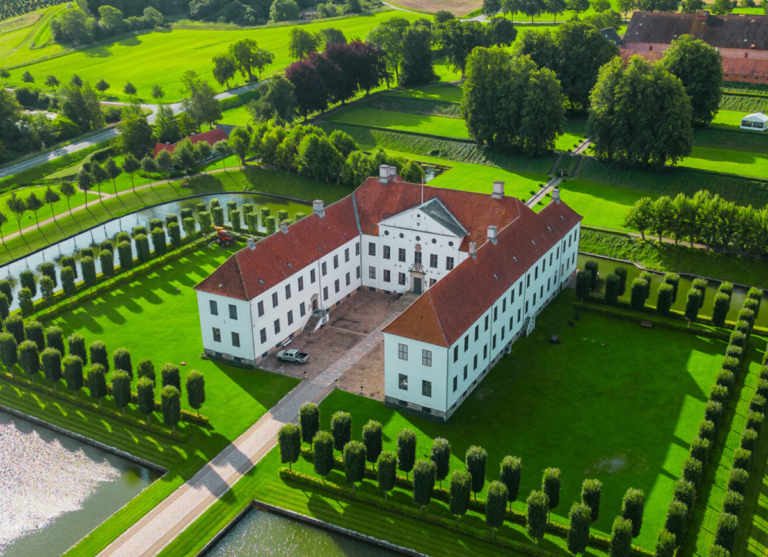
Palstrup’s estate covers 456 hectares: 200 hectares of arable land, 223 of woodland, 20 of meadows and 13 of parkland. The manor house stands within a large complex bounded by two red-brick ramparts and surrounded by moats crossed by bridges.
Manor and associated structures
Manor house
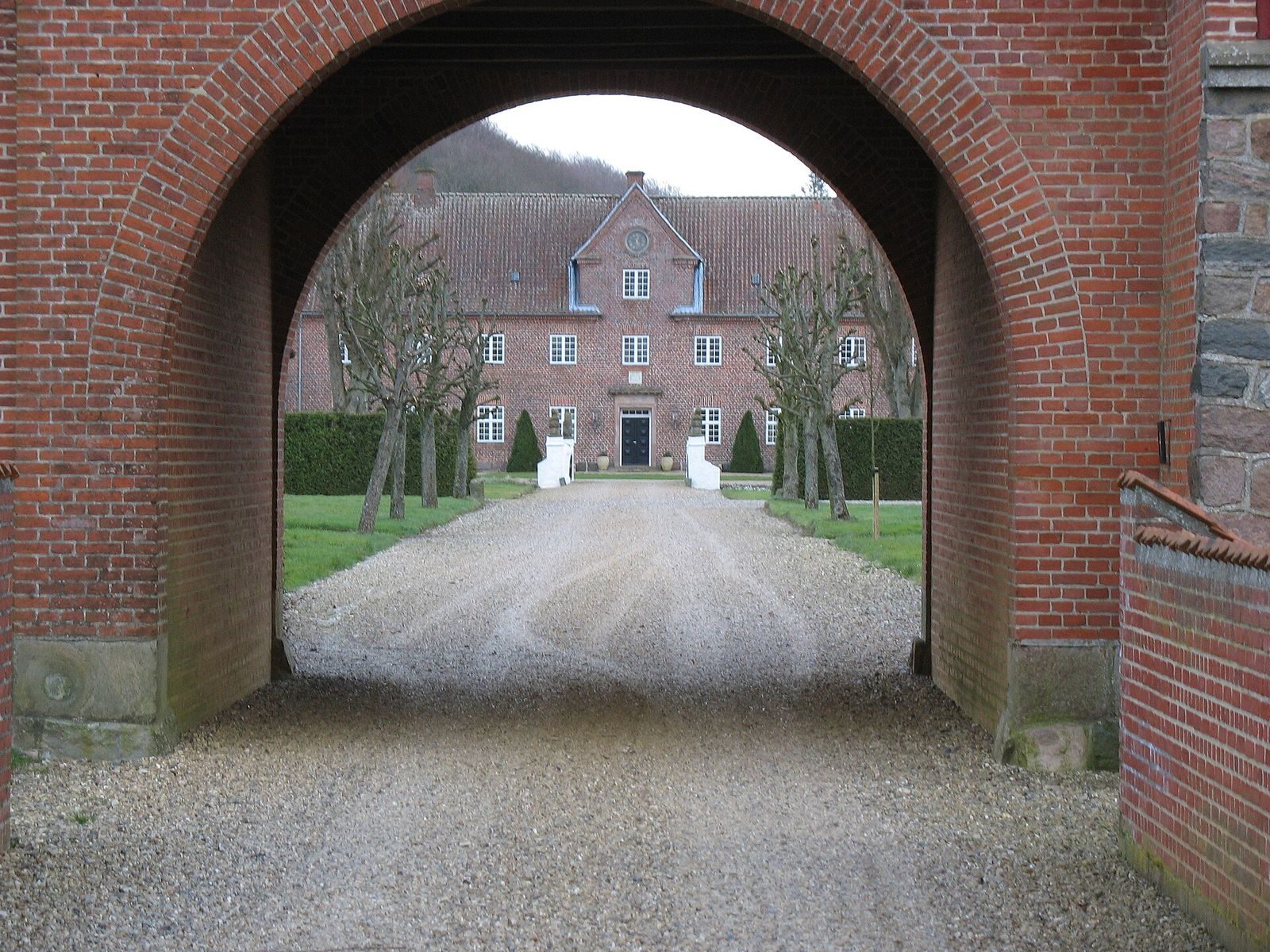
The two-storey manor house has a gabled roof. Two side wings, demolished in the eighteenth century, were added back during the 1919 remodeling.
Moat bridge and lion statues
A stone bridge over the inner moat dates to 1656 and was reconstructed in 1919. Five sandstone lion statues from 1656 survive at a bridge over the moat. They carry Oluf Parsberg’s coat of arms.
Storehouse
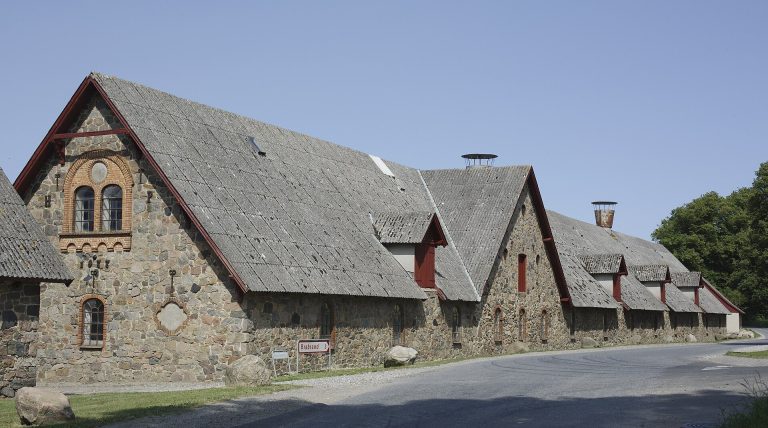
A storehouse dating to 1784 has a thatched roof reconstructed in 1919.