Paliesius Manor: A Historic Estate in Lithuania


Site at a Glance
- Rating
- 4.7
- Popularity
- Low
- Country
- Lithuania
- Primary era
- Early Modern
- External website
- Open
- Eras represented
- Early Modern
- Civilizations
- Polish–Lithuanian Commonwealth
- Site type
- Domestic
- Remains
- Manor House
On this page10 sections
History
Paliesius Manor is a historic estate in Lithuania whose development included a wooden manor house in the seventeenth century and major rebuilding after 1736. Formerly known as Polesie, it is now part of Polesie village in Ignalina District Municipality, within Vilnius County and Mielegiany Commune.
From the Tyzenhauz family to Kazimierz Jan Kublicki
In the seventeenth century, the manor belonged to the Tyzenhauz family, a noble house associated with the former Polish-Lithuanian Commonwealth and the eastern European borderlands. At that time, the estate had a wooden, two-wing manor house, with a bathhouse and brewery at nearby Konciarzyn.
In 1736, the Livonian official Kazimierz Jan Kublicki acquired Paliesius and began a substantial programme of development. He built a brick residential house, chapel, stable, icehouse, cowshed, and bathhouse. His activities also extended to nearby Mielegiany, where he established an inn, laid out a paved marketplace opposite it, and initiated the construction of a masonry church.
The nineteenth and early twentieth centuries
Kublicki’s brothers, Stanisław and Adolf, later organized and took part in the January Uprising, an armed insurrection against the Russian Empire in 1863 and 1864, in Zawilej County. After the uprising, they fled to Prussia. The estate was also the birthplace of Wincenty Bortkiewicz, who took part in the Kościuszko Uprising of 1794 and the November Uprising of 1830 and 1831.
During the partitions of Poland, Paliesius lay in Mielegiany Commune, Sventsyany County, within the Vilna Governorate of the Russian Empire. In 1905, it had 17 inhabitants and covered 1,412 dessiatines, a Russian land measure of approximately 1.09 hectares per unit. Liubimow bought the manor at auction in 1887 and became its administrator in 1900. Control later passed to the housekeeper Powarowa, who sold the property to Major General von Ekse. After his death, his widow, Maria Dmitrievna von Ekse, sold the manor estate and mortgaged the remaining land to the Vilna Land Bank.
Romuald Brzeziński became the owner in 1921. During the interwar period, the estate was in Poland, within the Vilnius Voivodeship, Sventsyany County, and Mielegiany Commune. In 1931, 79 people lived in four houses. The settlement belonged to the Roman Catholic parish at Mielegiany, came under the Sventsyany Municipal Court and Vilnius Regional Court, and was served by the post office at Mielegiany.
War, nationalization, and decline
After the Soviet invasion of Poland in 1939, the Red Army occupied the settlement and it was incorporated into the Byelorussian Soviet Socialist Republic. In 1940, it was transferred to the Lithuanian Soviet Socialist Republic. German occupation followed from 1941 to 1944, after which the settlement remained within the Lithuanian Soviet Socialist Republic.
After 1939, the estate was nationalized and converted into a collective farm, a Soviet agricultural enterprise in which land and production were administered collectively under state control. In 1940, it was taken over by the Cerkliszki collective farm. The property was looted during the Soviet period, and its manor buildings and watermill fell into ruin. The manor was in poor technical condition in 1956 and was later dismantled by village residents.
Remains
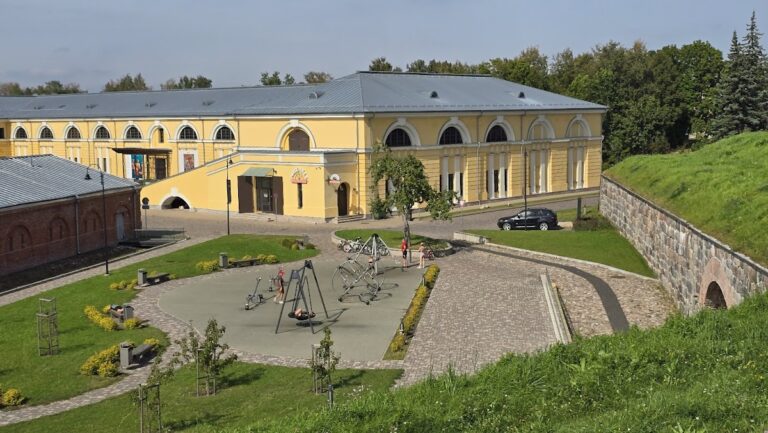
The surviving estate buildings represent a complex that combined residential, agricultural, service, and water-powered functions. Brick construction formed the core of the eighteenth-century rebuilding, while later restoration has adapted several structures for new uses.
Restored estate buildings
Former manager’s house
The former manager’s house has been restored and now contains a hotel and restaurant. Its present use preserves the building as part of the surviving manor complex while adapting it to contemporary purposes.
Horseshoe-shaped cowshed
The remains of the horseshoe-shaped cowshed are enclosed beneath a glass structure and adapted as a performance hall. The building belongs to the agricultural group created during the estate’s eighteenth-century development under Kazimierz Jan Kublicki.
Restored outbuilding
A restored outbuilding contains a bakery. It forms part of the service buildings associated with the manor estate.
Watermill
The former watermill deteriorated during the Soviet period and fell into ruin. Its remains belong to the working infrastructure of the estate, alongside the residential and agricultural buildings.