Palazzo Moroni: A Baroque Palace and Civic Art Museum in Bergamo


Site at a Glance
- Rating
- 4.6
- Popularity
- Medium
- Country
- Italy
- Primary era
- Early Modern
- External website
- Open
- Eras represented
- Medieval, Early Modern, Modern
- Civilizations
- Habsburg, Venetian
- Site type
- Domestic
- Remains
- Elite Residence
On this page12 sections
History
The Moroni family and the palace
Palazzo Moroni is a Baroque palace and civic art museum in Bergamo, Italy, built for the Moroni family between 1636 and 1666. The family originated in Albino and gained wealth during the fifteenth century through the military and engineering abilities of some of its members. From the seventeenth century, mulberry cultivation and silkworm breeding linked the family to Bergamo’s textile industry, a connection recalled by the mulberry tree in the Moroni coat of arms.
The family later moved into Bergamo’s upper town, first occupying a palace on Via Torre del Gombito. In the second half of the sixteenth century, it acquired property from the Pesenti family in an area then known as Via Porta Penta. Following his marriage to Lucrezia Roncalli in 1631, Francesco Moroni commissioned the palace that stands today. Battista della Giovanna carried out its construction.
The family’s status continued to develop. In 1798, an imperial eagle was added to the Moroni arms after Antonio Moroni received the title of count from the Duke of Saxe-Weimar. The palace and its collections consequently reflect both the family’s rise in Bergamo and the cultural ambitions associated with its position.
Seventeenth-century decoration
In 1649, Francesco Moroni commissioned Gian Giacomo Barbelli to decorate the interiors with frescoes. Barbelli was a seventeenth-century Italian painter known especially for fresco decoration, and he worked according to instructions from Francesco Moroni and Donato Calvi, prior of the convent of Sant’Agostino. Calvi later discussed the paintings in his 1655 work The Mysterious Paintings of Palazzo Moroni Explained.
The decoration gave the palace an elaborate visual language of allegory, mythology, family virtue, and literary narrative. Among its themes are the stories of Cupid and Psyche, the Fall of the Giants, and episodes from Torquato Tasso’s Gerusalemme Liberata, a major epic poem about the First Crusade. The palace’s rooms were subsequently named after several of these ceiling paintings.
Nineteenth-century transformation and later stewardship
A major renovation in the mid-nineteenth century gave Palazzo Moroni much of its present appearance. Antonio Moroni, who was also a painter, created the nineteenth-century interiors in 1835. The private rooms received vividly colored decorations and illusionistic reliefs that evoke settings such as a Chinese sitting room and a Turkish room.
In 1878, the Moroni family acquired Palazzo Marenzi, directly opposite their residence, and demolished it completely. The change improved the light and panoramic views from the first-floor openings. It may also have been connected with longstanding disputes between the Marenzi and Moroni families.
After Count Antonio Moroni died in 2009, the family’s art collection was donated for management by the Fondazione Museo del Palazzo Moroni in cooperation with the city. Since 2020, Palazzo Moroni has formed part of the properties of the Italian Environmental Fund, or FAI, a national nonprofit organization dedicated to preserving and presenting Italy’s cultural and natural heritage. It now functions as a civic art museum and a venue for cultural activities.
Remains
Entrance, courtyard, and garden
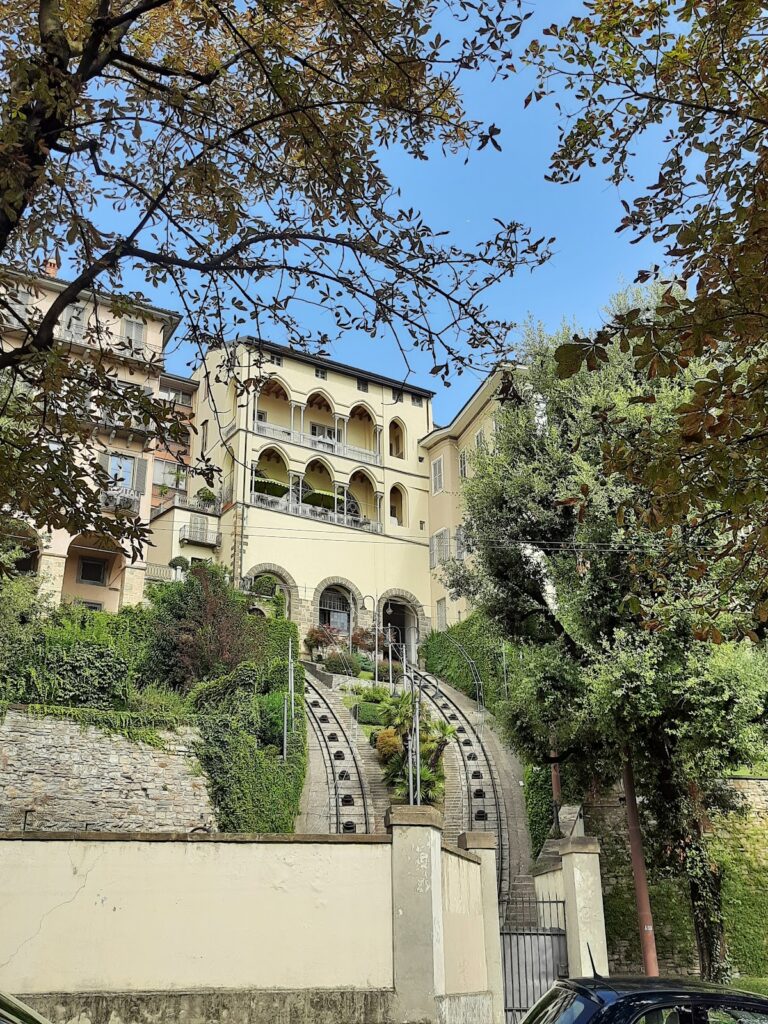
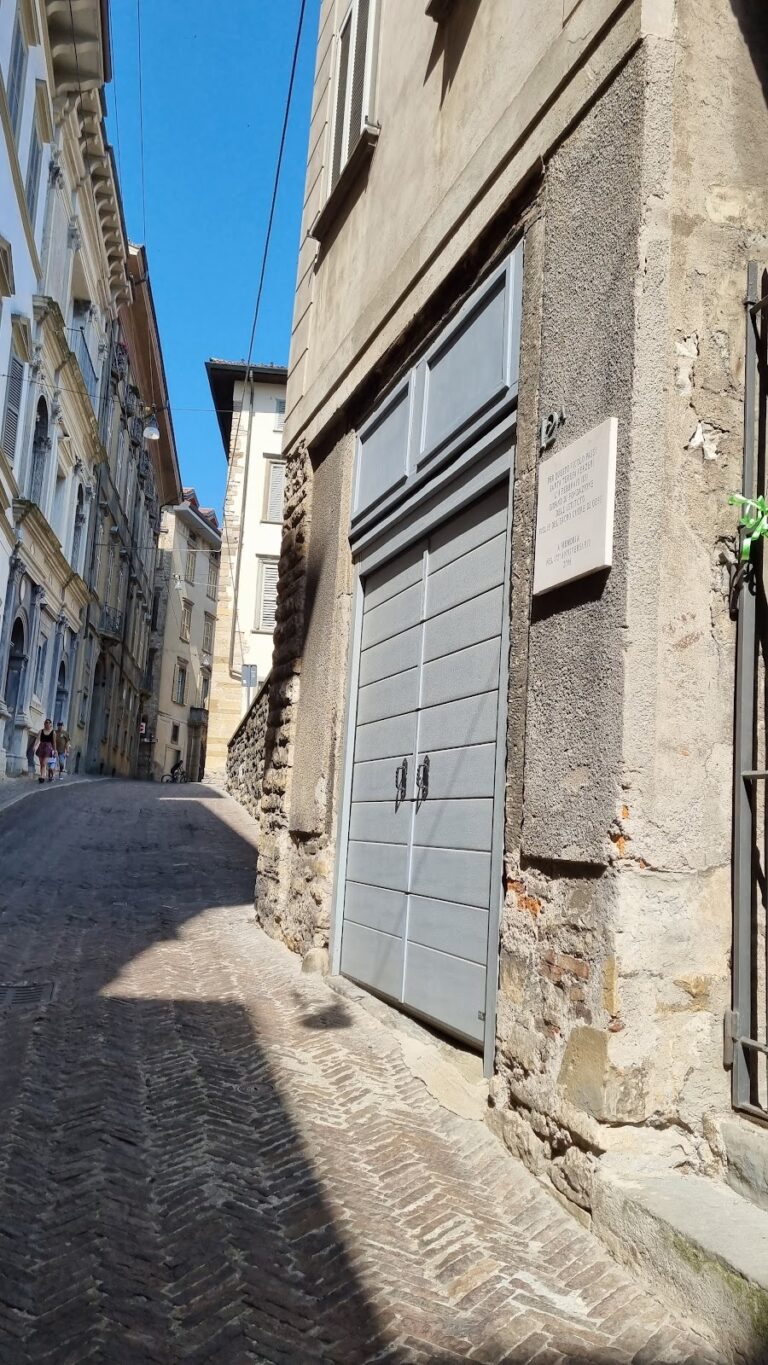
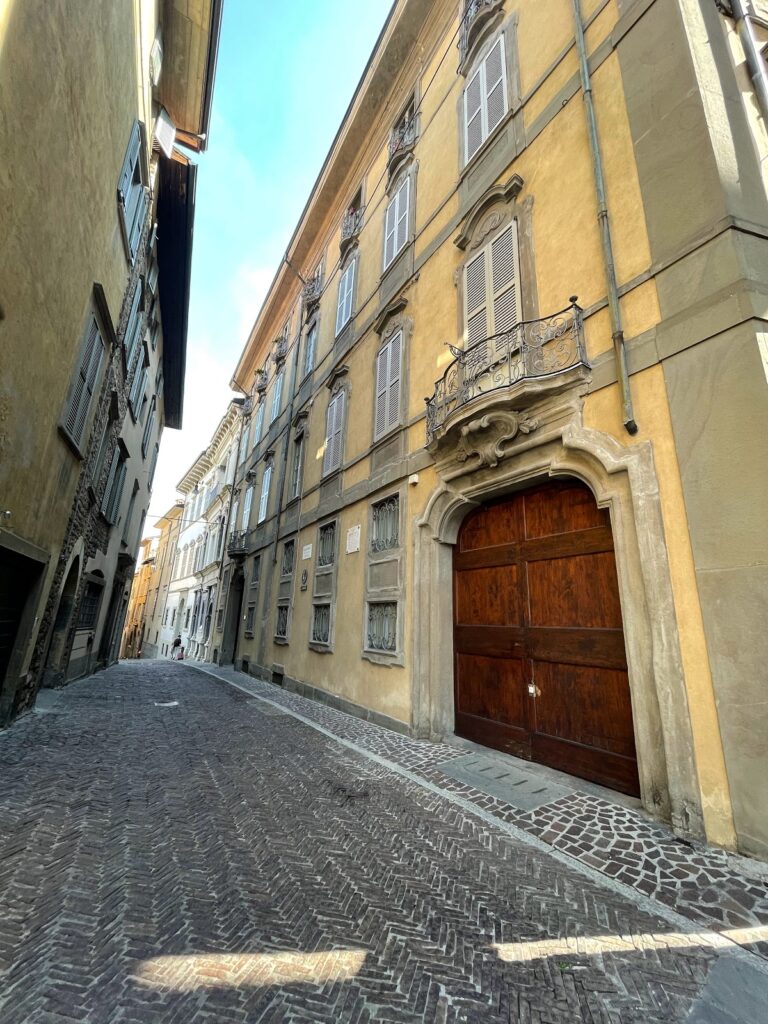
Palazzo Moroni has a plain Baroque exterior facing the narrow, steep Via Porta Dipinta. Its principal facade is turned away from the street, and the entrance portal is asymmetrical, a form associated with the former obstruction created by Palazzo Marenzi. The portal opens into a carefully composed inner courtyard, where a rusticated wall centers on a niche containing a seventeenth-century statue of Neptune by Lorenzo Redi.
The courtyard wall ends in a stone balustrade decorated with urns. It bounds the palace park, which extends toward the hill of Sant’Eufemia. An entrance-hall fresco depicted a putto holding a pair of scales beneath the inscription Aequa lance librandum, meaning that matters should be weighed with an equal balance.
Terraced garden
The garden is arranged across four seventeenth-century terraces. They begin above the wall of the small inner garden by the entrance and include an area that served as the productive part of the park during the nineteenth century. The first terrace follows the typical form of an Italian garden. A staircase between two retaining walls rises to a second level planted with hawthorn, roses, and irises.
The staircase continues upward past stone putti and urns to the third level. Six yew trees are clipped into varied forms there, alongside an elm and several native aquatic plants. The garden ends at the fifteenth-century turret called San Benedetto, also known as the count’s study or retreat. Connected with the properties of the Rocca, Bergamo’s historic upper-town fortress complex, the turret stands before a larger park containing mulberry and cherry trees.
Public interiors and painted decoration
Ceremonial staircase
On the right side of the entrance hall, a broad two-flight ceremonial staircase leads to the mezzanine and first floor. Large frescoes set within architectural frames by Giovanni Battista Azzola depict allegories and nine figures, including Nobility, Holiness, Antiquity, Wisdom, Dignity, Valor, and Fortune. Together they celebrate virtues associated with the Moroni family. Nine bronze statues stand on the balustrades, each bearing a representative motto on its base.
Three ceiling paintings present the story of Cupid and Psyche while also expressing the family’s rise in Bergamo society. In a service area, an eighteenth-century vaulted room was frescoed by Paolo Vincenzo Bonomini with a balustrade, vases, and putti set within a luxuriant landscape. Bonomini was associated with illusionistic and decorative interior painting.
Painted halls
The Hall of the Golden Age, also called the Hall of the Seasons, has a ceiling fresco of Saturn surrounded by four figures representing Peace, Abundance, Simplicity, and Cheerfulness. The room also contains paintings by Giovanni Battista Moroni and a sixteenth-century work by Andrea Previtali, both important painters from the Bergamo area.
The Hall of the Fall of the Giants contains Barbelli’s illusionistic scene of Jupiter striking the giants with lightning. Domenico Ghislandi created its architectural framing. The painted perspective extends the apparent height of the ceiling beyond the room’s actual dimensions.
Another decorative cycle in the principal rooms follows episodes from Tasso’s Gerusalemme Liberata. The ceiling shows the archangel Gabriel conveying God’s command to Goffredo, the poem’s Christian commander, and announcing his earthly mission. A wall frieze continues the narrative with female figures representing Faith, Labor, Bravery, and Victory, together with personifications of Jubilation, Contempt, Zeal, and Counsel. The four corners carry the Moroni arms. The same program includes The Apotheosis of Hercules and Hercules riding in a chariot.
Private rooms
The private rooms date mainly from the nineteenth-century restoration. Their trompe-l’œil reliefs use perspective and shading to create the illusion of three-dimensional forms on flat surfaces. The rooms include the Chinese room, with frescoed medallions on its curved ceiling, French lacquered furniture, and pink upholstery, as well as the Turkish room and the pink room.
The yellow room has a vaulted ceiling decorated with representations of the arts, including music, painting, and theater. A chiaroscuro frieze, painted in contrasting light and dark tones, runs around the room and depicts varied scenes. Two eighteenth-century Chinese vases stand in the room, together with a nineteenth-century landscape by Julius Lange acquired from the Brera Academy.
Collections and archive
The palace’s paintings include works by Giovanni Battista Moroni, Bernardino Luini, Gian Giacomo Barbelli, Giuseppe Roncelli, and Cesare Tallone. Among the named works are Moroni’s The Pink Knight, Portrait of Isotta Brembati, and Portrait of a Seated Elderly Woman; Giampietrino’s Penitent Magdalene; and Previtali’s Family Portrait, which depicts Giovannino di Bertolino Casotti, a resident of Palazzo Cassotti on Via Pignolo.
Pietro Moroni acquired the three paintings by Giovanni Battista Moroni from Marcantonio Fermo Grumelli in 1817. The Pink Knight was repeatedly included in exhibitions of seventeenth-century Lombard art. The palace also contains ceramics from Capodiponte, Meissen, Wedgwood, and Sèvres, along with furniture, sculptures, and other furnishings.
The first floor holds the family and palace paper archive in files. Some documents date from the fourteenth century, while others include letters from Cardinal Giuseppe Alessandro Furietti, an eighteenth-century cardinal and scholar. The archive also contains papers concerning a marriage dispute between a young Moroni woman and a member of the Benaglio family, described as evidence of what may have been the first divorce in Bergamo’s history.
Nearby sites