Palazzo Malvezzi de’ Medici: A Renaissance Palace in Bologna
Site at a Glance
- Rating
- 4.6
- Popularity
- Medium
- Country
- Italy
- Primary era
- Early Modern
- Eras represented
- Early Modern, Modern
- Civilizations
- Papal States
- Site type
- Domestic
- Remains
- Elite Residence
On this page11 sections
History
Construction and family residence
Palazzo Malvezzi de’ Medici is a Renaissance palace in Bologna, Italy. Renaissance architecture drew on classical forms and proportion. Work began in 1560 for the Malvezzi family, and the construction period is dated 1560 to 1590. Paola di Antonio Maria Campeggi, widow of Giovanni di Bartolomeo Malvezzi, commissioned the building, which was designed by Bartolomeo Triachini. The new residence occupied a large site that already contained properties belonging to the Malvezzi senatorial family. The branch that lived in the palace was known as “dal Portico Buio.”
Alterations and civic use
In 1725, Marquis Giuseppe Maria Malvezzi de’ Medici commissioned Ferdinando Galli-Bibiena to design the grand staircase. Alfonso Torreggiani carried out its construction. In the mid-nineteenth century, Giovanni Malvezzi had the palace refurbished under the direction of Francesco Cocchi. In 1852, Cocchi, Andrea Pesci, and Onorato Zanotti decorated several ceilings in the principal apartment with frescoes, paintings made by applying pigment to wet plaster.
Aldobrandino Malvezzi sold the palace to the Province of Bologna in 1931. It now houses the offices of the Metropolitan City of Bologna.
Remains
Facade and staircase
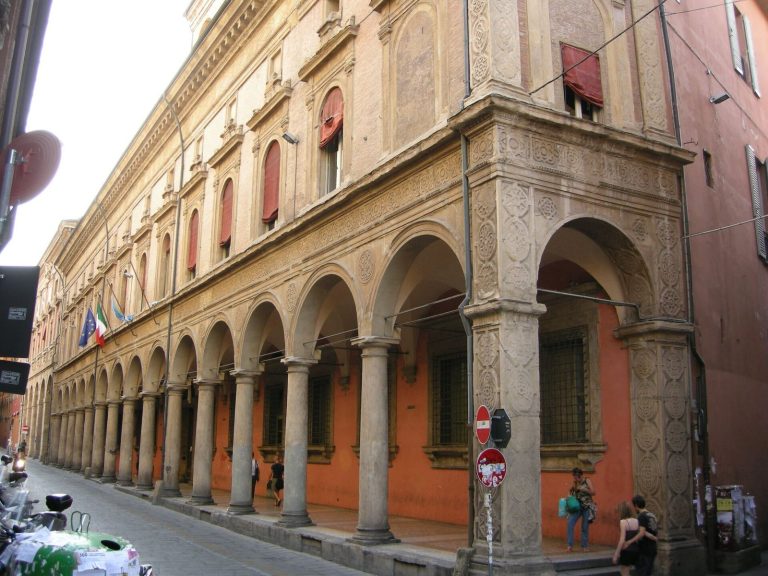
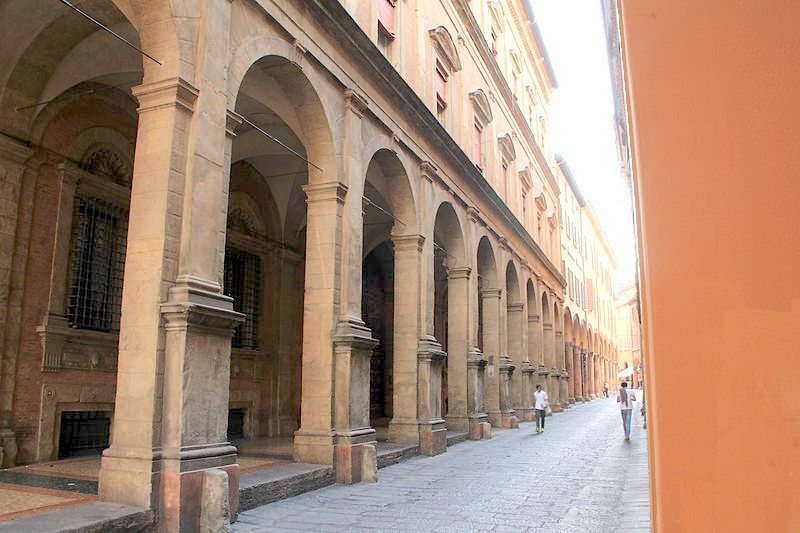
The palace façade faces Via Zamboni and has three tiers of classical architectural orders, systems of columns and their horizontal entablatures. The narrow street constricts the view of the façade. Inside, the grand staircase designed by Ferdinando Galli-Bibiena and built by Alfonso Torreggiani remains a defining architectural feature.
Decorated rooms
Much of Cocchi’s nineteenth-century wall decoration survives in rooms on the main floor. The interiors also contain twentieth-century works by artists from Bologna or closely associated with the city: Bruno Munari, Natale Guido Frabboni, Alberto Sughi, Carlo Caporale, Enrico Visani, and Carlo Amadori.
Zodiac Room
The ceiling of the Sala dello Zodiaco (Zodiac Room) bears frescoes of the zodiac. The room also contains Gabriele Ferrantini’s The Martyrdom of Saint Eufemia and Giacinto Campana’s The Martyrdom of Saint Ursula. Paintings of Saints Peter and Paul, early Christian apostles, are nineteenth-century copies by Andrea Bèsteghi after seventeenth-century originals by Bartolomeo Cesi.
Antechamber to the Council Chamber
The ceiling of the Anticamera della sala Consiglio (Antechamber to the Council Chamber) depicts Minerva, the Roman goddess associated with wisdom and the arts of war, alongside Apollo, a god linked with music and poetry, and the Muses, figures who inspire the arts.
Executive Committee Room
Francesco Cocchi painted the ceiling of the Sala di Giunta (Executive Committee Room). Two canvases on its walls portray Marco Minghetti, an Italian statesman, and Andrea Costa, an Italian socialist politician.
Hall of Love
The ceiling of the Sala Rosa, also called the Sala degli Amori (Hall of Love), was painted by Girolamo Dalpane with scenes from the Decameron, a collection of stories by the fourteenth-century writer Giovanni Boccaccio. Four scenes pair Tasso with Eleonora, Boccaccio with Fiammetta, Dante with Beatrice, and Petrarch with Laura. Eight oval portraits depict the Italian noblewomen and cultural figures Giulia Gonzaga, Violante Giustiniani, Ginevra Bentivoglio, Beatrice degli Obizzi, Vittoria Colonna, Maria di Monferrato, Bianca Sforza, and Maria d’Aragona.
Green Room
The ceiling of the Sala Verde (Green Room) shows the Triumph of Bacchus and Ariadne. Bacchus was the Roman god of wine, and Ariadne is a figure from Greek mythology. Two portraits by Carlo Berti Pichat hang in the room, along with a copy of Guido Reni’s Joseph and Potiphar’s Wife.