Palazzo La Marmora: A Historic Family Palace in Biella, Italy


Site at a Glance
- Rating
- 4.5
- Popularity
- Low
- Country
- Italy
- Primary era
- Early Modern
- External website
- Open
- Eras represented
- Medieval, Early Modern
- Civilizations
- Duchy of Savoy, Kingdom of Sardinia
- Site type
- Domestic
- Remains
- Elite Residence
On this page7 sections
History
Palazzo La Marmora, also known as Palazzo Ferrero La Marmora, is a historic family palace in Biella, Italy, whose original nucleus dates from the fourteenth century. It has belonged to the Ferrero della Marmora family since the sixteenth century and is described as having served as the family’s private residence for eight centuries. The palace remains partly residential and partly functions as a cultural venue containing a house museum, while other areas host private and corporate events.
Medieval origins and family expansion
The palace developed from a fourteenth-century core and grew through successive acquisitions by the marquises della Marmora. Major enlargements and alterations took place between the seventeenth century and the end of the eighteenth century, giving the complex its layered historical character.
The gardens occupy the foundations of a twelfth-century castle associated with Uguccione, a medieval bishop of Vercelli. The nearby Palazzo Ferrero, also on the course of the Piazzo, was formerly connected with Palazzo La Marmora. Before the family divided, it belonged to the Ferrero Fieschi of Masserano, a branch that later separated from the marquises della Marmora during the sixteenth century. Palazzo Ferrero is now municipally owned.
The della Marmora branch
The sixteenth-century division of the family established the principal branch of the marquises della Marmora alongside the Ferrero Fieschi princes of Masserano. The della Marmora line later produced Alfonso Ferrero della Marmora and his brother Alessandro Ferrero della Marmora, prominent figures in the Risorgimento, the nineteenth-century movement that led to the political unification of Italy.
The family’s archival papers are divided between the State Archive of Biella and the palace. At Palazzo La Marmora, they are managed by the Centro Studi Generazioni e Luoghi–Archivi Alberti La Marmora. The façade was restored between 2015 and 2016.
Remains
Palace interiors
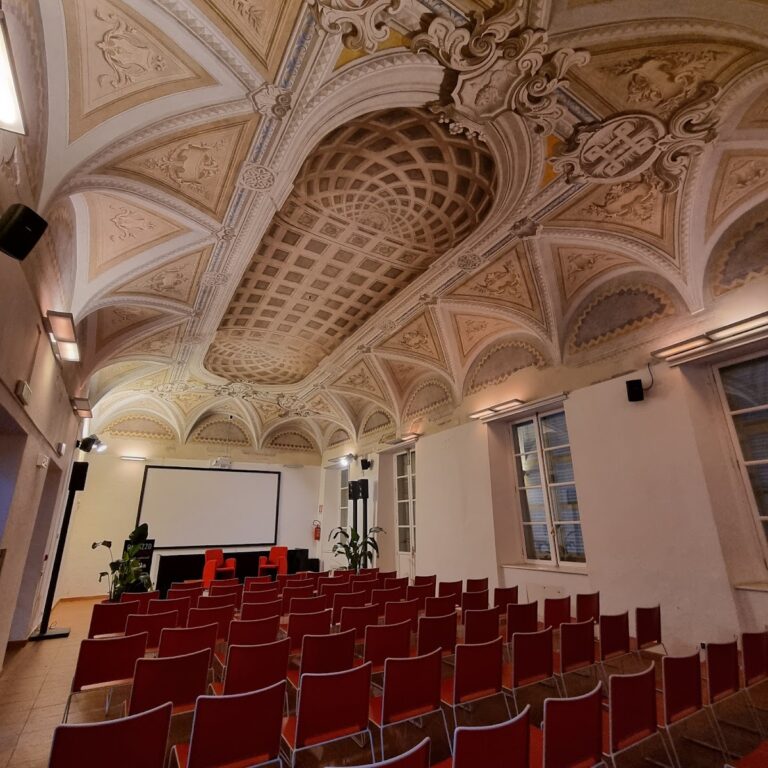
The building extends over two floors and preserves the results of numerous alterations made over the centuries. Many interior rooms retain their original decoration. Paintings by Gaudenzio Ferrari, an Italian Renaissance painter, depict family ancestors, while the noble rooms on the ground floor preserve the ceremonial character of the residence. The ground-floor armory contains a typical sixteenth-century fireplace. On the upper floor, the ballroom is decorated by Giovannino Galliari in collaboration with his father, Fabrizio Galliari, artists associated with decorative painting and theatrical design.
Sala dei Castelli
The Sala dei Castelli, or Hall of Castles, takes its name from its painted decoration. Early-seventeenth-century paintings faithfully represent the family’s possessions, and coats of arms commemorating marital unions complete the fresco scheme. Together, these features connect the room’s decoration with the family’s estates and alliances.
Façade and garden
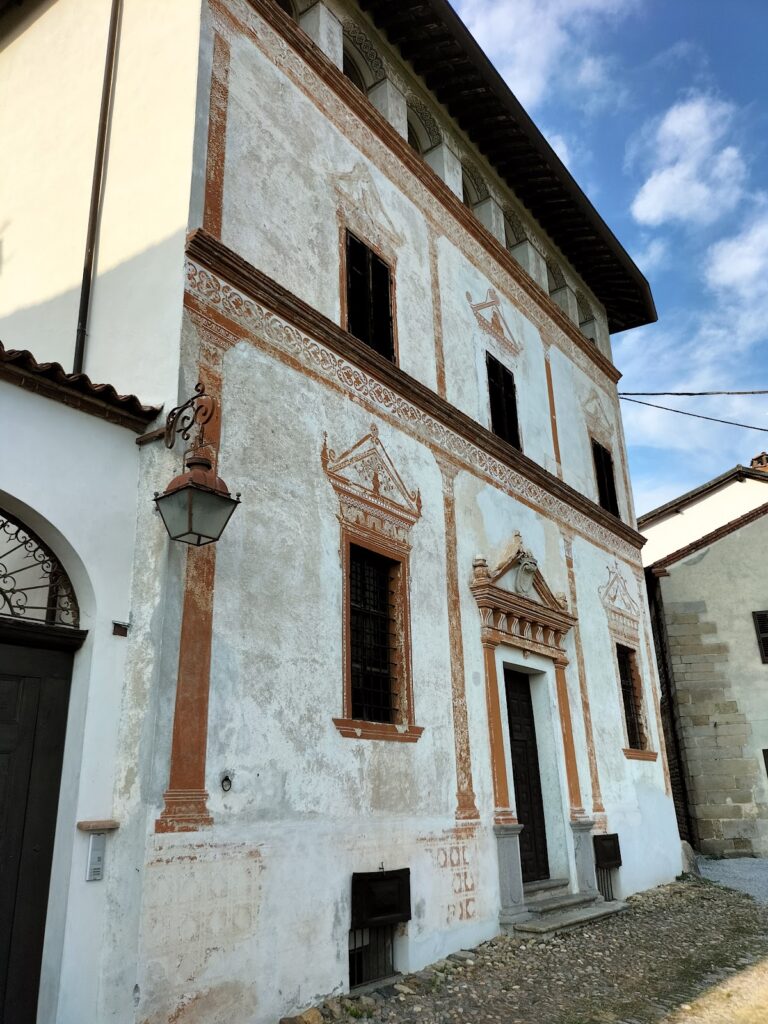
The neoclassical façade dates from the end of the eighteenth century and stretches for 80 metres along the course of the Piazzo. Its remodeling involved the Turin architect Filippo Castelli and the Biella architect Rolando Lodovico Giacinto Gromo. The coat of arms of the marquises della Marmora is displayed at the center of the façade.
Beyond the courtyard lies a large Renaissance-style garden, reached through the Serra, also called the Winter Garden. The Serra has a portico with double columns, tall glazed windows, and a barrel vault. A bicentenary Ficus repens grows within it, with branches decorating the wall and vault. The garden’s foundations preserve the physical trace of the earlier medieval castle associated with Uguccione.
Nearby sites